Need OEM supplier support for this product type?
Contact KOLARWIN Tools for OEM mechanic tools, private label packaging, wholesale quotation and product range support. This gives overseas buyers a clear path from article reading to supplier discussion.
Choose the knife around the cut and the refill supply. A slim 9 mm system can suit close trimming; an 18 mm system may better suit broader packaging work. Neither size alone tells you the permitted material, useful exposure or compatible replacement blade.
1. What do 9 mm and 18 mm describe?
The numbers refer to nominal blade width used by compatible snap-off knife systems. A 9 mm blade is narrower; an 18 mm blade is wider and typically fits a heavier-duty holder. Width alone does not specify blade thickness, segment pitch, steel, edge angle, or compatibility. OLFA’s blade guide identifies 9 mm standard-duty and 18 mm heavy-duty categories. Verify exact holder and refill. The width comparison sits within the broader choice of utility knife blade types.
- Check the width printed on both the handle listing and refill pack.
- Record the maker's blade code in addition to the nominal size.
| Label | What it identifies | What it does not prove |
|---|---|---|
| 9 mm | Narrow blade width category | Fit in another maker's 9 mm holder |
| 18 mm | Wider blade width category | A universal cutting capacity |
Build the purchase around a matched pair. Keep the holder model and approved refill code together on the purchase line.
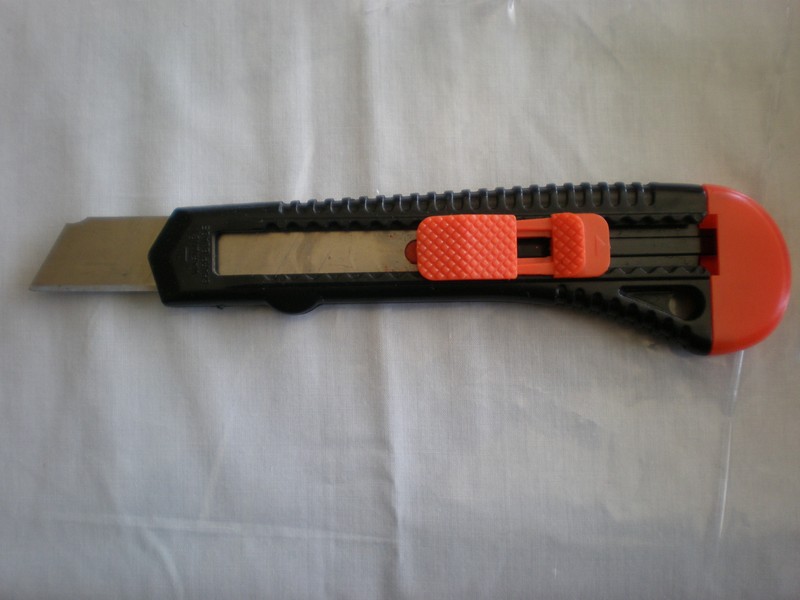
2. When does a 9 mm knife fit the task?
A 9 mm snap-off knife can suit controlled detail work, label trimming, light packaging, and narrow cuts where a slim holder and fine blade feel easier to position. It is not automatically safer or more precise; blade sharpness and user control matter. Avoid lateral force or prying, which can break a narrow exposed blade. Follow the holder’s extension and material limits. For leather work that requires a round opening rather than a slit, choose a suitable leather hole punch.
- Try the proposed 9 mm holder on the smallest required trim.
- Keep the supporting hand clear of the projected cut path.
| Detail task | Useful trial | Reason to change tools |
|---|---|---|
| Label edge trimming | Short controlled pass on backing | Edge tears or blade wanders |
| Tight corner cut | Access without twisting blade | Corner demands lateral force |
Judge the finished edge. Use the same label or film as the customer and inspect for tearing before approving the narrow blade.
3. When is an 18 mm knife more suitable?
An 18 mm system may suit heavier packaging and broader cutting tasks when a compatible heavy-duty holder supports the blade properly. Wider blades can offer more support, but actual capacity depends on blade thickness, steel, exposure, and handle design. Do not use width as a substitute for the manufacturer’s material guidance. For tough material, consider a purpose-built cutter rather than forcing a snap-off blade. For sheet-metal cutting, evaluate aviation snips and tin snips separately from the knife selection.
- Ask which heavier materials the exact 18 mm model is intended to cut.
- Check whether the job needs repeated shallow passes rather than one deep pass.
| Material behavior | Trial decision | Do not infer |
|---|---|---|
| Clean cut within maker guidance | Continue sample review | Universal suitability for thicker stock |
| High force or sideways bending | Stop and reassess cutter | More width will solve the problem |
Test resistance before ordering volume. Retain a sample of the intended board or sheet with the evaluation record.
4. How does blade support affect performance?
Blade width contributes to lateral support, but holder fit and blade exposure also influence stability. A loose track or excessive extension can increase flex and break risk. Use the shortest exposure that completes a pass. Keep the blade aligned with the cut and avoid twisting. Buyers should check blade lock, track play, segment retention, and holder compatibility during sample review. For metal sections requiring a saw, follow the appropriate hacksaw method rather than increasing knife pressure.
- Inspect the blade guide near the handle nose for damage.
- Check the chosen extension after locking and before touching the work.
| Support condition | Effect on evaluation | Next step |
|---|---|---|
| Short exposure and secure track | Useful baseline | Proceed with representative cut |
| Loose track or damaged nose | Blade behavior is unreliable | Reject or service sample |
Use a repeatable extension. Record the tested exposure setting so different holders are compared under similar conditions.
5. Are snap-off blades interchangeable?
Not necessarily. OLFA’s FAQ states there is no standard specifying all snap-off blade dimensions and does not guarantee compatibility with other manufacturers’ blades. Confirm both width and product-specific fit. Segment pitch, thickness, locking slot, and handle design may differ. Purchasing teams should test approved refills in each holder and record compatible model numbers. Never assume “9 mm” or “18 mm” alone guarantees interchangeability. Keep knife refills separate from the tools chosen for wire stripping and wire cutting in mixed maintenance kits.
- Ask for a written list of compatible refill codes.
- Check the replacement's seating and lock engagement before cutting.
| Refill proposal | Approval route | Status |
|---|---|---|
| Maker-listed refill | Verify pack code and fit | Candidate for stock |
| Same width from another source | Obtain compatibility evidence and evaluate | Do not assume equivalence |
Control substitutions. Require a new fit review whenever the refill supplier or blade code changes.
6. How do segment counts and snapping work?
Snap-off blades have scored segments intended for controlled separation when a segment dulls, following the maker’s directions. Segment count varies by blade. Use the holder’s end cap or a dedicated disposal device if instructions specify one, and contain the detached segment immediately. Never snap toward the body or leave loose blade fragments in a work area. Train users on site procedure. A household tool kit that includes snap-off knives also needs a practical way to contain used segments.
- Read the maker's snapping instructions before renewing an edge.
- Place a suitable segment container at the workstation before starting.
| Renewal situation | Action | Inventory consequence |
|---|---|---|
| Dull active segment | Follow prescribed snap procedure | Consume one usable segment |
| Last usable segment or damaged strip | Replace according to instructions | Use a new approved blade |
Contain every detached segment. Include the specified snapping or disposal device in the sample demonstration.
7. What blade materials and edges matter?
Blade product lines may differ in steel, coating, sharpness, edge angle, and intended material. The OLFA 180 compatibility list includes black and stainless 9 mm snap blades. Match blade characteristics to the cut and environment using manufacturer descriptions. A sharper edge may cut efficiently but still requires careful handling. Replace dull or damaged segments rather than applying more force. If the finishing task is a metal burr, select a suitable deburring tool rather than scraping it with a snap-off edge.
- Compare edge performance on the actual material, using equal exposure.
- Confirm corrosion-care instructions for the selected blade rather than relying on its color.
| Blade variant | Selection question | Required evidence |
|---|---|---|
| General-purpose edge | Does it cut the target material cleanly? | Material trial |
| Specialized edge or steel | What use does the maker specify? | Exact product description |
Keep performance claims product-specific. Write down the blade code that produced the accepted edge so a color description cannot substitute for it.
8. What holder features should buyers compare?
Compare lock type, blade exposure positions, handle stiffness, grip, blade storage, and safe separation features. A slim 9 mm model may suit precision work; an 18 mm holder may prioritize heavier cutting. Dimensions and mechanism vary by model. Request product drawings, compatible blade codes, and instructions. Include a cutting mat or suitable backing where the work process requires protection. For a shared shop supply, record the knife and refill pair in the industrial maintenance tool list.
- Operate the lock with the gloves normally worn.
- Check that the end cap and spare storage stay secured after normal handling.
| Holder choice | User check | Possible drawback |
|---|---|---|
| Slim handle | Control during close trimming | Poor comfort for some hands |
| Larger handle | Grip during longer cuts | Restricted access at narrow features |
Fit the handle to the operator. Have more than one intended user complete the same sample cut before selecting a common workplace model.
9. How should distributors build a knife assortment?
Stock blade widths against actual customer tasks and holder systems. Keep refill codes adjacent to compatible knife models and explain that size labels do not guarantee cross-brand fit. Product photos should show blade width and holder.
- Separate 9 mm and 18 mm refills visibly on shelves and order forms.
- Set reorder quantities from blade consumption as well as handle sales.
| Customer demand | Core offer | Supporting stock |
|---|---|---|
| Detail trimming | Matched narrow knife | Approved narrow refills |
| Packaging workshop | Matched wider knife where suitable | Refills and segment disposal |
Sell a replenishable system. Show the refill code on the knife label and the compatible handle codes on the refill listing.
10. What should an RFQ specify?
State blade width, thickness if required, segment design, blade material, holder model, lock style, compatible refills, packaging, and intended cutting material. Ask for compatibility documentation and sample blades. Do not promise universal interchangeability.
- Name the intended materials and normal cut depth in the brief.
- Require a compatibility review before any blade or holder substitution.
Attach the approved cutting sample. Send the supplier the accepted edge result, holder code and refill code with packaging and quantity requirements.
Frequently asked questions
Q1: What do 9 mm and 18 mm refer to? They identify nominal blade widths; they do not define all dimensions or compatibility.
Q2: Are 9 mm and 18 mm blades interchangeable? No. Use the holder’s specified blade width and compatible model.
Q3: What does OLFA say about cross-brand compatibility? OLFA does not guarantee compatibility for blades made by other manufacturers.
Q4: When should a segment be snapped? When the active edge is dull or damaged, following holder and disposal instructions.
Q5: Does a wider blade always cut heavier material? Not by itself; holder support, blade design, exposure, and maker limits matter.
For a quotation, contact our team with the selected configuration and sample acceptance requirements.
Looking for a reliable mechanic tools manufacturer in China?
If you are sourcing hand tools, socket tools, automotive repair tools, mechanic tool sets or OEM private label tools, contact KOLARWIN Tools for factory-direct quotation, customization support and product consultation.