Need OEM supplier support for this product type?
Contact KOLARWIN Tools for OEM mechanic tools, private label packaging, wholesale quotation and product range support. This gives overseas buyers a clear path from article reading to supplier discussion.
Household tool kits can look similar in a catalogue yet serve different shelf positions. A compact case may suit apartment repairs, while a larger case supports broader maintenance. Use a BOM, package dimensions, market rules, and sample checks before choosing a range. Supplied photos show two configurations and a bulk presentation; they do not prove shared SKU, capacity, or quality.
1. What should a distributor decide before choosing a household tool kit?
Start with the buyer’s use case. A household tool kit sells through coverage, so each tool needs a clear job. Hardware stores may need visible variety. Online parcel ranges may favor a lighter case.
Write down the intended shelf position before comparing photographs:
- General home repair, move-in gifts, or apartment maintenance.
- Retail shelf, online parcel, promotional bundle, or service counter.
- Required country language, package marks, warnings, and instructions.
Start with the shelf promise. Ask for a draft BOM and package drawing that match the task group you plan to sell.
For task planning, use this homeowner tool selection guide to shape a wholesale assortment.
Buyer brief comparison
| Decision field | Larger household kit | Compact household kit |
|---|---|---|
| Shelf promise | Broad home repair coverage | Basic repairs in a small case |
| Buyer question | Does coverage justify size and cost? | Does low volume leave a task gap? |
| Evidence | BOM, case drawing, package data | BOM, case drawing, package data |
| Main risk | Unused tools raise packout cost | Gaps create returns or add-on demand |
2. What does the larger household tool kit configuration contain?
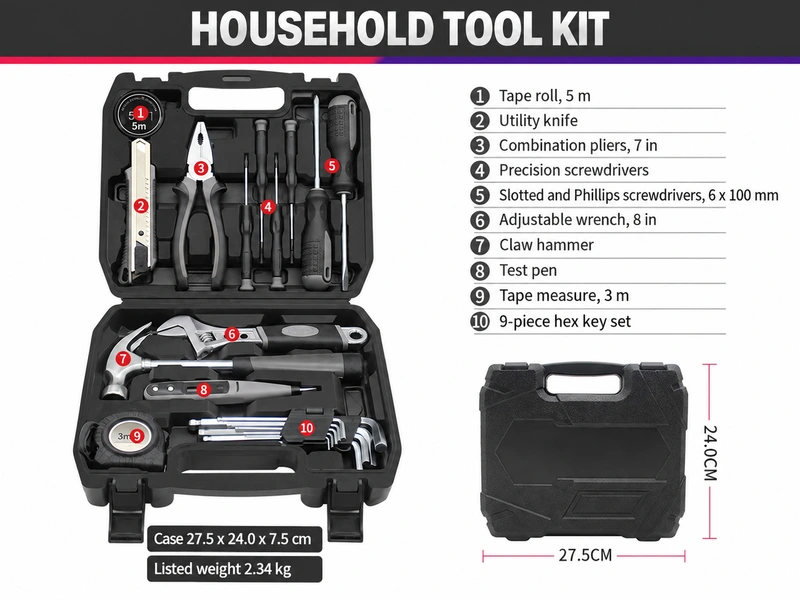
The larger gray and black case lists 27.5 × 24.0 × 7.5 cm and 2.34 kg. Weight basis is unstated, so confirm it against a packed sample.
Its ten numbered categories are not ten total pieces. The image lists a 5 m tape roll, utility knife, 7 in combination pliers, precision screwdrivers, slotted and Phillips screwdrivers listed as 6 × 100 mm, an 8 in adjustable wrench, claw hammer, test pen, 3 m tape measure, and a 9-piece hex key set. The hex keys contain multiple pieces, while the screwdriver group needs a final BOM count.
Request an item count, tool dimensions, cavity map, and packed-weight definition.
- Confirm every numbered category as an item line in the BOM.
- Separate piece count from category count.
- Record whether tester items remain in the proposed US SKU after review.
Read every number as a question. Request a signed packing list that explains category count, piece count, and packed-weight method.
A mechanics tool set assortment provides a neighboring reference, while this kit keeps its own BOM and claims.
Larger-kit configuration table
| Listed category | Supplied description | Buyer check |
|---|---|---|
| Consumable and measuring | 5 m tape roll; 3 m tape measure | Confirm tape-roll type; confirm tape-measure graduations in inches/mm |
| Driving | Precision drivers; slotted and Phillips 6 × 100 mm | Confirm count and tip profiles |
| Grip and turn | 7 in combination pliers; 8 in adjustable wrench | Confirm jaw details and use notes |
| Cutting and striking | Utility knife; claw hammer | Confirm spare-blade and handle information |
| Hex and testing | 9-piece hex keys; test pen | Confirm tester rating data before US offering |
3. What does the compact household tool kit configuration contain?
The orange and black compact case lists 23.8 × 12.7 × 4.4 cm and 0.56 kg. Weight basis is unstated. Its slim footprint can suit small parcels, apartment storage, gifts, and checkout displays, yet compare coverage against the larger case.
Seven numbered categories appear in this configuration: screwdriver bits with count unconfirmed, utility knife, transparent test screwdriver, two precision drivers in slotted and Phillips forms, hex keys in 2, 3, 4, 5, and 6 mm, bit-driver handle, and 6 in long-nose pliers. These are seven categories, not seven pieces. The bits and hex keys require exact piece counts in a final BOM.
It lacks a hammer, adjustable wrench, and tape measure, so a retailer may need an add-on plan.
- Confirm screwdriver-bit count and profile list.
- Confirm hex-key count, finish, and metric marking.
- Check whether every tool remains accessible without removing the tray.
Small cases need sharper boundaries. Position this configuration around named tasks, then show any missing tool as a planned add-on.
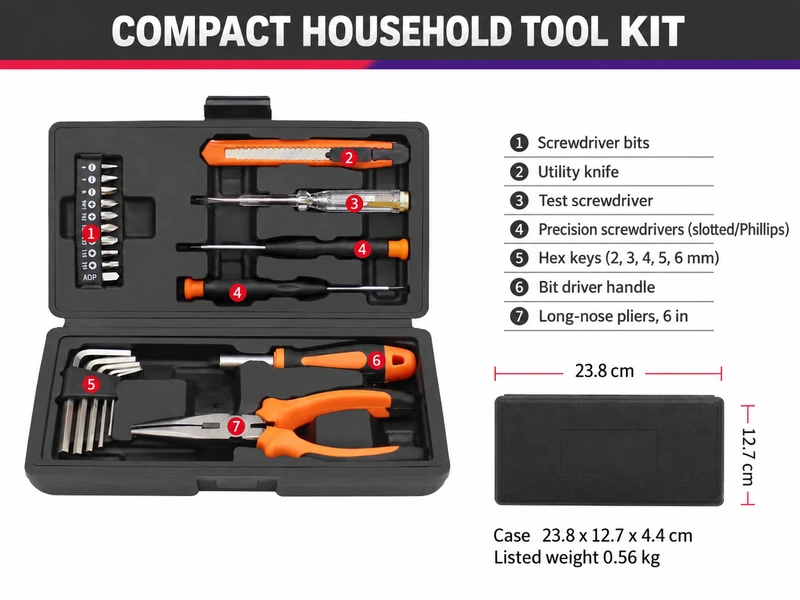
Use the hand tools category as an adjacent-product reference. Keep copy tied to the photographed configuration and BOM.
Compact-kit configuration table
| Listed category | Supplied description | Buyer check |
|---|---|---|
| Driving | Screwdriver bits; bit-driver handle; two precision drivers | Confirm bit count and driver interface |
| Gripping | 6 in long-nose pliers | Confirm jaw profile and handle details |
| Cutting | Utility knife | Confirm blade format and replacement policy |
| Hex work | 2, 3, 4, 5, and 6 mm hex keys | Confirm pieces and metric marking |
| Testing | Transparent test screwdriver | Confirm model-specific rating and instructions |
4. How should distributors compare the two configurations?
Compare task coverage, packout, and customer expectation. The larger case includes a hammer, adjustable wrench, a tape roll, a tape measure, and a 9-piece hex set. The compact case concentrates on driving, hex keys, cutting, testing, and long-nose gripping.
- Coverage: which named household tasks can each configuration support?
- Physical footprint: what shelf, parcel, and carton space does each consume?
- Retail story: can a customer understand the difference in five seconds?
- Add-ons: what should be sold separately rather than forced into one case?
Compare jobs before pieces. Ask a sample reviewer to score each case against three real customer scenarios and record missing tools.
An optional socket tools range may fill a fastener gap later, but socket products are not included in either photographed configuration. Keep that add-on explicit.
The compact hex keys are listed as 2, 3, 4, 5, and 6 mm. Do not assume metric coverage suits every US customer; ask whether SAE keys are required and quote them separately when needed.
Configuration decision table
| Decision point | Larger case | Compact case |
|---|---|---|
| Coverage direction | Broader mixed home repair | Smaller driving and light-grip set |
| Visible omissions | Exact accessory count still needed | Hammer, adjustable wrench, tapes absent |
| Packout question | Can shelf and parcel size absorb it? | Does limited coverage fit the promise? |
| Approval evidence | Packed sample and cavity map | Packed sample and cavity map |
5. How should a distributor turn a photo into a BOM?
A product photo helps a buyer spot layout and rough coverage. It cannot establish piece count, weight basis, material, rating, packaging, or production output. Convert each category into one BOM line and match it against a sample.
Use a BOM sheet with these fields:
- Line number and product name.
- Quantity per kit and loose accessories.
- Inner box, master carton, and packed-weight definitions.
- Instruction language, warning marks, and market-specific labels.
Mark uncertain lines as pending. “Screwdriver bits” without a count cannot support a piece-total claim. “Test pen” cannot support a US electrical-use claim without model data and instructions.
Make the photo answerable. Return one marked-up BOM to the supplier and ask for written confirmation against a physical sample.
Request an RFQ through the supplier contact page with market, quantity, packaging, carton preference, and sample questions.
BOM control table
| BOM field | Photo can suggest | Written confirmation needed |
|---|---|---|
| Tool presence | Visible category and placement | Exact model and quantity |
| Dimensions | Relative case shape | Measured case and packed carton |
| Weight | Listed value in supplied image | Net or gross basis and tolerance |
| Tester | Visible item | Rating, instructions, and market fit |
| Packaging | Case form | Inner, master, and shipping details |
6. What should be checked for US retail and electrical items?
US retail approval depends on more than an English label. A distributor needs a complete BOM, instructions, package warnings, traceable model data, and a review of any electrical-use claim. Ratings are unknown from supplied images. Appearance cannot prove insulation, voltage suitability, compliance, or intended use.
For any tester proposed for a US SKU, request model number, rating data, instructions, and package language. A Fluke safety guide supports checking a tester before and after use; see its primary safety reference.
Until review is complete, omit unverified testers from the proposed US SKU or list them as pending. Apply the same discipline to items needing package warnings or age guidance.
- Ask for model-specific rating and instruction files.
- Record the reviewer, date, sample ID, and open questions.
Treat a tester as a separate approval track. Hold its retail claim until model data and instructions support the market offer.
US-retail review table
| Review area | Evidence needed | Status for supplied photos |
|---|---|---|
| Tester identity | Exact model and rating sheet | Unconfirmed |
| Electrical wording | Instructions and market-specific warnings | Unconfirmed |
| Packout | English package and controlled BOM | Needs supplier confirmation |
| General tools | Size, count, use notes, and label review | Partly described; verify sample |
7. How do packout and logistics change the wholesale choice?
Case dimensions influence shelf depth, parcel fit, carton use, and damage exposure. Listed case size does not equal shipping size. Buyers need packed dimensions, inner quantity, master-carton count, gross weight, and pallet plan before quoting landed cost or retail margins.
Use a logistics worksheet:
- Case dimensions and packed dimensions.
- Inner-box count and master-carton count.
- Barcode, label, language, and retail-ready packaging needs.
Do not infer transit performance from a tidy photo. Ask for a packed sample and carton drawing. Extra coverage must earn shelf space, while limited coverage must remain clear.
Packout turns catalogue detail into margin. Ask for one physical packed sample before finalizing carton, freight, or shelf assumptions.
Packout comparison table
| Logistics field | Larger case | Compact case |
|---|---|---|
| Listed case size | 27.5 × 24.0 × 7.5 cm | 23.8 × 12.7 × 4.4 cm |
| Listed weight | 2.34 kg; basis unstated | 0.56 kg; basis unstated |
| Missing inputs | Packed size, carton count, gross weight | Packed size, carton count, gross weight |
| Buyer decision | Shelf and parcel margin | Small-parcel and storage fit |
8. What can a bulk photo tell a wholesale buyer?
The supplied bulk image shows rows of tool kits in a warehouse presentation. It can support packout discussion. It cannot prove shared SKU identity, production capacity, quality control, material grade, or lead time.
Use the image as a conversation starter, then request order-linked evidence:
- SKU code and revision matching the requested BOM.
- Inspection plan, if the buyer requires one.
- Capacity and lead-time statements supplied in writing.
Do not turn a warehouse scene into a promise. A supplier introduction page may explain company background, while order-specific capability and timing need confirmation.
Separate appearance from evidence. Ask what bulk rows represent before using the photograph in a sales deck.
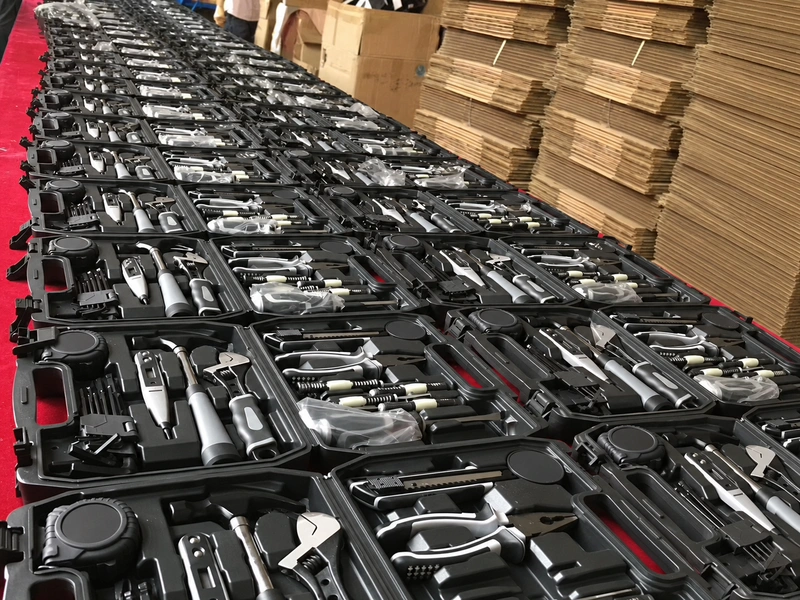
Related mechanics tool set products can help organize adjacent products. Keep household-kit claims tied to SKU evidence.
Bulk-photo evidence table
| Photo observation | Safe use | Claim still requiring evidence |
|---|---|---|
| Repeated cases in rows | Discuss visible presentation | Output capacity or available stock |
| Similar trays and tools | Ask whether one SKU is shown | Shared SKU identity |
| Warehouse setting | Discuss packout conversation | Factory ownership, QC, or lead time |
| Tool visibility | Draft questions for BOM review | Material, grade, rating, or performance |
9. What sample checks should happen before a wholesale quote?
Sample approval should connect shelf promise with measurable facts. Open every cavity, count loose accessories, measure case and packed carton, and compare copy with the BOM. Record defects as observations.
Run a practical review:
- Count categories and pieces against the BOM.
- Check tool fit, cavity retention, and tray access.
- Review tester data separately before any US electrical wording.
- Photograph sample ID, revision, and open questions.
Sample review does not prove durability or production consistency. Those questions need an inspection plan and order-linked records. For another round, send a revised RFQ through the contact page with marked changes.
Approve the evidence beside the sample. Release a wholesale quote only after open BOM lines have owners and due dates.
Sample-approval table
| Check | Larger configuration | Compact configuration |
|---|---|---|
| Count | Categories plus multi-piece sets | Categories plus bits and hex keys |
| Fit | Hammer, wrench, tapes, and trays | Bit set, drivers, pliers, and tray |
| Documents | BOM, packing list, instructions | BOM, packing list, instructions |
| Market gate | Tester and package review | Tester and package review |
10. What should a distributor include in the final RFQ?
A useful RFQ names configuration, market, packout, and review method. Attach a BOM with category and piece counts separated. Add dimensions, weight-basis questions, packaging, language, labels, and sample schedule.
Include these fields in the request:
- Target market and sales channel.
- Configuration name and revision.
- BOM with each category, count, and size.
- Tester review status and required documents.
- Sample quantity, approval checks, and quotation validity.
Ask the supplier to flag substitutions before quotation. List any socket set or accessory as an add-on.
Put the decision in writing. Send your BOM, target market, quantity, unit packaging, sample needs, and open compliance questions together.
For a supplier discussion, provide quantity, unit packaging, retail channel, and sample criteria. Ask for a reply tied to one revision.
Q1: Are the two photographed configurations the same SKU? The images do not prove that. Treat them as separate until a supplier confirms identity.
Q2: Does the larger kit contain ten pieces? No. It shows ten categories; the hex-key set has nine pieces and other counts need BOM confirmation.
Q3: Can a buyer quote listed case weights directly? Ask whether each means net or gross, then confirm against a packed sample.
Q4: Can a pictured test pen be offered for US electrical work? Not from a photo. Request model rating data and instructions, then complete market review.
Q5: Should socket tools be added to either kit? Quote them as an optional add-on because neither supplied configuration includes them.
Looking for a reliable mechanic tools manufacturer in China?
If you are sourcing hand tools, socket tools, automotive repair tools, mechanic tool sets or OEM private label tools, contact KOLARWIN Tools for factory-direct quotation, customization support and product consultation.