Need OEM supplier support for this product type?
Contact KOLARWIN Tools for OEM mechanic tools, private label packaging, wholesale quotation and product range support. This gives overseas buyers a clear path from article reading to supplier discussion.
Wire strippers remove insulation while preserving a usable conductor. Wire cutters sever the wire or cable. A combination tool may cover both operations, with separate limits for each function. Buyers should compare working geometry, conductor construction and documented capacity before selecting a tool for their range.
1. What changes between stripping and cutting?
Stripping removes a controlled insulation section while leaving a usable conductor. Cutting severs wire or cable for a later process. Combination tools may do both jobs, yet each needs separate contact features and checks.
Write each function as a procurement line. A stripper/cutter still needs documented strip and cut features. Notches do not prove capacity, compatibility, or safe use.
- Stripping: controlled insulation separation around a conductor.
- Cutting: full separation through a conductor or cable bundle.
- Combination tool: both functions, each subject to its own sample test.
Start with the operation. Put “strip,” “cut,” or “strip and cut” beside every planned SKU before comparing handles or retail photographs.
Review the hand tools category after this function decision. Keep category context separate from model approval.
Function decision table
| Buyer need | Working feature to confirm | Receiving evidence | Main failure risk |
|---|---|---|---|
| Remove insulation | Sized notch, blade, or self-adjusting head | Clean conductor with insulation slug released | Nicked or flattened conductor |
| Shorten wire | Cutting edge sized for stated wire | End geometry acceptable for the next process, without pulled strands or excess deformation | Pulled strands or crushed insulation |
| Perform both jobs | Independent strip and cut features | Separate tests for both functions | Only one function receives a sample check |
| Prepare a cable range | Cable-specific geometry and capacity | Samples matching cable construction | Tool used outside its documented scope |
2. How do blade and notch geometries differ?
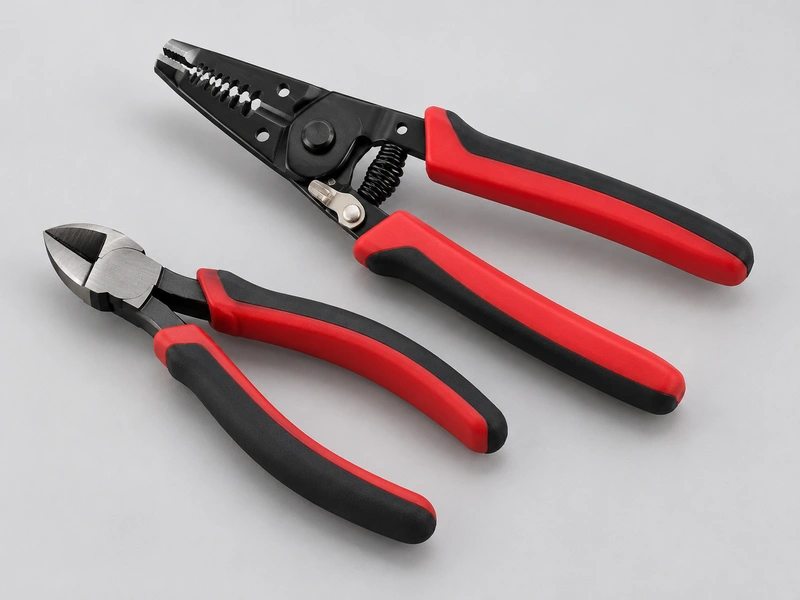
Cutting geometry varies. Diagonal cutters bring opposed edges together, while cable shears use blades that pass one another. A stripping notch targets insulation at a controlled depth. One feature cannot prove the other.
Klein’s 11055 page describes stripping holes beside cutting blades. KNIPEX’s 95 11 165 page describes passing blades for cable shearing, without stripping profiles. Use these pages for mechanism comparison only.
Inspect three geometry points before a quote:
- Jaw closure: do edges meet across the intended path?
- Notch profile: does wire seat without side play?
- Exit path: can the insulation slug leave without twisting the conductor?
Look at contact geometry before finish. Ask for a close-up drawing or sample view that separates stripping notches from cutting jaws.
Geometry comparison table
| Feature | Stripping profile | Cutting profile |
|---|---|---|
| Contact goal | Score insulation at controlled depth | Pass through conductor or cable |
| Shape to inspect | Notch, slot, or guided blade | Opposed cutting edges or passing shear blades, by model |
| Sample result | Exposed conductor without nicks | End geometry acceptable for the next process, without pulled strands or excess deformation |
| Document request | Wire construction and strip range | Wire or cable material and cut range |
3. Why does a dedicated cable cutter need separate review?
A dedicated cable cutter uses cutting geometry, jaw shape, and a defined cable application. It may grip round cable while edges pass through a bundle. That design does not add a stripping feature automatically.
Klein’s 63050-INS page identifies cable-gripping jaws without presenting stripping holes. KNIPEX describes a cable-shear model for stranded copper and aluminum cable. Read each model page separately.
Separate cutter review matters for:
- Larger cable diameters or bundled cores.
- Stranded copper or aluminum cable that needs a clean end.
- Work where a narrow stripping notch would create a bottleneck.
Keep cutter capacity in its own column. Record cable diameter or cross-section, conductor material, and stated operation separately from any stripping range.
Dedicated-cutter screening table
| Check | Dedicated cable cutter | Combination stripper/cutter |
|---|---|---|
| Primary job | Sever cable or wire | Strip insulation and cut wire |
| Geometry | Cable-gripping jaws and model-specific cutting edges | Notches plus a cutter under the pivot or at jaw area |
| Capacity evidence | Cable construction and size | Separate strip and cut rows in specification |
| Buying risk | No stripping function | Cutter may be limited for larger cable |
4. When does a multifunction stripper/cutter fit a kit?
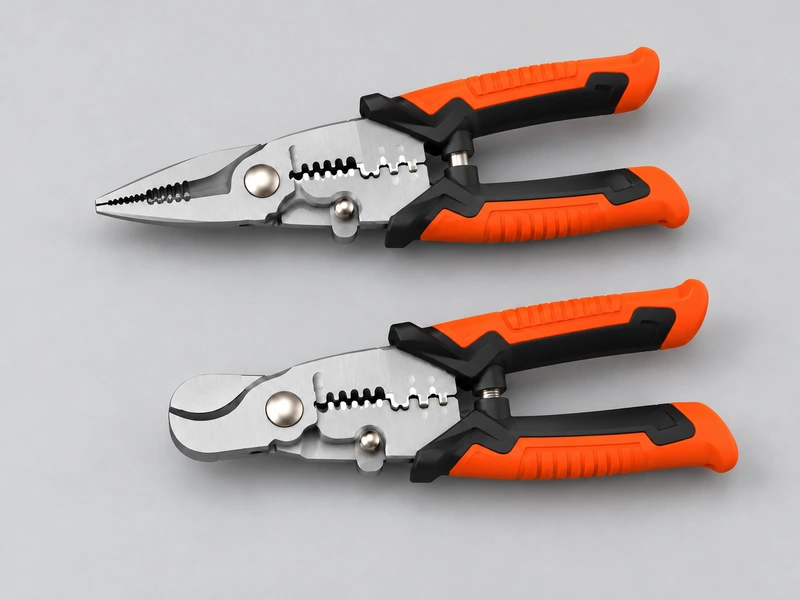
A combination tool fits a kit when operators repeatedly strip and cut within one documented wire family. It can reduce bench changes, yet still needs a clear capacity table. Value task coverage over feature count.
A documented self-adjusting combination model includes tension and strip-length adjustments plus a separate cutter. Use those features as questions for the selected model, rather than as specifications for the photographed manual tools.
Ask suppliers to state:
- Whether strip and cut ranges differ.
- Whether both functions cover solid, stranded, or fine-stranded wire.
- Whether cable forms such as NM cable have a separate line.
- Which parts are replaceable or adjustable.
Buy for the repeated task. If a kit mostly cuts large cable, pair a dedicated cutter with a separate stripper rather than forcing one body across unrelated work.
Kit-fit decision table
| Work pattern | Suitable direction | Evidence needed | Hold point |
|---|---|---|---|
| Repeated small-wire strip and cut | Combination tool | Separate strip and cut ranges | Sample repeatability |
| Mixed wire plus larger cable | Two dedicated tools may fit better | Cable and wire models | Cross-section compatibility |
| Occasional repair work | Compact combination tool | Named tasks and sample wire | Avoid vague “general use” claim |
| Production cell | Tool matched to one process | Work instruction and QC limits | Cycle and replacement plan |
If your kit also needs terminal assembly, use our crimping tool selection guide to specify a separate tool-and-die combination.
5. How do solid, stranded, and fine-stranded wires change selection?
Solid wire presents one conductor body. Stranded wire contains multiple strands that can spread or flatten during a cut. Fine-stranded wire can behave differently when a notch grips outer strands. A solid-wire result cannot stand in for all constructions.
Manufacturer listings show that solid and stranded ranges can differ by model. Record construction beside every capacity line; do not transfer a listed range to Kolarwin tools or photographed products.
Record these fields for each proposed model:
- Solid-wire range and conductor material.
- Stranded or fine-stranded range.
- Insulation construction and outer diameter where relevant.
- Whether a range applies to stripping, cutting, or both.
Split the sample set by construction. Test solid, stranded, and fine-stranded coupons separately whenever a purchase will serve all three.
See the specialty pliers buying guide for adjacent tool-family questions. Keep wire-tool evidence model-specific.
Conductor-construction table
| Construction | Stripping concern | Cutting concern | Buyer record |
|---|---|---|---|
| Solid | Depth control around one conductor | Controlled end geometry without flattening | Solid range and material |
| Stranded | Avoid pulled or severed strands | Prevent strand spread and burrs | Stranded range and strand form |
| Fine-stranded | Notch fit and strand retention | Edge support across many small strands | Fine-stranded approval status |
6. How should buyers read AWG and mm² ranges?
AWG and metric cross-section describe size systems. Outer diameter or insulation construction can limit fit. Never convert an unverified range into a guaranteed claim.
Build a model matrix with separate rows for stripping and cutting. Include material, construction, insulation, and cable form. Mark missing fields before a purchase order moves forward.
- Copy the maker’s stated AWG range exactly.
- Record mm² only when the maker supplies it or approves a conversion.
- Note whether the listed range covers strip, cut, or both.
- Keep unknown ranges out of public product copy.
Make every range traceable. Tie each number to a model number, document revision, and sample result.
Use the hand tools category for adjacent families, but tie this matrix to exact model documents.
Range-control table
| Matrix field | Why procurement needs it | If absent |
|---|---|---|
| AWG range | Matches a US buying specification | Hold model approval |
| mm² range | Supports metric market comparison | Request maker confirmation |
| Construction | Separates solid from stranded behavior | Run separate samples |
| Function | Distinguishes strip from cut | Do not combine ranges |
| Insulation or cable form | Controls physical fit | Request application limits |
7. Which conductor and cable materials need separate models?
Copper, aluminum, steel, copper-clad conductors, and finished cable assemblies place different demands on an edge. Hardness, strand form, bundle size, and insulation shape affect contact. Suppliers should name materials instead of using a generic “wire” label.
Do not assume a copper-wire stripper suits steel wire. Klein warns that its cited combination model should not cut steel wire. KNIPEX’s example names stranded copper and aluminum cable for its own model. These examples support a material-screening rule; they do not approve an unverified tool. See the industry page for broader sector navigation.
Ask for evidence covering:
- Copper and aluminum conductors separately.
- Steel wire or cable, if a buyer needs that application.
- Copper-clad or specialty conductors where relevant.
- Cable jacket material and construction, not only conductor metal.
Name material before price. A quote without conductor material and cable form leaves capacity open to interpretation.
Material-screening table
| Material or form | Questions for supplier | Sample note |
|---|---|---|
| Copper | Solid or stranded? What insulation? | Cut and strip separately |
| Aluminum | Which cable construction and size? | Inspect deformation and strands |
| Steel | Is a dedicated cutter required? | Never infer approval from copper range |
| Copper-clad or specialty | Is this listed by model? | Hold until written scope exists |
| Finished cable | Jacket, cores, and diameter? | Test a matching sacrificial coupon |
8. Does handle color prove electrical insulation?
Handle color identifies a visual family or comfort grip. It does not prove insulation, dielectric suitability, a voltage rating, or a standard. Klein lists one colored combination tool as not insulated, while its insulated cable-cutter page describes model-specific insulation details and rating markings. Color alone cannot separate those cases.
The reference tools have colored grips, while their electrical status remains unverified. Treat electrical status as unknown until model marking, insulation construction, rating symbol, standard, and manufacturer document agree. Do not use them as energized-work evidence.
Use a document gate:
- Exact model and handle marking.
- Insulation construction and rating symbol.
- Standard or test report named by the maker.
- Instructions that define permitted use and limitations.
Read marking, not paint. Put electrical rating review on a separate approval line from cutting and stripping performance.
Insulation-evidence table
| Evidence | What it can support | What it cannot support alone |
|---|---|---|
| Handle color | Visual sorting or family recognition | Insulation or voltage rating |
| Model marking | Identity matching | Performance outside documents |
| Rating symbol and standard | Documented electrical claim, if authentic | General approval for another model |
| Supplier data sheet | Stated construction and limits | Independent test result unless supplied |
9. What should a buyer test on receiving samples?
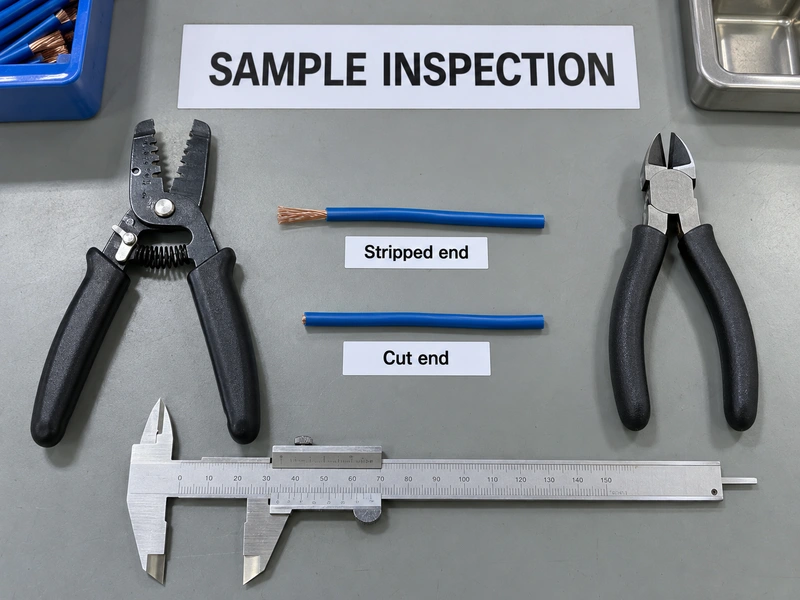
Use clean, loose, de-energized sacrificial coupons matching a proposed specification. These checks belong in receiving or pre-production review, not live electrical work. Photograph markings so results stay tied to one model and revision.
Run this bench sequence:
- Match carton, model, range, marking, and data sheet.
- Cut representative solid and stranded samples within the documented range.
- Strip short sections and inspect conductors under magnification.
- Repeat one strip length and measure exposed-conductor variation.
- Recheck alignment, notch condition, pivot, spring return, and jaw gap after defined cycles.
Inspect end geometry, crushed insulation, pulled strands, conductor nicks, residue, and hand effort. Set cycle counts and acceptance limits in your QC plan; supplied photos establish no cycle-life result.
Test both functions separately. A clean cut cannot rescue a poor strip, and a neat strip cannot validate a cutter outside its stated capacity.
Read related notes on the Kolarwin blog after setting acceptance limits.
Sample-QC table
| Check | Record | Hold or reject trigger |
|---|---|---|
| Identity | Model, marking, document revision, photos | Listing and tool disagree |
| Cut quality | Material, construction, end condition, effort | Burr, crush, pulled strands, uneven closure |
| Strip quality | Length, conductor condition, slug release | Nicked strands, flattening, residue |
| Repeatability | Exposed length across repeat tests | Drift beyond buyer limit |
| Durability screen | Cycle method and post-check findings | Loose pivot, misalignment, damaged notch |
10. What belongs in the final RFQ and approval file?
A clear RFQ turns “wire tool” into a model brief. Name operation, construction, material, size system, cable form, packaging, and sample method. Ask for flagged substitutions, then tie answers to a revision-controlled BOM.
Include:
- Required operation: strip, cut, or both.
- Solid, stranded, or fine-stranded construction.
- Copper, aluminum, steel, copper-clad, or finished cable form.
- AWG and/or mm² range for each function.
- Strip length, cable diameter, package, marking, and document needs.
- Sample quantity, test coupons, acceptance limits, and response owner.
Use the Kolarwin contact page for an inquiry carrying those fields. Ask for a model matrix before approving a quote. Use a sample evaluation inquiry to resolve open technical questions, and review supplier background alongside the product records.
Send one controlled brief. Ask for a marked specification, sample identity, and written response against every open line before approving a wire-tool order.
Q1: Can a wire cutter strip insulation? Usually, a dedicated cutter should not be assumed to have a controlled stripping feature. Confirm a documented notch or blade profile, then run a sample check.
Q2: Can a wire stripper cut cable? A combination model may cut within its stated scope. A small stripping tool should not be assigned larger cable work without model-specific cutting evidence.
Q3: Does a colored handle mean a tool is insulated? No. Verify model marking, insulation construction, rating symbol, standard, and manufacturer documents.
Q4: Can a solid-wire result prove stranded-wire performance? No. Test each conductor construction separately and record material, insulation, and size with each result.
Q5: What should a buyer request before ordering? Request a model matrix, separate strip and cut ranges, material and cable limits, markings, data sheets, samples, and written acceptance criteria.
Looking for a reliable mechanic tools manufacturer in China?
If you are sourcing hand tools, socket tools, automotive repair tools, mechanic tool sets or OEM private label tools, contact KOLARWIN Tools for factory-direct quotation, customization support and product consultation.