Need OEM supplier support for this product type?
Contact KOLARWIN Tools for OEM mechanic tools, private label packaging, wholesale quotation and product range support. This gives overseas buyers a clear path from article reading to supplier discussion.
Wire strippers, leather punches and eyelet-setting pliers can share a display while needing three different purchase specifications. A useful assortment starts with what each jaw must do, which material it handles, and how buyers will check the result. This specialty pliers buying guide compares the three product families shown in the supplied photographs, with practical checks for distributors, importers and private-label buyers.
1. Which specialty pliers belong in your product range?
Sort the range by operation before comparing handle colors or prices. Wire strippers remove insulation from conductors. Rotary leather punches cut round openings in suitable sheet material. Eyelet-setting pliers form compatible hardware in that material. Similar handles do not make their working parts interchangeable.
The photographs show a wire-stripper assortment, two turquoise-and-black combination tools, several rotary punch presentations, and a punch-plus-eyelet kit. Two red-and-blue punch photographs are alternate views, rather than evidence of two separate SKUs. A single broad catalogue description would hide those distinctions.
Buy by the operation. Give each proposed SKU a clear job:
- Electrical preparation: specify stripping, cutting and any additional approved functions.
- Leather or craft work: specify the required hole and material.
- Eyelet installation: specify hardware and matched setting dies.
Use the hand tools range to plan adjacent categories, then create separate specifications for these specialty products. Ask whether customers need an individual tool, a paired workflow kit, or a wider assortment.
Product-family comparison
| Family | Main operation | Decisive purchase input |
|---|---|---|
| Wire stripper | Remove conductor insulation | Wire construction and stripping range |
| Rotary leather punch | Cut a round opening | Hole diameter, material and reachable position |
| Eyelet-setting pliers | Form compatible eyelet hardware | Eyelet design, material stack and die fit |
2. What should buyers check on multifunction wire strippers?
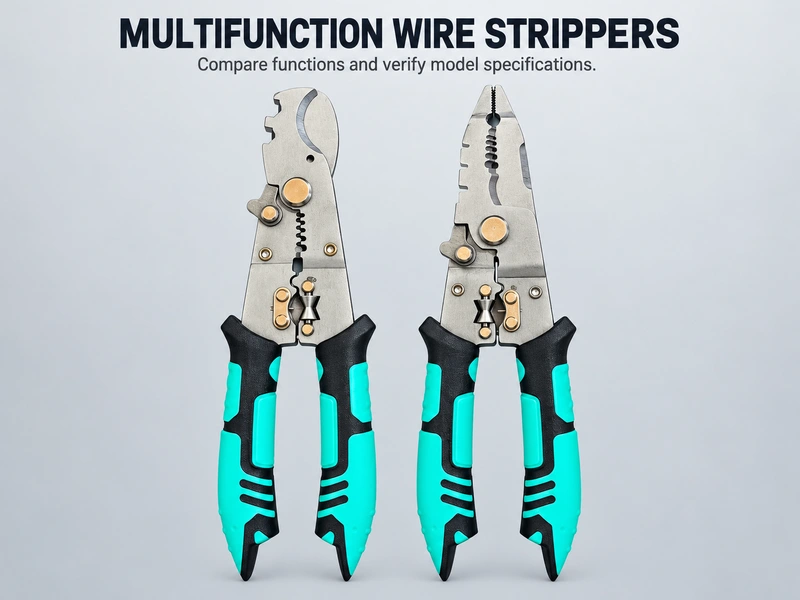
A multifunction tool may combine stripping notches, a cutter, gripping jaws and other features. Each function needs its own stated range. The presence of several openings does not establish which conductors, terminals or fasteners they accept.
The turquoise-and-black tools in the photographs have different jaw profiles. Their visible markings are insufficient for a reliable AWG specification. Nor does a spring prove automatic size adjustment. Request a labeled function diagram, with separate lines for solid and stranded conductors where applicable.
An official wire-stripper specification illustrates why construction matters: solid-wire and stranded-wire ranges are listed separately. Those particular ratings belong to that manufacturer's model, not these photographed products.
Specify every working feature separately. Request:
- Conductor material, construction and accepted size range.
- Insulation types and stripping-length provisions.
- Cutting capacity stated independently from stripping capacity.
- Terminal families for any claimed crimping function.
When comparing pliers within a wholesale hand-tool range, retain separate model descriptions. Approve a wire sample and its stripped result before printing a size claim.
Wire-tool specification checks
| Feature | Request from supplier | What to inspect |
|---|---|---|
| Stripping | Solid/stranded range and conductor material | Insulation removal without conductor damage |
| Cutting | Approved materials and maximum sizes | Complete cut within stated conditions |
| Crimping | Compatible terminal and conductor combinations | Connection evaluated to terminal-maker criteria |
| Screw shearing, if offered | Thread system and approved sizes | Fit and thread condition after cutting |
3. How does a rotary leather hole punch differ?
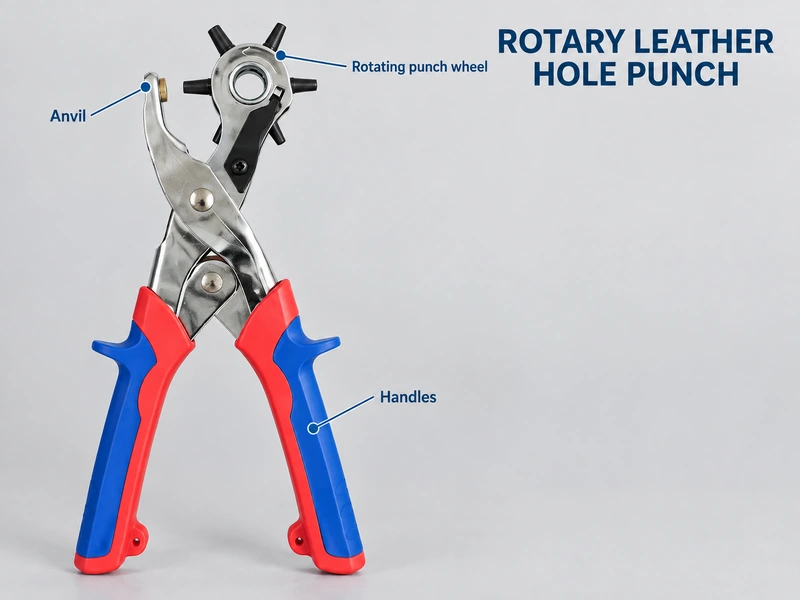
A rotary punch brings a selected hollow tube into alignment with an opposing anvil. Closing the handles drives the tube through suitable material. Jaw reach limits where the tool can place a hole, so diameter alone is not enough for selection.
The red-and-blue tool and the plain red-handled boxed tool show this working concept. Their photographs do not establish identical construction, diameter sets or operating limits. A thicker-looking grip also provides no measured evidence of lower squeezing effort.
A manufacturer's revolving-punch description confirms the rotating-tube principle and demonstrates that tube sets are model-specific. Obtain the actual size list for the product being quoted.
Check the hole and its location together. Ask for:
- Nominal punch diameters and agreed dimensional tolerances.
- Reach from the material edge to the hole center.
- Approved material types and constructions.
- Availability of matching replacement tubes and anvils.
Test the chosen position on representative scrap before approving a product description. If the hole lies beyond the jaws' reach, evaluate another tool format instead of distorting the workpiece.
Rotary-punch selection checks
| Parameter | Buyer decision | Evidence to request |
|---|---|---|
| Tube diameters | Which openings can be cut? | Model-specific size list |
| Jaw reach | Can the required location be reached? | Dimensioned drawing or measured sample |
| Alignment | Does the tube meet the anvil squarely? | Check at every supplied position |
| Service parts | Can worn components be replaced? | Compatible part numbers and instructions |
4. What does an eyelet-setting kit add?
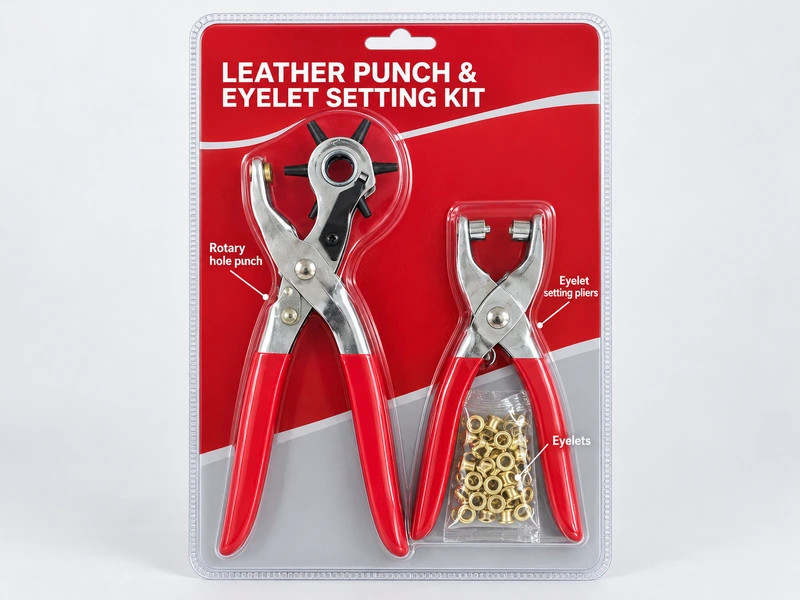
The supplied retail kit contains a rotary punch, a separate setting plier and loose gold-colored eyelets. It presents a two-stage workflow: prepare an appropriate opening, then install compatible hardware. Neither the eyelets' alloy nor their exact quantity can be established confidently from the photograph.
Some purpose-built tools combine punching and setting. For example, a manufacturer's eyelet puncher and fixing plier specifies its compatible eyelets. That capability cannot be assumed for every setting plier, including the separate tool shown here.
Match the hardware before building the kit. Confirm:
- Eyelet barrel dimensions, flange shape and any required washer.
- Recommended hole diameter from the hardware supplier.
- Material thickness and total layer stack.
- Matched dies and the correct setting sequence.
Eyelet inner diameter does not automatically equal the required cut-hole diameter. Send hardware and material samples with an eyelet-kit inquiry, then request a correctly installed reference sample.
Eyelet-kit compatibility checks
| Item | Confirmation needed | Common purchasing error |
|---|---|---|
| Hole | Hardware-maker recommendation | Selecting by eyelet inner diameter alone |
| Barrel | Length matched to material stack | Ordering hardware too short for the layers |
| Dies | Fit to eyelet design and size | Assuming all setting pliers accept all eyelets |
| Kit contents | Tools, eyelets and washers where required | Treating a photograph as a counted packing list |
5. How should AWG, metric markings and punch diameters be presented?
These products use several size systems. Keep them in separate specification fields. AWG identifies conductor gauge; square millimeters describe conductor cross-sectional area. Millimeters may also describe a punch diameter or another physical dimension. A unit without its feature name invites mistakes.
Similarly, a screw-size mark on a combination tool does not describe its wire-stripping range. Confirm the associated function through a drawing or manual before translating jaw markings for US packaging.
The supplied punch-kit card lists 2.5, 3, 3.5, 4, 4.5 and 5 mm. Record those as the package's listed punch diameters, pending sample verification. Do not transfer that set to the bare red-and-blue punch or the boxed red-handle variant.
Name the feature beside the number. Your data sheet should distinguish:
- Conductor gauge and solid/stranded construction.
- Cross-sectional area from physical diameter.
- Screw-thread sizes from stripping positions.
- Punch diameter from eyelet dimensions.
Size-label controls
| Marking | Intended information | Required clarification |
|---|---|---|
| AWG | Conductor gauge | Solid or stranded; approved material |
| mm² | Conductor cross-sectional area | Compatible wire construction |
| Metric screw size | Fastener thread designation | Associated screw-cutting function, if supplied |
| Punch size in mm | Nominal cutting diameter | Which model and tube position |
| Eyelet size | Hardware dimension | Inner diameter, barrel or another stated feature |
6. What do materials, finishes and handles actually tell buyers?
Surface appearance can help identify a sample, but it cannot establish steel grade, hardness or electrical protection. Silver-colored jaws may have several possible finishes. Black surfaces likewise do not identify a particular treatment without supporting information.
Colored or cushioned grips should be described by their confirmed material and construction. Electrical insulation requires model-specific evidence. Klein's published warnings explicitly distinguish ordinary plastic-covered handles from electrical protection; photographs cannot support an insulated-tool claim for these samples.
Separate appearance from performance. Put the following requests in distinct fields:
- Body, cutting-edge and punch-tube materials where they differ.
- Agreed heat-treatment or hardness requirements where relevant.
- Surface-finish specification and corrosion-test conditions, if requested.
- Grip material, retention checks and applicable electrical documentation.
For wire-tool evaluations, use isolated, de-energized samples under appropriate procedures. Do not turn a retail grip-color description into permission for live electrical work.
Choose the evidence according to your sales channel and application. A craft-store punch and an electrical distributor's stripper need different acceptance records.
Claim-and-evidence checklist
| Proposed claim | Appropriate supporting record |
|---|---|
| Material grade | Agreed specification and traceable material evidence |
| Cutting or punching capability | Defined workpiece and functional sample results |
| Corrosion performance | Named test method, conditions and acceptance criteria |
| Electrical protection | Model-specific rating, documentation and applicable verification |
7. How should a distributor evaluate samples across all three families?
Use a common inspection form with a different functional test for each tool. Start by checking model identity, finish, loose components, jaw movement and package contents. Then assess the operation customers will actually perform.
For strippers, use the intended conductor and insulation combinations. Inspect for damaged strands or cuts into a solid conductor after stripping. Any crimping claim needs a matched terminal evaluation; visual appearance alone cannot establish connection performance.
For rotary punches, assess each quoted diameter on representative material. Inspect both sides for incomplete cuts, distorted openings and tearing. For setting pliers, examine the installed hardware and material together, using the hardware maker's acceptance criteria.
Give each sample a recorded outcome. Include:
- Sample ID and specification revision.
- Actual wire, material or hardware used.
- Test conditions and observed defects.
- Agreed follow-up for failures or substitutions.
Review supplier background separately from product approval. A sample pass is useful evidence for that configuration; it does not establish unlimited service life or consistency across every future shipment.
Functional sample plan
| Product | Representative sample | Record |
|---|---|---|
| Wire stripper | Specified conductor and insulation | Strip quality and conductor condition |
| Rotary punch | Intended leather or approved sheet material | Diameter, position and cut condition |
| Eyelet setter | Matched hardware and material stack | Formation, seating and material condition |
8. Should you buy individual pliers, boxed tools or retail kits?
Package format should follow the customer's workflow. An individual wire stripper can fill a specific gap in an electrical range. A boxed rotary punch suits a single-tool offer. A punch-and-eyelet kit should contain a genuinely compatible sequence of tools and hardware.
The photographs show both a plain box and a hanging retail pack. These establish presentation options, not carton dimensions, stock quantities or shipping performance. Obtain the packed dimensions and weight definitions before calculating shelf space or freight.
Count useful contents before counting pieces. Ask for:
- A bill of materials identifying every tool and accessory.
- Eyelet quantities, sizes and replenishment options.
- English instructions and function-specific warnings.
- Barcode placement, package protection and carton quantities.
Keep packaging illustrations consistent with the approved contents. A reconstructed English reference image can support an artwork discussion, but final retail artwork needs its own approval. Other tool sourcing guides can support that planning process.
Packaging comparison
| Format | Suitable purchasing purpose | Approval focus |
|---|---|---|
| Individual tool | Fill a specific assortment gap | Exact model and instructions |
| Plain boxed tool | Single-product distribution | Protection, identification and packed dimensions |
| Retail workflow kit | Sell related operations together | Tool/hardware compatibility and counted contents |
9. What should a specialty pliers RFQ contain?
A useful RFQ gives each tool a separate line, even when several families share one shipment. State the intended operation, model or reference photograph, required range, accessories, market and package format. Attach the workpiece or hardware details needed for a meaningful sample response.
Avoid a single specification such as “multifunction pliers, good quality.” A supplier cannot tell whether your priority is conductor preparation, round-hole cutting or hardware installation. Nor can buyers compare prices fairly when one quote includes eyelets and another covers a bare tool.
Make quotations comparable line by line. Request:
- Exact function and model-specific capacity information.
- Included components and any optional accessories.
- Sample evaluation against agreed criteria.
- Packaging, labeling, quantity and delivery terms.
- Replacement-part and substitution arrangements.
Send the packet through a specialty-tool quotation request. Ask suppliers to identify assumptions, exclusions and unavailable documentation beside the affected line.
RFQ comparison fields
| Field | Wire stripper | Rotary punch | Eyelet kit |
|---|---|---|---|
| Workpiece | Conductor and insulation | Material and hole location | Hardware and material stack |
| Critical range | Strip/cut/crimp specifications | Diameter list and reach | Eyelet and die compatibility |
| Included items | Tool and stated accessories | Tool and stated tubes | Tools, counted hardware and instructions |
| Approval | Functional wire samples | Punched material samples | Installed hardware samples |
10. How can buyers keep the assortment accurate after approval?
Turn the approved sample into a controlled product record. Store its model code, photographs, specification revision, packing list and accepted test results together. A handle-color change may be cosmetic; a changed jaw, punch tube or setting die can alter the product's function.
Require notification before substitutions affect an approved order. Update English instructions whenever a feature, range or kit component changes. Keep wire preparation, leather punching and eyelet setting as separate catalogue functions, even when they appear on one buying-guide page.
Carry the sample decision into the order. Before release:
- Match product and packaging revisions.
- Resolve outstanding capacity or compatibility questions.
- Confirm how defects and missing components will be handled.
- Retain an approved sample for repeat-order comparisons.
Use the hand-tool category to plan the wider range. For these three families, send your product list and sample requirements with the intended market, order quantity and package format. Request a separate technical and commercial response for each tool.
Q1: Can a wire stripper replace a leather hole punch?
No. Stripping notches are designed around conductor preparation, while a leather punch uses a cutting tube and anvil for a round opening.
Q2: Are all six-position rotary punches supplied with the same diameters?
No. Confirm each model's size list. The supplied kit card lists 2.5, 3, 3.5, 4, 4.5 and 5 mm only for that kit.
Q3: Can every eyelet-setting plier also punch holes?
No. Some documented combination tools can perform both operations. Confirm the selected tool's instructions and compatible hardware.
Q4: Do colored handles mean the wire strippers are electrically insulated?
No. Grip appearance does not establish electrical protection. Require appropriate model-specific evidence before making that claim.
Q5: What should importers send with an inquiry?
Send the required functions, conductor or material details, hardware samples, quantities, package requirements and sample-approval criteria for each product line.
Looking for a reliable mechanic tools manufacturer in China?
If you are sourcing hand tools, socket tools, automotive repair tools, mechanic tool sets or OEM private label tools, contact KOLARWIN Tools for factory-direct quotation, customization support and product consultation.