Need OEM supplier support for this product type?
Contact KOLARWIN Tools for OEM mechanic tools, private label packaging, wholesale quotation and product range support. This gives overseas buyers a clear path from article reading to supplier discussion.
A socket set can pair one square drive with several handle types. Each changes how users reach and turn a fastener. Buyers need to separate ratchet mechanisms from handle forms and sockets. This guide maps common types of socket wrenches to practical work. Manufacturer catalogs support the examples; drive compatibility, dimensions, and instructions remain model-specific.
1. What does “socket wrench” mean in a tool catalog?
“Socket wrench” often names the socket-and-handle system: a detachable socket meets a fastener, while a handle turns it. A ratchet is one handle mechanism within that system. A socket-and-ratchet setup differs from a ratcheting combination wrench, whose ratchet sits in a box-end wrench body. Broad catalogs may group them near each other, so product names need an interface field.
A useful category map separates handle form, movement, and function. Ratchet handles permit repeated turning without lifting the socket. T-handles and spinners use different grips. Breaker bars provide a rigid handle without a ratcheting mechanism. Torque wrenches serve controlled tightening. Wera lists ratchets and socket wrenches as distinct catalog groups; PROTO likewise lists ratchets, breaker bars, and extensions separately.
- Handle: transfers hand force.
- Mechanism: ratcheting, fixed, sliding, or torque-controlled.
- Socket: replaceable fastener interface.
Name each piece. Clear records prevent “socket wrench” from obscuring whether a buyer needs a handle, socket, or set.
Socket-wrench system map
| Tool family | Handle/mechanism | Main role | Buyer distinction |
|---|---|---|---|
| Ratchet handle | Reversible or fixed-direction ratchet | Repeated turning | Mechanism is in the handle |
| T-handle | Crossbar grip, sometimes sliding | Direct turning and control | Grip position may move |
| Spinner handle | Screwdriver-style grip with square-drive output | Free-running fasteners | Optional cap/knob only when documented |
| Speed brace | Cranked handle | Rapid continuous rotation | Needs rotation clearance |
| Breaker bar | Rigid non-ratcheting handle | Controlled loosening | No ratchet mechanism |
| Torque wrench | Model-specific measurement/control | Specified tightening | Follow maker’s instructions |
Practical action: split product records into handle type, mechanism, socket interface, and intended operation.
2. What types of ratchet handles fit socket systems?
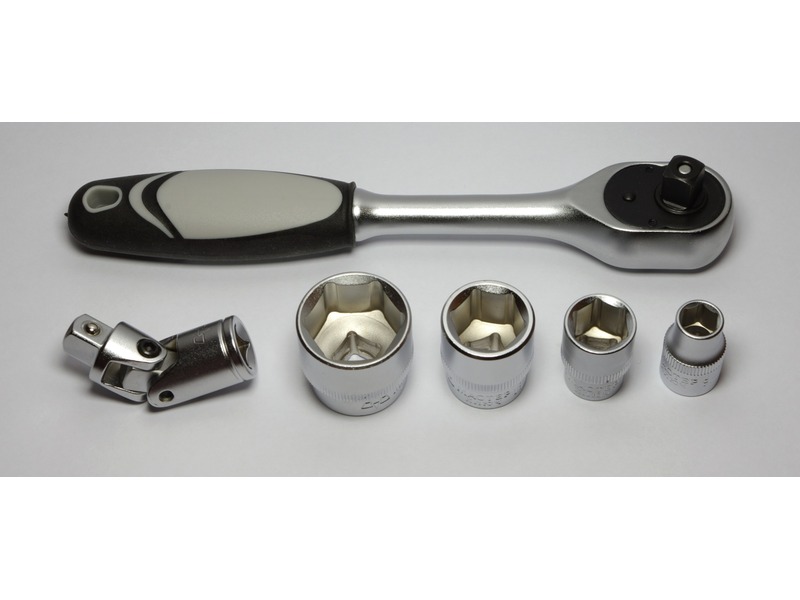
A ratchet handle combines a square drive with a mechanism that turns a socket in one direction and resets in the other. Common catalog variations include pear-head and round-head shapes, reversible switch or push-through mechanisms, compact heads, long handles, and pivoting heads. These are handle design variants, not separate socket types.
PROTO’s ratchet catalog shows standard and flex-head models. An existing flex-head vs fixed-head guide covers head styles; this article treats ratchets as one socket-wrench handle family. Compare head envelope, handle length, reverse control, retention, and clearance against intended sockets and fasteners.
- Standard head: fixed head-to-handle relation.
- Pivoting head: angle changes within model travel.
- Reversing mechanism: changes ratchet direction by design.
- Compact or long handle: alters access and reach.
Check the head with a socket installed. Bare-handle dimensions do not show the complete access envelope.
Ratchet-handle specification fields
| Field | Why it matters | Evidence |
|---|---|---|
| Square drive | Must match the socket | Product drawing or sample |
| Head profile | Affects local clearance | Height and width dimensions |
| Reverse control | Sets operation method | Model instructions |
| Handle length | Affects reach and swing | Overall length |
| Retention | Holds socket at connection | Release/retainer description |
Practical action: approve a ratchet only after testing it with the intended socket and a representative fastener location.
3. When should buyers choose a T-handle or sliding T-handle?
A T-handle places a crossbar across a shaft, giving the user a centered grip. On a sliding T-handle, the square-drive head travels along the crossbar, or the bar slides through the head, depending on model. Position changes grip and clearance. Some catalogs also list T-handle ratchets, which add a ratcheting mechanism to the grip system.
BAHCO’s socket set includes sliding T-handles and ratchets as separate items. GEDORE lists T-handle ratchets and T-driving handles. This avoids an ambiguous “T-handle wrench” line. A product may be fixed, sliding, ratcheting, or a T-shaped socket driver with a specific square connection.
- Fixed T-handle: crossbar stays at a defined position.
- Sliding T-handle: drive head travels along crossbar, or bar slides through head as designed.
- T-handle ratchet: adds ratcheting operation.
Ask how the crossbar moves. A drawing should show whether it slides, locks, or remains fixed.
T-handle choices
| Form | User interface | Buyer check | Use note |
|---|---|---|---|
| Fixed T-handle | Crossbar fixed on shaft | Drive and length | Direct turning |
| Sliding T-handle | Drive head travels along crossbar, or bar slides through head | Travel and retention | Clearance changes with position |
| T-handle ratchet | Crossbar with ratchet head | Ratchet direction and drive | Repeated turning |
Practical action: include a side-view drawing showing the drive head on the crossbar and its travel range.
4. What is a spinner handle used for?
A spinner is a screwdriver-style hand tool with square-drive output for turning compatible sockets on free-running fasteners. A spinning cap or knob is optional and must be documented for that model. It does not provide one-way ratchet action. BAHCO lists a square-drive spinner handle separately from its reversible ratchet, sliding T-handle, and breaker bar.
A spinner suits bench work where a fastener turns freely and fingers can rotate the handle. Use a ratchet for repeated short strokes under load; a spinner suits free-running fasteners. Check square drive, handle length, access, and any model-documented cap or knob. Keep spinner-handle specifications separate from bit-holder screwdriver sizes.
- Confirm square-drive size and retention.
- If equipped, check spinning cap or knob diameter against nearby panels or recess walls.
- State whether the customer needs socket or bit compatibility.
Use a spinner for a free-running turn. Do not call it a ratchet because both handles rotate a socket.
Spinner-handle data
| Data field | Buyer question | Approval check |
|---|---|---|
| Drive | Which socket or adapter connects? | Sample fit |
| Cap/knob (if equipped) | Is a spinning cap or knob documented? | Model specification and hand clearance |
| Retention | How does the socket stay attached? | Detent or locking detail |
| Overall length | Does the handle reach the fastener? | Assembly trial |
Practical action: test the spinner on a free-running fastener and record access limits.
5. How does a speed brace differ from a ratchet?
A speed brace has a crank-shaped handle that rotates a socket continuously. Teng Tools describes its speed brace as designed for quick fastener turning; its cited model has a square drive and ball detent. Unlike a ratchet, a speed brace needs a rotation path for its crank and does not reset through a pawl mechanism.
A speed brace suits rapid turning where the handle can rotate freely. Obstructions, hoses, walls, or nearby parts can block its sweep. It also differs from a sliding T-handle: a speed brace uses a crank, while a T-handle has a crossbar. Quote the drive, crank length, socket retention, and rotation clearance.
- Speed brace: continuous rotation with a crank.
- Ratchet: short strokes with reset action.
- Sliding T-handle: drive head travels along crossbar, or bar slides through head as designed.
Look at the sweep, not just the drive. The same socket can work with handles that need different clearance.
Speed-brace fit
| Attribute | Buyer check | Why it matters |
|---|---|---|
| Crank radius | Compare with available space | Sets rotation envelope |
| Drive size | Match socket family | Interface compatibility |
| Retention | Confirm ball detent or other system | Socket security |
| Grip | Check free-turn grip and knurl | User control |
Practical action: map crank sweep around a representative fastener before adding a speed brace to a kit.
6. When is a breaker bar the right socket-wrench handle?
A breaker bar is a rigid handle with a socket drive and no ratcheting mechanism. It supplies a turning path for controlled loosening when a fastener resists movement. PROTO lists breaker bars separately from ratchets, while BAHCO includes a breaker bar beside a reversible ratchet in one socket set.
A breaker bar is not a torque wrench. Use a breaker bar for initial loosening, then a specified torque wrench for controlled tightening. Do not use a torque wrench as a substitute for a breaker bar when freeing a fastener; follow the torque-wrench maker’s instructions. The published torque wrench vs breaker bar comparison covers that tool choice directly.
- Check drive and head articulation.
- Confirm bar length and swing access.
- Select a compatible socket for the fastener and operation.
Keep loosening and controlled tightening separate. A breaker bar and torque wrench serve different stages of a job.
Breaker-bar RFQ fields
| Field | Buyer purpose | Evidence |
|---|---|---|
| Drive | Socket compatibility | Interface sample |
| Handle length | Reach and swing envelope | Overall length drawing |
| Head style | Access around obstruction | Pivot/fixed specification |
| Operation | Loosening or other approved task | Manufacturer instructions |
Practical action: identify breaker bars by drive, length, head type, and socket compatibility.
7. What types of torque wrenches connect to sockets?
Torque wrenches use sockets for controlled tightening. Their setting and indication methods vary by model. GEDORE describes mechanical and electronic torque-tool families for controlled screw tightening. The existing professional torque wrench guide covers those distinctions in more detail.
A torque wrench can include a ratcheting square drive, but its purpose differs from a general ratchet handle. Use it under its own instructions. Do not assume every model allows loosening or uses the same drive. Confirm the connection and tightening method on its product sheet.
- Socket connection: match the wrench’s stated drive.
- Measurement type: mechanical, beam, or electronic as listed.
- Operation: controlled tightening per product instructions.
Keep measurement attached to the model. Do not transfer accuracy or capacity claims between torque tools.
Torque-wrench interface check
| Field | What to confirm | Source |
|---|---|---|
| Drive | Square or interchangeable head | Manufacturer sheet |
| Measurement type | Beam, release, or electronic | Product description |
| Tightening method | Direction and end fitting | Instructions |
| Setpoint data | Range and unit | Exact model document |
Practical action: record torque-wrench interface separately from ratchet-handle inventory.
8. How do sockets and accessories affect handle selection?
Socket wrenches work as a system: handle, square drive, socket, and accessories add dimensions and interfaces. Socket drive size, working profile, point count, and depth remain separate fields. Existing guides cover socket drive sizes, deep versus shallow sockets, and 6-point versus 12-point profiles; this article does not repeat those selections.
An extension changes reach; a universal joint changes approach angle; an impact-rated socket belongs to a powered-tool system. These accessories do not transform a spinner into a ratchet or make a hand socket suitable for impact. See the existing flexible extension vs universal joint guide and impact socket vs regular socket article for those decisions.
- Record each connection from handle to fastener.
- Check accessory length, articulation, and retention.
- Keep hand and powered-tool socket specs separate.
Trace the whole path. A matching square at one connection does not establish all remaining interfaces.
System interface table
| Component | Interface role | Buyer evidence |
|---|---|---|
| Handle | Supplies motion or control | Type and drive |
| Socket | Contacts fastener | Profile, size, depth, and class |
| Extension | Adds reach | Length and retention |
| Universal joint | Changes angle | Joint profile and clearance |
| Powered tool | Drives compatible sockets | Maker-approved use |
Practical action: draw the full handle-to-fastener path for any access-sensitive set.
9. How should buyers select and inspect socket-wrench handles?
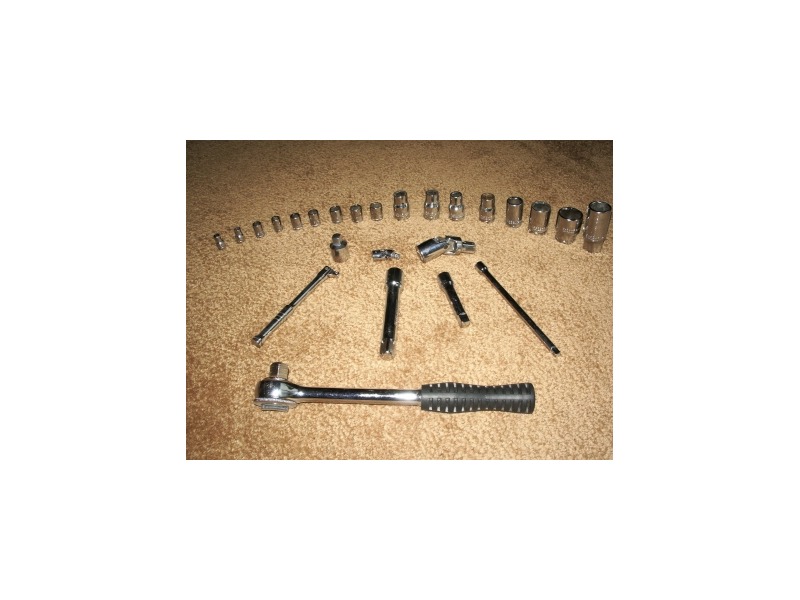
Choose a handle by motion, available space, fastener condition, and customer tool ecosystem. Ratchets suit repeated short strokes; T-handles provide a crossbar grip; spinners turn free-running fasteners when the model supports the required square drive. Speed braces need rotation room; breaker bars provide a rigid loosening handle. Torque wrenches serve controlled tightening. These categories can share a kit, but not a function.
Inspect drive fit, retention, ratchet direction, moving parts, grips, finish, and handle alignment. Keep socket and accessory specifications separate. The mechanic tool-set guide for distributors provides wider kit context while each handle remains its own line item.
- Check the connection with a representative socket.
- Confirm release and ratchet controls work as intended.
- Inspect hinges, crossbars, any fitted caps or knobs, and handle surfaces.
- Record the approved handle, accessory, and socket combination.
Sample the working combination. The handle alone cannot show whether accessories and fastener fit together.
Handle approval matrix
| Use condition | Starting handle | Fit check |
|---|---|---|
| Repeated short strokes | Ratchet | Reset path and head clearance |
| Direct crossbar grip | T-handle | Crossbar travel and access |
| Free-running fastener | Spinner | Square-drive fit and any documented cap/knob clearance |
| Fast continuous turning | Speed brace | Crank rotation envelope |
| Resistant fastener loosening | Breaker bar | Swing clearance and socket fit |
| Specified tightening | Torque wrench | Model instructions and drive |
Practical action: retain a sample record with handle, socket, and application configuration.
10. What should a socket-wrench RFQ include?
An RFQ identifies handle family, drive size, mechanism or grip form, socket interface, and intended operation. State whether the quote covers a handle alone, a socket set, or a complete assembly. Add access constraints such as head clearance, handle sweep, extension need, and working position. For torque wrenches, identify controlled tightening and request model-specific documents.
Keep requirements separate from quote options. A buyer may specify a reversible ratchet with one drive and ask for alternate handle lengths. Include quantity, market, packaging, brand, label language, and required documentation. Send the schedule through KOLARWIN’s contact page.
Make each line quoteable. List handle type, drive, socket interface, access condition, quantity, market, and package format as separate fields.
- Handle type and mechanism
- Drive size and socket compatibility
- Access requirements and accessory path
- Quantity, target market, and packaging
- Documents required for controlled-tightening tools
A marked layout or representative fastener helps suppliers assess access before quoting.
FAQ
Q1: Is a ratchet the same thing as a socket wrench?
A ratchet is one handle mechanism used in a socket-wrench system. The system also includes a socket and its drive interface.
Q2: What is a sliding T-handle?
Its square-drive head travels along the crossbar, or the bar slides through the head, depending on model. Confirm travel and retention from the drawing.
Q3: What is a speed brace used for?
A speed brace uses a crank handle to rotate a socket quickly when the work area allows a rotation path.
Q4: Can I use a torque wrench as a breaker bar?
Use a breaker bar for loosening resistant fasteners. Follow torque-wrench instructions and reserve that tool for specified tightening work.
Q5: What should a socket-wrench RFQ include?
List handle family, mechanism, drive, socket interface, access needs, operation, quantity, market, packaging, and documentation requirements.
Looking for a reliable mechanic tools manufacturer in China?
If you are sourcing hand tools, socket tools, automotive repair tools, mechanic tool sets or OEM private label tools, contact KOLARWIN Tools for factory-direct quotation, customization support and product consultation.