
Need OEM supplier support for this product type?
Contact KOLARWIN Tools for OEM mechanic tools, private label packaging, wholesale quotation and product range support. This gives overseas buyers a clear path from article reading to supplier discussion.
Repair shops and tool buyers often see hand-drive and impact sockets with the same nominal size. That visual overlap creates a costly question: can a regular socket serve on a powered wrench? Use the tool maker’s instructions, socket classification, drive interface, retention, and product evidence as your decision path. This guide gives buyers a practical way to separate the two classes and write a quote that suppliers can inspect.
What is the difference between impact sockets and regular sockets?
Regular sockets belong to hand-drive work, such as a ratchet, breaker bar, or torque wrench. Impact sockets are documented for powered impact service, where repeated shock loads travel through an anvil, accessory, and socket. Both classes may share a drive size or point count. Those shared fields do not make them interchangeable.
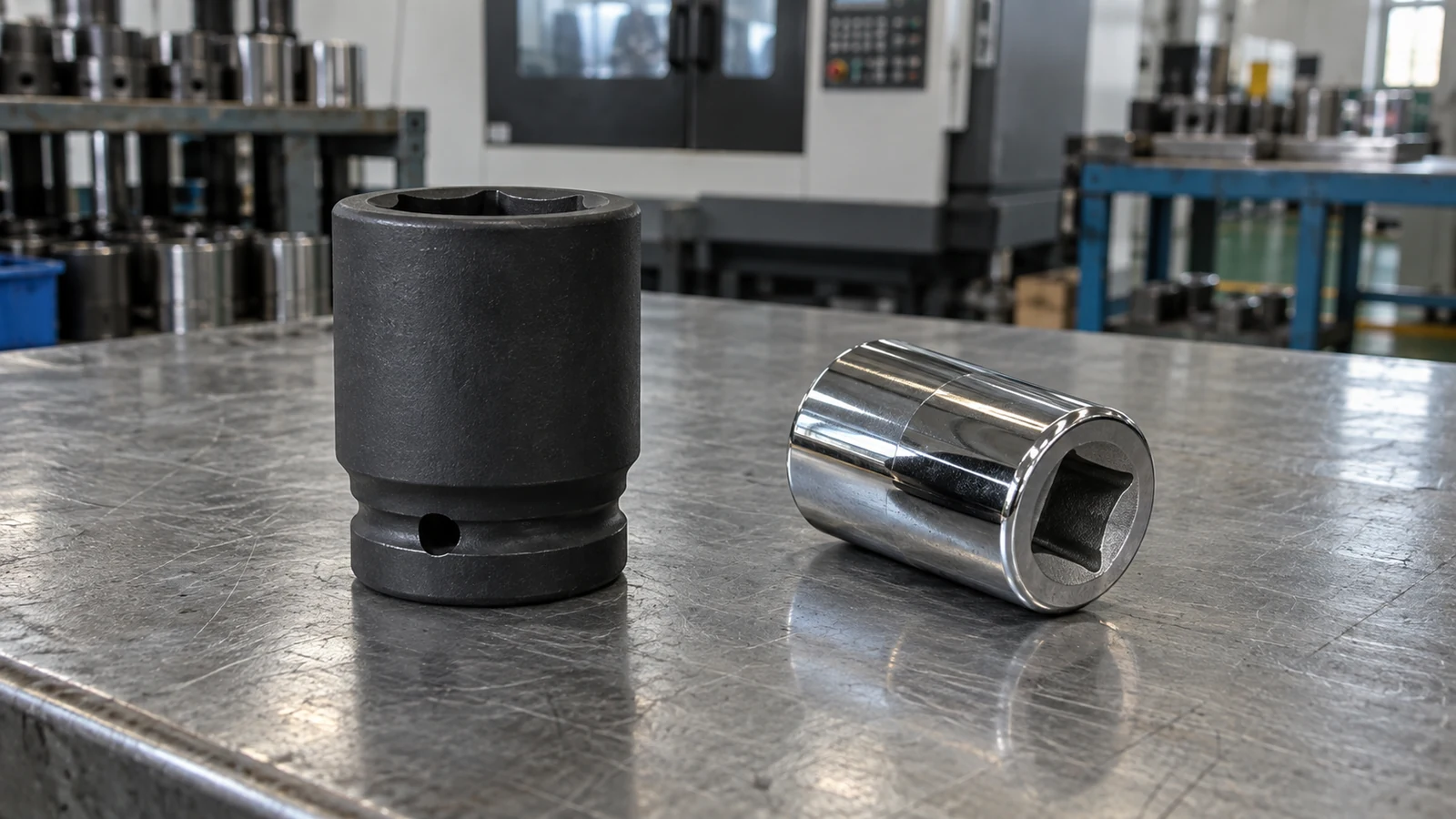
ASME’s socket-wrench structure separates hand-driven products from power-drive impact products. Treat that separation as a buying category. A supplier should state intended use for each model rather than leave buyers to infer it from color, steel name, or wall appearance. Your BOM should also separate square drive from fastener opening. A 1/2-inch drive describes the tool interface; 19 mm describes the opening. For documented impact-rated sockets, keep this classification visible on each line item.
- Hand-drive class: ratchets, breaker bars, and hand torque tools.
- Impact-rated class: powered wrenches plus compatible impact accessories.
- Shared fields: nominal opening, drive size, point count, depth, and unit system.
Start with the tool class. Add hand-drive or impact-rated before comparing alloy, profile, or reach. Buyers seeking a wider socket tools range can carry that class field into every related accessory.
Classification fields for a purchase order
| Field | Hand-drive example | Impact-rated example | Approval question |
|---|---|---|---|
| Intended use | Ratchet or breaker bar | Impact wrench or driver | Does product documentation state this use? |
| Drive interface | 3/8-inch square | 1/2-inch square | Does square size match the tool anvil? |
| Fastener opening | 19 mm, 6-point | 19 mm, 6-point | Does opening match fastener and application? |
| Retention | Hand-tool detent groove | Pin hole, ring groove, or stated system | Does retention match the anvil? |
Practical action: add tool class, drive, opening, point count, depth, and retention as separate columns in your master SKU sheet.
Why should regular hand sockets stay off impact wrenches?
Powered impact tools send rapid torque pulses through a short drive path. A hand socket may fit the square anvil yet lack documentation for that service. Under shock loading, a damaged or unsuitable socket can crack, break, or leave the anvil unexpectedly. A fitting drive does not change intended use.
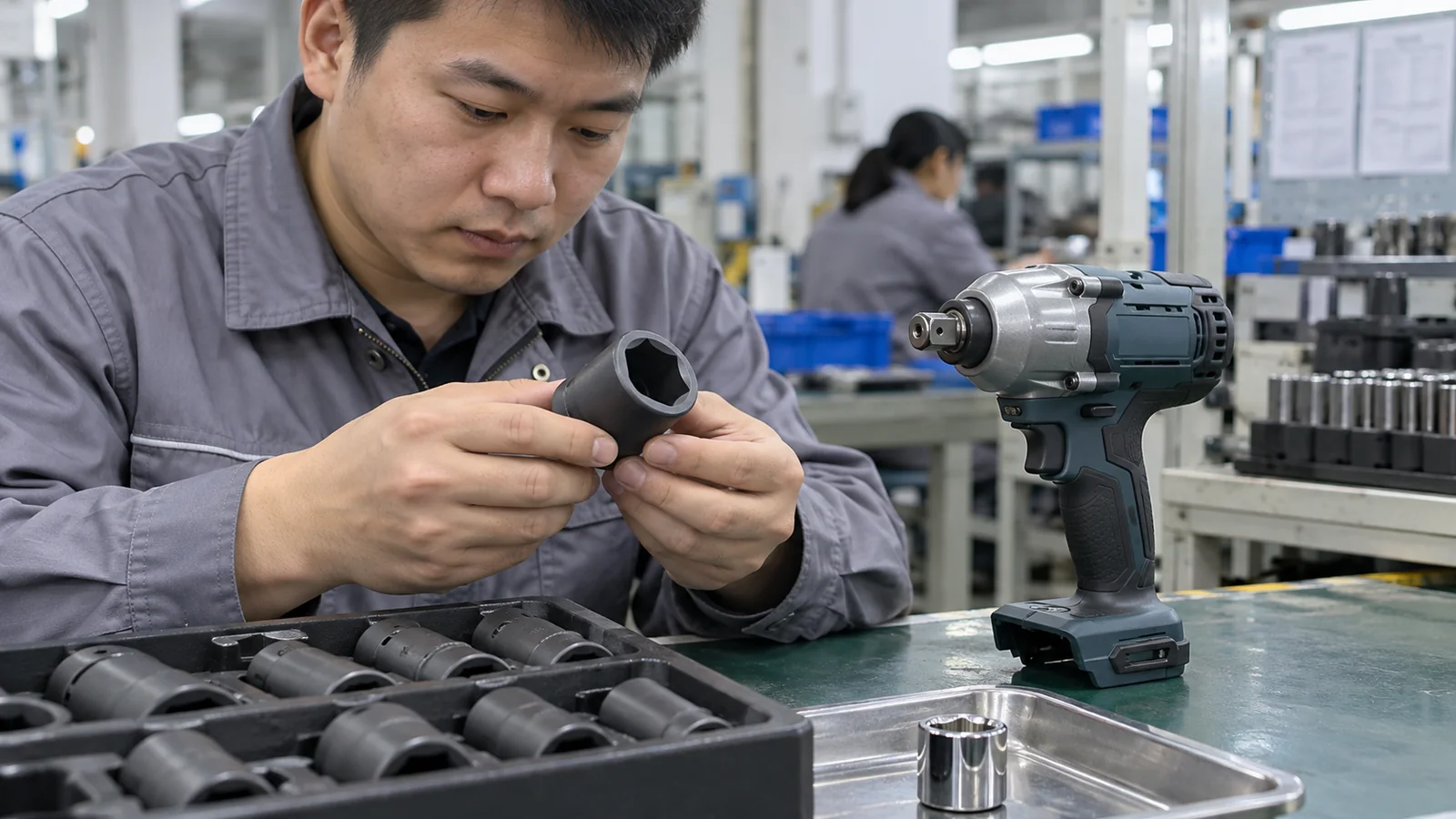
Tool instructions commonly require impact-rated sockets, extensions, universal joints, reducers, and adapters across the complete path. That means a buyer cannot make a safe chain with one impact socket plus a hand-rated extension. Check every accessory in the assembly, then verify secure seating before work begins. Keep the wrench manual with your product approval record.
- Read the exact wrench instructions before selecting accessories.
- Confirm every link in the drive path carries an impact designation.
- Remove accessories with excessive wear, cracks, deformation, or damage history.
Use the whole drive path as your check. A socket, extension, adapter, and retention system must suit one powered application. This simple rule keeps a regular hand socket out of a powered row.
Powered-use screening table
| Screening point | Acceptable evidence | Stop condition | Buyer action |
|---|---|---|---|
| Socket class | Explicit impact or power-drive statement | Hand-use label only | Reject for impact service |
| Accessory path | Each part documented for impact use | Hand-rated link appears | Replace or re-specify link |
| Fit and retention | Correct square and compatible anvil system | Loose or incomplete seating | Stop and correct fit |
| Condition | Undamaged; wear within the manufacturer's limits | Crack, distortion, drop history | Quarantine and replace |
Practical action: require a compatibility check for the wrench, socket, extension, adapter, and retention hardware before a powered kit reaches a service bay.
How do construction and material requirements differ?
Impact construction combines material choice, heat treatment, forming, and geometry. A product page may name CR-MO, CR-V, high-alloy steel, or a hardness range. Such data applies to that model or family. It does not create a universal rule for every impact socket.
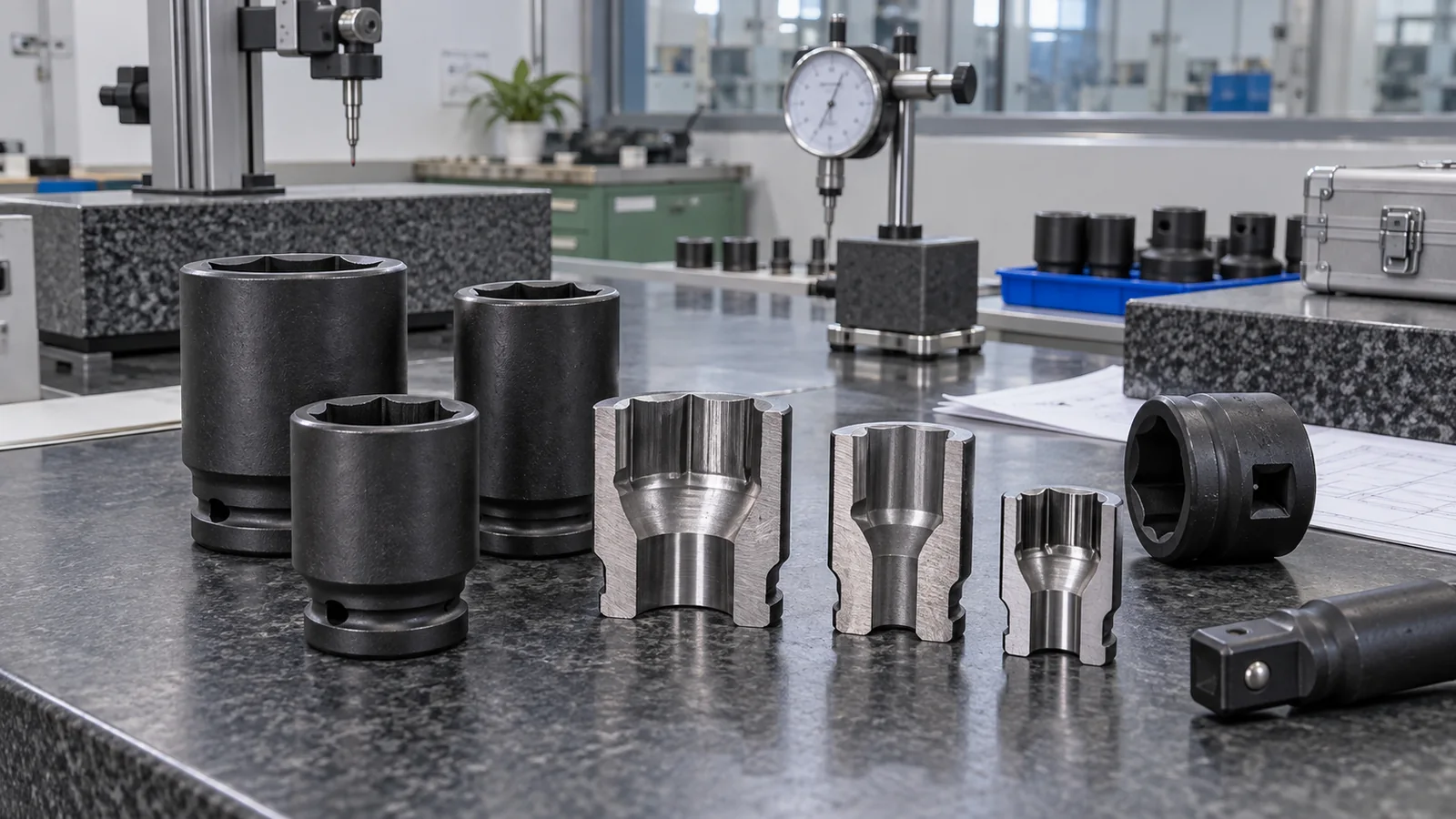
Hand sockets also use steel and may carry proof-torque data. That fact does not qualify them for powered service. Likewise, an alloy label alone cannot establish toughness, service life, or safe torque. Ask for product-level material and heat-treatment details when your application needs them. A CR-MO or CR-V label does not replace an impact-use designation.
Standards can help frame review. A manufacturer may state compliance with a named edition and product scope. A standards body does not approve or endorse every proprietary item carrying a reference. Check exact model, edition, test statement, and any limits supplied by the maker.
- Request alloy, heat treatment, forming, and geometry details for the quoted model.
- Record whether data covers a single socket, family, set, or accessory.
- Treat hardness numbers as product evidence, not universal impact rules.
Ask what the evidence covers. A credible data sheet connects each material or test statement with a model, size, and intended use.
Construction evidence buyers can compare
| Evidence field | Useful question | Common mistake | Approval record |
|---|---|---|---|
| Material | Which alloy applies to this model and size? | Treating CR-MO or CR-V as proof | Supplier data sheet |
| Heat treatment | What process and scope are documented? | Copying a family claim to every size | Model-level document |
| Geometry | What wall, neck, and drive features are specified? | Assuming every impact socket is thick | Drawing or sample |
| Standard | Which edition and product scope apply? | Calling a standard an approval | Exact compliance statement |
Practical action: add model number, size range, material statement, heat-treatment record, and standard edition to your sample-review checklist.
How do walls, depth, and access affect selection?
Wall thickness and socket length solve clearance problems. A shallow socket may fit beside an obstruction. A deep socket may reach a nut on a long stud. A thin-wall or necked design may enter a restricted bore. Those choices remain independent from impact classification.
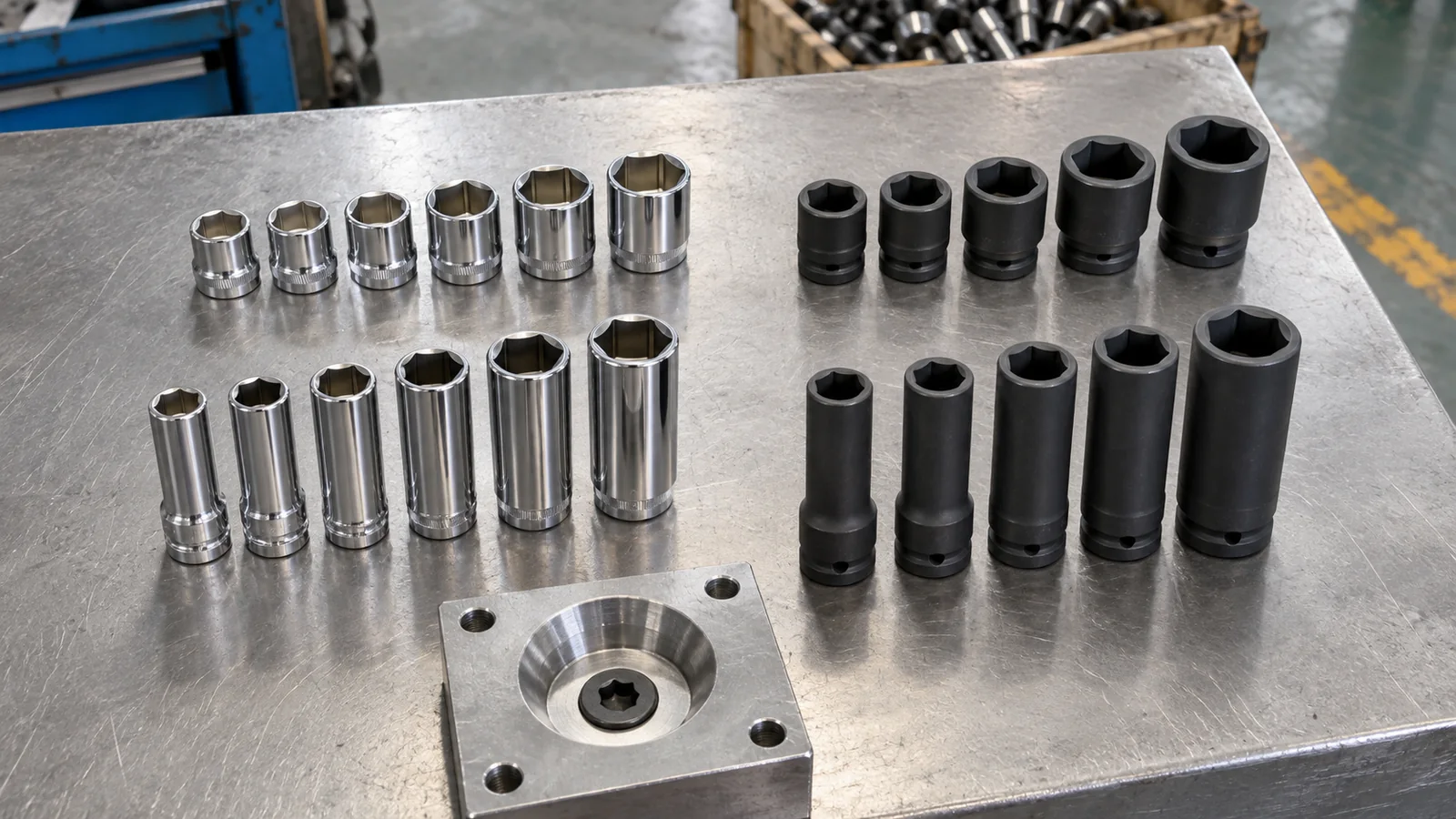
Avoid the shortcut that every impact socket has a heavy wall. Published standards include impact categories with specific thin-wall options. Actual wall and neck dimensions vary by model, drive size, opening, and application. Ask for a drawing or measure an approved sample where clearance controls fit.
Depth also deserves a separate line from point count. A six-point opening can be shallow or deep. A twelve-point opening can be shallow or deep. Keep profile, reach, outside diameter, and tool class visible in the same BOM without collapsing them into one label.
- Record shallow, standard, deep, or special reach as its own field.
- Check outside diameter, neck, and fixture clearance against a reference part.
- Treat extensions and universal joints as accessory choices, not socket-class proof.
Let the fixture set the dimensions. Send a photo, section sketch, or reference assembly when a supplier must solve a tight approach.
Access and construction fields
| Buyer need | Field to specify | Evidence to review |
|---|---|---|
| Recessed nut or long stud | Deep length and internal well | Drawing or measured sample |
| Nearby obstruction | Outside diameter and neck profile | Fixture clearance check |
| Tight bore | Thin-wall requirement | Model-specific dimensions |
| Powered use | Impact classification | Product document and tool match |
Practical action: attach a clearance sketch to each access-sensitive RFQ, then approve dimensions before discussing set packaging.
Which drive and retention features matter?
Square-drive size must match the wrench anvil. Retention must also match. Impact tools may use a friction ring, detent pin, side hole, groove, clip, or another documented method. A socket with a hole is not automatically compatible with every pin. A ring groove does not prove fit with every friction ring.
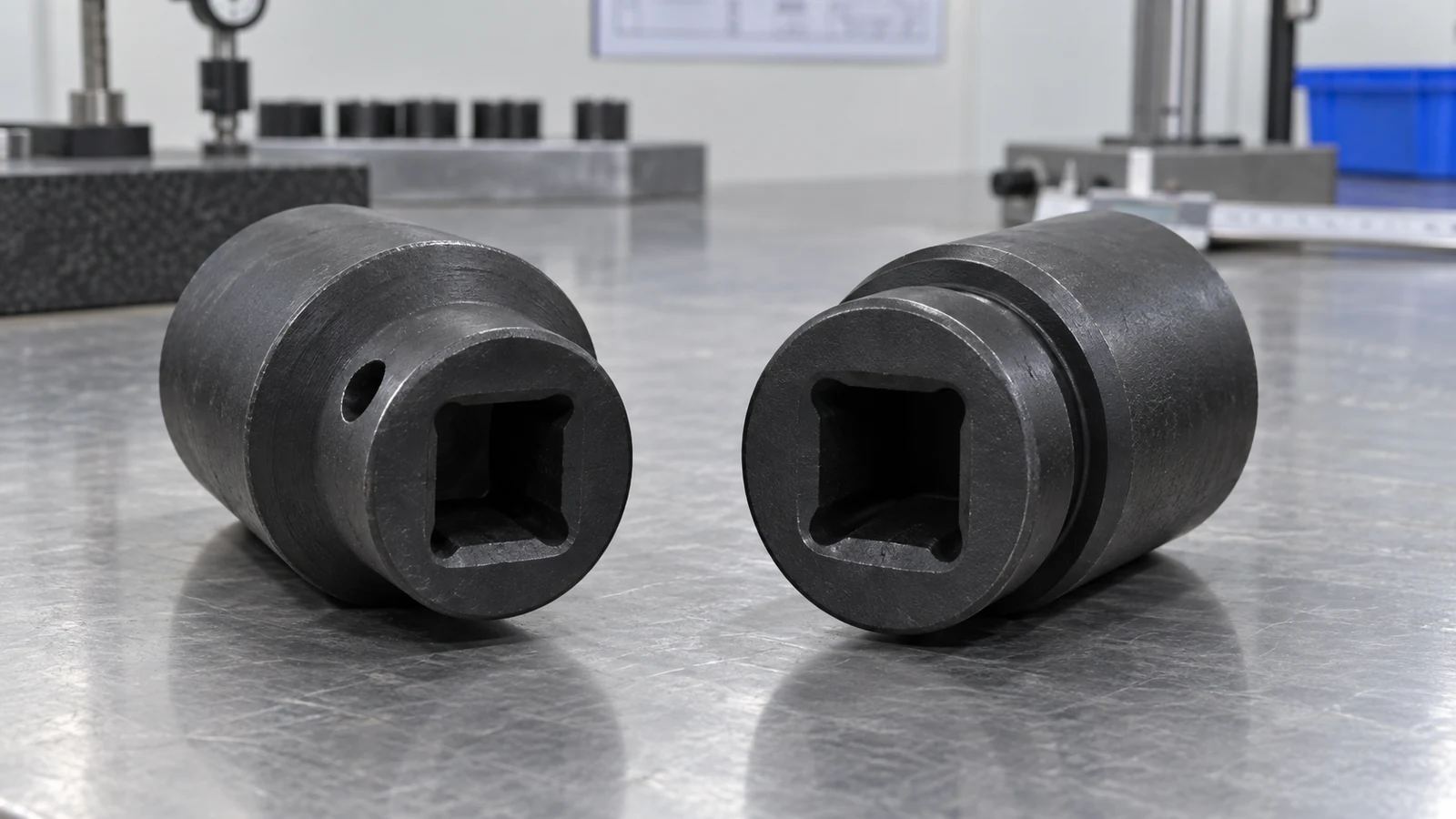
Confirm anvil shape, drive size, retention location, and assembly method at sample stage. The same socket may be offered for more than one retention pattern, or a supplier may need a product-specific hole or groove. Keep that detail beside the part number rather than in a general note.
Extensions, reducers, and universal joints receive the same scrutiny. Adding an adapter can change load path, reach, and retention. Use only accessories documented for powered service when they sit between an impact wrench and socket.
- Match square drive dimensions before reviewing nominal opening.
- Identify friction-ring, pin-detent, hole, groove, or clip requirements.
- Verify retention under the actual anvil and accessory arrangement.
Retention deserves a line of its own. A secure square fit still needs a compatible locking method for safe, repeatable service.
Drive and retention approval matrix
| Interface item | What buyer states | What sample review checks |
|---|---|---|
| Square drive | 1/4, 3/8, 1/2, 3/4, or other size | Full seating on tool anvil |
| Retention type | Friction ring, detent pin, hole, groove, or clip | Pin, ring, and hole alignment |
| Accessory path | Extension, reducer, or universal joint | Impact classification for each link |
| Release method | Manual removal or retaining hardware | Secure fit without binding |
Practical action: send an actual anvil drawing or sample with your RFQ when pin, ring, or hole position affects approval.
Can color, finish, or markings prove impact suitability?
Color and finish help a technician sort tools, yet appearance cannot carry a safety classification. Many documented impact products use black oxide or phosphate. Chrome or bright finishes often identify hand-drive products. A black socket still needs an impact statement. A bright socket still requires product-specific review before any powered use.

Markings support selection and traceability. Permanent size marks, model numbers, and drive details help a buyer match a socket with a BOM. Markings become useful evidence only when they identify the quoted product and align with its documentation. A laser size mark alone says nothing about shock-service suitability.
Use sample photographs, dimensional checks, and documents together. If a private-label item needs a color system, define color as an identification aid. Do not allow color coding to replace impact classification or an approved part number.
- Use finish and color for sorting, not for safety decisions.
- Require durable size, drive, or model markings where selection needs them.
- Match sample marks with drawings, documents, and revision records.
Make appearance serve traceability. The finish may help a worker reach the right drawer, while documentation decides the product class.
Appearance and marking review
| Visible feature | What it helps with | What it cannot prove | Required backup |
|---|---|---|---|
| Black oxide or phosphate | Sorting and surface identification | Impact rating by itself | Product classification |
| Chrome or bright finish | Cleaning and hand-tool identification | Universal safety status | Intended-use statement |
| Color band or case color | Drawer or set organization | Material or hardness | SKU and sample record |
| Size or model marking | Selection and traceability | Impact capacity | Documented model match |
Practical action: add a marking photograph and product-class statement to every approved sample file.
How should sockets be inspected and replaced?
Inspect before use and after demanding service. Check the square drive, retention hole or groove, fastener opening, walls, and neck. Look for cracks, deformation, corrosion damage, excessive wear, and signs of impact or dropping. A socket with uncertain history deserves quarantine until a responsible reviewer clears or replaces it.
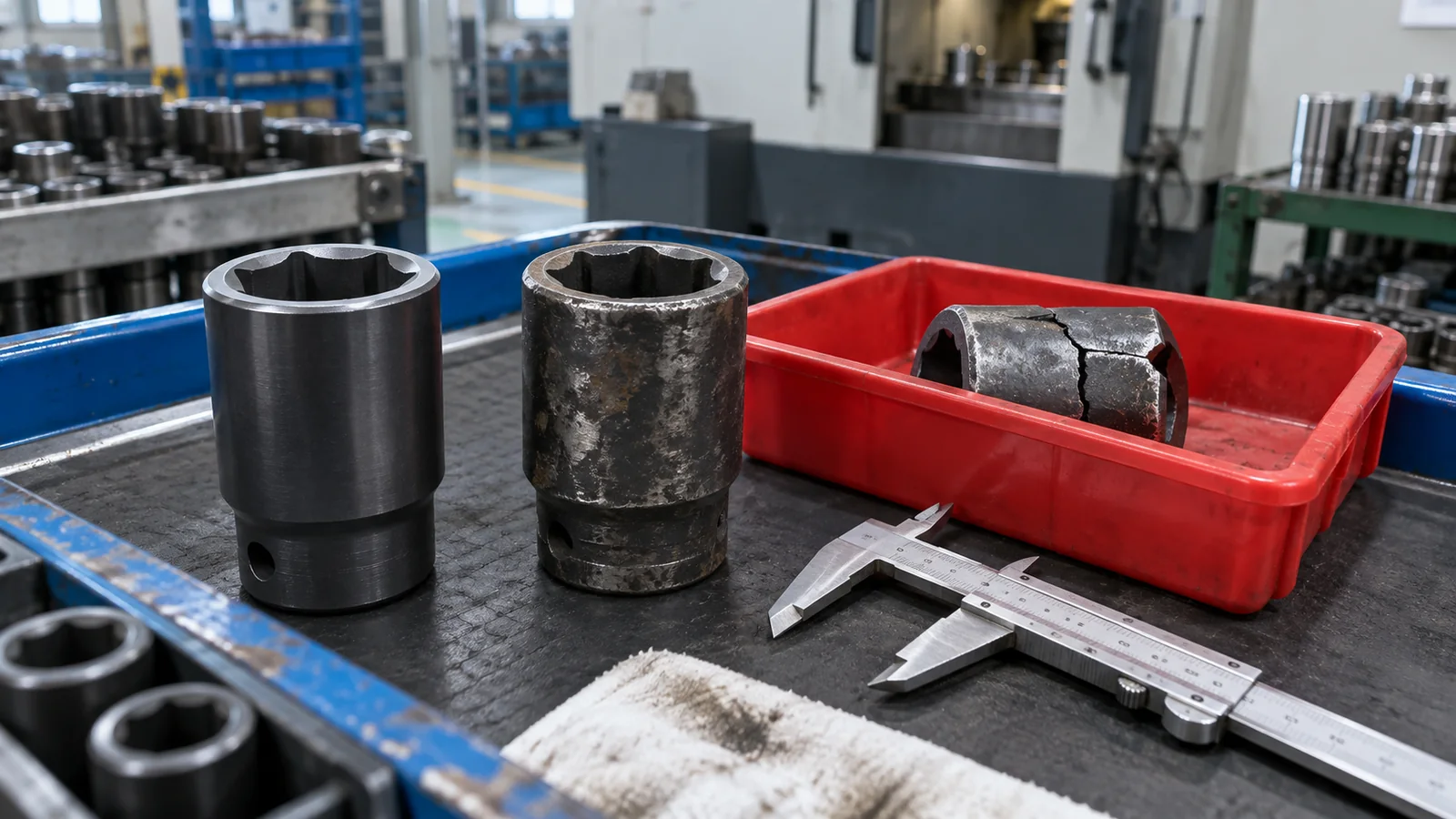
Do not grind, weld, drill, or reshape a socket unless its maker explicitly authorizes that repair. Modification can change fit and load behavior. Replacement is the sensible control for a cracked, distorted, excessively worn, or damaged socket. Apply the same discipline to impact extensions, adapters, and universal joints.
Keep a small inspection record for fleet tools and rental or service kits. Record part number, condition, date, and disposition. That record supports a repeatable replacement rule without pretending one service interval fits every application.
- Check drive and retention before checking cosmetic finish.
- Compare opening and neck against a known-good sample when wear is unclear.
- Quarantine damaged or uncertain-history parts immediately.
Stop at the first doubtful feature. A low-cost replacement protects a worker and prevents one damaged socket from entering another kit.
Inspection and disposition table
| Check area | Acceptable condition | Quarantine trigger | Disposition |
|---|---|---|---|
| Square drive | Full, clean engagement | Rounded, spread, or distorted | Remove from service |
| Retention feature | Correct shape and location | Cracked, enlarged, or missing | Replace or seek maker review |
| Opening and walls | Correct fit, no cracks | Deformation, crack, or severe wear | Quarantine and replace |
| History | Known service record | Known drop, accidental blow, or uncertain service history | Hold for review |
Practical action: post a four-point check at each tool crib and require a disposition record for every quarantined socket.
How should a repair shop organize hand and impact sets?
Separate hand-drive and impact-rated sockets by drawer, tray, case, or color band. Physical separation reduces a rushed selection error. Mark drive, profile, size system, and depth where a worker can read them without guessing. Keep accessories with their class so a hand extension does not migrate into an impact row.

A repair shop can build core hand coverage around common hex fasteners, then add impact sizes tied to actual powered jobs. Twelve-point profile choices, metric-to-SAE conversion, deep reach, and special access each deserve their own planning fields. Do not let a universal “socket set” label hide those differences.
For a packaged socket set configuration or a complete mechanics tool set, map each socket row before approving case layout. A larger kit still needs clear class separation.
- Separate hand and impact rows physically.
- Group by drive size, unit system, profile, and depth.
- Set a replacement rule for unclear markings, damage, and missing retention parts.
Organize for the rushed moment. A worker should identify class and drive before lifting a socket from its tray.
Set organization example
| Storage zone | Recommended contents | Label fields | Control |
|---|---|---|---|
| Hand-drive core | Matching hand sockets | Drive, size, profile, depth | Keep with hand accessories |
| Impact row | Documented impact sockets | Impact class, drive, retention | Keep with impact accessories |
| Access tray | Shallow, deep, extensions | Reach and clearance | Review before issue |
| Quarantine tray | Worn or uncertain parts | Reason and date | No service use |
Practical action: audit one drawer this week and move any socket with unclear class, size, or retention into a review tray.
What should distributors put in an RFQ and inspection plan?
An RFQ should state the job before it lists a quantity. Identify hand-drive or impact-rated class, square-drive size, fastener opening, point count, metric or SAE system, depth, wall or neck requirement, retention, marking, packaging, and quantity. Add reference fasteners or a fixture when fit and access drive approval.
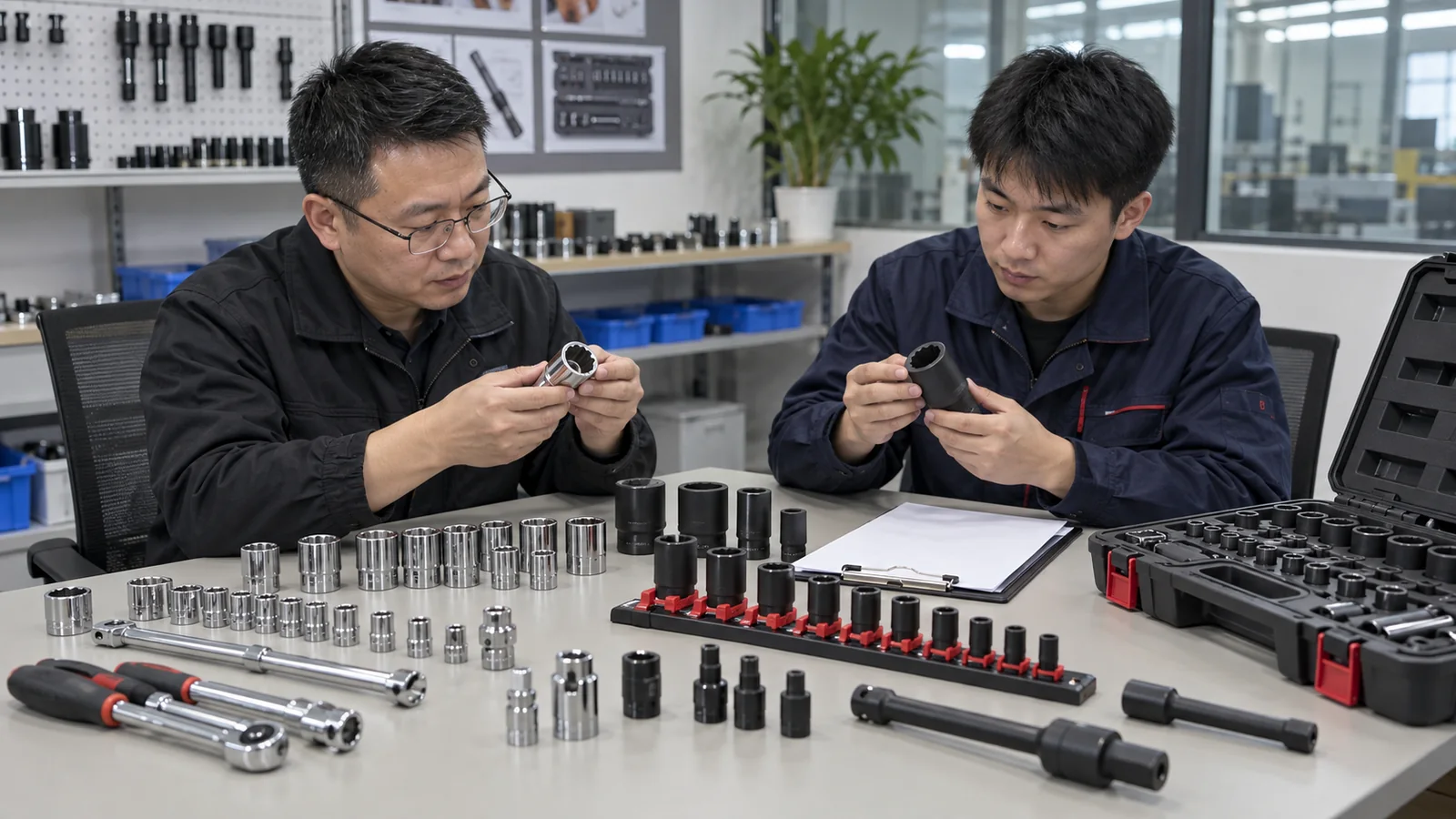
Ask for documents that support claims tied to the quoted model. Request material and heat-treatment details where needed, plus any named standard edition and scope. Keep commercial questions separate from technical acceptance. A socket set manufacturer checklist can cover broader supplier review while this RFQ stays focused on socket class and fit.
For automotive applications, connect your use case with automotive repair tools only after socket fields are clear. A sample should seat on a reference fastener, fit the stated anvil, retain correctly, and show approved markings.
- Identify tool class, drive, opening, profile, depth, and unit system.
- Request drawings, documents, markings, and sample evidence by model.
- Define acceptance, revision control, replacement, and change-notice rules.
Write acceptance before price comparison. A low quote cannot rescue an unspecified drive class or an unapproved retention feature.
RFQ and inspection fields
| RFQ field | Example requirement | Sample or document check |
|---|---|---|
| Tool class | Impact-rated, 1/2-inch drive | Product statement and anvil fit |
| Opening | 19 mm, 6-point, metric | Reference fastener seating |
| Access | Deep, stated neck and outside diameter | Fixture or dimensional sample |
| Retention | Detent pin hole with compatible location | Tool and socket assembly |
| Identification | Permanent size and model marking | Photo and revision record |
Practical action: issue a pilot RFQ with one reference tool, one reference fastener, and written pass/fail criteria before expanding a private-label range.
Which socket class should a buyer choose?
Choose regular hand sockets for ratchets, breaker bars, and hand torque work. Choose impact-rated sockets for powered impact tools, then match square drive, retention, accessories, and documented use. A nominally matching hand socket does not become impact-rated through fit, color, or a material label.
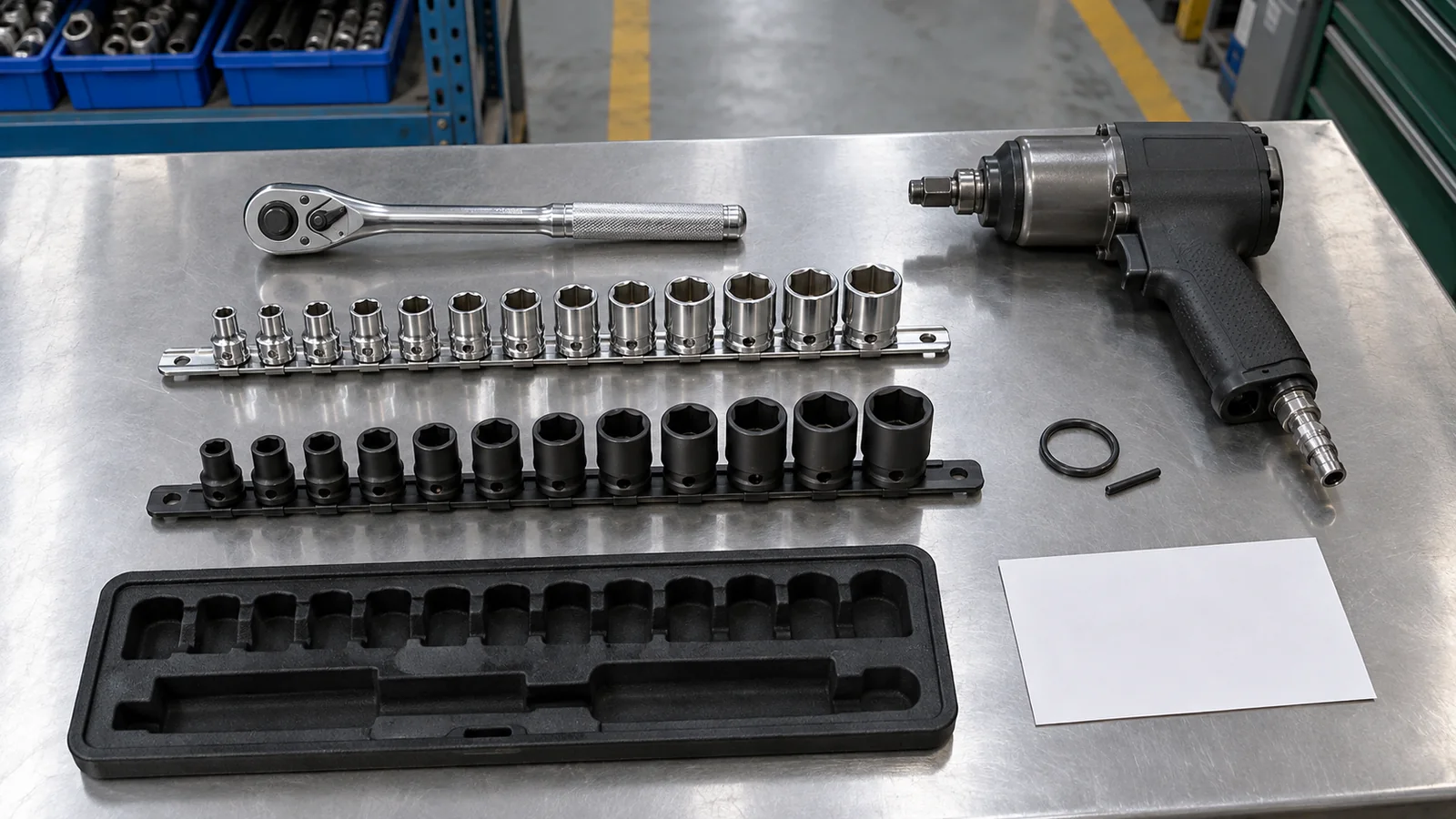
Match opening profile and size with the fastener. Choose depth and clearance from the assembly. Evaluate material, heat treatment, wall, and finish from product-level evidence. For a broad range, keep hand and impact rows separate, then use a metric-to-SAE conversion chart only for unit-system checks.
- Hand tool plus hand socket: confirm opening, drive, profile, reach, and condition.
- Impact tool plus impact socket: confirm every accessory and retention point.
- Distributor or importer: approve samples against the written BOM.
Make the class decision before the set decision. After tool type, fit, access, and evidence are clear, send approved quantities through a request for an impact socket quotation.
Practical action: agree a sampling plan for the range, then approve each model and size against its documented use, dimensions, retention, and marking requirements before release.
Can a regular socket fit an impact wrench? It may fit physically, yet fit does not establish impact suitability. Use an explicitly impact-rated socket and compatible accessories.
Are black sockets always impact sockets? No. Black oxide or phosphate can be a clue, but product documentation decides classification.
Does CR-MO automatically mean better impact performance? No. Alloy, heat treatment, forming, geometry, and testing work together. Review evidence for the quoted model.
Can impact sockets have thin walls or shallow depth? Yes. Wall, neck, and depth vary by model. Check dimensions and application limits.
What belongs in an impact socket RFQ? State class, drive, opening, profile, unit system, retention, access, markings, documents, quantity, and sample acceptance rules.
Looking for a reliable mechanic tools manufacturer in China?
If you are sourcing hand tools, socket tools, automotive repair tools, mechanic tool sets or OEM private label tools, contact KOLARWIN Tools for factory-direct quotation, customization support and product consultation.


