
Need OEM supplier support for this product type?
Contact KOLARWIN Tools for OEM mechanic tools, private label packaging, wholesale quotation and product range support. This gives overseas buyers a clear path from article reading to supplier discussion.
A flex head ratchet changes head angle at a hinge; a fixed head keeps one head-to-handle relationship. Buyers should match articulation with clearance, alignment, retention style, drive size, and documented limits. This guide separates head movement from gear design.
1. What separates a flex head ratchet from a fixed head?
Both tools use a ratcheting head to turn a compatible socket or accessory. A flex head adds a pivot between head and handle. A fixed head holds one relationship, which can make the tool’s orientation more predictable in open access. Actual hinge range, detents, locking positions, head dimensions, and use limits vary by model.
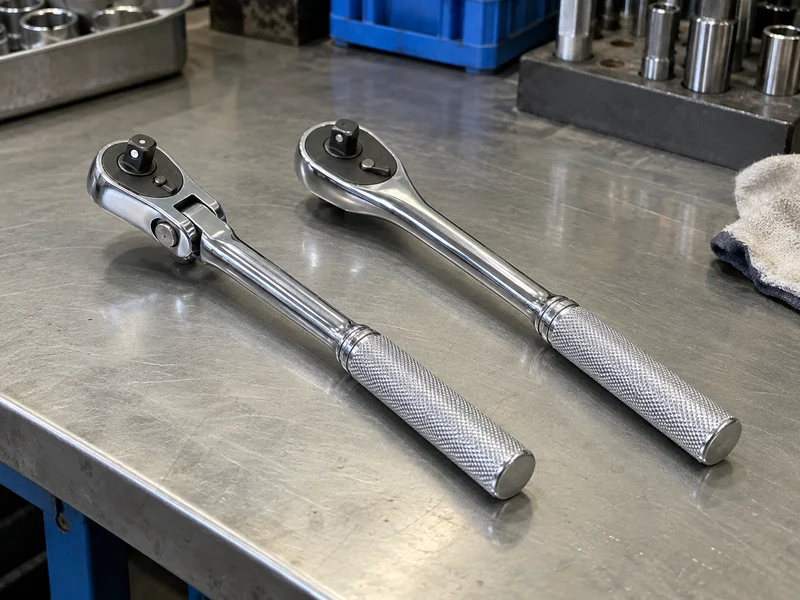
Keep three design questions apart: how the head articulates, how the ratchet advances, and how the socket attaches. A flex pivot does not tell a buyer the gear’s tooth count or proof torque. A fixed head does not establish strength by itself. Compare the manufacturer’s specifications and instructions for each model. The existing 72-tooth versus 90-tooth ratchet guide covers a separate gear-selection axis; do not use its tooth-count discussion as evidence about head articulation.
Start the purchase review with these fields:
- Flex, fixed, locking, or free-moving head configuration.
- Head thickness, width, drive size, and handle length.
- Fastener location and available hand or swing clearance.
- Product-specific service and load instructions.
Separate the hinge from the gear. Ask the supplier to list head style, gear details, and drive interface in distinct fields.
Design comparison
| Feature | Flex head | Fixed head | Buyer evidence |
|---|---|---|---|
| Head angle | Pivots within model-specific range | Holds one relationship | Drawing and position details |
| Access | May route around an obstruction | Needs alignment from its fixed orientation | Sample access check |
| Position retention | Detent, lock, friction, or another design | No articulation joint | Instructions and inspection |
| Gear operation | Depends on model | Depends on model | Gear specification separately |
2. When does head articulation help?
A pivot can change the handle path while a socket stays seated. It may help around an obstruction, depending on head thickness, hinge range, handle length, and available space.
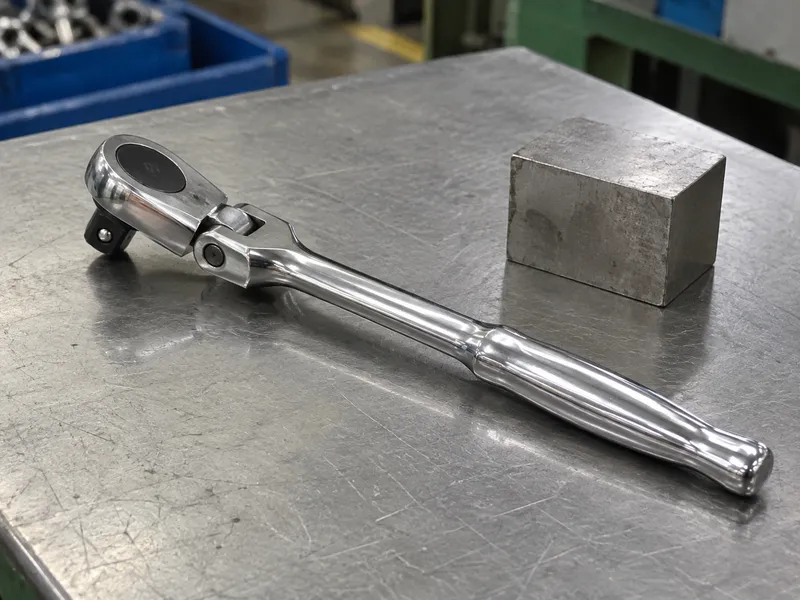
An angled handle can also make access worse. A head may collide with a casting or adjacent fastener, or the handle may no longer have enough room for a controlled stroke. More movement does not mean more clearance in every orientation. Buyers should use a representative workpiece and obstruction rather than judging a tool from its side-view photograph.
The flexible socket extension versus universal joint guide covers another way a drive line can change angle. Those accessories move the connection between ratchet and socket; they do not make a ratchet head itself flexible.
- Record where the fastener sits and what blocks the handle.
- Check the head at several useful angles with the socket attached.
- Confirm hinge movement does not push the socket off the fastener.
- Review access with gloves or the grip style used by buyers.
Let the obstruction set the angle. Approve the model only after a sample reaches the target fastener with stable socket engagement.
Access matrix
| Access condition | Flex head question | Fixed head question |
|---|---|---|
| Side obstruction | Can pivot route handle past it? | Can handle stay in a clear path? |
| Recessed fastener | Does hinge fit outside recess? | Does head align straight into recess? |
| Limited swing | Can handle reset at another angle? | Is the fixed position usable? |
| Nearby fasteners | Does wider head collide? | Does fixed profile clear adjacent hardware? |
3. Why might a buyer choose a fixed head?
A fixed head keeps one angle between handle and drive square. In open access, that removes a pivot setting from setup. If a straight approach and working arc are clear, articulation may add no needed access.
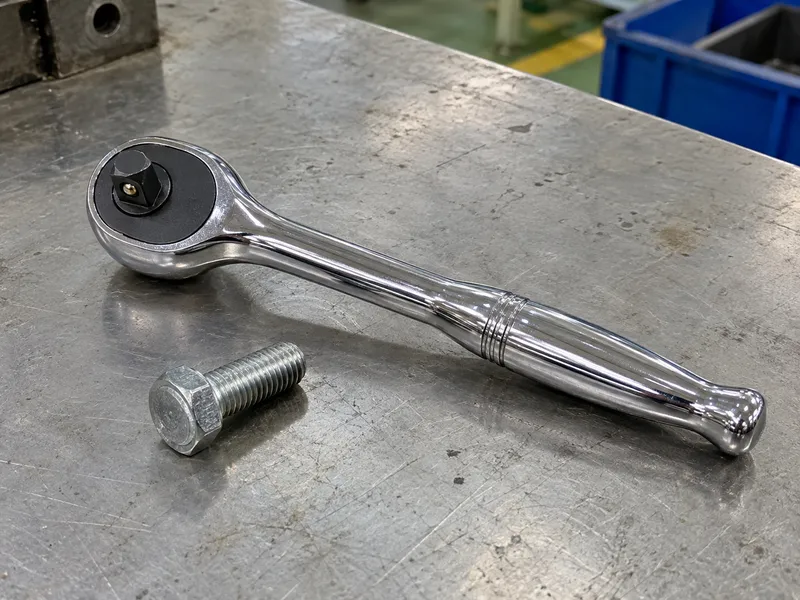
“Fixed” does not mean perfectly straight in every model. Some ratchets have offset handles or compact heads. Record the actual geometry instead of relying on the category name. A fixed head can still be blocked by nearby components, while a flex head can provide useful reach. The right comparison is a sample against the buyer’s access envelope.
A fixed model also needs the correct socket depth and drive. The deep versus shallow socket guide covers reach and clearance around protruding threads; pair that choice with a ratchet that aligns on the drive square.
- Check head offset, thickness, and overall handle length.
- Confirm the drive square matches the intended socket system.
- Test a full stroke and reset in the available space.
- Compare sample reach with the flex model’s actual pivot positions.
Keep the setup simple where access allows. Choose fixed head when its orientation clears the work and the pivot offers no needed route.
Fixed-head fit check
| Check | What a buyer should record | Acceptance evidence |
|---|---|---|
| Head profile | Height, width, offset | Drawing and sample |
| Drive alignment | Square drive and socket fit | Seated connection check |
| Stroke path | Start, sweep, and reset space | Mock-up or application test |
| Reach | Handle length and socket depth | Fastener sample |
4. What is the difference between locking and free-moving flex heads?
A flex head may use detents, a lock, friction, or another position mechanism. Exact operation varies, so inspect the model and its instructions.
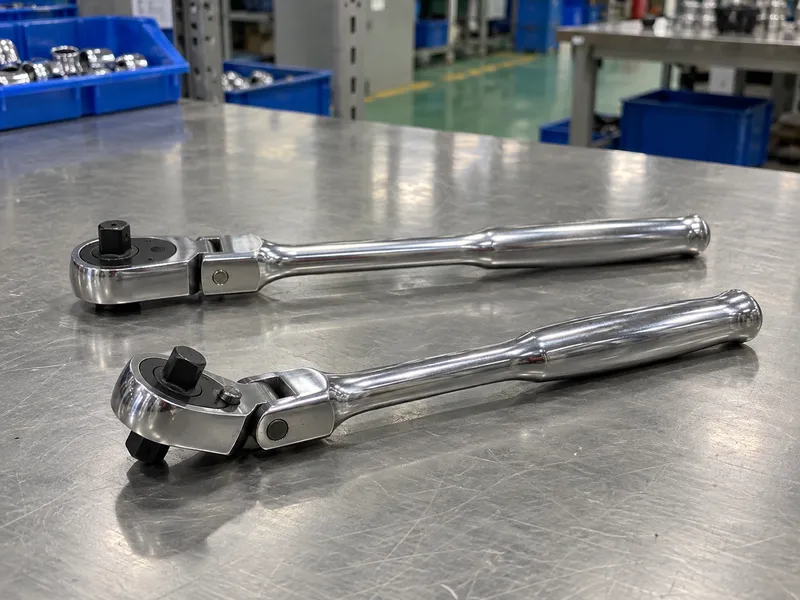
Position retention affects handling around a fastener. A head that stays in place can make setup easier when the ratchet is placed at an angle. A freely moving head can offer more positioning choices but may fold during placement or reset. Neither behavior guarantees higher torque capacity. The hinge and ratchet gear need separate evaluation under the manufacturer’s stated conditions.
The pin-detent versus friction-ring guide compares socket-retention systems at the drive square. That is separate from a flex-head position lock, even though both product pages may use the word “detent.”
- Identify whether positions are stepped, continuous, or lockable.
- Test adjustment with the socket installed.
- Check for looseness, binding, or unintended release.
- Read whether the maker permits use in a selected locked position.
Ask what “locking” means on this model. Request a demonstration and a drawing of the pivot mechanism before writing catalog copy.
Pivot-retention matrix
| Head style | Position behavior | Buyer question |
|---|---|---|
| Detented | Holds at selected positions | Which positions and how does release work? |
| Locking | User secures chosen position | Does instruction define locked operation? |
| Free-moving | Pivot moves without set stops | Does it remain manageable during placement? |
| Fixed | No head pivot | Does one orientation provide enough access? |
5. Does a flex head change ratcheting swing requirements?
Head articulation changes where the handle sits; gear design changes how far the handle moves before another engagement. Those are related during a cramped repair, yet they are different measurements. A flex head may let a user place a handle in an available corridor. The ratchet still needs enough room for its own swing and reset, and the chosen tooth count or mechanism remains model-specific.
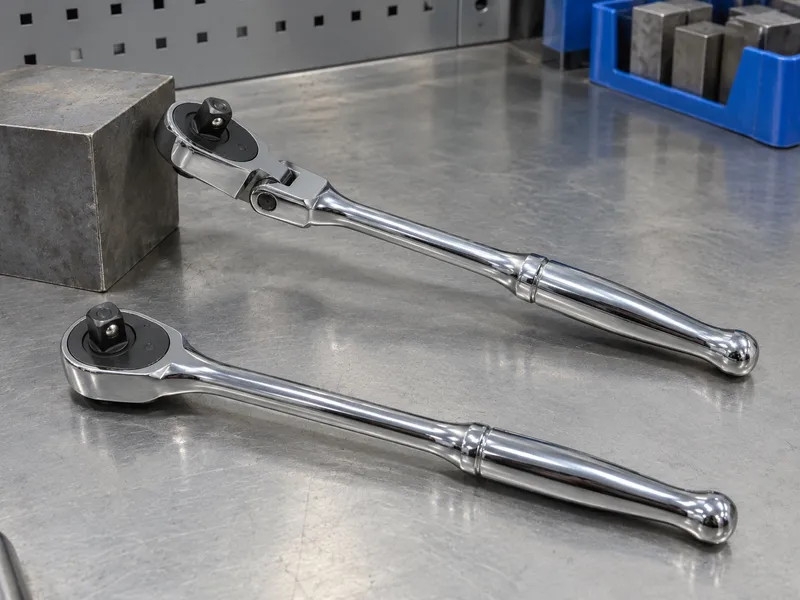
Do not add “tight-space ratchet” to a listing based only on a pivot. Check the full assembly with the intended socket, fastener, and nearby parts. A thick joint can consume the clearance gained by angling the handle. A compact head or a different socket profile may matter as much as the pivot. Never infer a smaller swing arc from flex articulation.
- Measure handle sweep at the head angle the technician can use.
- Check whether the socket or fastener obstructs the pivot.
- Compare ratchet engagement details separately from articulation.
- Keep any swing-angle statement tied to the exact gear model.
Test the complete stack. Record ratchet, socket, extension, fastener, and obstruction together rather than approving each part in isolation.
Clearance and gear matrix
| Variable | What it changes | How to verify |
|---|---|---|
| Head angle | Handle route | Position sample around obstruction |
| Head dimensions | Local clearance | Measure height, width, and joint envelope |
| Gear design | Reset movement | Use maker’s tooth and swing specifications |
| Socket depth | Reach and stack height | Test selected socket on representative fastener |
6. How do drive size and socket fit affect access?
Drive size determines which sockets and accessories fit the ratchet square. A larger drive can support a different socket range and head envelope; a smaller one may fit a narrower access path. Actual dimensions and permitted uses belong to each product’s specification. Do not treat a common drive size as proof of universal socket compatibility across brands or locking features.
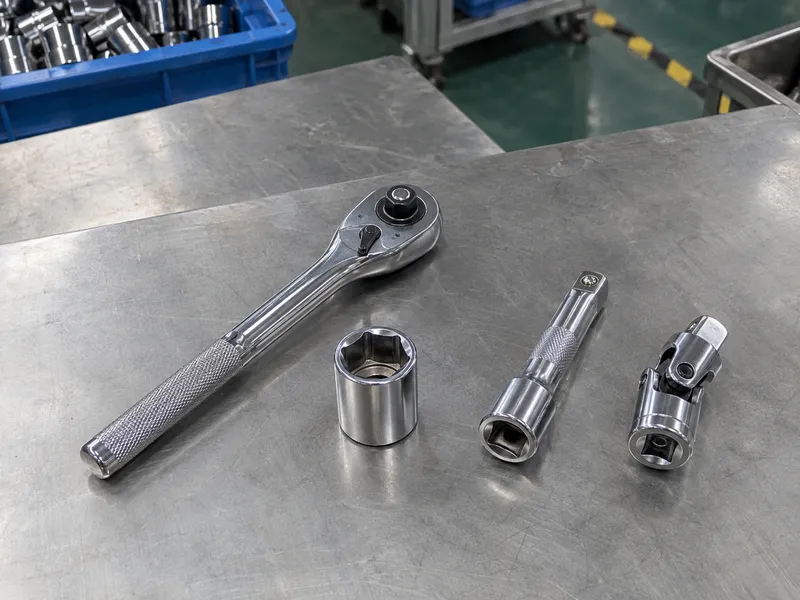
Socket profile also changes access. A deep socket reaches over more protruding thread, while a shallow model can reduce stack height. Six-point and twelve-point sockets meet fasteners differently. Those choices do not change the ratchet’s flex pivot, but they can determine whether the tool reaches and seats on the intended fastener. Use the socket drive size guide and 6-point versus 12-point socket guide when planning a compatible kit.
- Match square drive, socket drive, and any release feature.
- Check head width with the chosen socket installed.
- Confirm socket depth against thread projection and recess depth.
- Verify fastener engagement before adding force.
Check every interface in sequence. Build one working sample from ratchet through socket to fastener before approving a kit.
Drive and socket fit table
| Interface | Fit question | Evidence |
|---|---|---|
| Ratchet square | Does the socket drive size match? | Dimension or sample check |
| Retention feature | Does release style engage properly? | Install and remove test |
| Socket profile | Does it seat on the fastener? | Fastener sample |
| Socket depth | Does it clear threads or recess? | Installed stack check |
7. How should buyers judge load and durability?
A hinge adds parts and contact surfaces; a fixed head has a different construction. That observation does not establish which design is stronger. Torque capacity depends on the complete model, drive size, materials, gear, handle, pivot, and test method. Some makers publish proof-torque information for named models. Treat those values as model-specific evidence rather than transferring them to another length, drive, or head style.
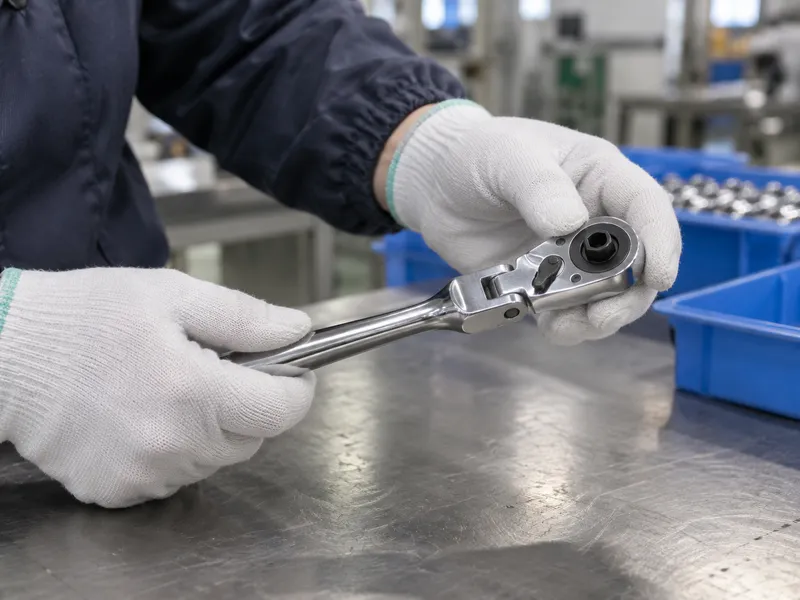
A ratchet turns fasteners through repeated short strokes. Stuck fasteners may require a tool intended for breakaway force; do not improvise an extension. The impact socket versus regular socket guide distinguishes impact-rated socket use; it does not establish any ratchet’s rating.
- Ask for the exact model’s rating and test basis, if one is stated.
- Inspect pivot play, lock engagement, gear action, and drive square.
- Compare like drive sizes and handle lengths under the same method.
- Keep breakaway work within tool-maker guidance.
Demand evidence for the whole model. Do not rank flex and fixed heads by assumed strength or hinge appearance.
Durability review table
| Field | Buyer review | Limit |
|---|---|---|
| Published rating | Model, drive, and method | Does not transfer across models |
| Pivot condition | Play, retention, smooth movement | Visual check is not a torque test |
| Gear action | Direction switch and engagement | Use maker’s service method |
| Handle and drive | Deformation, cracks, fit | Remove damaged tools from service |
8. What quality checks belong in a ratchet sample review?
Verify function before appearance. Cycle the selector, seat and release a socket, inspect gear engagement, and move the pivot through its permitted range. Record the sample ID and revision.
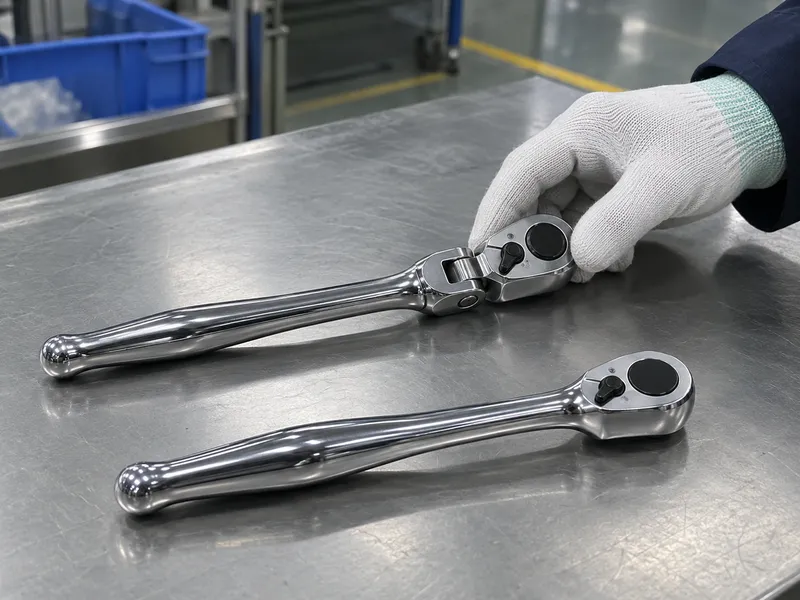
Do not use an improvised overload test. If a supplier gives a torque or proof test, ask for the method, fixture, acceptance criteria, and model coverage. Surface finish, plating, grip texture, packaging, and markings can be reviewed separately from functional evidence. A photograph can show head shape, but it cannot verify gear performance or pivot retention.
- Compare the sample against its drawing and model label.
- Test all selectors and retention features under stated conditions.
- Record defects, sample revision, and corrective actions.
- Confirm replacement parts or service instructions if offered.
Turn inspection into a record. Keep the function checklist with approved product data and artwork.
Ratchet sample inspection
| Check | Flex head | Fixed head |
|---|---|---|
| Head movement | Full stated range and retention | No unwanted joint movement |
| Ratchet | Direction and engagement | Direction and engagement |
| Socket interface | Fit and release at all approved angles | Fit and release in working orientation |
| Documentation | Pivot and use instructions | Head and use instructions |
9. How should distributors build a flex and fixed assortment?
Build around customer access patterns. Add flex models where an angled approach solves a documented obstruction; add fixed models where direct alignment suits regular work. A locking feature needs its own application case.
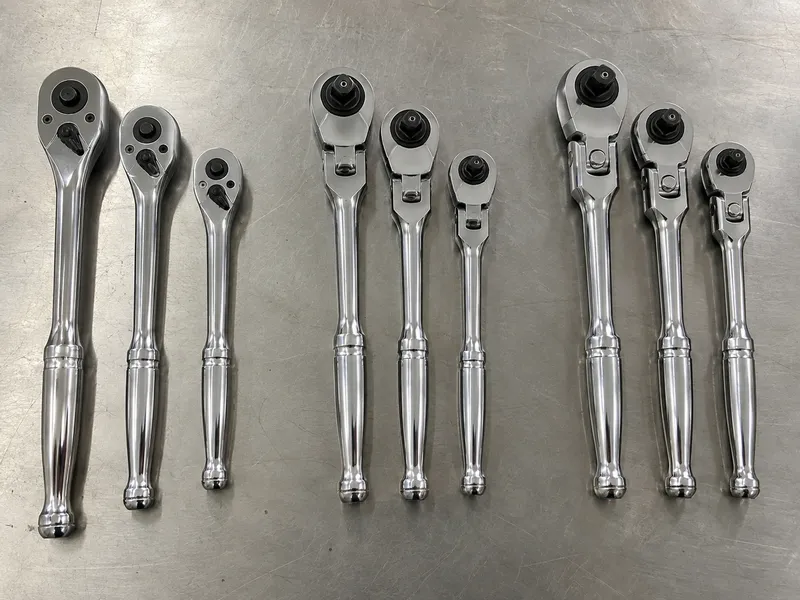
Avoid positioning flex and fixed models as substitutes for gear-count comparisons. The complete mechanic tool list helps map ratchets within a broader line. A socket-tool product range is a useful adjacent program page for buyers considering drives, extensions, and sockets alongside ratchets.
- Group products by drive, length, head style, and pivot behavior.
- Show compatible sockets and retention type.
- Identify real access cases for each flex SKU.
- Keep ratings and claims on the exact model record.
Add models where the work changes. Use customer applications and sample feedback to close coverage gaps without blurring specifications.
Assortment matrix
| Customer need | Starting style | Add-on check |
|---|---|---|
| Open, straight access | Fixed head | Handle and drive match |
| Obstructed approach | Flex head | Pivot clearance and position behavior |
| Angled placement needs retention | Locking or detented model | Instructions and tested operation |
| Mixed socket program | Matched drive family | Size, retention, case layout |
10. What should a flex-head ratchet RFQ specify?
An RFQ should name head style and drive size, then describe the actual access problem. Include handle length, head dimensions, pivot range or position behavior, direction switch, socket-retention feature, finish, grip, packaging, market, and sample expectations. State whether the buyer needs a fixed, freely moving, detented, or locking head. Avoid a generic “heavy-duty” request without an agreed test method.
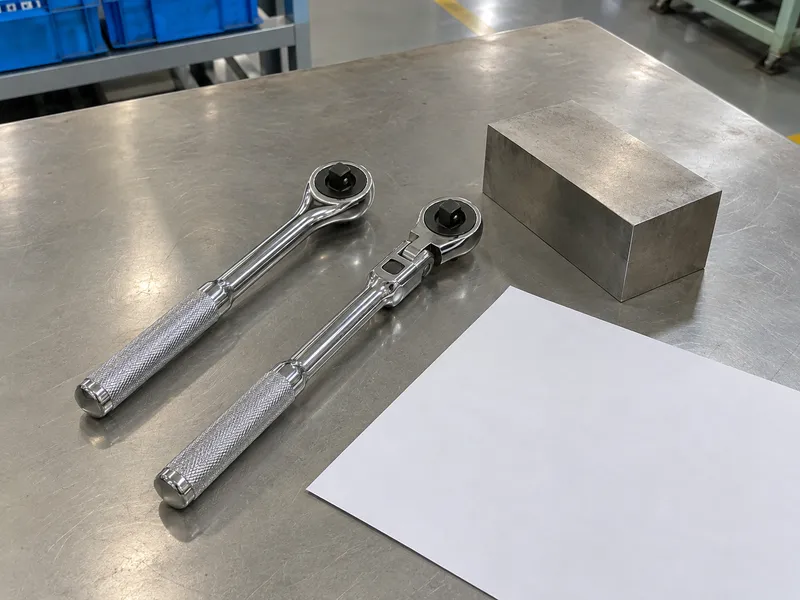
Ask for a drawing, model-specific instructions, compatibility list, replacement-part information, and any rating with its scope. Include a fastener or mock-up photo with an obstruction and required handle path. Request a sample check that records engagement, reset clearance, socket release, and pivot behavior. Keep tooth count and swing claims separate from flex angle.
- Attach the intended socket and drive details.
- Mark the tightest working envelope.
- Define sample acceptance and evidence required.
- Approve copy only after the model and application match.
Write the constraint into the RFQ. A drawing plus one representative access test gives a supplier a clear basis for recommendation.
Q1: Does a flex head ratchet always reach tighter spaces? No. Head thickness, socket stack, pivot range, and the obstruction determine fit.
Q2: Is a locking flex head stronger than a free-moving one? Do not assume that. Compare model-specific ratings and instructions.
Q3: Does head articulation reduce ratchet swing arc? Not by itself. Gear design and head angle are separate variables.
Q4: Should a flex head ratchet replace a universal joint? They change different interfaces. Test the complete drive stack for the application.
Q5: What should buyers compare first? Drive size, head dimensions, access, pivot behavior, and documented model limits.
Looking for a reliable mechanic tools manufacturer in China?
If you are sourcing hand tools, socket tools, automotive repair tools, mechanic tool sets or OEM private label tools, contact KOLARWIN Tools for factory-direct quotation, customization support and product consultation.


