
Need OEM supplier support for this product type?
Contact KOLARWIN Tools for OEM mechanic tools, private label packaging, wholesale quotation and product range support. This gives overseas buyers a clear path from article reading to supplier discussion.
A 72-tooth ratchet and a 90-tooth ratchet differ by nominal gear indexing, commonly described as a 5-degree versus 4-degree swing arc. That angle affects how far a handle moves before the next engagement point. It does not, by itself, establish torque capacity, durability, backdrag, head clearance, or speed in every job.
For distributors and private-label teams, the better choice comes from the complete tool: drive size, head profile, pawl architecture, handle length, socket retention, rating, replacement parts, and sample QC. This guide uses 72-tooth and 90-tooth examples as comparison fields while keeping actual mechanisms model-specific.
1. What do 72 and 90 teeth mean?
Tooth count describes the physical teeth on the ratchet gear. Pawl arrangement determines how those teeth create engagement positions. A single-index calculation gives 360 degrees divided by 72, or 5 degrees. The same calculation gives 4 degrees for 90 teeth. Actual pawl layouts can create different engagement behavior, so catalog tooth count and measured operation should stay separate.
Start with the index arc, then read the mechanism note.
- Record nominal tooth count and published swing arc.
- Ask whether the mechanism uses a single pawl, dual pawl, or another architecture.
- Record head thickness, width, and drive size beside tooth count.
- Separate manufacturer claims from your own sample observations.
- Keep the exact model and revision with each specification row.
The socket tools range helps buyers place ratchets beside extensions, adapters, and universal joints. A 90-tooth label should not replace a complete drive-tool specification.
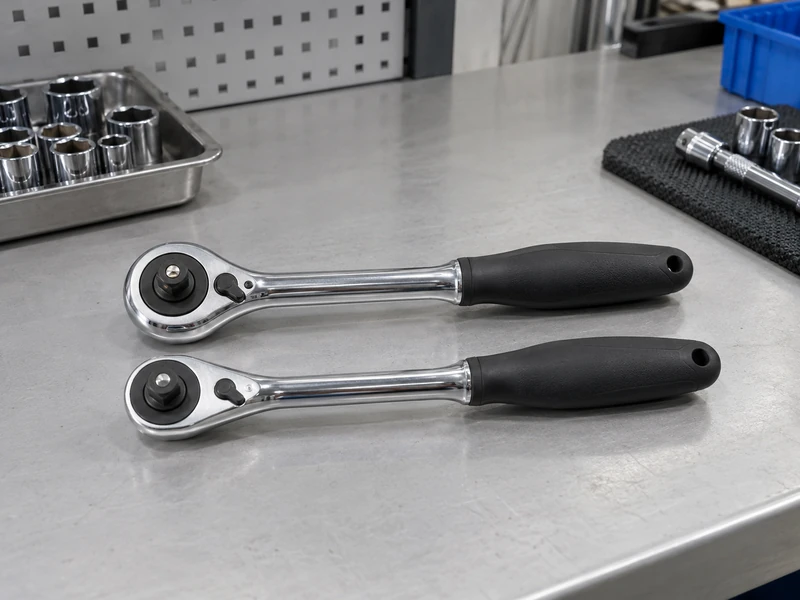
Tooth-count comparison matrix
| Nominal count | Single-index assumption | What it helps compare | What it does not prove |
|---|---|---|---|
| 72 teeth | 5° | Index spacing | Strength or speed |
| 90 teeth | 4° | Index spacing | Durability or torque |
| Other design | Model-specific | Pawl behavior | Universal access |
Write “72T / 5° published” or “90T / 4° published” in the RFQ. Add a separate field for pawl design and engagement evidence.
2. How much swing clearance does each need?
Swing arc matters when a handle meets a frame, bracket, tire, panel, or adjacent fastener before the next tooth engages. A 4-degree index can reduce the minimum angular movement under a single-index assumption. The real handle travel also depends on head center distance, socket height, hand position, and obstruction shape.
Measure the handle envelope around the actual fastener.
- Record the available angular clearance before the handle contacts an obstruction.
- Measure center-to-handle distance for short and long models.
- Check socket depth and extension height in the same fixture.
- Test forward and reverse movement around the obstruction.
- Note whether a flex head changes the working envelope.
Use socket set planning to map clearance decisions across a set. A compact 90-tooth head may fit one service bay, while a longer 72-tooth handle may suit another job with more room.
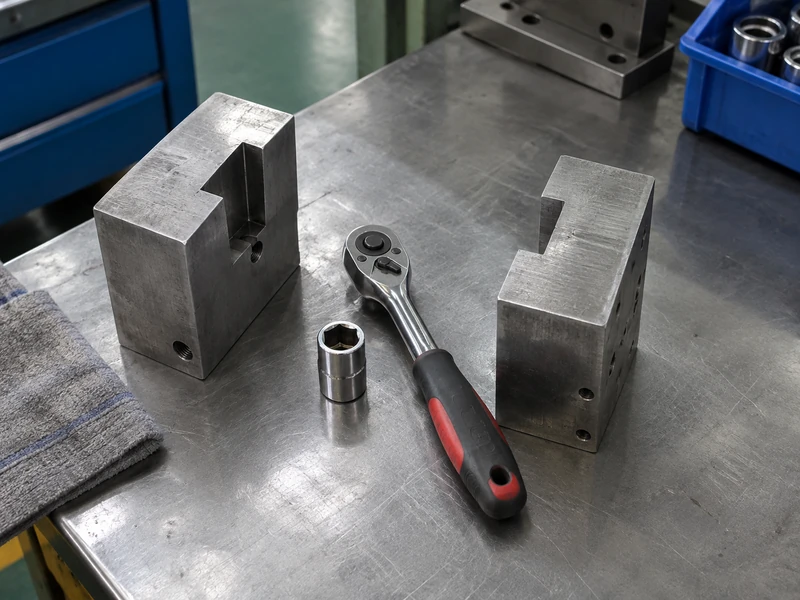
Swing-clearance matrix
| Clearance field | 72-tooth example | 90-tooth example | Approval method |
|---|---|---|---|
| Published index arc | 5° | 4° | Catalog record |
| Handle travel | Model-specific | Model-specific | Fixture measurement |
| Head obstruction | Model-specific | Model-specific | Side-view sample |
| Socket height | Drive and socket dependent | Drive and socket dependent | Assembled check |
Approve based on the tightest real fastener location, then keep the fixture photo in the model file.
3. Does head profile matter more than tooth count?
Head profile controls whether a ratchet reaches a fastener at all. Thickness, width, drive height, selector position, and quick-release hardware can outweigh a one-degree indexing difference. A narrow head can help in a recess, yet a smaller body may change pawl size, socket retention, or service access.
A thin head earns value only at the fastener.
- Request head thickness and width at the widest points.
- Record drive square height and socket release hardware.
- Check selector clearance beside walls and wiring.
- Compare head profile with the socket and extension being sold.
- Review flex-head stop positions separately from fixed-head clearance.
If a kit includes impact sockets, check their outside diameter and assembled height with the chosen ratchet. Socket ratings do not establish a hand ratchet’s impact rating.
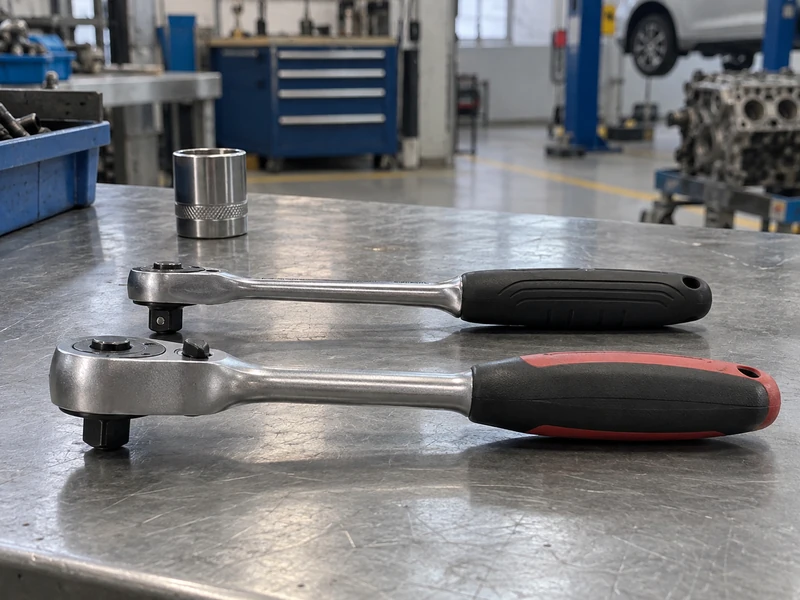
Head-profile matrix
| Head field | Buyer question | Evidence |
|---|---|---|
| Thickness | Will it enter the recess? | Drawing and gauge |
| Width | Does it clear adjacent parts? | Fixture photo |
| Drive height | Does socket length remain workable? | Assembled sample |
| Selector position | Can an operator reverse it? | Gloved-hand check |
| Release hardware | Does it add interference? | Side inspection |
Ask for head dimensions at the point of maximum interference, not a single headline thickness.
4. How does backdrag affect repetitive work?
Backdrag describes resistance felt while a ratchet returns for the next stroke. Low resistance can make repetitive fastening feel smoother, but a buyer should connect that feel with lubrication, seal design, pawl contact, gear finish, contamination, and service condition. A lower tooth count does not automatically mean higher or lower backdrag.
A lightly engaged fastener may follow the socket backward if thread resistance cannot overcome ratchet backdrag. That can force an operator to steady the socket during return strokes. Test this behavior with a low-resistance fixture as well as a loaded one. Use matching sockets and the same sample condition for both tooth counts. Record whether each return stroke resets the mechanism or reverses the fastener. A smooth empty-hand demonstration alone does not show how either ratchet behaves at the start of a thread.
Backdrag belongs in a repeatable test.
- Define a clean, lubricated, and contaminated sample condition.
- Measure return resistance with the same handle position.
- Record selector position and socket load.
- Check whether the pawl skips, binds, or drags during return.
- Ask how spare service parts and lubrication guidance are supplied.
Review mechanics tool sets when planning kits that see repeated operator use. A kit decision should include return feel, storage, and service parts rather than tooth count alone.
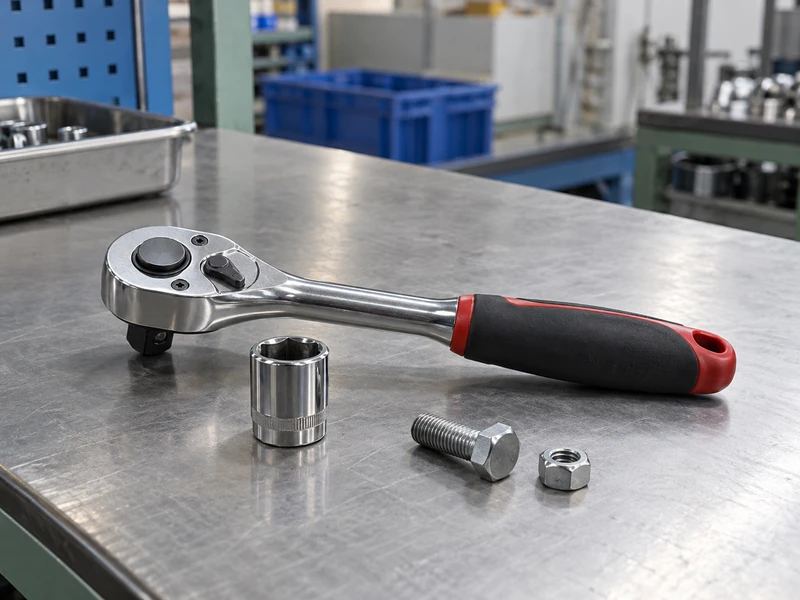
Backdrag test matrix
| Backdrag factor | Why it changes feel | Buyer evidence |
|---|---|---|
| Lubrication | Changes friction and return | Controlled sample |
| Pawl contact | Adds resistance or support | Mechanism view |
| Seal or debris | Changes movement over time | Contamination cycle |
| Socket load | Alters contact conditions | Loaded return test |
Set a buyer-defined backdrag band only after the test method is stable. Avoid unsupported “zero backdrag” language.
5. Which drive and fastener sizes should be planned?
Drive size determines the socket family, accessory range, and typical load class. A 1/4-inch ratchet can suit small fasteners and compact access. A 3/8-inch family often bridges service work. A 1/2-inch family covers larger sockets and greater hand-tool turning force. Tooth count cannot fill a drive-size gap.
Plan the drive family before the tooth-count split.
- Map 1/4, 3/8, and 1/2-inch demand by fastener range.
- Record metric and SAE socket coverage separately.
- Add extensions, adapters, universal joints, and storage rails.
- Check whether a compact head shares sockets with the standard head.
- Keep hand-ratchet and impact-tool families clearly separated.
The hand tools range can support category planning, while a socket family page carries the drive and accessory context.
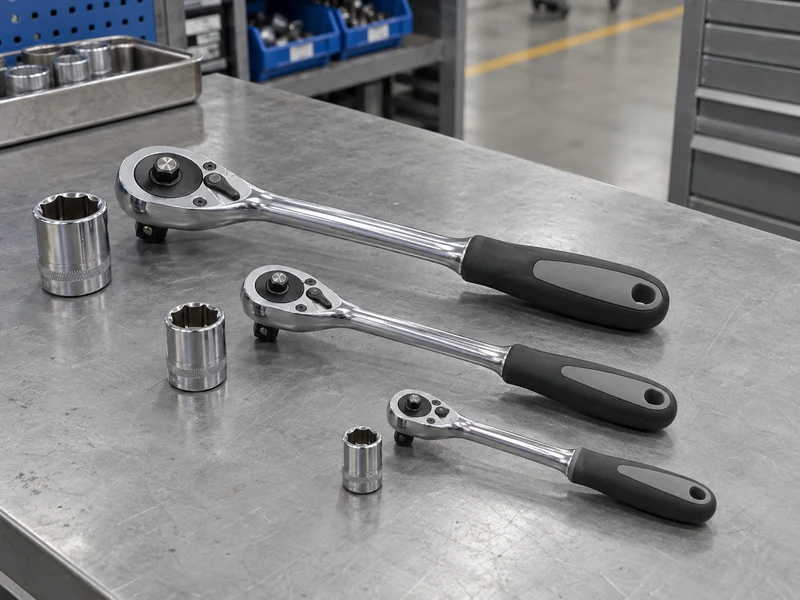
Drive-size matrix
| Drive family | Typical buyer question | Range evidence |
|---|---|---|
| 1/4 in. | Does compact access cover small fasteners? | Socket map and head check |
| 3/8 in. | Does one range bridge service work? | Mixed metric and SAE map |
| 1/2 in. | Does turning force match the hand-tool rating? | Rating and socket map |
Build the assortment by drive and fastener coverage. Split 72T and 90T only where access or buyer demand supports both.
6. What can pawl evidence tell a buyer?
Pawl evidence explains engagement better than a tooth badge. A manufacturer may describe a single half-moon pawl, dual pawls, a stated number of engaged teeth, or a protected head. Those descriptions belong to exact models. They do not create a universal strength ranking between 72 and 90 teeth.
Count teeth as an indexing field, not a durability shortcut.
- Request a mechanism drawing or service view when available.
- Record pawl count, shape, spring arrangement, and engagement statement.
- Ask what test load, direction, and sample condition support a rating.
- Separate torque performance from cycle durability.
- Check whether replacement pawls, gears, and selector parts exist.
For industrial buyers, industrial maintenance solutions provides context for service frequency and bulk programs. It cannot validate an unreferenced pawl claim.
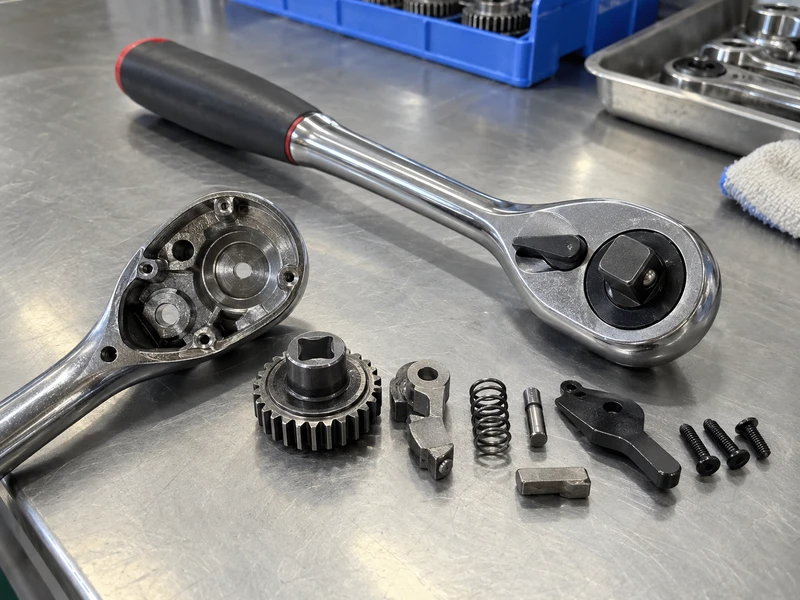
Pawl-evidence matrix
| Evidence field | What it answers | What remains open |
|---|---|---|
| Pawl architecture | How engagement is created | Life under your cycle |
| Engaged teeth | Contact claim for a model | Measured strength |
| Load test | Stated direction and load | Contamination behavior |
| Cycle test | Repetition evidence | Every SKU in a family |
| Spare parts | Repair path | Total service cost |
Ask for test conditions with every strength or durability statement. Reject a comparison that uses tooth count as the only proof.
7. How should handle length and ratings be read?
Handle length changes reach, turning force, storage, and operator clearance. A long handle can help a hand ratchet apply more turning moment, yet it can strike nearby components or tempt misuse beyond a tool’s rating. A short handle can fit a recess while giving less turning force. Hand-ratchet ratings do not authorize impact use.
Handle length is a use-condition field.
- Record effective working length and full length separately.
- Check grip width, end shape, and clearance around the user’s hand.
- State whether the tool is fixed, flex-head, stubby, or extra-long.
- Request hand-tool load ratings and test direction.
- Exclude powered impact use unless explicitly rated.
The automotive repair tools range helps a distributor place compact and standard ratchets beside service tools. Match length to the intended bay, cart, or kit.
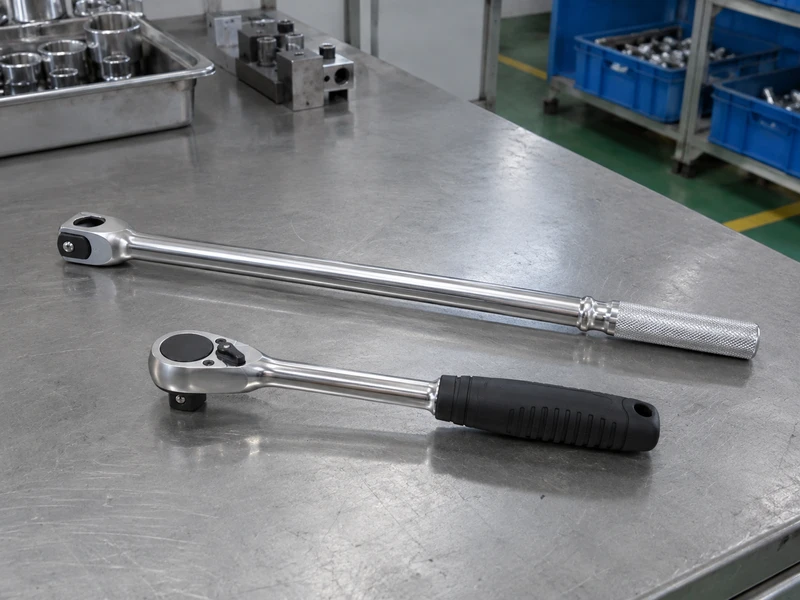
Handle and rating matrix
| Handle field | Buyer effect | QC evidence |
|---|---|---|
| Full length | Reach and storage | Measurement |
| Effective length | Working turning force | Drawing |
| Grip | Control and hand clearance | Ergonomic sample |
| Flex feature | Obstruction access | Stop-position check |
| Rating | Permitted hand use | Test document |
Put the rating, drive size, handle type, and prohibited use in product data. A “heavy-duty” adjective is not a rating.
8. What should sample QC and reversing checks cover?
Sample QC should verify operation before a buyer compares tooth count in a spreadsheet. Check forward and reverse selection, pawl engagement, square-drive dimensions, socket retention, quick release, handle finish, markings, and package contents. Run a repeat cycle that reflects the buyer’s intended use.
Reverse the tool, retain the socket, and record the result.
- Remove applied torque before switching direction; check selector access with a gloved hand and an attached socket.
- Check selector travel, detent, and accidental movement.
- Measure drive square and test socket retention.
- Cycle clean and lightly contaminated samples under a defined load.
- Inspect gear, pawl, springs, plate, and fasteners after the cycle.
A polished finish cannot compensate for a selector or retention failure.
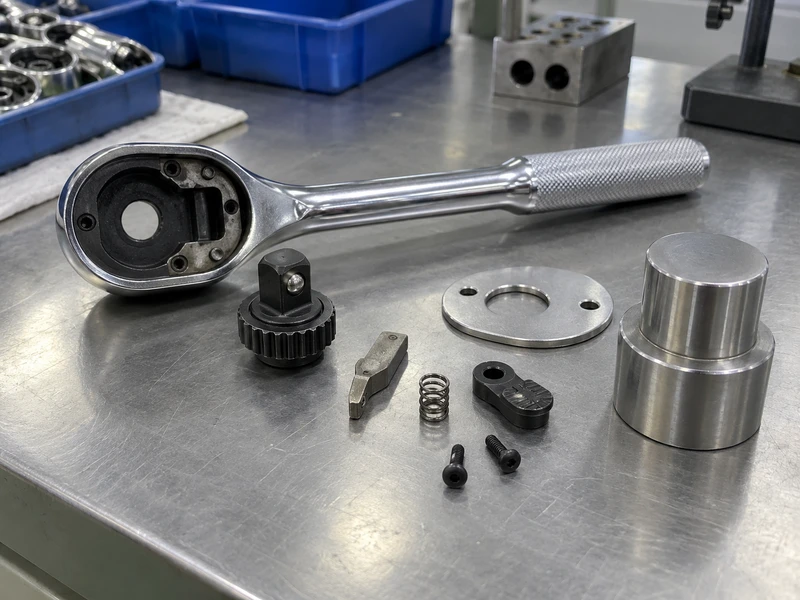
Sample-QC matrix
| QC check | Pass evidence | Stop condition |
|---|---|---|
| Forward/reverse | Positive selector and pawl action | Ambiguous direction |
| Socket retention | Secure hold and intentional release | Socket drops |
| Drive square | Dimension within drawing | Oversize or undersize |
| Cycle | No skip, bind, or loose parts | Functional change |
| Marking | Model and drive readable | Traceability gap |
Keep the sample teardown photos with the approved SKU. Repeat checks after any gear, pawl, selector, or handle change.
9. How should a ratchet range be planned?
A useful range combines drive sizes, head profiles, handle lengths, and replacement paths. Some buyers need compact 90-tooth heads for crowded service bays. Others need 72-tooth models with familiar layouts, longer handles, or a price point that suits a broad mechanic set. Neither count should dominate range planning.
Build the assortment around jobs, then assign tooth counts.
- Start with fastener and socket demand by drive size.
- Add compact, standard, flex-head, and long-handle forms where evidence supports them.
- Choose a 72T or 90T option by clearance, feel, rating, and target channel.
- List repair kits, gears, pawls, selectors, and detents.
- Keep packaging labels consistent across the family.
Use the complete mechanic tool list when mapping ratchets into a larger SKU program.
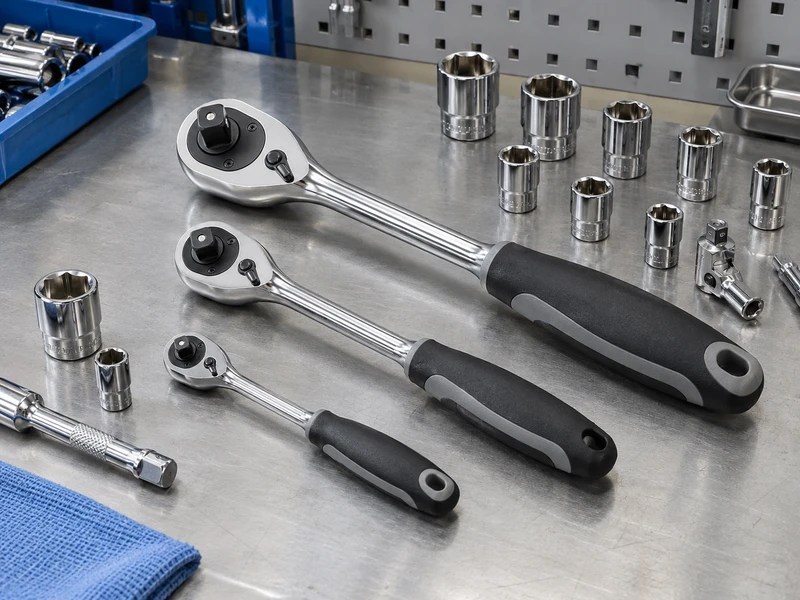
Range-planning matrix
| Planning field | Why it matters | Decision evidence |
|---|---|---|
| Drive size | Determines socket family | Sales and range map |
| Head form | Sets access | Fixture trial |
| Handle length | Sets turning force and storage | Sample measurement |
| Tooth count | Sets nominal index arc | Published and measured data |
| Spares | Controls serviceability | Parts availability |
Approve a small pilot range, then expand only after return feel, retention, and fit records support each new form.
10. What should a ratchet RFQ include?
An RFQ should ask for more than “72 or 90 teeth.” State drive size, socket range, head dimensions, selector, retention type, handle length, pawl architecture, rating, sample cycles, packaging, and spare parts. Ask the supplier to identify every field as published, measured, or proposed.
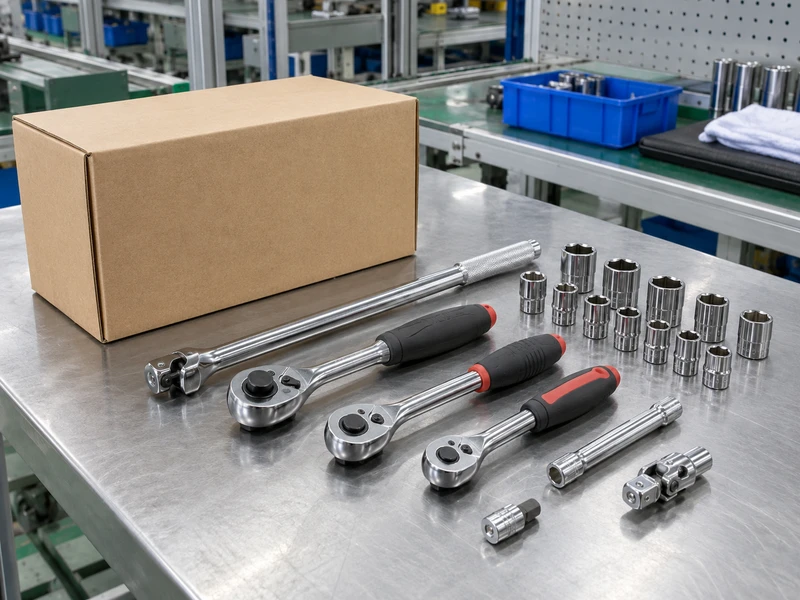
A clear RFQ leaves no room for tooth-count shorthand.
- State the nominal tooth count and published arc assumption.
- Request head and drive drawings with tolerance fields.
- Define hand-ratchet use and exclude impact use unless rated.
- Ask for pawl, selector, retention, and cycle evidence.
- Include sample quantity, packaging, markings, and replacement parts.
Send the completed specification through the contact page. Add your market, drive mix, target packaging, sample fixture, and inspection record requirements.
Ask for a sample response that distinguishes 72T / 5° and 90T / 4° as nominal indexing assumptions. The decision should then rest on actual clearance, head profile, backdrag, pawl evidence, rating, and range fit.
Q1: Does a 90-tooth ratchet always turn faster?
No. A 90-tooth design can offer a smaller published index arc, yet actual work depends on access, handle travel, socket height, backdrag, and operator movement.
Q2: Is a 72-tooth ratchet weaker than a 90-tooth model?
Tooth count alone cannot answer that. Compare pawl architecture, gear dimensions, engagement evidence, rated load, cycle data, and the exact model.
Q3: Are 72 degrees and 90 degrees the swing arcs?
No. Under the single-index assumption, 72 teeth correspond to 5 degrees and 90 teeth correspond to 4 degrees per index. Published architectures can differ.
Q4: Can a hand ratchet be used with an impact tool?
Do not assume it can. Use a tool explicitly rated for the powered impact application, and keep hand-ratchet specifications separate in the catalog.
Q5: What samples should a buyer request?
Request each drive size and head form planned for launch, plus a matching socket. Record swing clearance, selector action, retention, backdrag, cycle result, markings, packaging, and spare-part evidence.
Looking for a reliable mechanic tools manufacturer in China?
If you are sourcing hand tools, socket tools, automotive repair tools, mechanic tool sets or OEM private label tools, contact KOLARWIN Tools for factory-direct quotation, customization support and product consultation.


