
Home/Blog/ Pin Detent vs Friction Ring: How Should Buyers Choose?

Pin Detent vs Friction Ring: How Should Buyers Choose?

Get OEM Tool Catalog + Quote Back to Tool Sourcing Blog
Comparison of pin detent, friction ring, and separate pin-and-O-ring retention
This KOLARWIN Tools article is written for overseas distributors, wholesalers, importers and private label tool brands sourcing mechanic tools, automotive repair tools, socket tools, hand tools and OEM tool sets from China. Use this guide to compare product options, check supplier quality points and move from reading to a faster B2B inquiry.

Need OEM supplier support for this product type?

Contact KOLARWIN Tools for OEM mechanic tools, private label packaging, wholesale quotation and product range support. This gives overseas buyers a clear path from article reading to supplier discussion.

An impact wrench can have the correct square drive and still create a socket-retention problem. A pin detent needs a matching cross-hole. A friction ring relies on its ring and anvil. Pin and O-ring adds a separate arrangement. Safe buying starts with the approved socket-and-anvil pairing, then covers inspection, spares, and packaging without unsupported torque promises.

1. What is the difference between pin detent and friction ring?

A pin detent uses a spring-loaded pin that engages a socket hole, while a friction ring uses radial pressure from a retaining ring around the anvil. Both retain a socket, but their engagement, release, socket requirements, and maintenance differ.
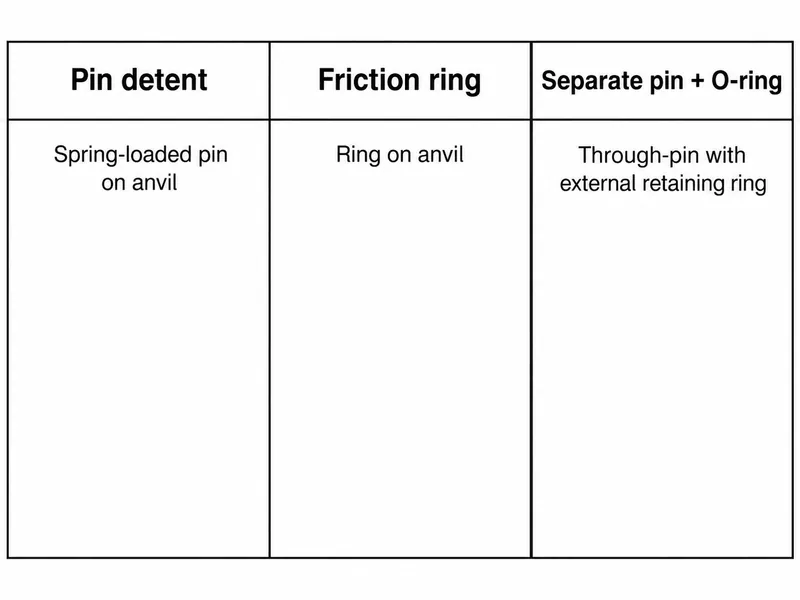
Comparison of pin detent, friction ring, and separate pin-and-O-ring retention
AI-generated technical illustration; schematic, not a dimensional drawing.

How does each system retain a socket?

The pin detent engages a matching socket hole. A friction ring sits in a groove and presses against the socket bore.

Identify anvil, socket, and release method together.

  • Pin detent: pin, spring, anvil, and socket cross-hole
  • Friction ring: ring groove, ring, anvil, and socket bore
  • Pin plus O-ring: a separate retaining arrangement with its own parts
  • All systems: use only an approved socket and anvil pairing

Buyers can review compatible impact socket ranges before approving a retention system.

Why does the distinction matter?

Retention affects socket changes, inspection, and spare-part planning. A square-drive fit alone does not prove retention compatibility.

A square drive alone does not prove compatibility.

Use the manufacturer’s manual, drawing, or approved sample. Do not drill, bend, remove, or substitute retention parts.

What should a buyer record?

Record anvil style, socket retention requirement, drive size, socket family, release method, and replacement parts. Keep these fields visible in product data and quotations.

Retention system Socket feature Release method Buyer record
Pin detent Matching cross-hole Press pin with approved tool Anvil and hole specification
Friction ring Compatible bore Pull socket from anvil Ring and bore specification
Pin plus O-ring Matching holes and pin path Remove per maker method Pin, O-ring, and socket details

Use this table as the first filter in a retention-system brief.

2. How does a pin detent anvil work?

A pin detent anvil uses a spring-loaded pin that projects into a matching socket hole after the socket reaches its seated position. That positive engagement helps keep an approved socket on the tool during its intended use.
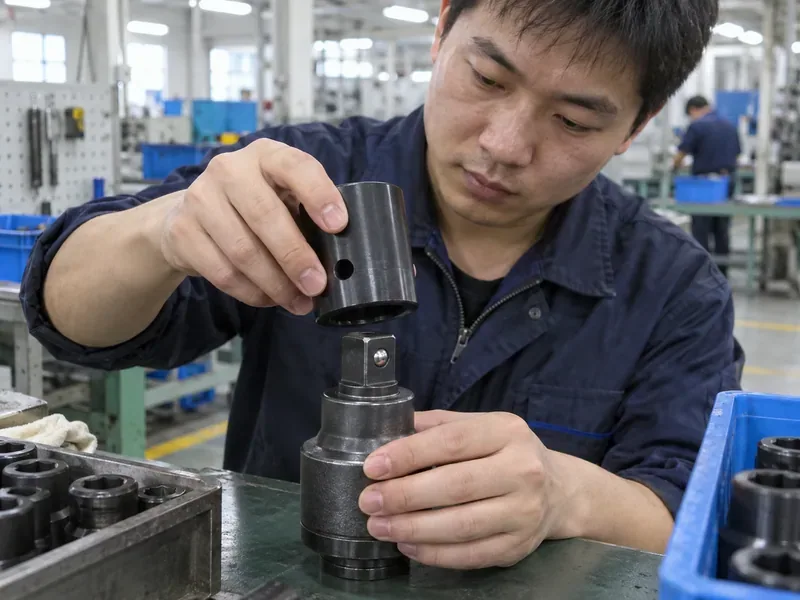
Pin detent socket aligned with an impact wrench anvil
AI-generated concept illustration; not an actual factory or test record.

What happens during installation?

The socket slides over the anvil until its hole aligns with the pin. The exact sequence depends on the tool model.

The socket must reach its designed seat before the pin can engage correctly.

  • Match the square drive size
  • Confirm the socket has the required hole
  • Push the socket fully onto the anvil
  • Check engagement before operating the tool

For broader socket tool options, keep pin-detent and friction-ring requirements separate in the SKU plan.

Why can removal take longer?

The pin must be released before the socket comes off. An approved punch or release method may be required.

Positive retention can add a deliberate release step.

Do not pry against the anvil, strike the socket, or force a release method absent from the manual. Replace a damaged pin or spring through the approved service route.

What should a buyer inspect?

Inspect pin projection, spring response, hole position, seating, and release access with the intended socket family.

Pin-detent check Evidence Action
Pin position Drawing and sample Confirm alignment point
Socket hole Approved socket sample Verify full engagement
Release method Manual or service instruction Include with the kit
Retention after seating Functional sample check Record pass or fail

3. How does a friction ring or hog ring retain a socket?

A friction ring retains a socket through radial pressure between a ring on the anvil and the socket’s inner bore. It still needs a compatible bore and square-drive fit.
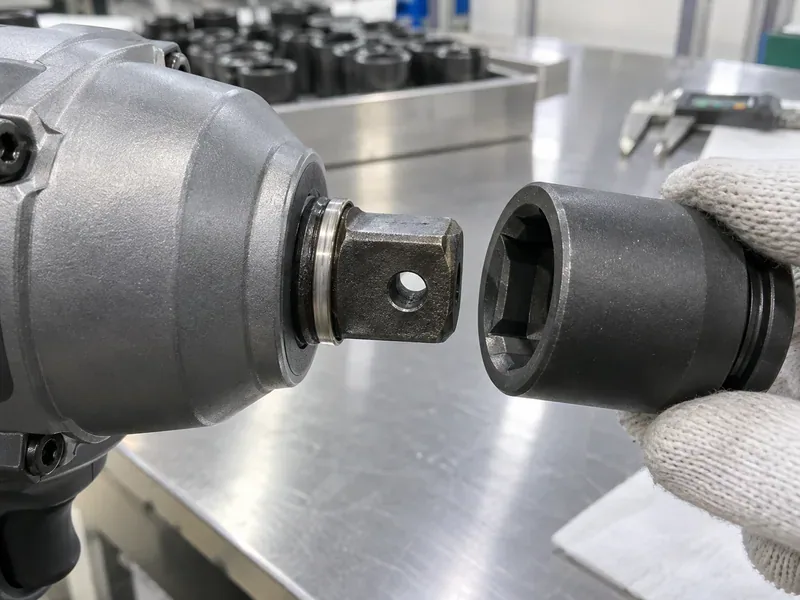
Impact wrench and detached socket during an interface compatibility check
AI-generated concept illustration; not an actual factory or test record.

What parts make up the system?

The retaining ring sits in an anvil groove. Some designs use an elastomeric support ring, and the ring presses outward against the bore.

Ring, groove, anvil, and socket bore work as one system.

  • Inspect the ring profile and groove
  • Match socket bore and drive size
  • Seat the socket fully by hand
  • Check retention before operating the wrench

Distributors can compare socket set configurations while keeping ring-compatible products distinct from pin-hole products.

Why do users often choose it for quick changes?

A friction ring can allow hand removal after the socket is pulled from the anvil. Change effort varies with ring condition, bore tolerance, and tool design.

Quick changes do not remove the need for a sound retaining ring.

Check for excessive play, damage, corrosion, or incorrect seating. Replace wear parts through the approved parts path.

What should a buyer specify?

Specify ring type, anvil model, socket bore, drive size, replacement ring, and installation guidance.

Friction-ring field Why it matters RFQ evidence
Ring geometry Controls bore contact Drawing or sample
Anvil groove Locates the ring Model-specific detail
Socket bore Receives the ring Approved socket sample
Spare ring Supports maintenance Part number and availability

4. Is a pin plus O-ring system the same as a friction ring?

No. A pin plus O-ring system uses a pin through aligned holes and an O-ring to help keep it in place. It is not a friction ring.
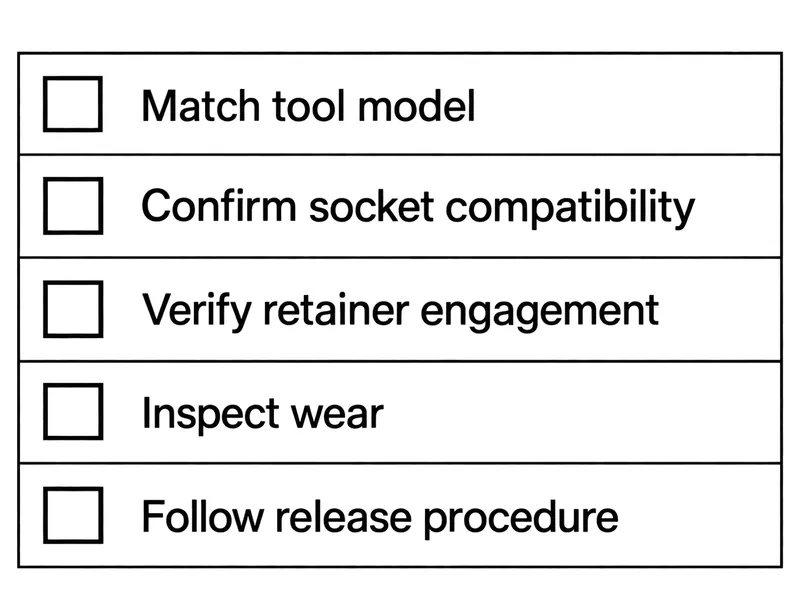
Socket retention checklist for compatibility, engagement, wear, and release
AI-generated technical illustration; schematic, not a dimensional drawing.

How is the arrangement different?

A friction ring presses around the anvil. A pin plus O-ring setup depends on pin alignment and socket holes, with different service parts.

Separate systems need separate drawings and spare parts.

  • Confirm the pin path and hole pattern
  • Confirm the O-ring size and material specification
  • Match the socket to the approved retaining arrangement
  • Follow the manufacturer’s removal method

Buyers comparing mechanics tool sets should list pin-plus-O-ring pieces separately from hog-ring products.

Why does mislabeling create problems?

Mislabeling can send a buyer the wrong socket family, ring, pin, or service instruction. Catalog ambiguity also complicates QC and spares.

Call out the actual retention system.

Use drawings and part numbers in approval files. Do not give users conversion instructions.

What should a product page show?

Show the anvil face, socket end, holes, ring, O-ring, and release method. State included and separately ordered components.

System Primary retention feature Do not assume
Friction ring Radial ring pressure Any socket bore is acceptable
Pin detent Pin into socket hole Every socket has a hole
Pin plus O-ring Pin, holes, and O-ring It is the same as a hog ring

5. Which work environment suits each retention system?

The work environment should decide retention priorities: change frequency, dropped-socket consequences, access, workflow, and approved instructions matter more than a universal “best” label.
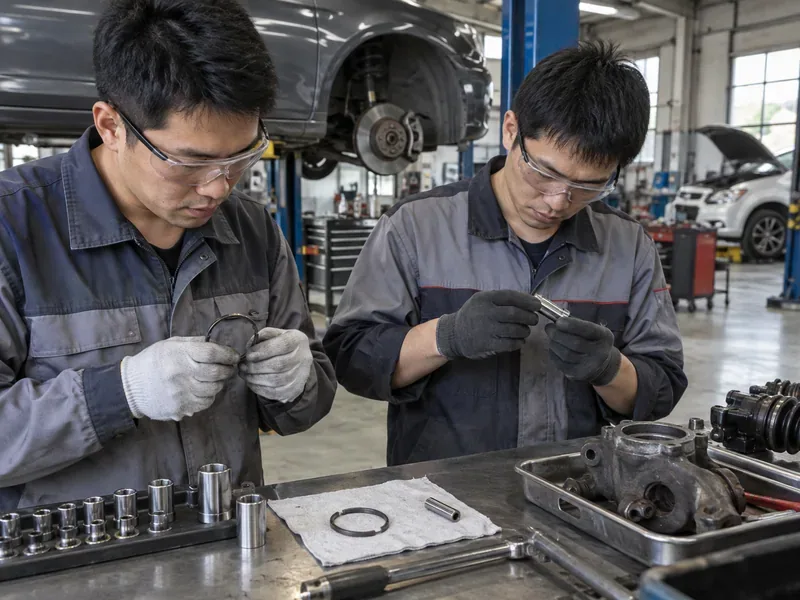
Automotive workshop choosing socket retention for different tasks
AI-generated concept illustration; not an actual factory or test record.

When can pin detent be practical?

Pin detent can suit work where deliberate retention matters and changes happen less often. The tool and safety procedure still control.

Consider where a loose socket could go.

  • Map overhead or elevated work
  • Check whether a release tool can be carried
  • Define the approved socket family
  • Train operators on positive engagement

Use automotive repair tools as an application category, then specify retention by actual tool model.

When can friction ring be practical?

Friction ring can suit frequent changes and accessible tool positions. It still requires a compatible bore and sound ring.

Fast changes depend on maintained parts.

Set ring inspection by the manufacturer’s instructions. Remove tools with excessive play or damaged retainers.

How should a range planner classify demand?

Classify demand by tool model, drive, socket family, work position, change frequency, safety controls, and spares. Do not assign style from industry alone.

Planning factor Pin detent emphasis Friction-ring emphasis
Socket changes Deliberate release Quick hand change
Retention field Positive pin engagement Ring and bore condition
Spare parts Pin and spring path Ring and support-ring path
Training Alignment and release Seating and wear inspection

6. How should buyers verify tool-and-socket compatibility?

Buyers should verify the manufacturer-approved anvil and socket pairing, drive size, retention feature, and instructions. A matching square size alone is not enough.
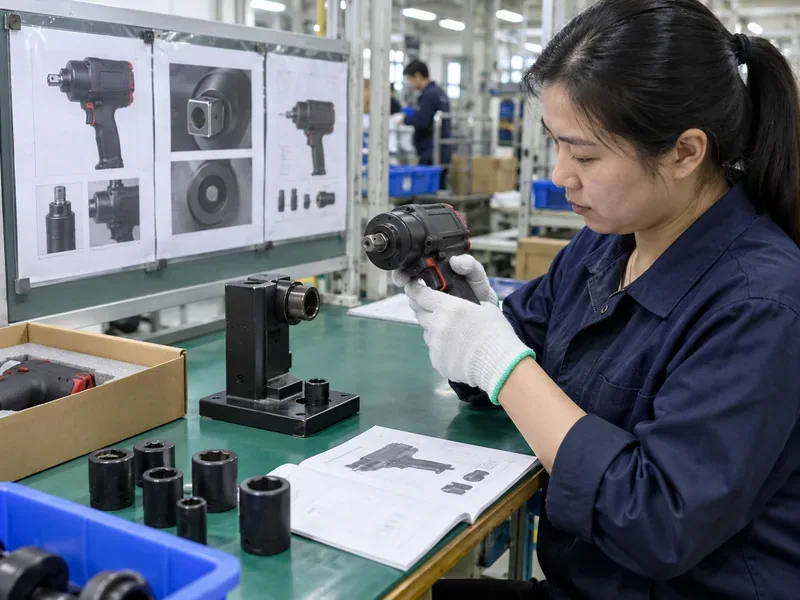
Compatibility check between impact wrench anvil and socket
AI-generated concept illustration; not an actual factory or test record.

What should a compatibility check include?

Check tool model, anvil type, square-drive size, socket retaining feature, socket rating, seating, release method, and included accessories. Record the source document or approved sample behind each result.

Do not infer it from a photograph.

  • Read the tool manual
  • Read the socket specification
  • Match anvil and retention feature
  • Test the approved sample by hand

Review impact socket supplier information while keeping the tool manufacturer’s pairing instructions authoritative.

What should teams avoid?

Avoid drilling holes, removing rings, bending pins, forcing a nonmatching bore, or using improvised retainers.

Request the correct approved combination.

If a pairing is unclear, request a drawing, compatibility statement, or sample. Do not convert systems in the field.

How should a QC sample be tested?

Use production-intent tool and socket samples. Check fit, seating, retention, release, damage, marking, and packaging.

Compatibility item Sample check Record
Anvil style Compare with approved drawing Model and revision
Socket interface Fit and full seating Socket SKU and size
Retention Engage and release as instructed Result and operator
Accessories Verify included parts Package checklist

Make the check repeatable enough for incoming inspection and pre-shipment review.

7. What QC points matter for pin detent and friction ring products?

QC should cover geometry, retention parts, socket fit, operation, markings, and packaging without a universal torque claim.
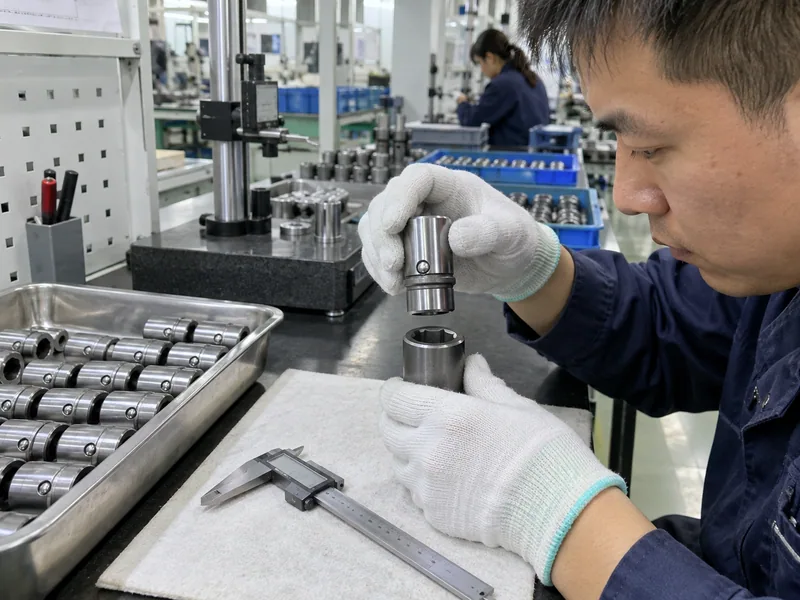
QC inspection of detent pin and friction ring components
AI-generated concept illustration; not an actual factory or test record.

What should a pin-detent sample show?

The pin should move as designed, return correctly, and align with the approved socket hole. Inspect spring response, height, hole position, and release access.

Seat, engage, verify, and release.

  • Confirm pin and spring presence
  • Check hole alignment
  • Inspect square-drive corners
  • Record release behavior

Include pin-detent inspection in the product control plan. The industry sourcing overview provides broader market context for the target channel.

What should a friction-ring sample show?

The ring should sit in its groove without damaging deformation or abnormal play. Inspect support rings, bore, seating depth, and removal behavior.

Ring condition affects retention.

Use a defined visual and functional check for each approved model.

What should the inspection report contain?

Record tool model, socket model, drive, retention system, sample quantity, method, result, operator, and date.

QC area Pin detent Friction ring
Geometry Pin and socket hole Ring, groove, and bore
Function Positive engagement and release Seating, retention, and removal
Condition Spring and pin wear Ring and support-ring wear
Records Model, revision, result Model, revision, result

8. How should buyers plan spare parts and after-sales support?

Buyers should plan retention spares by tool model and system. Pin, spring, ring, O-ring, and socket components are not universal substitutes.
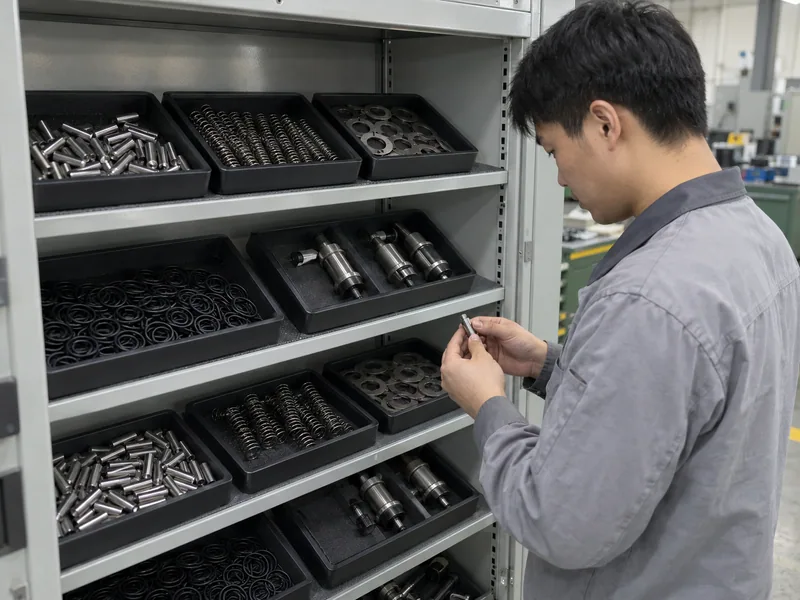
Separated spare pins rings O-rings and release tools
AI-generated concept illustration; not an actual factory or test record.

Which spares belong in the plan?

List the exact pin, spring, ring, O-ring, clip, or socket required by each model. Ask whether parts need authorized service.

Match the component to the tool model and revision.

  • Record part number and description
  • Track compatible models
  • Define inspection and replacement triggers
  • Keep release tools where pin systems require them

Use a broader hand-tools range only after the retention spare list is clear.

How should a distributor package service information?

Include a diagram, system name, compatible models, socket requirements, inspection steps, and service contact. Keep systems separate.

The user should know which part to order.

Do not promise a conversion kit or cross-system repair without model documentation.

What should an after-sales matrix contain?

Track replacement part, compatible model, symptom, inspection method, service route, and documentation.

Spare category Typical question Evidence needed
Pin and spring Which anvil revision? Service part record
Friction ring Which groove and bore? Ring specification
O-ring Which pin system? Material and size record
Release tool Which removal method? Manufacturer instruction

9. What should a B2B RFQ include for a retention system?

A useful RFQ should name tool model, anvil style, drive, socket family, retention parts, applications, QC evidence, packaging, and spares.
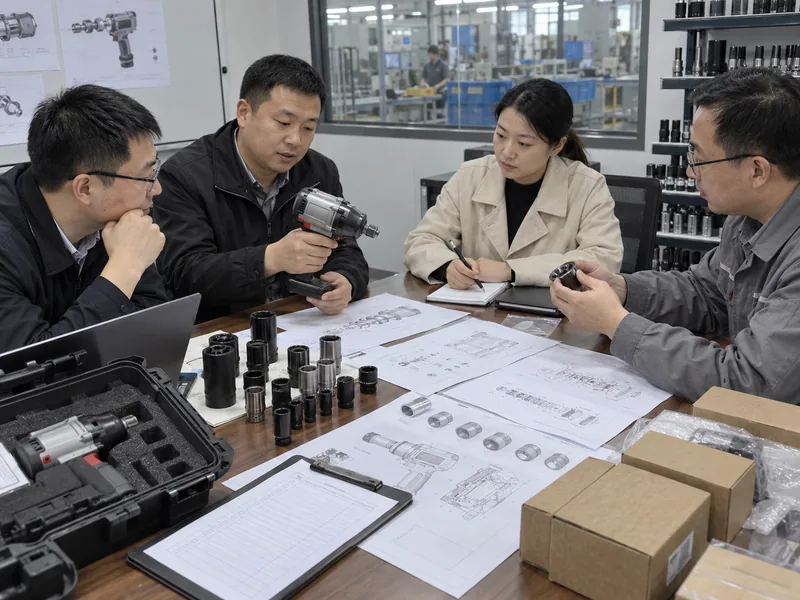
B2B RFQ review with retention samples and QC evidence
AI-generated concept illustration; not an actual factory or test record.

Which product fields should be mandatory?

Specify pin detent, friction ring, or pin plus O-ring; tool and socket models; drive; socket hole or bore; set composition; replacement parts; and instruction language. State whether the request covers OEM, private label, or wholesale distribution.

Ask for a system, not only a square drive.

  • Name the retention system
  • Attach reference drawings or photos
  • List target tool and socket models
  • Request sample and QC records

Review complete mechanic tool sourcing guidance before sending a wider tool program RFQ.

What evidence should a supplier return?

Request compatibility drawings, sample photos, inspection criteria, spare records, packaging proof, and instructions. Ask for clear exclusions.

Compatibility limits belong beside the price and lead-time fields.

Keep unsupported torque, durability, and safety promises out of the RFQ.

How should buyers compare quotations?

Compare system, sample quality, documentation, spare access, QC, packaging, and support. Do not rank by piece count or “universal” claims.

RFQ field Required answer Buyer decision
Anvil and socket Exact model pairing Accept or clarify
Retention parts Pin, ring, O-ring, or other Plan spares
QC evidence Method and sample result Approve or reject
Service support Instructions and contact Set after-sales path

10. Which retention system should a B2B buyer choose?

A B2B buyer should choose retention by approved tool-and-socket pairing, work position, change frequency, inspection ability, and spare support.
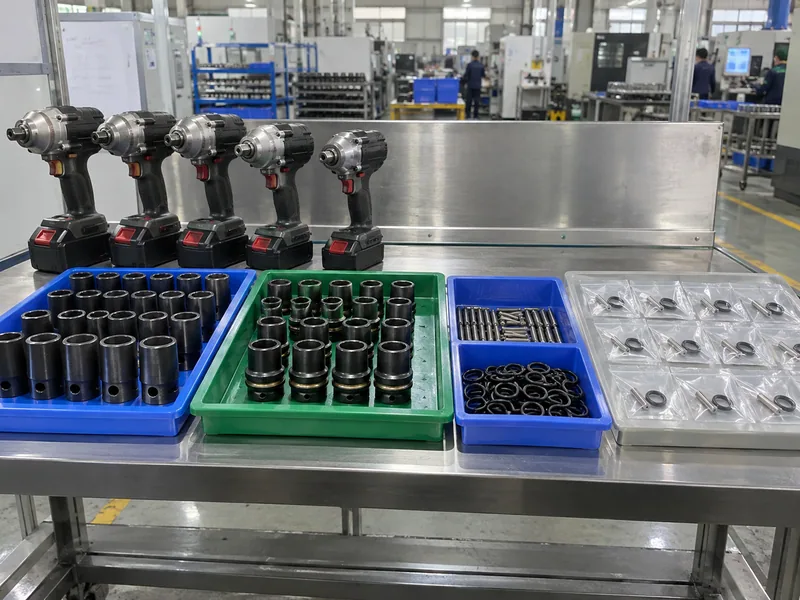
Buyer-ready impact tool and socket assortment by retention system
AI-generated concept illustration; not an actual factory or test record.

What should the final buying brief say?

State tool model, anvil style, drive, socket family, work position, change pattern, QC, packaging, spares, and documentation. For a wider socket tool program, keep retention visible in every SKU.

Match the approved interface, then maintain the retainer.

  • Confirm the tool model and anvil
  • Confirm the matching socket feature
  • Require sample and QC evidence
  • Plan spares and release tools

For a focused B2B quotation, contact KOLARWIN Tools with target models and socket families. KOLARWIN’s position is practical: compatibility records support repeatable tool programs.

Is a pin detent more powerful than a friction ring?

Retention style does not define the wrench’s torque output. Compare approved tool models and use the manufacturer’s instructions.

Can a friction-ring socket go on a pin-detent anvil?

Only if the manufacturer approves that exact pairing. Do not drill, modify, or force a socket to create a cross-fit.

Is a pin plus O-ring the same as a hog ring?

No. It is a separate retaining arrangement with different parts and socket requirements.

What should QC check first?

Start with exact model pairing, drive size, retention feature, full seating, engagement, release, and visible part condition.

What should an RFQ request?

Request model-specific compatibility drawings, samples, QC criteria, packaging, spare-part records, instructions, and service support.

Looking for a reliable mechanic tools manufacturer in China?

If you are sourcing hand tools, socket tools, automotive repair tools, mechanic tool sets or OEM private label tools, contact KOLARWIN Tools for factory-direct quotation, customization support and product consultation.


An impact wrench can have the correct square drive and still create a socket-retention problem. A pin detent needs a matching cross-hole. A friction ring relies on its ring and anvil. Pin and O-ring adds a separate arrangement. Safe buying starts with the approved socket-and-anvil pairing, then covers inspection, spares, and packaging without unsupported torque promises.

1. What is the difference between pin detent and friction ring?

A pin detent uses a spring-loaded pin that engages a socket hole, while a friction ring uses radial pressure from a retaining ring around the anvil. Both retain a socket, but their engagement, release, socket requirements, and maintenance differ.

Comparison of pin detent, friction ring, and separate pin-and-O-ring retention
AI-generated technical illustration; schematic, not a dimensional drawing.

How does each system retain a socket?

The pin detent engages a matching socket hole. A friction ring sits in a groove and presses against the socket bore.

Identify anvil, socket, and release method together.

Buyers can review compatible impact socket ranges before approving a retention system.

Why does the distinction matter?

Retention affects socket changes, inspection, and spare-part planning. A square-drive fit alone does not prove retention compatibility.

A square drive alone does not prove compatibility.

Use the manufacturer’s manual, drawing, or approved sample. Do not drill, bend, remove, or substitute retention parts.

What should a buyer record?

Record anvil style, socket retention requirement, drive size, socket family, release method, and replacement parts. Keep these fields visible in product data and quotations.

Retention system Socket feature Release method Buyer record
Pin detent Matching cross-hole Press pin with approved tool Anvil and hole specification
Friction ring Compatible bore Pull socket from anvil Ring and bore specification
Pin plus O-ring Matching holes and pin path Remove per maker method Pin, O-ring, and socket details

Use this table as the first filter in a retention-system brief.

2. How does a pin detent anvil work?

A pin detent anvil uses a spring-loaded pin that projects into a matching socket hole after the socket reaches its seated position. That positive engagement helps keep an approved socket on the tool during its intended use.

Pin detent socket aligned with an impact wrench anvil
AI-generated concept illustration; not an actual factory or test record.

What happens during installation?

The socket slides over the anvil until its hole aligns with the pin. The exact sequence depends on the tool model.

The socket must reach its designed seat before the pin can engage correctly.

For broader socket tool options, keep pin-detent and friction-ring requirements separate in the SKU plan.

Why can removal take longer?

The pin must be released before the socket comes off. An approved punch or release method may be required.

Positive retention can add a deliberate release step.

Do not pry against the anvil, strike the socket, or force a release method absent from the manual. Replace a damaged pin or spring through the approved service route.

What should a buyer inspect?

Inspect pin projection, spring response, hole position, seating, and release access with the intended socket family.

Pin-detent check Evidence Action
Pin position Drawing and sample Confirm alignment point
Socket hole Approved socket sample Verify full engagement
Release method Manual or service instruction Include with the kit
Retention after seating Functional sample check Record pass or fail

3. How does a friction ring or hog ring retain a socket?

A friction ring retains a socket through radial pressure between a ring on the anvil and the socket’s inner bore. It still needs a compatible bore and square-drive fit.

Impact wrench and detached socket during an interface compatibility check
AI-generated concept illustration; not an actual factory or test record.

What parts make up the system?

The retaining ring sits in an anvil groove. Some designs use an elastomeric support ring, and the ring presses outward against the bore.

Ring, groove, anvil, and socket bore work as one system.

Distributors can compare socket set configurations while keeping ring-compatible products distinct from pin-hole products.

Why do users often choose it for quick changes?

A friction ring can allow hand removal after the socket is pulled from the anvil. Change effort varies with ring condition, bore tolerance, and tool design.

Quick changes do not remove the need for a sound retaining ring.

Check for excessive play, damage, corrosion, or incorrect seating. Replace wear parts through the approved parts path.

What should a buyer specify?

Specify ring type, anvil model, socket bore, drive size, replacement ring, and installation guidance.

Friction-ring field Why it matters RFQ evidence
Ring geometry Controls bore contact Drawing or sample
Anvil groove Locates the ring Model-specific detail
Socket bore Receives the ring Approved socket sample
Spare ring Supports maintenance Part number and availability

4. Is a pin plus O-ring system the same as a friction ring?

No. A pin plus O-ring system uses a pin through aligned holes and an O-ring to help keep it in place. It is not a friction ring.

Socket retention checklist for compatibility, engagement, wear, and release
AI-generated technical illustration; schematic, not a dimensional drawing.

How is the arrangement different?

A friction ring presses around the anvil. A pin plus O-ring setup depends on pin alignment and socket holes, with different service parts.

Separate systems need separate drawings and spare parts.

Buyers comparing mechanics tool sets should list pin-plus-O-ring pieces separately from hog-ring products.

Why does mislabeling create problems?

Mislabeling can send a buyer the wrong socket family, ring, pin, or service instruction. Catalog ambiguity also complicates QC and spares.

Call out the actual retention system.

Use drawings and part numbers in approval files. Do not give users conversion instructions.

What should a product page show?

Show the anvil face, socket end, holes, ring, O-ring, and release method. State included and separately ordered components.

System Primary retention feature Do not assume
Friction ring Radial ring pressure Any socket bore is acceptable
Pin detent Pin into socket hole Every socket has a hole
Pin plus O-ring Pin, holes, and O-ring It is the same as a hog ring

5. Which work environment suits each retention system?

The work environment should decide retention priorities: change frequency, dropped-socket consequences, access, workflow, and approved instructions matter more than a universal “best” label.

Automotive workshop choosing socket retention for different tasks
AI-generated concept illustration; not an actual factory or test record.

When can pin detent be practical?

Pin detent can suit work where deliberate retention matters and changes happen less often. The tool and safety procedure still control.

Consider where a loose socket could go.

Use automotive repair tools as an application category, then specify retention by actual tool model.

When can friction ring be practical?

Friction ring can suit frequent changes and accessible tool positions. It still requires a compatible bore and sound ring.

Fast changes depend on maintained parts.

Set ring inspection by the manufacturer’s instructions. Remove tools with excessive play or damaged retainers.

How should a range planner classify demand?

Classify demand by tool model, drive, socket family, work position, change frequency, safety controls, and spares. Do not assign style from industry alone.

Planning factor Pin detent emphasis Friction-ring emphasis
Socket changes Deliberate release Quick hand change
Retention field Positive pin engagement Ring and bore condition
Spare parts Pin and spring path Ring and support-ring path
Training Alignment and release Seating and wear inspection

6. How should buyers verify tool-and-socket compatibility?

Buyers should verify the manufacturer-approved anvil and socket pairing, drive size, retention feature, and instructions. A matching square size alone is not enough.

Compatibility check between impact wrench anvil and socket
AI-generated concept illustration; not an actual factory or test record.

What should a compatibility check include?

Check tool model, anvil type, square-drive size, socket retaining feature, socket rating, seating, release method, and included accessories. Record the source document or approved sample behind each result.

Do not infer it from a photograph.

Review impact socket supplier information while keeping the tool manufacturer’s pairing instructions authoritative.

What should teams avoid?

Avoid drilling holes, removing rings, bending pins, forcing a nonmatching bore, or using improvised retainers.

Request the correct approved combination.

If a pairing is unclear, request a drawing, compatibility statement, or sample. Do not convert systems in the field.

How should a QC sample be tested?

Use production-intent tool and socket samples. Check fit, seating, retention, release, damage, marking, and packaging.

Compatibility item Sample check Record
Anvil style Compare with approved drawing Model and revision
Socket interface Fit and full seating Socket SKU and size
Retention Engage and release as instructed Result and operator
Accessories Verify included parts Package checklist

Make the check repeatable enough for incoming inspection and pre-shipment review.

7. What QC points matter for pin detent and friction ring products?

QC should cover geometry, retention parts, socket fit, operation, markings, and packaging without a universal torque claim.

QC inspection of detent pin and friction ring components
AI-generated concept illustration; not an actual factory or test record.

What should a pin-detent sample show?

The pin should move as designed, return correctly, and align with the approved socket hole. Inspect spring response, height, hole position, and release access.

Seat, engage, verify, and release.

Include pin-detent inspection in the product control plan. The industry sourcing overview provides broader market context for the target channel.

What should a friction-ring sample show?

The ring should sit in its groove without damaging deformation or abnormal play. Inspect support rings, bore, seating depth, and removal behavior.

Ring condition affects retention.

Use a defined visual and functional check for each approved model.

What should the inspection report contain?

Record tool model, socket model, drive, retention system, sample quantity, method, result, operator, and date.

QC area Pin detent Friction ring
Geometry Pin and socket hole Ring, groove, and bore
Function Positive engagement and release Seating, retention, and removal
Condition Spring and pin wear Ring and support-ring wear
Records Model, revision, result Model, revision, result

8. How should buyers plan spare parts and after-sales support?

Buyers should plan retention spares by tool model and system. Pin, spring, ring, O-ring, and socket components are not universal substitutes.

Separated spare pins rings O-rings and release tools
AI-generated concept illustration; not an actual factory or test record.

Which spares belong in the plan?

List the exact pin, spring, ring, O-ring, clip, or socket required by each model. Ask whether parts need authorized service.

Match the component to the tool model and revision.

Use a broader hand-tools range only after the retention spare list is clear.

How should a distributor package service information?

Include a diagram, system name, compatible models, socket requirements, inspection steps, and service contact. Keep systems separate.

The user should know which part to order.

Do not promise a conversion kit or cross-system repair without model documentation.

What should an after-sales matrix contain?

Track replacement part, compatible model, symptom, inspection method, service route, and documentation.

Spare category Typical question Evidence needed
Pin and spring Which anvil revision? Service part record
Friction ring Which groove and bore? Ring specification
O-ring Which pin system? Material and size record
Release tool Which removal method? Manufacturer instruction

9. What should a B2B RFQ include for a retention system?

A useful RFQ should name tool model, anvil style, drive, socket family, retention parts, applications, QC evidence, packaging, and spares.

B2B RFQ review with retention samples and QC evidence
AI-generated concept illustration; not an actual factory or test record.

Which product fields should be mandatory?

Specify pin detent, friction ring, or pin plus O-ring; tool and socket models; drive; socket hole or bore; set composition; replacement parts; and instruction language. State whether the request covers OEM, private label, or wholesale distribution.

Ask for a system, not only a square drive.

Review complete mechanic tool sourcing guidance before sending a wider tool program RFQ.

What evidence should a supplier return?

Request compatibility drawings, sample photos, inspection criteria, spare records, packaging proof, and instructions. Ask for clear exclusions.

Compatibility limits belong beside the price and lead-time fields.

Keep unsupported torque, durability, and safety promises out of the RFQ.

How should buyers compare quotations?

Compare system, sample quality, documentation, spare access, QC, packaging, and support. Do not rank by piece count or “universal” claims.

RFQ field Required answer Buyer decision
Anvil and socket Exact model pairing Accept or clarify
Retention parts Pin, ring, O-ring, or other Plan spares
QC evidence Method and sample result Approve or reject
Service support Instructions and contact Set after-sales path

10. Which retention system should a B2B buyer choose?

A B2B buyer should choose retention by approved tool-and-socket pairing, work position, change frequency, inspection ability, and spare support.

Buyer-ready impact tool and socket assortment by retention system
AI-generated concept illustration; not an actual factory or test record.

What should the final buying brief say?

State tool model, anvil style, drive, socket family, work position, change pattern, QC, packaging, spares, and documentation. For a wider socket tool program, keep retention visible in every SKU.

Match the approved interface, then maintain the retainer.

For a focused B2B quotation, contact KOLARWIN Tools with target models and socket families. KOLARWIN’s position is practical: compatibility records support repeatable tool programs.

Is a pin detent more powerful than a friction ring?

Retention style does not define the wrench’s torque output. Compare approved tool models and use the manufacturer’s instructions.

Can a friction-ring socket go on a pin-detent anvil?

Only if the manufacturer approves that exact pairing. Do not drill, modify, or force a socket to create a cross-fit.

Is a pin plus O-ring the same as a hog ring?

No. It is a separate retaining arrangement with different parts and socket requirements.

What should QC check first?

Start with exact model pairing, drive size, retention feature, full seating, engagement, release, and visible part condition.

What should an RFQ request?

Request model-specific compatibility drawings, samples, QC criteria, packaging, spare-part records, instructions, and service support.

Why Partner with Kolarwin Tools?

Factory-Direct Pricing Skip the middleman — access competitive wholesale prices and protect your margins
Private Label & OEM Ready Your brand, our expertise — full customization from logo to packaging
Fast Global Shipping Reliable delivery to 60+ countries with full export documentation support
Low MOQ, High Flexibility Start small, scale fast — flexible order quantities to fit your business
Dedicated B2B Support One-on-one account management from quote to delivery, every time

Get Your Free Quote in 24 Hours

Tell us your sourcing needs — we'll respond with a tailored quote, product specs, and the best pricing for your market. No commitment required.

Chat on WhatsApp Email Us Directly
