
Need OEM supplier support for this product type?
Contact KOLARWIN Tools for OEM mechanic tools, private label packaging, wholesale quotation and product range support. This gives overseas buyers a clear path from article reading to supplier discussion.
Hex keys are direct hand tools for hexagon socket fasteners, but “type” can mean handle form, working end, or reach. Keep those axes separate when choosing a key or building a kit. L-keys, T-handles, and folding sets differ in grip and access; ball ends and special profiles describe tips, independently of handle form. Size charts and detailed ball-end comparisons belong in the existing guides linked below.
1. What does “type of hex key” describe?
A hex-key type may refer to its handle shape, working-end profile, shaft length, or set format. Those labels answer different questions. A long L-key still has an L form whether its end is straight or ball-ended. A folding set may carry several working-end types in one handle. To avoid mixed specifications, name the handle family and end profile in separate fields.
Klein’s hex-key wrench catalog groups products under L-style, T-handle, and folding families. Wera’s 950/9 datasheet names its 950/9 as L-keys for hexagon socket screws. For dimension charts, use hex key sizes rather than treating handle styles as sizes.
Name form first, then specify working end.
- Record handle family separately from end profile.
- Identify fastener recess and measurement standard.
- Keep shaft or arm reach separate from key size.
- Use maker model numbers for any special feature.
Hex-key type fields
| Field | Example values | Buyer question |
|---|---|---|
| Handle form | L, T-handle, folding | How does the user hold and position it? |
| Working end | Straight hex, ball end, maker-specific hex profile | What recess does it engage? |
| Reach | Arm or shaft length | Can it reach the fastener with clearance? |
| Size system | Metric or SAE | Does it match the fastener specification? |
2. What are L-style, T-handle, and folding hex keys?
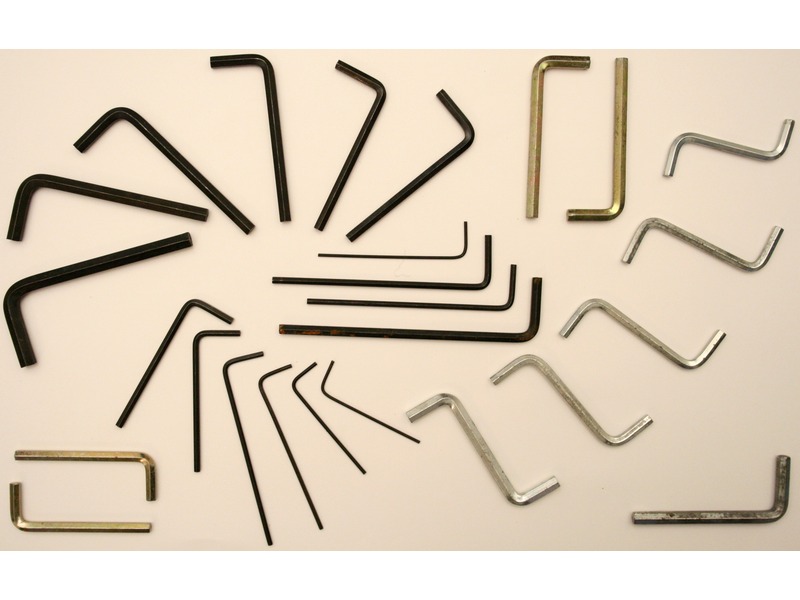
An L-key has two arms at a right angle. The user selects an arm based on access and leverage available from that model. Wera’s 950/9 datasheet labels its set as L-keys for hexagon socket screws and lists individual key lengths. Those labels describe handle form and reach; they do not say which fastener size the key fits.
A T-handle adds a crossbar grip at the end of a shaft. Klein lists T-handle hex keys. Wera’s 454 product sheet describes a T-handle hexagon screwdriver. A folding set stores multiple keys in a compact body. Klein’s 70540M product page identifies a folding set. Each form affects grip, storage, and access differently. None provides a universal torque rating.
Choose the form for access and handling.
- Use L-style as a compact direct key with two arm lengths.
- Consider T-handles where a fixed grip and shaft suit access.
- Use folding sets where storage and portability matter.
- Check shaft or arm dimensions for the exact model.
For a T-handle set, compare a sample against the actual work envelope before standardizing it.
Handle-form comparison
| Form | Main layout | Selection check |
|---|---|---|
| L-key | Two perpendicular arms | Which arm reaches and clears surrounding parts? |
| T-handle | Crossbar fixed to a shaft | Does grip width and shaft reach suit the station? |
| Folding set | Multiple keys pivot from a compact handle | Can the selected key open and align as required? |
3. How does the working end change the key’s use?
Match working end to a fastener’s recess. A straight hex end enters along the recess axis. A ball-end version may support angled access where its maker permits. Some manufacturers also sell a modified hex profile, such as Wera’s Hex-Plus on the named L-key family. These are end-profile choices, separate from whether a key has an L, T, or folding body.
Do not treat the ball as a universal angle rating or use a ball end beyond its published limits. Klein’s BLS9M page lists up to 25°; treat that as a model limit only. The ball-end vs straight hex key guide covers that detailed comparison. For different recess profiles, see Torx vs Allen; a similar outline does not make two profiles interchangeable.
Match tip and recess before considering access.
- Verify profile and size from the fastener drawing.
- Confirm any angled-entry limit from the exact maker page.
- Keep specialized profile names in the product specification.
- Do not assume a color sleeve identifies the tip material.
When access is tight, approve the specific end and key length together.
Working-end selection
| End profile | What to verify | Boundary |
|---|---|---|
| Straight hex | Recess profile and size | Requires aligned entry |
| Ball end | Maker’s permitted use and angle | No universal angle applies |
| Hex-Plus or other modified hex | Exact maker profile and compatible fastener | Do not treat every profile as identical |
| Torx or other star profile | Exact drive designation | Not a hex-key substitute |
4. How should reach and arm length affect selection?
Reach is a physical dimension, not a profile or size designation. An L-key’s short and long arms create different reach options. A T-handle’s shaft length affects clearance around the crossbar. A folding set’s usable blade length depends on its housing and selected key. Read model drawings and product specifications instead of relying on “long,” “extra-long,” or “extended reach” alone.
Klein’s BLS9M page lists key lengths from 4.5 to 8.78 inches separately from the set’s sizes. Those figures apply to that model. A buyer should record fastener size, shaft or arm length, grip envelope, and nearby clearance as distinct measurements.
Measure path to fastener, not key.
- Check reach from tool body to working end.
- Include nearby panels, walls, and neighboring fasteners.
- Record grip width and rotation clearance.
- Request a drawing when the work envelope is constrained.
Use a sample key in a representative fixture when dimensions determine the selection.
Reach and clearance
| Dimension | What it measures | Where to confirm |
|---|---|---|
| Key size | Fit across the hex working end | Fastener spec and size chart |
| Arm or shaft length | Reach along the key | Maker product page or drawing |
| Grip envelope | Space needed for hand or handle | Sample or product drawing |
| Rotation clearance | Room for the handle to turn | Assembly or fixture review |
5. Are hex keys the same as hex bits or sockets?
No, a direct hex key has its working end built into the shaft or handle. A hex insert bit has a separate shank for a bit holder or driver. A hex bit socket connects a driver interface to a socket body. “Hex” may name a fastener recess or accessory drive shank; specify both ends in an RFQ.
Wera’s 840/4 Z data sheet lists a hex bit with a 1/4-inch hex drive for compatible holders. That interface differs from a direct L-key, T-handle key, or folding key. Socket drive sizes covers square-drive interfaces, while Impact bits vs regular bits covers bit selection for powered tools.
Specify working and connection ends separately.
- State whether the tool is a direct key or insert bit.
- Name the holder, driver, or socket interface.
- Confirm fastener recess profile and size.
- Keep hand keys separate from powered-tool accessories.
Before ordering, compare the complete tool path from handle to fastener.
Interface comparison
| Tool | Fastener end | Tool connection |
|---|---|---|
| Direct hex key | Hex working tip | Integral shaft or handle |
| Hex insert bit | Hex bit tip | Hex shank fits holder or driver |
| Hex bit socket | Hex bit tip | Square drive fits ratchet or driver |
| T-handle hex key | Hex tip | Integral crossbar and shaft |
6. How should you choose a form for the job?
Start with fastener recess and surrounding access. An L-key may suit compact storage and two-arm reach. A T-handle may fit a station where a crossbar grip is useful. A folding set may suit field carry or a mixed-size kit. These are starting points, not universal rules: shaft length, end profile, handle envelope, and maker limits still determine suitability.
A T-handle can change how the operator holds and turns a fastener, but its shape does not set a guaranteed torque value. Follow maker instructions for fastener and application. For a screwdriver-style option, compare types of screwdrivers and confirm tip and interface match the fastener.
Let fastener and access guide form choice.
- Identify the recess and size system first.
- Check reach and rotation clearance in the assembly.
- Match grip form to use and storage requirements.
- Confirm any use limits for the exact key model.
Keep form, tip, reach, and set format in separate RFQ fields.
Form-selection cues
| Work condition | Form to evaluate | Evidence to request |
|---|---|---|
| Restricted reach | L-key or folding model | Arm length and clearance |
| Repeated access with fixed grip | T-handle | Shaft length and handle dimensions |
| Field kit with several sizes | Folding set | Key inventory and pivot clearance |
| Mixed access tasks | L-key set or modular kit | End profiles, sizes, and individual lengths |
7. What should you verify before using a hex key?
Confirm the key’s size and profile, then inspect its working end for rounding, burrs, bends, or visible damage. Confirm key engages its recess fully. Do not use a mismatched or damaged key because partial contact can harm the fastener or tool. For a folding model, confirm the selected blade opens and holds position as designed. Follow model-specific maintenance and storage instructions.
Do not infer insulation from a colored sleeve, plastic handle, finish, or brand. Klein’s BLS9M warnings state that this product is not insulated and cannot protect against electric shock. That warning is specific to the named set, but it also shows why appearance cannot establish electrical protection. Use only tools explicitly rated for any electrical application, following the relevant safety procedure.
Check the exact model and condition before engagement.
- Verify profile and size against the fastener.
- Reject rounded, bent, or otherwise damaged keys.
- Confirm folding blades remain secure in the selected position.
- Never infer insulation from color or coating.
If fastener engagement feels loose, stop and confirm the recess and key specification.
Pre-use check
| Check | Pass condition | Stop when |
|---|---|---|
| Profile and size | Full, close engagement | Key rocks or slips |
| Condition | Straight, undamaged working end | Tip is rounded, bent, or burred |
| Folding body | Key opens and remains positioned | Pivot or handle is damaged |
| Electrical rating | Exact product documentation supports task | Color or grip is the only evidence |
8. What should buyers include in a hex-key RFQ?
Specify fastener profile, size system, handle form, working-end type, reach, set composition, and packaging. Ask for model drawings or product data showing key lengths and handle dimensions. State whether the use involves angled entry, repeated access, field carry, or a holder/driver interface. Do not ask a supplier to infer torque capability, angle limits, insulation, or material from color.
For a powered accessory package, separate direct keys from bits and holders. Industrial maintenance repair tools and the mechanic tools list offer broader assortment context; keep hex-key item details specific to each SKU.
A clear RFQ prevents form, profile, and reach from collapsing into one label.
- State profile, size system, form, and tip style.
- Specify shaft or arm lengths separately.
- Request exact model documentation and use limits.
- Define set contents, holder, packaging, and sample review.
RFQ fields
| Field | Buyer specification |
|---|---|
| Fastener | Recess profile and size system |
| Key form | L, T-handle, or folding |
| Working end | Straight, ball, or maker-specific profile |
| Reach | Shaft or arm lengths and clearance |
| Set | Contents, holder, packaging, and sample criteria |
9. How can distributors organize different key families?
Store keys by profile, size system, and form so a user can tell a direct key from a bit. Keep L-keys in labeled holders, folding sets in their intended cases, and T-handles in a rack that protects the shaft and grip. Labels should state sizes and working ends. If a maker uses color coding, follow that maker’s published system instead of treating color as a shared industry standard.
For consumer assortment planning, hand tools for home repairs provides separate range context. It does not replace product documentation. Keep size labels consistent with the maker’s catalog and model documentation.
Good storage makes the correct interface easier to find.
- Separate metric and SAE sets.
- Label profile, form, and model number.
- Keep folding tools in the maker’s case.
- Remove damaged keys from shared inventory.
Storage and identification
| Storage group | Label | Control |
|---|---|---|
| L-key sets | Profile, size system, model | Return each key to marked slot |
| T-handles | Profile, size, shaft length | Protect handle and working end |
| Folding sets | Contents and model | Keep pivots clean and case intact |
| Bits and sockets | Fastener tip and drive interface | Store apart from direct keys |
10. How should you choose among types of hex keys?
Start with fastener recess and nearby access. Then choose L, T-handle, or folding form by reach, grip, and storage. Select working-end profile separately; verify model dimensions and restrictions. A bit or socket that shares a hex profile may still have a different tool connection.
Use the linked size and tip guides above for those detailed checks. Product questions can go through Contact Us. For a kit, match key to actual fastener and access path.
Approve a tool by interface, reach, and documented use.
- Confirm the fastener recess and measurement standard.
- Match handle form to access and operator needs.
- Separate key ends from bit and socket drives.
- Keep unsupported angle, torque, and insulation claims out.
Q1: What are the main types of hex keys?
Common handle forms include L-keys, T-handles, and folding sets. Working-end profiles and reach are separate choices.
Q2: Are ball-end keys a separate handle type?
No; ball end describes a working-end profile. It can appear on different handle forms; check model-specific limits.
Q3: Is a hex key the same as a hex bit?
No; direct keys have integral shafts, while hex bits fit separate holders or drivers.
Q4: Does a colored hex key indicate its steel or insulation?
No; color coding may identify sizes within one maker’s system, but it does not establish steel or electrical ratings.
Q5: What measurements belong in a hex-key RFQ?
Specify fastener profile, size system, handle form, working-end type, reach, set contents, and any required documentation.
Looking for a reliable mechanic tools manufacturer in China?
If you are sourcing hand tools, socket tools, automotive repair tools, mechanic tool sets or OEM private label tools, contact KOLARWIN Tools for factory-direct quotation, customization support and product consultation.



