Need OEM supplier support for this product type?
Contact KOLARWIN Tools for OEM mechanic tools, private label packaging, wholesale quotation and product range support. This gives overseas buyers a clear path from article reading to supplier discussion.
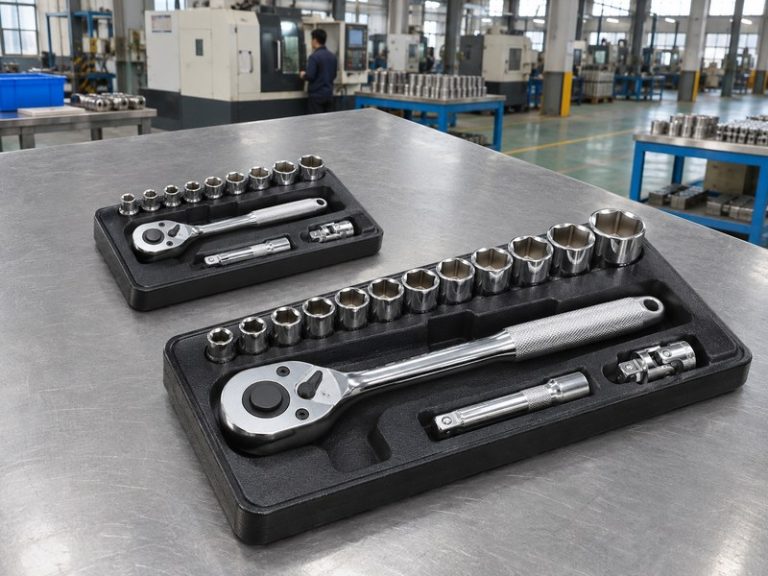
Socket organization means assigning every socket a visible, repeatable home that fits how a shop works. Mixed sockets slow technicians, hide shortages, and complicate kit replenishment. A practical system starts with drive size and measurement standard, then uses labeled rails, trays, or fitted cases. For distributors and workshop buyers, case layout also affects inventory checks, replacement planning, and private-label presentation. The guide below focuses on those decisions rather than socket size conversion.
1. How should a shop define its socket inventory?
Begin with a count by drive size, measurement system, socket type, and storage location. That simple inventory gives a buyer a view of what gets used and what sits untouched. Here’s the useful starting point: record each socket as an identifiable item rather than treating a mixed drawer as one kit. Track deep and standard sockets separately; mark impact sockets distinctly from hand-use sockets. Keep metric and SAE groups apart, even when both serve similar jobs.
For multiple bays or mobile technicians, record the assigned kit owner or work area. Count loose pieces and complete sets separately. A complete kit can appear full while one socket is missing and another has been substituted. Keep a short exception field for damaged, borrowed, or quarantined items. Avoid adding a new size range simply because a supplier offers it. Base replenishment on service tasks, equipment, and purchasing history.
Useful inventory fields include:
- Drive size and measurement standard
- Socket type, depth, and profile
- Item count, storage position, and condition
- Replacement status and responsible bay
| Inventory field | Why record it | Example entry |
| Drive | Separates tool families | 3/8 in |
| Standard | Prevents metric/SAE mix-ups | Metric |
| Form | Distinguishes application | Deep socket |
| Status | Supports replenishment | Replace |
2. How do you choose a storage method?
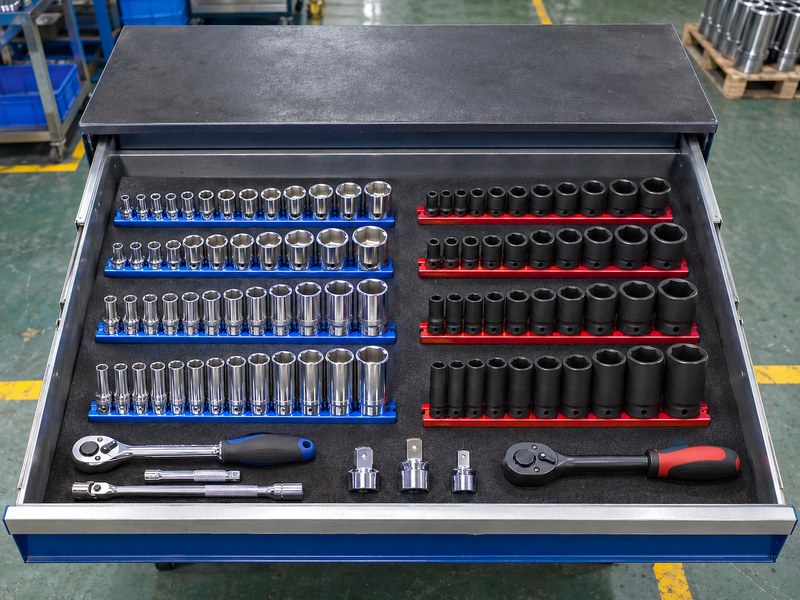
Choose rails, trays, or cases around the work pattern. A rail suits a technician who needs quick access and can return tools to a fixed drawer. A tray keeps a group together during bench work and supports a quick visual count. A fitted case travels well and presents a defined assortment, though missing pieces can disrupt the whole set. The deciding factor is movement: tools that stay at one bench have different storage needs from tools shared across bays.
Check available drawer depth, width, clearance, and whether a lid or neighboring drawer catches the organizer. For mobile service, consider closure security and whether each tool remains retained during transport. For wholesale assortment planning, consider case footprint, visible layout, labeling space, and whether a single replacement socket can be sourced separately. KOLARWIN’s socket tools range includes rails and accessories among its listed categories; confirm exact organizer options for a proposed configuration.
Before placing a volume order, request a sample layout or dimensional drawing. Load representative sockets and check reach, legibility, and retention. A quick fit check saves rework: test in the actual drawer or service vehicle.
| Method | Best fit | Buyer check |
| Rail | Fixed drawer access | Clip retention and label visibility |
| Tray | Bench-side grouping | Footprint and count-at-a-glance |
| Case | Transport or retail kit | Closure, fit, and replacement policy |
3. How should sockets be grouped for quick identification?
Group by drive size first, then by measurement standard, followed by socket profile and depth. This arrangement creates a predictable scan: a technician can identify the family before reading every size stamp. Keep metric and SAE sockets on separate rails or tray zones. Color can provide a secondary cue, but it should never carry the full identification burden because lighting, wear, and user preference vary.
Separate hand sockets from impact sockets. Their intended use differs, and a crowded shared rail can invite the wrong selection. Place frequently used standard-depth sockets in the easiest reach position; locate deep or specialty sockets nearby without blending them into the primary row. If a kit includes bit sockets or spark-plug sockets, give those a dedicated labeled area. Here’s the practical rule: use one grouping logic throughout every bay and replacement kit.
For product programs, decide whether markings appear on the socket, organizer, or both. Durable size markings support identification after a piece leaves its assigned slot. Organizer labels help restore order but cannot replace tool markings. KOLARWIN’s socket set category presents different drive families and set configurations; buyers should define their own group sequence in the approved packing specification.
| Grouping layer | Keep together | Keep separate |
| Drive | Same drive family | Different drives |
| Standard | Metric series | SAE series |
| Application | Hand-use sockets | Impact sockets |
| Profile | Standard or deep | Specialty bits and plugs |
4. How can a team keep metric and SAE sockets apart?
Use physical separation and plain labels. Put each standard in a different organizer, tray, or clearly divided case zone. Label the zone with “Metric” or “SAE” in readable type. A color convention may help a team, but labels and size stamps remain the dependable reference. Avoid relying on a technician remembering that one rail color means one standard.
When purchasing mixed kits, confirm both standards appear in the contents list and on the packaging. Ask the supplier to provide a clear component map; vague terms such as “mixed sizes” make receiving difficult. At goods-in, compare labels and piece counts with the approved list. At each bay, inspect whether borrowed sockets return to the correct standard zone. That small routine catches drift early: a misplaced socket can otherwise migrate through several drawers before anyone notices.
For private-label assortments, review the printed legend at actual size. Make sure abbreviations are familiar to target users and remain legible after the case closes. Keep metric and SAE groupings consistent across refills and replacement packs. A buyer can review KOLARWIN’s mechanics tool set configurations when planning a broader kit, then specify the standard split and case map in writing.
| Control | Shop practice | Procurement check |
| Separation | Dedicated zones | Confirm case map |
| Identification | Plain standard label | Review proof at size |
| Receiving | Count against list | Match label to contents |
5. What makes a socket organizer easy to read?
A readable organizer shows the group, size, and empty positions without forcing a user to lift every socket. Use labels that match the actual contents and place them close to the corresponding slots. Keep text short: drive, standard, and size range can often communicate more than decorative copy. Look at it from standing height: a label that works in a product photo may disappear inside a low drawer.
Check contrast under workshop lighting, spacing between labels, and whether a socket covers the marking when seated. Tool stamps should remain visible enough for verification. For a portable case, map slots in a consistent direction, such as small-to-large across each row. Leave no unexplained empty slots; mark reserved positions or remove them from the design. A blank slot can otherwise look like a missing component.
During a sample review, ask someone unfamiliar with the layout to return several sockets after use. Observe whether that person can identify each home without coaching. This is a simple usability check, not a performance certification. Buyers comparing hand tools and related workshop items can apply the same labeling discipline across adjacent storage systems.
| Readability element | Good practice | Warning sign |
| Labels | Near corresponding slots | Legend detached from tools |
| Sequence | Consistent size progression | Irregular row order |
| Empty slots | Identified or removed | Looks like missing stock |
| Markings | Visible for verification | Hidden when seated |
6. How do you stop sockets from moving or going missing?
Retention depends on the storage format and the movement expected. A fixed drawer rail may need only enough grip for normal handling; a vehicle case faces vibration and repeated carrying. Test the organizer under realistic handling before approving a design. Close and carry a case, open it in its intended orientation, and check whether pieces remain seated. Do not assume a product photograph proves retention.
Use a checkout habit for shared kits. Assign the case to a bay or technician, count sockets at shift change, and mark missing pieces promptly. A shadow outline or numbered slot can expose gaps quickly. Quarantine damaged tools rather than returning them to a full-looking row. Keep replacement parts and returns in a labeled holding area until checked.
The simplest control is visible ownership: name the bay or kit custodian on a removable tag. Avoid permanent labels that become inaccurate after reassignment. If multiple kits share parts, standardize their layout so a replacement socket returns to the same position everywhere. Buyers sourcing impact sockets should specify storage and intended application separately from material or finish requirements.
| Risk | Control | Review point |
| Vibration loss | Sample retention check | After carrying test |
| Borrowed items | Kit owner or sign-out | Shift change |
| Damage | Quarantine location | Before restocking |
| Layout variation | Common slot map | Each replenishment |
7. How should buyers plan case layout and stock control?
Treat the case as a stock-control surface. A fixed position for every component makes shortages visible during receiving, routine checks, and replenishment. Prepare a bill of contents with names, quantities, standards, and slot references. Match that list to case labels and any printed insert. For a retail kit, align packaging copy with actual contents; for a workshop kit, prioritize fast checking and easy replacement.
Decide whether replacement sockets will be purchased individually, in small packs, or only through complete sets. This affects total ownership cost and downtime when a piece disappears. Ask suppliers whether mixed-SKU packing is possible and how each inner pack will be identified. Here’s where procurement details matter: a well-designed case cannot compensate for ambiguous replenishment records.
If the kit includes sockets plus ratchets, extensions, or bits, reserve clear zones for each family. KOLARWIN’s socket tools page lists sockets and related accessories, while its automotive repair tools range covers adjacent service categories. Specify the intended combination rather than assuming a standard assortment fits every bay.
| Stock-control item | Record | Why it helps |
| Contents list | Item and quantity | Receiving accuracy |
| Slot map | Position per item | Fast missing-piece check |
| Reorder route | Replacement method | Less kit downtime |
| Pack label | SKU and standard | Fewer mix-ups |
8. What should a buyer check before approving a socket set?
Review the physical sample against a written specification. Confirm drive families, measurement standards, socket forms, quantity, labels, and organizer dimensions. Check each socket’s marking and fit in its assigned position. Inspect whether the case closes cleanly and whether latches, hinges, or rails suit expected handling. For a drawer organizer, compare dimensions against a real drawer rather than a nominal cabinet description.
Ask for clear product photos and a contents list for the sample configuration. If custom packaging or a private label is involved, review logo placement, color, barcode, and insert artwork before production. Request any inspection records that matter for your program and agree which checks apply. KOLARWIN describes OEM and packing support on its About page; buyers should confirm scope, sample process, and documentation for each order.
A written approval closes the loop: retain the final contents sheet, case map, and label artwork together. Use those documents at receiving and when ordering replenishment. For a mixed hand-tool package, compare the organizer plan with the broader industry solutions and intended maintenance environment.
| Approval check | Evidence to retain |
| Contents and count | Signed component list |
| Fit and retention | Sample review record |
| Labels and artwork | Approved proof |
| Case dimensions | Drawing or measurement sheet |
9. How can a shop maintain an organized socket system?
Set a short routine that fits existing work. At shift end, return sockets to mapped positions, flag empty slots, and move damaged pieces to quarantine. Once per week or at another practical interval, reconcile shared kits against their contents lists. Review repeat shortages before ordering replacements; a pattern may point to a layout issue, unclear ownership, or insufficient replenishment stock.
Keep the system stable when possible. If a new socket family arrives, update the map, labels, and purchasing record at the same time. Remove obsolete labels promptly. Train users on one rule: return each item to its marked location and report a gap instead of borrowing silently from another kit. A tidy drawer comes from a repeatable habit, not a one-time cleanout.
For larger programs, designate a buyer or tool-room owner to approve layout changes. Keep one reference kit or image record as the standard. KOLARWIN’s contact page gives buyers a route for discussing a proposed configuration; provide quantity, target market, packaging needs, and the desired contents map when requesting a quotation.
| Routine | Frequency | Record |
| Return and gap check | Each shift | Missing-item note |
| Kit reconciliation | Set interval | Count sheet |
| Layout revision | When contents change | Updated map |
| Replenishment review | Before reorder | Shortage history |
10. What is the best next step for organizing sockets?
Start with one representative drawer, cart, or portable case. Count what belongs there, group pieces by drive and standard, then test a rail, tray, or fitted case against actual working conditions. Ask users to retrieve and return tools without instruction. Their hesitation will expose unclear labels, awkward slot order, or poor placement faster than a polished product image can.
For a purchasing program, turn that trial into a clear specification: contents, layout, labels, case dimensions, replenishment method, and inspection records. Keep the approved map with the purchase record so later batches can be compared. Make changes only when a real task or stock issue justifies them. One consistent layout across kits helps users spot missing pieces and helps buyers manage repeat orders with fewer ambiguities.
Socket organization is a small operational decision with daily consequences. Choose storage around use, make each position legible, and connect the case map to inventory control. For a configured set or private-label discussion, send a supplier the contents list and storage requirements before asking for a sample.
FAQs
Q1: Should metric and SAE sockets share one rail?
They can if zones are clearly separated and labeled, but dedicated rails reduce mix-ups in busy shops.
Q2: Are socket rails or trays better?
Rails suit fixed drawers and quick access; trays support grouped bench work and visual counting.
Q3: How can a buyer check a case layout?
Compare a sample with the contents list, verify labels and dimensions, then carry and open it as users will.
Q4: What should a socket inventory record include?
Record drive, standard, form, quantity, position, condition, and replacement status.
Q5: How often should shared socket kits be counted?
Return tools and check gaps each shift; reconcile full contents at a cadence that fits usage.
Looking for a reliable mechanic tools manufacturer in China?
If you are sourcing hand tools, socket tools, automotive repair tools, mechanic tool sets or OEM private label tools, contact KOLARWIN Tools for factory-direct quotation, customization support and product consultation.