
Need OEM supplier support for this product type?
Contact KOLARWIN Tools for OEM mechanic tools, private label packaging, wholesale quotation and product range support. This gives overseas buyers a clear path from article reading to supplier discussion.
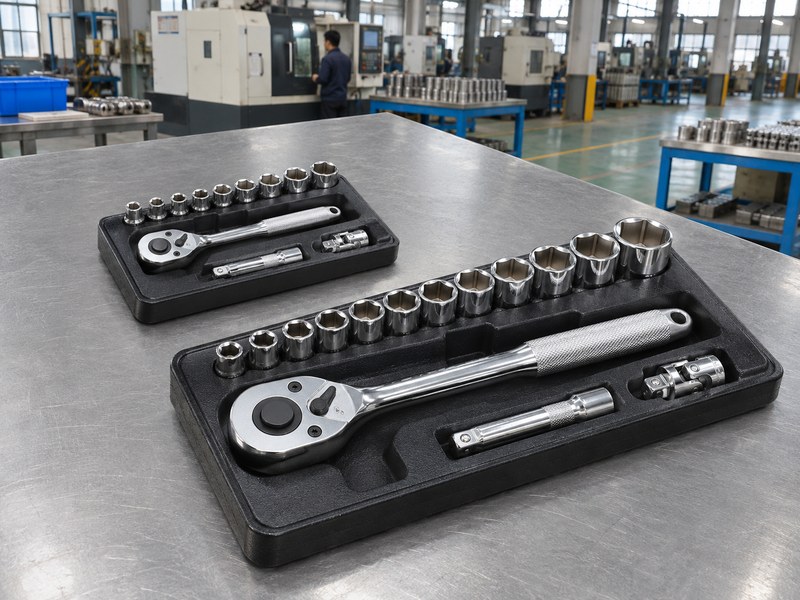
A 3/8-inch ratchet usually suits compact general-service kits, while a 1/2-inch ratchet supports a larger tool system when access and rated capacity permit. Choosing between them requires more than comparing handles. Buyers need a socket list, representative jobs, access measurements and documented tool limits before approving a workshop set.
1. What does 3/8 vs 1/2 ratchet actually compare?
The 3/8 vs 1/2 ratchet comparison concerns square-drive size, not fastener size or a universal torque rating. A drive connects your ratchet with its socket. Both systems can include sockets with overlapping fastener openings, so a particular nut size does not identify one mandatory drive.
Separate three dimensions before requesting quotes
Start with the interface. Your purchase specification should distinguish square drive, socket opening and overall assembly dimensions. Confusing these fields creates apparently comparable quotations for different tools. Use your socket tools range as a product map, then compare exact drawings and item lists.
- Record drive size separately from millimetre or inch openings.
- Include socket depth and outside diameter.
- Measure assembled head height with a representative socket fitted.
| Specification | What it tells a buyer |
| Square drive | Ratchet-to-socket interface |
| Socket opening | Fastener fit |
| Assembly envelope | Whether the tool reaches the work |
Key Takeaway: Require three separate specification fields before comparing prices.
2. When should a buyer choose a 3/8-inch system?
In a 3/8 vs 1/2 ratchet decision, a 3/8-inch system deserves consideration when routine work needs moderate tool bulk and broad socket coverage. Suitability still depends on each tool's rating and actual access. It should not be marketed as a universal solution for every automotive fastener.
Evaluate ordinary jobs with a sample kit
Check the work customers repeat. Ask service teams which fasteners they reach frequently and where larger heads become awkward. Select representative maintenance assemblies for a fit trial. A useful mechanics tool set should serve that workload without relying on several adapters for ordinary jobs.
- Record clearances around brackets and housings.
- Check whether markings remain visible during selection.
- Compare short and deep socket coverage against actual needs.
| Observed need | Buyer response |
| Limited working space | Compare actual head and socket dimensions |
| Repeated general maintenance | Build a task-based socket list |
| Frequent adapter use | Reconsider native drive coverage |
Key Takeaway: Choose a 3/8-inch kit from representative work, rather than a generic vehicle label.
3. When does a 1/2-inch system deserve its own kit?
The 3/8 vs 1/2 ratchet choice may favor a dedicated 1/2-inch kit when customers regularly use larger accessories and tools with appropriate documented capacity. Larger drive size alone does not authorize greater force. A specific ratchet, socket and extension must each suit the application.
Define the larger system without overselling it
Follow the complete assembly. A distributor serving heavier maintenance should assess socket coverage, tool length and accessory ratings together. Separate ordinary hand-ratchet work from powered impact work. Your automotive repair tools offer can explain these different jobs without treating every dark-finish socket as impact-rated.
- List larger sockets genuinely required by customers.
- Confirm access around surrounding components.
- Identify which tasks require a different tool altogether.
| Requirement | Evidence to request |
| Larger socket coverage | Itemized opening and depth list |
| Higher rated tool capacity | Applicable manufacturer documentation |
| Powered impact use | Explicit impact suitability for every component |
Key Takeaway: Specify a coherent larger tool system, rather than simply adding a longer handle.
4. Can drive size predict safe torque capacity?
A 3/8 vs 1/2 ratchet comparison cannot establish safe torque capacity by itself. Material, heat treatment, geometry, mechanism design and condition all matter. Rated performance belongs to a defined product and test method, not to every tool sharing a nominal drive size.
Ask for evidence that matches the ordered model
This is where specifications matter. Request the maker's applicable limits and supporting documentation for each model under consideration. Confirm whether a cited test describes proof loading, durability or another property. A single impressive number should not become an operating instruction for a mixed kit.
- Match documents with model identifiers and revisions.
- State how damaged tools will be removed from service.
- Keep controlled final tightening within an appropriate torque-tool process.
| Supplier statement | Follow-up question |
| High torque | What limit and use conditions apply? |
| Tested | Which model, method and acceptance criteria? |
| Strong steel | What finished-tool evidence supports that claim? |
Key Takeaway: Compare documented performance and conditions, not drive-size folklore.
5. How should buyers compare socket coverage?
For 3/8 vs 1/2 ratchet kits, compare useful fastener coverage before headline piece count. Two sets can contain the same number of pieces yet cover very different tasks. Repeated bits, alternative depths and adapters can change that count without filling a missing socket size.
Build a coverage matrix that reveals gaps
Count useful combinations. Create a row for each required opening and columns for drive, depth and profile. Mark which combinations customers actually use. Review your proposed socket set configuration against that matrix and ask suppliers to list every included component separately.
- Separate metric and inch opening requirements.
- Identify skipped sizes inside a quoted range.
- Keep accessory counts visible beside socket counts.
| Quotation field | Why it belongs in the comparison |
| Individual openings | Reveals gaps hidden by a range |
| Depth by size | Shows whether recessed work is covered |
| Accessories listed separately | Prevents misleading piece-count comparisons |
Key Takeaway: Approve a component schedule that technicians can check against their work.
6. Do adapters replace buying both drive systems?
Adapters make some 3/8 vs 1/2 ratchet combinations physically possible, but they do not remove component limits or access constraints. A reducer does not increase a smaller tool's capacity. Extra connections also alter assembly height and may make work less convenient.
Treat adapters as planned accessories
Check the added height. Trial the complete combination before listing an adapter as a standard solution. A mixed hand tools assortment should explain which accessories fit which system and whether they are intended for hand use. Avoid promising compatibility beyond the maker's instructions.
- Confirm both ends of each adapter.
- Check socket retention and release.
- Identify the limiting component in each intended assembly.
| Adapter question | Procurement action |
| Does it physically fit? | Trial representative samples |
| Does it clear nearby parts? | Measure the assembled envelope |
| Is the application permitted? | Check every component's instructions |
Key Takeaway: Buy adapters for defined occasional needs, not as substitutes for a coherent kit.
7. What sample checks expose handling problems?
A practical 3/8 vs 1/2 ratchet trial should assess selection, fit, retention, reversal and access under controlled conditions. These checks complement documented performance testing. They cannot certify torque capacity or replace formal acceptance criteria.
Use the same trial sequence for both samples
Let operators compare like with like. Use representative sockets and fixtures for both candidates. Ask technicians to note awkward release buttons, unclear direction controls or excessive bulk. Keep dangerous overload demonstrations out of a procurement trial. Match checks with the actual industry applications served by your customers.
- Fit and release several representative sockets.
- Check reversing controls in restricted space.
- Record visible damage and inconsistent engagement.
| Check | Record |
| Socket attachment | Retention and release observations |
| Direction control | Accessibility and positive operation |
| Restricted access | Measured clearance and operator notes |
Key Takeaway: Keep a repeatable observation sheet for every approved sample.
8. How should a mixed-drive case be organized?
The 3/8 vs 1/2 ratchet decision affects case design because users must distinguish overlapping socket openings across different drives. Separate zones and readable markings make the kit easier to check. Packaging should retain components during ordinary handling without hiding missing pieces.
Trial a loaded case, not an empty shell
Open it after transport. Inspect how representative tools sit after agreed handling checks. Confirm that socket labels remain visible and that loose accessories cannot migrate between compartments. For a wider tool supply discussion, bring the component schedule and proposed case arrangement together.
- Keep different drives in distinct rows or zones.
- Reserve clear locations for reducers and extensions.
- Check loaded case weight and latch operation.
| Case feature | Sample check |
| Dedicated locations | Missing pieces are identifiable |
| Retention | Tools remain seated under agreed handling |
| Clear organization | Operators distinguish both drive systems |
Key Takeaway: Approve packaging with actual tools installed and documented acceptance checks.
9. What belongs in the purchase specification?
A 3/8 vs 1/2 ratchet purchase specification should identify the application, bill of materials, tool dimensions, applicable performance requirements and packaging. It should also state how sample approval carries into production acceptance. This prevents substitutions that preserve piece count while changing usefulness.
Give suppliers one controlled specification
Write down what cannot change. Include model references and the revision of each approved component list. Ask suppliers to identify proposed substitutions before production. Use your procurement enquiry to resolve missing details, rather than assuming catalog photographs define a complete specification.
- List sockets, ratchets and accessories individually.
- Define marking, packaging and inspection requirements.
- Record change approval and replacement arrangements.
| Document | Purpose |
| Component schedule | Controls configuration |
| Approved sample record | Captures agreed handling and finish |
| Inspection plan | Defines measurable acceptance checks |
Key Takeaway: Attach controlled documents to the order rather than relying on a product photograph.
10. Which system should your business order?
Choose your 3/8 vs 1/2 ratchet offer around customer tasks, suitable rated tools and verified access. A compact general-service line and a separate larger-system line may serve distinct buyers. A combined kit makes sense when its contents and case justify carrying both.
Turn the comparison into a sample request
Make the next quote comparable. Prepare two component schedules and ask for samples against the same acceptance process. Compare useful coverage, handling and replacement support before comparing price. To discuss a KOLARWIN Tools configuration, contact us with your task list and required sizes.
- Define the customer workload.
- Approve the complete tool assembly.
- Order against a checked component schedule.
Key Takeaway: Buy the system your customers can use and verify, with limits stated clearly.
Frequently asked questions
Q1: Can I use a 1/2-inch socket on a 3/8-inch ratchet?
An appropriate adapter can provide a physical connection. Follow every component's limits and check added height; the adapter does not increase ratchet capacity.
Q2: Is a 1/2-inch ratchet always stronger?
No. Compare specific tools and documented ratings. Drive size alone does not establish safe working capacity or durability.
Q3: What's the best drive size for a mixed workshop?
There is no universal choice. Map common tasks and clearances, then decide whether one system or two coherent sets provide useful coverage.
Q4: How do I know whether a socket is impact-rated?
Check its identification and manufacturer documentation. Finish color, drive size or material wording alone does not prove impact suitability.
Q5: Should I choose the set with more pieces?
Choose useful coverage. Compare individual sizes, depths, accessories and replacement options before using total piece count as a purchasing criterion.
Looking for a reliable mechanic tools manufacturer in China?
If you are sourcing hand tools, socket tools, automotive repair tools, mechanic tool sets or OEM private label tools, contact KOLARWIN Tools for factory-direct quotation, customization support and product consultation.


