Need OEM supplier support for this product type?
Contact KOLARWIN Tools for OEM mechanic tools, private label packaging, wholesale quotation and product range support. This gives overseas buyers a clear path from article reading to supplier discussion.
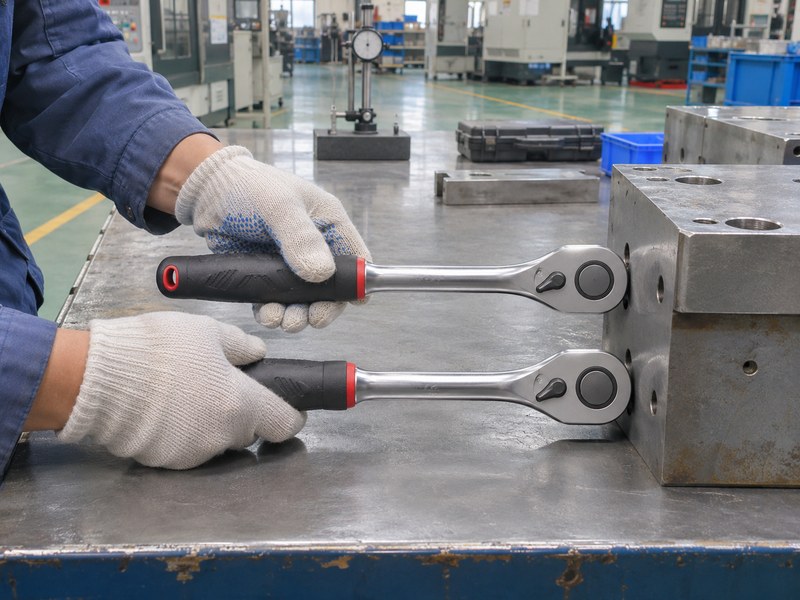
A ratchet’s tooth count describes its internal gear teeth, not a direct measure of strength. For a nominal single-pawl mechanism, 72 teeth correspond to a 5-degree theoretical increment, while 90 teeth correspond to 4 degrees. That one-degree difference can matter in cramped spaces, though actual engagement and tool design also count. Buyers should compare access, durability evidence, handle dimensions, serviceability, and the intended job before choosing a ratchet for a shop or product assortment.
1. What does ratchet tooth count mean?
Tooth count refers to the number of teeth on the ratchet gear. As the handle moves, a pawl engages the gear and allows rotation in one direction while driving in the other. A higher count places teeth closer together around the gear. In a nominal single-pawl model, dividing 360 degrees by tooth count gives a theoretical increment: 360 ÷ 72 = 5 degrees; 360 ÷ 90 = 4 degrees.
That figure helps describe potential handle movement between nominal gear positions. It does not by itself tell you how smoothly a ratchet will operate, how much force it can handle, or how long it will last. Pawl geometry, gear design, manufacturing quality, lubrication, materials, and fit all affect tool behavior. Here’s the key distinction: tooth count describes indexing resolution, while strength needs separate design evidence.
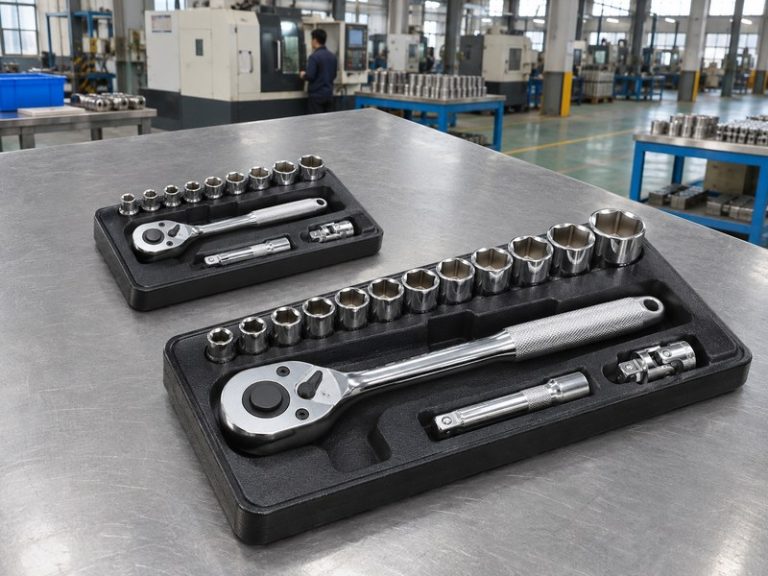
For a product listing or purchasing specification, use the maker’s stated tooth count and mechanism description. Avoid converting a theoretical angle into a guarantee about minimum movement in every actual stroke. KOLARWIN’s socket tools range lists ratchets alongside sockets and accessories; confirm the exact mechanism and specifications for any proposed model.
| Nominal tooth count | Calculation | Theoretical increment |
| 72 | 360 ÷ 72 | 5° |
| 90 | 360 ÷ 90 | 4° |
2. How does a 72 tooth ratchet compare with a 90 tooth ratchet?
Using the nominal single-pawl calculation, a 72-tooth ratchet indexes in 5-degree increments; a 90-tooth ratchet indexes in 4-degree increments. The 90-tooth version therefore offers one degree finer theoretical spacing per position. When a fastener sits near a panel, bracket, or obstruction, that smaller increment may help the handle find another engagement point sooner.
The difference is modest in open work. If a technician can swing the handle through a broad arc, reach and handle length may matter more than one degree. In restricted access, every possible repositioning angle can help, but the head’s outside dimensions and clearance around the handle still decide whether the tool fits. A fine tooth count cannot compensate for a bulky head or an obstructed swing path.
What does that mean in practice? Compare the ratchet in the space where it will be used. A buyer evaluating workshop assortments should weigh handle shape, head profile, drive size, and application along with tooth count. KOLARWIN’s socket set category can inform broader set planning, but verify each ratchet specification for the actual configuration.
| Comparison point | 72 tooth | 90 tooth |
| Nominal theoretical increment | 5° | 4° |
| Potential advantage | Finer than coarser designs | One degree finer than 72T |
| Still requires checking | Head size and swing clearance | Head size and swing clearance |
3. Why can a smaller swing angle matter?
A fastener in an open engine bay or on a clear workbench gives a ratchet room to move. Behind a bracket, close to a firewall, or between machine components, the handle may travel only a short arc before hitting an obstruction. A smaller theoretical engagement increment can give the user more opportunities to reposition and continue turning without removing the socket.
This benefit depends on the ratchet’s real mechanism. A gear count alone does not guarantee that every small handle movement will engage the next tooth under load. The user also needs enough room for the pawl to engage and the handle to reset. Head thickness, neck shape, socket length, extension use, and fastener orientation all affect access.
Use tooth count as one screening criterion, then try the tool in representative work positions. A mock-up beats guesswork: test beside a similar obstruction or fixture before standardizing a model across multiple bays. For automotive applications, KOLARWIN’s automotive repair tools page provides context for adjacent service-tool categories, while the ratchet choice should remain tied to the specific task.
| Work condition | What to evaluate | Why |
| Open access | Handle length and comfort | A broad swing may be available |
| Tight obstruction | Head profile and increment | Repositioning room is limited |
| Recessed fastener | Socket and extension fit | Stack height can block access |
4. Does a 90 tooth ratchet have more strength?
Tooth count alone does not establish a ratchet’s strength. A 90-tooth gear has more teeth than a 72-tooth gear, but that fact does not prove greater torque capacity, longer life, or higher durability. Those outcomes depend on gear and pawl dimensions, material, heat treatment, tolerances, handle construction, and how loads are applied. A finer tooth mechanism may use different component geometry, but no universal strength conclusion follows from count alone.
Compare published torque ratings only when they apply to the exact model and test method. Review manufacturer instructions, warranty terms, and any stated limitations. Do not use a ratchet as a breaker bar unless its manufacturer permits that use. A cheater pipe or impact tool can impose loads beyond the intended operating conditions.
Keep the claims clean: request model-specific evidence rather than inferring performance from a headline number. For a sourcing project, the impact sockets category is relevant to impact-rated socket applications, but impact sockets do not make a hand ratchet suitable for impact use. Specify intended tool type and application separately.
| Claim | What supports it | Tooth count alone? |
| Engagement increment | Gear count and mechanism | Yes, as nominal arithmetic |
| Torque rating | Model-specific test data | No |
| Service life | Design, materials, use, and evidence | No |
| Warranty | Published terms | No |
5. Which tooth count works better in a crowded tool assortment?
For a workshop or distributor, the better choice depends on users’ jobs and the assortment’s role. A general-purpose ratchet used mostly in open spaces may not gain much from a one-degree theoretical difference. A specialist tool intended for tight access may benefit from finer indexing, provided its head geometry and operating feel suit users. A buyer should also consider whether technicians can obtain replacement parts or another matching ratchet when a tool leaves service.
Standardizing one model can simplify training, maintenance, and replenishment. Offering two configurations may make sense when different teams face distinct access constraints. Avoid stocking variants without a reason: more models can complicate labels, inventory records, and replacements. Gather feedback from the technicians who use the tools, then compare their reported access issues with sample trials.
Keep the assortment tied to work: identify applications, users, and storage locations before choosing a tooth count. KOLARWIN’s mechanics tool set range presents complete kit configurations; buyers should define whether a ratchet is a standard component or a task-specific upgrade.
| Assortment approach | Benefit | Trade-off |
| One standard model | Simpler stocking | May not fit every access condition |
| General plus fine-tooth option | More task coverage | More SKUs and training |
| Task-specific kits | Clear intended use | Requires disciplined replenishment |
6. What else should you compare besides tooth count?
Compare drive size, head dimensions, handle length, grip, direction switch, finish, and serviceability. Drive size should match the socket family and expected fastener work. A compact head may fit where a larger head cannot, while a longer handle changes leverage and reach. Grip shape and texture affect comfort, especially over repeated tasks. Switch location and direction markings should be easy to operate with the user’s normal hand position.
Check whether the tool is repairable and whether replacement parts are available in the intended market. For fleet or industrial maintenance programs, repair options can influence lifecycle planning. Ask how the maker identifies model revisions, so replacement orders do not silently change dimensions or components.
For a broader sourcing comparison, align these criteria with the package and documentation requirements. KOLARWIN’s hand tools range includes other workshop tools that may be grouped in a procurement program. One specification sheet keeps comparisons honest: list all requested features in a common format instead of letting one prominent metric dominate.
| Feature | Buyer question |
| Drive size | Does it match the planned sockets? |
| Head profile | Will it fit representative access points? |
| Handle and grip | Can users hold and swing it comfortably? |
| Serviceability | Are parts or repair routes documented? |
7. How should a buyer evaluate ratchet samples?
Test samples under the intended conditions without exceeding manufacturer instructions. Check direction switching, socket retention, handle clearance, and operation through the available arc. Try representative fasteners in open and restricted positions. Note any difficulty resetting the handle or identifying the switch direction. Compare tools side by side using the same socket and task where practical.
Record observations rather than relying on a vague impression such as “feels better.” Include model identification, drive size, stated tooth count, head dimensions, and the work condition used. Ask the supplier for product drawings, model-specific specifications, and applicable test records. Make sure marketing language does not substitute for evidence about torque capacity or durability.
A documented trial is repeatable: another technician or purchasing reviewer can check the same points. Buyers sourcing a mixed set can also inspect the full socket tools assortment and identify which accessories are included or optional. Confirm contents and packaging in writing before approval.
| Sample check | Record |
| Access test | Fastener position and obstruction |
| Operation | Switch, reset, and socket retention |
| Identification | Model and stated tooth count |
| Supporting material | Drawing and relevant records |
8. What should procurement ask a ratchet supplier?
Request the exact model number, drive size, stated tooth count, head dimensions, handle length, and intended-use instructions. Ask whether the mechanism uses a single pawl or another design before treating 360 divided by tooth count as its engagement spacing. Confirm whether quoted specifications apply to the supplied model and production revision. If the ratchet will be part of a set, request the complete component list and case layout.
Clarify sample availability, order quantities, packaging, labeling, inspection scope, and replacement arrangements. Any minimum order or delivery estimate should be tied to the specific product and project. For OEM or private-label work, review logo placement, color, barcode, and instruction materials against an approved proof. KOLARWIN’s About page describes its stated supply and OEM scope; confirm project details directly before relying on a capability for a specific order.
Ask for written answers: they give purchasing and receiving teams a common reference. KOLARWIN’s contact page provides a route for inquiries; include market, quantity, packaging, and ratchet requirements in the request.
| Procurement question | Written confirmation |
| Which exact model? | Part number and revision |
| What mechanism and count? | Stated design and tooth count |
| What dimensions? | Drawing or specification |
| What set contents? | Approved component list |
9. How should ratchets be stored and maintained?
Store ratchets where users can identify and return them without mixing drive sizes or models. A shadowed drawer, labeled case, or mapped tool board helps reveal missing equipment. Keep clean hand ratchets separate from tools intended for impact applications. Avoid leaving tools exposed to moisture, dirt, or damaging contact with loose heavy parts. Follow the manufacturer’s cleaning and lubrication instructions rather than applying an unverified maintenance routine.
Inspect tools at a cadence appropriate for use. During manufacturer-authorized servicing, check any visible teeth for damage, abnormal movement, a loose direction switch, or a handle issue. Remove a questionable ratchet from service and have it assessed according to the maker’s guidance. Do not attempt improvised repairs that could alter engagement or safe operation.
For kit buyers, include storage position and inspection responsibility in the maintenance plan. KOLARWIN’s industry solutions page addresses industrial maintenance procurement context; set the inspection schedule to match local procedures and actual tool use. Consistent storage supports consistent checks.
| Maintenance practice | Purpose |
| Labeled storage | Helps locate and return tools |
| Visual inspection | Flags visible damage |
| Maker-directed care | Avoids unsupported service steps |
| Quarantine | Keeps questionable tools out of use |
10. How should you decide between 72 and 90 teeth?
Use the calculation as a starting point: nominally, 72 teeth give 5-degree spacing and 90 teeth give 4-degree spacing for a single-pawl mechanism. If cramped access is common, compare both models in representative positions. If work is mostly open, other factors may outweigh that difference. Head profile, handle clearance, comfort, stated specifications, and service support deserve direct review.
Do not infer strength from tooth count. Request model-specific ratings or test evidence for any performance claim, and use tools only as directed. For a procurement decision, document the required applications, sample findings, dimensions, packaging, and replenishment plan. Standardize the choice when it serves users consistently; maintain a second model only when distinct work conditions justify it.
Make the decision on the job: place both samples beside a representative fastener and compare access, reset, and user preference. Then record the approved model and source its exact specification for repeat purchasing.
FAQs
Q1: What angle does a 72-tooth ratchet represent?
For a nominal single-pawl calculation, 360 divided by 72 equals 5 degrees.
Q2: What angle does a 90-tooth ratchet represent?
For a nominal single-pawl calculation, 360 divided by 90 equals 4 degrees.
Q3: Is a 90-tooth ratchet stronger?
Tooth count alone does not establish strength; compare model-specific design and test evidence.
Q4: Which ratchet is better in tight spaces?
A finer nominal increment may help, but head size and actual clearance also determine access.
Q5: What should buyers verify before ordering?
Confirm model, mechanism, tooth count, dimensions, use instructions, set contents, and packaging in writing.
Looking for a reliable mechanic tools manufacturer in China?
If you are sourcing hand tools, socket tools, automotive repair tools, mechanic tool sets or OEM private label tools, contact KOLARWIN Tools for factory-direct quotation, customization support and product consultation.