
Need OEM supplier support for this product type?
Contact KOLARWIN Tools for OEM mechanic tools, private label packaging, wholesale quotation and product range support. This gives overseas buyers a clear path from article reading to supplier discussion.
Hex key size names the width across flats of its hex tip, not thread diameter or arm length. Separate metric and inch charts help identify replacements without guessing from a screw’s M-size. A unit conversion alone does not approve a fit; use the specified size for the socket.
1. What does a hex key size number measure?
A hex key size is the nominal width across flats (AF) of its hex end: the distance between two opposite, parallel faces. ISO 2936 describes this dimension separately from the width across corners and from each arm length. That distinction matters in a catalog because a 4 mm key still has a 4 mm AF working end whether its long arm is standard, long, or extra-long. The key’s end may also be straight, ball-end, chamfered, or rounded, while AF remains the primary size label. When a fastener has an internal hex socket, match the socket’s specified key size, not the screw’s outside thread diameter. The wrench sizes guide covers across-flats sizing for external heads; internal-hex key size is a separate fit field.
Keep size, end style, and length in separate fields. Record what the working end measures, then add form and reach. A product description should distinguish:
- AF size and unit system.
- Straight or ball-end configuration.
- Short-arm and long-arm dimensions.
If an old key has no marking, measure across the flats with a suitable caliper and verify against the socket.
Hex key dimensions
| Dimension | What it describes | Catalog label |
|---|---|---|
| Across flats | Width between parallel faces | Hex key size, mm or inch |
| Across corners | Distance between opposite vertices | Not the nominal key size |
| Arm length | Reach from bend to tip | Short arm / long arm |
| End form | Straight, ball, chamfer, or other tip | State separately from AF |
2. Which metric hex key sizes are commonly used?
ISO 2936:2014 specifies hexagon socket screw keys and gives nominal widths across flats in millimeters. Its metric series supports identification and replacement; retail sets carry only selected values from the size range. For example, the Klein hex-key catalog lists metric sets containing selected sizes such as 1.5, 2, 2.5, 3, 4, 5, 6, 8, and 10 mm. That set contents list is one product example, not an assertion that every set includes each standard size. Check a current supplier catalog or fastener drawing for the actual requirement. If your inventory system supports a chart, keep the metric column independent from inch sizes rather than placing “closest equivalents” on the same row.
Use the series as a lookup, then confirm the fastener. ISO’s chart is a size reference; the maker’s set list shows what a particular SKU contains. Read the table as nominal AF in millimeters, then check package contents.
- Keep each size labeled in millimeters.
- Verify included sizes against the named set SKU.
For a standard-conforming key, consult the standard’s dimensions, designation, and test requirements.
Metric hex key sizes (AF)
| Group | Metric AF sizes (mm, ascending) |
|---|---|
| Small | 0.7, 0.9, 1.3, 1.5, 2, 2.5, 3, 3.5 |
| Medium | 4, 4.5, 5, 6, 7, 8, 9, 10, 11, 12 |
| Larger | 13, 14, 15, 16, 17, 18, 19, 21, 22, 23 |
| Largest | 24, 27, 29, 30, 32, 36 |
3. Which SAE or inch hex key sizes should a chart show?
Inch hex key sizes are often labeled as common fractions, while some product lines also use decimal-inch marks for smaller keys. Keep each value in the exact form shown by its manufacturer. Klein’s L-style key catalog, for instance, lists sizes from 0.050 inch through 5/16 inch in one product family; a Pro Folding set includes larger entries up to 1/2 inch. These examples demonstrate that set contents vary. A short chart can cover sizes often seen in common SAE assortments, but should not imply every listed size ships in one caddy. Avoid converting a nearby metric value and calling it interchangeable. A fractional-size tool and a metric tool can differ enough to loosen, round, or damage a socket under load.
Read the mark on both the key and holder. A mixed set can place inch and metric keys side by side, so keep slots and records distinct. The chart combines common Klein catalog examples; not every size ships in one set.
- Preserve the exact fraction or decimal marking.
- Check set contents before promising a size.
Check the maker’s package list before promising those sizes in an included set.
SAE / inch hex key sizes (ordered)
| Order | Inch AF size |
|---|---|
| 1 | 0.050 in |
| 2 | 1/16 in |
| 3 | 5/64 in |
| 4 | 3/32 in |
| 5 | 7/64 in |
| 6 | 1/8 in |
| 7 | 9/64 in |
| 8 | 5/32 in |
| 9 | 3/16 in |
| 10 | 7/32 in |
| 11 | 1/4 in |
| 12 | 5/16 in |
| 13 | 3/8 in |
| 14 | 1/2 in |
4. Are metric and inch hex keys interchangeable after conversion?
No. Arithmetic conversion compares units; it does not approve a tool substitution. One inch equals exactly 25.4 millimeters, but that relationship does not mean a nominal 1/8-inch key can replace a 3 mm key. A conversion result may fall between available nominal sizes, and socket tolerances, wear, or the fastener’s specified system affect fit. Treat metric and inch sets as separate inventories. If a drawing lists millimeters, select a metric key; if it specifies an inch size, select that size. For an older or undocumented assembly, identify the socket by its drawing, part data, or a careful AF measurement rather than selecting the nearest converted key. The ball-end versus straight hex key guide covers end style separately from unit choice.
Keep conversion notes out of the fit field. If a spreadsheet needs unit conversion for reference, preserve the original nominal size beside the converted number. Check:
- Original drawing unit and nominal key size.
- Socket condition and fit during a controlled trial.
- Whether a supplier’s set is metric, inch, or mixed.
Do not relabel a converted value as the replacement size.
Conversion versus fit
| Record | Appropriate use | Not proof of |
|---|---|---|
| Exact unit conversion | Arithmetic comparison | Key/socket interchangeability |
| Nominal metric size | Selection for metric callout | Fit on an inch socket |
| Nominal inch size | Selection for inch callout | Fit on a metric socket |
5. Can the screw’s M size tell you which hex key to use?
No universal M-thread-to-key-size lookup works across all fastener head styles and standards. “M6” identifies a nominal metric thread diameter; it does not by itself name an internal-hex AF dimension. A socket-head cap screw, low-head screw, set screw, or proprietary part can use different head geometry or a different drive. ISO 2936 standardizes key dimensions within its stated scope, while the fastener drawing or product standard identifies a screw’s drive. Check both documents rather than guessing from the thread. A supplier listing that says only “M6 screw” is incomplete if the assembly needs a replacement key. Record socket profile and AF alongside thread and length. The Torx versus Allen comparison distinguishes drive profiles; this page does not repeat that comparison.
Read the head specification, not only the thread. For a fastener, verify:
- Thread designation and pitch when relevant.
- Head style and drive profile.
- Hex socket AF size or maker part number.
For a replacement, match the drawing or confirmed original component.
Fastener-to-key identification
| Fastener information | What it tells you | What to confirm separately |
|---|---|---|
| M thread callout | Nominal thread diameter | Drive profile and socket AF |
| Head style | Screw-head form | Internal-hex dimension if present |
| Part or drawing number | Exact product reference | Revision and replacement status |
6. Does a ball end change the hex key size?
No. A ball-end key retains a nominal AF size, but its rounded end changes how it contacts the socket and may allow angled entry within the maker’s stated limits. It is an access feature, not a different size system. Use a straight end for square insertion when access permits; use a ball end only as its manufacturer allows. Do not assume ball-end access suits every torque level or damaged socket. Klein’s product catalog labels ball-end and standard L-style families separately, which is a useful catalog distinction. For an explicit geometry comparison, use the ball end versus straight hex key guide; here the point is to keep AF size and end style in separate fields.
Choose the end for access after confirming size. A correct AF measurement remains the first check. Then specify:
- Straight or ball-end working tip.
- Any required approach angle from the maker’s instructions.
- Key length and access envelope.
If a tool will be used at an angle, confirm its maker’s limits before use.
End-style record
| End style | Contact description | Catalog note |
|---|---|---|
| Straight | Full straight hex section enters socket | State AF and end treatment |
| Ball end | Rounded end permits angled access | State AF and maker’s allowed angle |
| Chamfered | Entry edge is relieved | Does not change nominal AF |
7. How do you measure a hex key if its marking is worn?
Measure the straight hex section across two opposite parallel flats, not across corners. A caliper gives a practical reading; compare the result with the nominal size chart and then verify the fit in the correct socket. Dirt, burrs, corrosion, or wear can alter the reading and the fit. Avoid measuring on a ball end, chamfer, or worn tip because those surfaces may not show nominal AF. ISO 2936 distinguishes across-flats size from across-corners dimension, reinforcing why vertex-to-vertex measurements do not identify nominal key size. If measurement falls between chart sizes, do not force the closest key. Check the fastener drawing or source a correct replacement. The wrench sizes reference explains an external across-flats measurement; for an internal hex key, measure the key’s own parallel faces.
Measure the intact working section. Keep the caliper square to the flats and record units. For a worn key:
- Check several points along the straight end.
- Compare readings with the nominal metric or inch chart.
- Confirm with a matching socket or part drawing.
Replace a rounded key instead of compensating with force.
Measurement method
| Measurement | Correct reference | Common error |
|---|---|---|
| Hex key size | Across parallel flats | Measuring across corners |
| Arm length | Bend to tip along each arm | Treating length as AF size |
| Worn tool | Undamaged straight section | Measuring ball tip or damaged end |
8. Do short-arm and long-arm dimensions change key size?
No. Arm dimensions describe reach and access, while AF describes the working-end width. ISO 2936 lists arm lengths separately from width across flats. Manufacturer catalogs also distinguish short-arm and long-arm lengths for a given hex size. A long-arm key may reach a recessed socket, while a short arm may fit a confined side clearance; neither changes nominal fit. When comparing kits, check whether a manufacturer’s listed lengths are measured to the bend, tip, or full tool outline as shown in its drawing. Folding holders add bulk that may block access even when the key’s hex tip fits. The types of socket wrenches guide describes a different driven tool format; do not confuse square-drive size with hex-key AF.
Choose reach after the AF size is set. Match the available envelope around the fastener. Capture:
- Short-arm and long-arm dimensions.
- Clearance above and beside the socket.
- Holder or folding-handle dimensions if supplied.
Request a dimensioned drawing when storage or access affects selection.
Length and access fields
| Field | Meaning | Buyer check |
|---|---|---|
| AF | Hex working-end size | Match socket callout |
| Short arm | Reach of shorter leg | Side clearance |
| Long arm | Reach of longer leg | Recess depth and swing |
| Holder envelope | Set storage dimensions | Drawer or panel fit |
9. What should a hex-key set or replacement RFQ include?
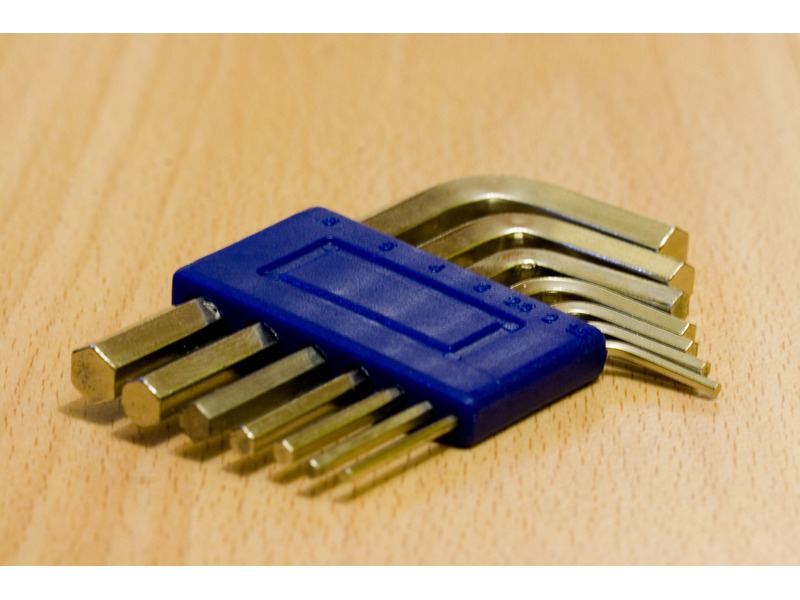
List sizes as separate metric or inch values, then identify end form and length. State whether the order is for a full set, an individual replacement, or a caddy refill. Include holder type, size markings, key count, packaging, and any required drawing or standard. Do not claim exact set contents from a product photo; use the maker’s package list. A visible holder mark helps users return each key to its slot, but label wording should match the keys actually supplied. For assortment planning, the custom socket set design guide and complete mechanic tools list for distributors cover broader kit considerations. Share part data through KOLARWIN’s contact page for a sourcing discussion.
Make set contents auditable. Ask for the exact included sizes and verify them against a catalog sheet or sample. A hex-key RFQ should state:
- Metric or inch sizes, each listed explicitly.
- AF, straight or ball end, and arm-length preference.
- Holder, labeling, set count, material, and model documentation.
Confirm any standard or material claim against the named product data.
Hex-key RFQ checklist
| RFQ field | Example format | Evidence to request |
|---|---|---|
| Size system | Metric / inch (SAE) | Size list and marking plan |
| Key sizes | Individual nominal AF values | Maker catalog or drawing |
| Construction | L-style, folding, T-handle | Model and end style |
| Set contents | Count, holder, labels, packaging | BOM or approved sample |
10. How can buyers keep hex-key size records clear?
Keep metric and inch sizes separate, with nominal AF, end style, and arm length in distinct fields. Do not pair “nearest” sizes as substitutes; thread, photo, or color does not confirm socket AF. The types of wrenches overview supports broader tool organization without merging drive systems. Verify any chart against manufacturer data and set contents before release.
Keep the chart tied to the SKU. A short, accurate list beats a longer list that promises unverified sizes. Review one sample and its catalog record together before approval.
- Keep metric and inch lists separate.
- Record AF, end style, and arm lengths individually.
- Verify included sizes against the exact package list.
Q1: What does a hex key size refer to?
It refers to the nominal width across flats of the working hex end, not the key’s arm length or the screw’s thread diameter.
Q2: Which metric hex key sizes are common?
Many sets include 1.5, 2, 2.5, 3, 4, 5, 6, and 8 mm. ISO 2936 lists a broader standardized range.
Q3: Can I use the closest inch key in a metric socket?
No. A numerical conversion does not establish interchangeable fit. Match the socket’s specified system and nominal AF size.
Q4: Does an M6 screw always use one specific hex key?
No universal mapping applies. Thread diameter alone does not identify head style or internal-hex size.
Q5: Does a ball-end key have a different AF size?
No. Ball end describes tip geometry; AF remains the nominal size. Confirm angled-use limits with the key maker.
Looking for a reliable mechanic tools manufacturer in China?
If you are sourcing hand tools, socket tools, automotive repair tools, mechanic tool sets or OEM private label tools, contact KOLARWIN Tools for factory-direct quotation, customization support and product consultation.



