Need OEM supplier support for this product type?
Contact KOLARWIN Tools for OEM mechanic tools, private label packaging, wholesale quotation and product range support. This gives overseas buyers a clear path from article reading to supplier discussion.
Choosing clamps by name alone can leave gaps in a distributor’s range: two products may look similar yet solve different access, reach, or pressure problems. This guide groups common types of clamps by frame and holding action, then connects each family with workpiece geometry and buyer checks. The classifications follow manufacturer product families and safety guidance; model ratings and compatible accessories still require their own documentation. For a wholesale range, compare the task first, then define opening, throat, contact faces, adjustment method, materials, and packaging in the RFQ.
1. What makes one clamp type different from another?
Clamp names often describe frame shape, rail arrangement, or closing mechanism. A C-clamp uses a rigid C-shaped frame and threaded spindle. An F-clamp or bar clamp slides one jaw along a rail before screw pressure closes the gap. A parallel-jaw clamp uses a bar frame too, yet its jaw design targets alignment across a broader face. Pipe-clamp fixtures place a head and tail assembly on compatible pipe. These labels describe construction; they do not establish load capacity, duty class, or suitability for every material. BESSEY’s catalog separates C-clamps, bar clamps, parallel systems, pipe fixtures, spring clamps, strap clamps, and specialty models, which helps show why “clamp” alone is a weak product description. A distributor should group products by buyer task and distinguish families that need separate fit checks. For the wider assortment context, see our wholesale woodworking clamp selection guide.
Start with the mechanism, then check the geometry. Ask a buyer what must stay in place, how far jaws must reach, and whether setup speed or broad contact matters more. Typical comparison points include:
- Frame or rail type and how its movable jaw travels.
- Maximum opening, throat depth, and clear access around a handle.
- Contact-pad shape, material, swivel action, or replaceable accessories.
- Adjustment method: screw, trigger, spring, strap, or locking linkage.
For an RFQ, request a model drawing and exact product-family name before comparing quoted specifications.
Clamp family at a glance
| Family | Holding mechanism | Best first fit question |
|---|---|---|
| C-clamp | Screw advances through a fixed frame | Can its throat reach the contact point? |
| F or bar clamp | Sliding arm and screw or quick action on a rail | Does its opening and rail suit the span? |
| Parallel-jaw clamp | Bar frame with broad jaws designed for alignment | Does the assembly need broad, square contact? |
| Pipe-clamp fixture | Heads mount on compatible pipe | Which pipe and thread does this model require? |
| Spring, band, corner, hand-screw | Spring, strap, angle, or opposing screws | Which shape or speed constraint dominates? |
2. Which clamp families suit different workholding tasks?
Match clamp action to shape and access. C- and F-clamps suit point or edge pressure where a frame can reach around the work. Parallel-jaw models support panel or case assemblies where broad faces and alignment matter. Pipe fixtures can offer configurable span through compatible pipe systems. Spring clamps provide fast, lighter holding for short tasks; hand-screw models offer adjustable wood jaws; band clamps wrap around frames; corner clamps help bring two parts together at an angle. Locking plier-style clamps grip localized areas through a toggle linkage. None of these names alone guarantees a force rating. Manufacturer data, pad design, frame material, and the intended task define the practical limit. Consider whether operators need one-handed setup, repeatable positioning, delicate-face protection, or many clamp points along a long assembly. A home-repair overview covers consumer examples in popular clamp options for small home repairs, while a wholesale range needs documented model distinctions.
Treat “holds the part” as the start of the selection. Then check what could shift, mark, or block access during the operation. Buyers can screen options with these questions:
- Is pressure applied at a point, along an edge, or around a perimeter?
- Must the clamp stay in place during cutting, gluing, assembly, or service?
- Does the process call for rapid temporary holding or controlled screw adjustment?
- Can the frame clear the workpiece and nearby fixtures without an extension?
When an operation needs measured pressure or a safety-rated fixture, route that requirement to engineering rather than inferring it from a clamp family.
Task-to-family shortlist
| Workholding need | Families to compare | Confirm before selection |
|---|---|---|
| Local edge or bench hold | C-clamp, F-clamp | Throat, opening, pad, frame clearance |
| Wide panel or case assembly | Parallel-jaw, bar, pipe fixture | Jaw geometry, span, alignment, support |
| Quick temporary hold | Spring clamp, lever clamp | Opening, spring action, rated application |
| Irregular perimeter | Band or strap clamp | Strap length, corner blocks, tension method |
| Two-part corner assembly | Angle or corner clamp | Supported angle range and part thickness |
3. How do C-clamps differ from F-clamps and bar clamps?
A C-clamp keeps its frame fixed while a spindle advances toward an opposing anvil. It can apply pressure in a compact footprint, but throat depth limits reach. BESSEY recommends choosing a C-clamp whose maximum capacity only slightly exceeds work thickness, and warns against over-tightening or using damaged clamps. F-clamps and other sliding-arm bar clamps use a rail with one movable jaw; that arrangement can span wider parts while retaining a screw or quick-adjust action. “F-clamp” and “bar clamp” can overlap in everyday naming, so product data should state exact rail and jaw design. Fixed-bar models differ from pipe fixtures because their rail belongs to the clamp assembly. The dedicated bar clamp versus pipe clamp comparison explains that distinction in more detail. For buyers, frame depth and opening matter as much as nominal size. A deeper throat can reach farther across a workpiece, but that alone says nothing about safe pressure or stiffness.
Measure how the frame enters the job. Note the farthest contact point, workpiece thickness, and any obstruction behind the edge. Compare:
- C-frame throat depth and maximum opening.
- Sliding rail length, jaw travel, and end-stop design.
- Spindle reach, swivel-pad movement, and handle clearance.
- Manufacturer limits for tightening method and service conditions.
For a trial, place the clamp on a sample assembly without forcing parts together; the clamp should hold a suitable fit, not correct a poor one.
C-frame and sliding-rail comparison
| Check | C-clamp | F or bar clamp |
|---|---|---|
| Frame | Fixed curved frame | Rail with sliding jaw |
| Main fit limit | Throat depth and opening | Rail span and jaw travel |
| Typical buyer question | Can the spindle reach the contact point? | Does the rail clear the full assembly? |
| Data needed | Frame, spindle, pad, capacity | Rail profile, jaw type, opening, throat |
4. When should buyers consider parallel-jaw or pipe-clamp systems?
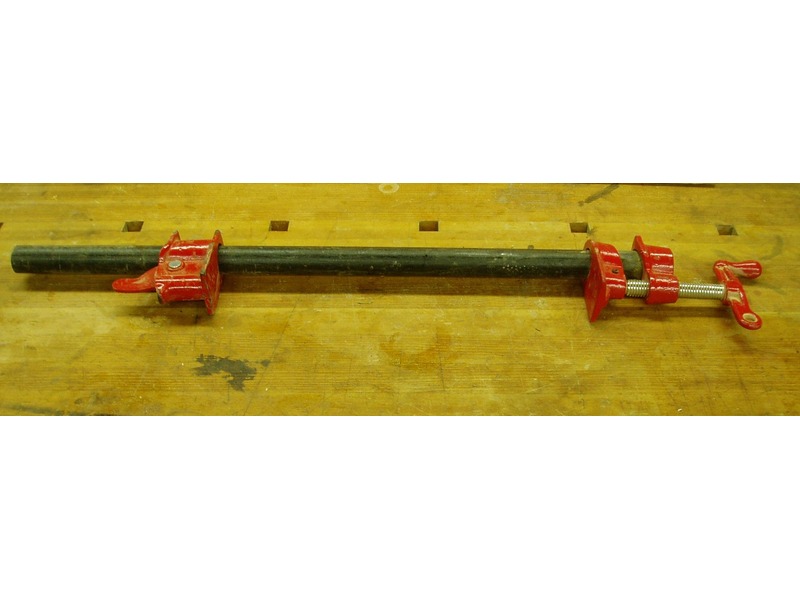
Parallel-jaw clamps and pipe fixtures both support broader assemblies, yet their constructions differ. A parallel-jaw clamp has a dedicated rail and jaw system intended to keep pressure faces aligned during use. BESSEY describes “parallel” as nominal behavior: its FAQ notes a small toe-in at rest for one family, while alignment is intended under clamping pressure. Buyers should avoid promising perfect geometry without model data. Pipe-clamp fixtures attach a head and tail to compatible pipe, letting the pipe form the long span. Compatibility remains model-specific. Pony’s #50 manual, for example, identifies 3/4-inch NPT pipe; its #52 fixture calls for 1/2-inch NPT pipe. Those figures illustrate why nominal pipe size and thread details belong in the RFQ. They do not apply to every fixture. Check included heads, stops, pads, pipe supply, and thread requirements as a matched system. A buyer should also compare throat, handles, and storage needs before choosing a longer setup.
Keep rail alignment and pipe compatibility as separate checks. Request the relevant drawing or manual for each model. Then confirm:
- Parallel jaw description and contact-face dimensions.
- Pipe designation, outside diameter, thread, and supplied components.
- Working span, throat, handle access, and any support requirement.
- Whether pads, end stops, or accessories are part of the quoted kit.
Do not infer plumbing pressure suitability from a pipe-clamp fixture or use clamp ratings as lifting capacity.
Parallel-jaw versus pipe fixture
| Buyer criterion | Parallel-jaw clamp | Pipe-clamp fixture |
|---|---|---|
| Span structure | Dedicated rail | Compatible pipe plus fixture heads |
| Jaw behavior | Model-specific parallel design | Depends on fixture head and setup |
| Main compatibility issue | Rail, jaw, accessory fit | Pipe size, OD, thread, head fit |
| Request from supplier | Drawing and jaw specification | Manual and pipe interface details |
5. Where do spring clamps and hand-screw clamps fit?
Spring clamps open when handles are squeezed and close when released. They suit quick placement when a task needs temporary holding and the model’s opening and spring action fit the material. They are not a substitute for a screw clamp when an operation depends on documented pressure or controlled adjustment. Hand-screw clamps use two threaded spindles, often with wooden jaws, so operators can adjust jaw angle and opening independently. That can help with shaped assemblies or work where a metal jaw may contact a delicate face. Both families occupy different assortment roles: spring clamps favor quick handling; hand-screw designs favor adjustment flexibility. Buyers should verify jaw material, pivot range, pad coverage, opening, and replacement parts. For a broader list of household tasks and tools, the home-repair hand-tool guide provides consumer context; wholesale specifications still need model-level evidence.
Look at how often operators reposition the clamp. A fast spring action may suit a repetitive temporary hold, while independent screws can handle awkward angles with more setup time. Review:
- Jaw opening and depth against actual workpiece dimensions.
- Contact surface and risk of marking, slipping, or crushing material.
- Spring, pivot, and screw components that require maintenance.
- Whether sample testing matches the intended process and operator method.
For a new SKU, record the intended use in catalog copy and avoid translating “quick” into an unsupported load claim.
Spring versus hand-screw clamp
| Feature | Spring clamp | Hand-screw clamp |
|---|---|---|
| Adjustment | Squeeze handles; spring closes jaws | Adjust two screws independently |
| Setup character | Fast repositioning | More deliberate alignment |
| Fit check | Opening, spring action, pad | Jaw material, screw travel, pivot |
| Buyer question | Is a temporary quick hold enough? | Must the jaws adapt to an angle? |
6. What do band clamps and corner clamps hold well?
Band clamps wrap a strap around a frame or perimeter and tension it through a mechanism. They can distribute a holding arrangement around multiple sides, but corner blocks or pivoting heads affect contact and alignment. BESSEY’s strap-clamp instructions describe setting corner pieces around a workpiece, removing slack, then tightening its handle. That method is model-specific; review the included instructions before writing usage copy. Corner and angle clamps use a frame or jaws to bring parts together at a corner, often during frame or cabinet assembly. Buyers should verify supported part thickness, angle range, contact-pad design, and whether one clamp or a pair forms a usable kit. Neither family replaces a fixture designed for a load-bearing or safety-critical operation. For wholesale selection, photograph the actual accessory arrangement and list which blocks, straps, screws, or handles ship in each package.
Trace pressure around the whole assembly. A band may wrap broadly but still skew a frame if tension or corner contact differs. A corner clamp may position two parts yet obstruct fasteners or finishing. Check:
- Workpiece perimeter and whether strap length covers it.
- Corner-block shape and movement under tension.
- Supported angle, thickness, and assembly orientation.
- Package contents, replacement straps, pads, and instructions.
Ask for a sample assembly or clear application drawing when kit contents are not obvious from the listing.
Band and corner clamp fit
| Family | Geometry to measure | Possible sourcing gap |
|---|---|---|
| Band clamp | Perimeter, strap travel, corner positions | Strap or corner blocks sold separately |
| Corner clamp | Included angle, thickness, joint access | Pair count or accessories unclear |
| Strap fixture | Tension handle, pivot heads, slack range | Instructions or replacement strap omitted |
| Miter clamp | Frame profile and miter access | Jaws may suit only specific shapes |
7. How are locking clamps different from locking pliers?
“Locking clamp” can describe a workholding clamp with a latch or toggle mechanism; “locking pliers” usually describes pliers whose jaws close and lock around a localized object. Product catalogs sometimes blur these terms, so name the mechanism and intended workpiece clearly. Toggle clamps, for example, mount to a bench or fixture and hold a repeat position; locking pliers travel by hand and grip a smaller area. They are not interchangeable in a process plan. A hose clamp tool is another separate category: hose clamp pliers operate hose-clamp fasteners, while bench workholding clamps secure a workpiece. For hand-held locking plier jaw options, see how to use locking pliers. Buyers should compare jaw opening, pad shape, lever travel, mounting method, and release action, then verify whether the product is intended for repetitive fixture use or occasional local grip.
Describe the job before choosing the word “locking.” If a clamp will mount to a workstation, request its base pattern and actuation details. If a hand tool will grip a part, state the part shape and access limits. Compare:
- Toggle or latch action versus hand-held plier linkage.
- Fixed mounting holes, jaw opening, and release clearance.
- Contact pad, jaw profile, and adjustment screw range.
- Intended application and safe-use instructions from its maker.
Catalog taxonomy should keep specialty pliers in their own family, even when their jaws lock.
Locking-mechanism comparison
| Product family | How it stays closed | Typical buyer fit check |
|---|---|---|
| Toggle clamp | Linkage locks on a mounted base | Mounting pattern and stroke |
| Locking pliers | Hand-held jaw linkage locks locally | Jaw profile, opening, release access |
| Screw clamp | Threaded spindle applies adjustable pressure | Throat, opening, spindle travel |
| Hose clamp pliers | Tool manipulates a hose-clamp fastener | Fastener style, cable or jaw access |
8. Which dimensions and load details should distributors compare?
Start with capacity dimensions: opening, throat depth, rail or strap length, jaw travel, and clearance around handles. Then inspect the contact system: pad size, swivel action, jaw width, and material. Ask whether pads or accessories can be replaced and how each component is packaged. If a maker publishes force or load data, keep it attached to the exact model and test conditions; never transfer a rating across visually similar products. BESSEY’s selection sheet cautions that nominal values apply to its own products and calls for a safety margin. It also identifies opening, throat depth, clamping force, and physical size as selection factors. This supports a procurement checklist, not a generic clamp-rating table. Compare coatings and corrosion information only where supplier documentation provides it. For industrial tool range planning, the industrial maintenance and repair tools guide can help organize adjacent categories without conflating their specifications.
Put every number beside its source and model. A spreadsheet field labeled only “capacity” can mix jaw opening, load limit, nominal force, and pipe length. Define each field in the data sheet. Include:
- Model number, frame material, finish, and included accessories.
- Maximum opening, throat depth, jaw dimensions, and total length.
- Published force or load terminology, unit, and model-specific source.
- Packaging, spare-pad availability, and instruction language when confirmed.
For validation, compare a supplier’s drawing with a physical sample and record discrepancies before catalog release.
Distributor comparison fields
| Data field | Why capture it | Evidence |
|---|---|---|
| Opening and throat | Defines workpiece reach and fit | Drawing or model table |
| Jaw or pad details | Shows contact coverage and replaceability | Parts list or close-up image |
| Force or load term | Prevents ratings being mixed | Exact maker specification |
| Accessories and pack | Defines sellable unit | BOM, carton, or sample |
| Instructions | Supports correct handling | Current model manual |
9. What should a clamp RFQ include?
A useful RFQ describes both the product and its job. State clamp family, intended workpiece, target opening and throat, contact material, adjustment method, expected use frequency, and required accessories. Add model drawings or reference photos when a buyer needs a specific jaw or rail profile. For pipe fixtures, include compatible pipe designation, thread, and whether pipe ships with the kit. For band or corner systems, define strap length and corner pieces. Ask suppliers to identify which values are measured, nominal, or published ratings. Specify packaging, labeling, spare parts, language, and sample approval steps only when your business needs them; do not presume MOQ or production lead time. An RFQ should also flag prohibited uses when product copy could be misread as lifting or transport equipment. Send dimensional questions through KOLARWIN’s contact page with a drawing and target market. This keeps the response focused on a defined configuration rather than a vague request for “heavy duty clamps.”
Make uncertainty visible in the quote. Ask suppliers to mark unavailable data instead of filling gaps with assumptions. Your RFQ can request:
- Exact model, clamp family, drawing, and instruction sheet.
- Opening, throat, pad type, material, finish, and included parts.
- Any published force or load rating with source and stated conditions.
- Sample, packaging, spare parts, and quotation assumptions.
Before approval, match every quoted attribute against the same model code and retain a record of changes.
Clamp RFQ checklist
| RFQ field | Buyer entry | Supplier response |
|---|---|---|
| Application and workpiece | Material, shape, process | Recommended family and limits |
| Dimensions | Opening, throat, clearance | Drawing and model dimensions |
| Contact and adjustment | Pad, jaw, screw, spring, strap | Exact configuration and parts |
| Rating or safety data | Required term and use | Model-specific documentation |
| Commercial details | Packaging, sample, market | Quote assumptions and exclusions |
10. How should a buyer build a practical clamp assortment?
Build an assortment around distinct workholding jobs rather than a row of similar-looking sizes. A core line might separate compact C-clamps, sliding-arm bar clamps, parallel-jaw systems, compatible pipe fixtures, quick spring models, and specialty band or corner products. Add locking or fixture-mounted products only where a documented buyer task supports them. Keep family names, dimensions, accessories, and published ratings in separate catalog fields so customers can compare like with like. Do not promise universal compatibility, pressure, or use cases. Samples and current manufacturer data should resolve fit questions before a listing claims them. For distributor planning, the broader clamp hub and the related clamp options for home repairs can help separate trade and consumer needs. The next step is concrete: send one sample application, one dimensional drawing, and your target configuration for review.
Choose each SKU for a distinct gap. Compare overlap in opening, throat, contact shape, adjustment speed, and accessories before adding another model. A practical review should:
- Map each proposed clamp to a named process or buyer segment.
- Identify duplicate products with no clear dimensional or mechanism difference.
- Confirm data and packaging for the exact sellable model.
- Gather buyer feedback from sample evaluation before expanding the range.
Use a documented shortlist with required dimensions and target market for the next product review.
Q1: What are the main types of clamps?
Common families include C-clamps, F- or bar clamps, parallel-jaw clamps, pipe-clamp fixtures, spring clamps, hand-screw clamps, band clamps, corner clamps, and locking or toggle clamps. Exact names and model uses vary by manufacturer.
Q2: What is the difference between an F-clamp and a C-clamp?
A C-clamp has a fixed C-shaped frame and spindle. An F-clamp slides one jaw along a rail, which can accommodate a longer span when its model dimensions fit.
Q3: Are bar clamps and parallel clamps the same?
Parallel-jaw clamps are a subtype of rail clamp with a documented jaw design. A general bar clamp does not automatically have parallel jaws.
Q4: Can any pipe be used with a pipe-clamp fixture?
No. Use pipe size, outside diameter, thread, and configuration specified for that exact fixture model.
Q5: What information should I provide when sourcing clamps?
Share clamp family, application, opening, throat, jaw or pad details, adjustment method, required accessories, target market, and any model-specific rating documentation you need.
Looking for a reliable mechanic tools manufacturer in China?
If you are sourcing hand tools, socket tools, automotive repair tools, mechanic tool sets or OEM private label tools, contact KOLARWIN Tools for factory-direct quotation, customization support and product consultation.