
Need OEM supplier support for this product type?
Contact KOLARWIN Tools for OEM mechanic tools, private label packaging, wholesale quotation and product range support. This gives overseas buyers a clear path from article reading to supplier discussion.
A hex key’s shape changes reach, grip and the way a user applies force. L-keys fit tight spaces and offer two working arms; T-handles give a palm grip and a straight axis for repeated turning. Neither form wins for every maintenance task. Buyers should compare fastener access, key engagement, storage, size range and user workflow. ISO 2936 covers hexagon socket screw keys, while manufacturer catalogues show distinct L-key and T-handle formats. This guide helps distributors specify the geometry customers actually need.
1. How do T-handle and L-handle hex keys differ?
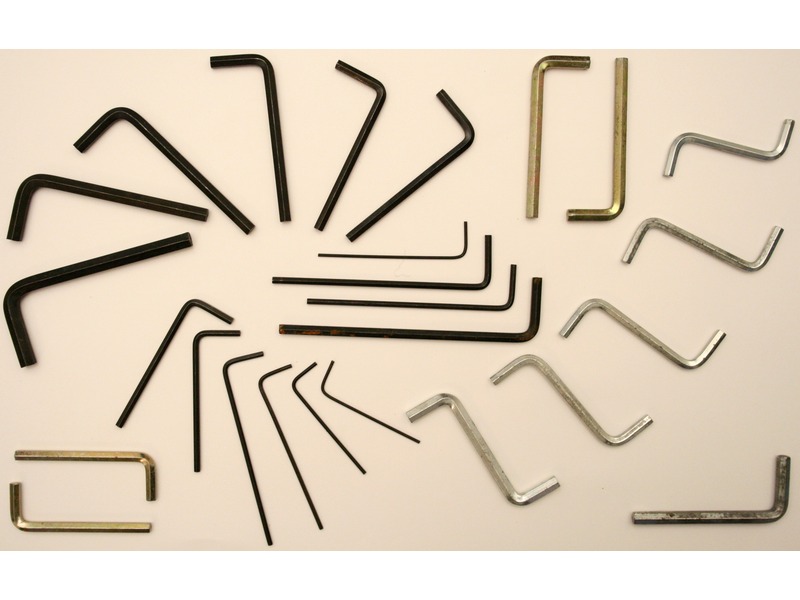
An L-key has a long arm and a short arm joined at a right angle. A T-handle places a crossbar grip above a straight shaft. Both can engage a hex socket, but they offer different access and hand positions. ISO 2936 addresses hexagon socket screw keys; buyers should state dimensions and applicable product claims rather than treating handle shape as a substitute for size accuracy.
The overview in types of hex keys places these two handle forms within a wider assortment.
Two arms create two access options.
- Check the L-key short-arm approach first.
- Then confirm the long-arm swing path.
| Format | Common advantage | Buyer concern |
|---|---|---|
| L-key | Compact and reversible | Arm clearance |
| T-handle | Direct grip | Crossbar clearance |
| Both | Hex engagement | Correct key size |
2. Where does an L-key work best?
The short arm can reach a fastener where a handle or crossbar would collide with nearby structure. The long arm can also provide reach, while the short arm offers a different lever arm. Users can flip the key to change orientation. The trade-off is a smaller grip surface and less comfortable repetition for some tasks. Buyers should check whether the long arm can swing through the required arc without striking surrounding parts.
Choose end geometry separately using ball-end vs straight hex keys; handle shape alone does not describe the working tip.
Reach is useful only if the key can turn.
- Map the obstruction around the short arm.
- Turn the key through a full usable arc.
| Access check | Trial | What to observe |
|---|---|---|
| Short arm | Close obstruction | Can tool enter? |
| Long arm | Swing arc | Can user rotate? |
| Flip | Repositioning | Does it clear? |
3. What does a T-handle add?
A T-handle provides a crossbar grip that can support turning with one or both hands, depending on the task. The straight shaft may help keep the key aligned with an accessible fastener. Yet the crossbar needs room to rotate, and a fixed handle may not fit a narrow channel. Wera’s catalogue shows T-handle products with specific features such as holding functions; do not assume every model has them.
A straight shaft still needs room for its grip.
- Measure crossbar clearance before choosing T-handles.
- Confirm shaft length and special features by model.
| T-handle feature | Buyer check | Implication |
|---|---|---|
| Crossbar | Length and shape | Requires side clearance |
| Shaft | Reach and size | Confirm fastener access |
| Holding feature | Model-specific | Verify catalogue |
4. How should torque and leverage be compared?
Handle form influences grip and applied leverage, but it does not establish a safe torque value. The fastener, key size, material and user force all matter. A longer lever can encourage greater applied force, which may damage a small fastener or tool if the task calls for controlled tightening. Use the fastener or equipment specification for torque requirements and choose the key as a fit tool. Do not publish an unverified torque rating based on handle shape.
Where controlled tightening is required, consult the torque wrench guide and select a suitable calibrated system.
Leverage is not a torque specification.
- Use fastener specifications for torque targets.
- Do not infer a rated value from arm length.
| Factor | T-handle | L-key |
|---|---|---|
| Grip | Crossbar handhold | Direct arm grip |
| Leverage | Two-hand grip possible | Arm length changes |
| Torque claim | Requires data | Requires data |
5. What matters for hex socket engagement?
Both forms depend on matching the key size and keeping the working end fully seated. A ball-end L-key may permit angled access on some models, while a straight end usually supports direct engagement. The angle and use limits are model-specific. Do not assume ball ends suit high-load tightening simply because they reach around an obstruction. Ask for geometry and intended-use information, then trial the actual fastener.
The comparison in Torx vs Allen helps prevent a star recess from being mistaken for a hex socket.
Start with hex key sizes so handle preference does not hide a size mismatch.
Access must not defeat engagement.
- Seat the key fully before testing angled entry.
- Use ball ends only within the maker’s stated limits.
| End style | Use case | Verification |
|---|---|---|
| Straight | Direct insertion | Seat fully |
| Ball end | Angled access where designed | Confirm use limits |
| Size | Metric / inch | Check fastener |
6. How should materials and finish be specified?
Ask for the exact material and finish stated by the supplier, plus any applicable standard or test documentation. Color coding can support size identification but does not prove material, hardness or torque capacity. Inspect the working ends for burrs, rounding, coating defects and clear size marks. If a supplier makes a wear or corrosion claim, request model-specific evidence before repeating the claim in product listings.
Color coding is not material proof.
- Request grade and finish evidence by SKU.
- Inspect end condition and size marks on samples.
| Data item | Request | Inspection |
|---|---|---|
| Material | Named grade if specified | Document scope |
| Finish | Supplier description | Surface check |
| Color | Size identification | Legible marks |
7. Which handle is easier to stock and replace?
L-keys commonly lend themselves to sets held by a rail or compact case, while T-handles occupy more individual space and are often sold by size or in a rack. Packaging changes shelf footprint, picking, replenishment and loss control. Ask distributors how customers replace missing sizes and whether they prefer individual tools or a complete set. A lower unit cost may not outweigh a range that is hard to organize at point of use.
The families covered in types of wrenches can help distributors organize adjacent tools without treating their interfaces as interchangeable.
Packaging changes replenishment.
- Compare set rail footprint with individual racks.
- Ask distributors how customers replace a missing size.
| Channel question | L-key set | T-handle range |
|---|---|---|
| Storage | Compact holder possible | Rack or larger slot |
| Replenishment | Replace individual keys | Size-specific items |
| Display | Set organization | Size visibility |
8. How should buyers choose for a work cell?
Map the fastener locations, required swing arc, operator posture and change frequency. A T-handle may suit repetitive fastening where the crossbar clears the fixture. An L-key may fit service work with varied angles or restricted access. If a cell needs controlled tightening, pair the hex interface with an appropriate torque tool rather than assuming a hand key controls torque.
Use the tasks in a complete mechanic tools list to decide whether compact service keys or repetitive-assembly handles need priority.
Let the fixture decide the handle.
- Trial both formats at the actual work cell.
- Use a torque instrument when the process specifies one.
| Work factor | Question | Record |
|---|---|---|
| Swing arc | What path is open? | Fixture check |
| Repetition | How often used? | Cycle workflow |
| Torque | Controlled value needed? | Equipment spec |
9. What should an RFQ specify?
State hex size system, individual sizes or set range, handle form, end style, shaft length, material and finish claims, markings, packaging, and relevant product standard. Attach a fastener or drawing if socket depth or access is unusual. Request samples of representative sizes, not only the largest key. For private label, define color, size marks, storage rail, set layout and item codes.
For mixed kits, the terminology in wrench sizes helps keep hex-key sizes distinct from other wrench dimensions.
Comparable size lists produce useful bids.
- List metric or inch sizes, handle, end and length.
- Quote individual tools and sets separately.
| RFQ line | Detail | Proof |
|---|---|---|
| Size | Metric / inch range | Drawing / sample |
| Form | T or L, end style | Model list |
| Pack | Individual / set / rack | Artwork review |
10. What is the final selection rule?
Use an L-key when a compact, reversible shape solves access and the swing arc remains usable. Use a T-handle where a crossbar grip suits repeated work and clears surrounding parts. Choose the correct hex size first; then evaluate handle geometry and packaging. If users need controlled tightening, specify a torque instrument for that process. For a quotation, provide dimensions, size range, end style, set format, sample fasteners, packaging and volume.
Release the sample that fits the station.
- Approve the format that clears and seats fully.
- Record the chosen size range and storage format.
FAQ
Send a sourcing inquiry with the application, required sizes, order quantity and documentation needs. Ask for model availability and a written specification before approval.
Q1: Which hex key shape gives more leverage? Handle geometry and arm length affect grip, but neither shape establishes a rated torque.
Q2: Can a T-handle reach every recessed fastener? No. The crossbar may need more clearance than an L-key.
Q3: Are L-keys reversible? The two arms allow different working positions; verify access and engagement for the specific task.
Q4: What size should I order? Match the key to the fastener’s specified hex socket size and unit system.
Q5: Should T-handles replace torque tools? No. Use a suitable torque instrument when the task requires controlled tightening.
For a quotation, send Kolarwin Tools the exact tool type, interface or fastener profile, intended use, required sizes, representative sample or drawing, packaging, order quantity, and document requirements. Request confirmation for each proposed model before approving a production configuration.
Looking for a reliable mechanic tools manufacturer in China?
If you are sourcing hand tools, socket tools, automotive repair tools, mechanic tool sets or OEM private label tools, contact KOLARWIN Tools for factory-direct quotation, customization support and product consultation.



