Need OEM supplier support for this product type?
Contact KOLARWIN Tools for OEM mechanic tools, private label packaging, wholesale quotation and product range support. This gives overseas buyers a clear path from article reading to supplier discussion.
When it comes to automotive repair, industrial maintenance, bicycle assembly, machinery installation, or aerospace fastening, torque accuracy matters. A loose bolt can cause vibration and failure. An over-tightened fastener can damage threads, crack materials, or create safety risks. That is exactly why torque wrenches have become one of the most essential precision tools in modern workshops and manufacturing environments.
For distributors, wholesalers, hardware brands, and industrial buyers, selecting the right torque wrench supplier is equally important. Product consistency, calibration accuracy, OEM capability, packaging quality, and long-term reliability all directly affect your market reputation.
At KOLARWIN TOOLS, we manufacture and supply OEM torque wrenches for global distributors, tool brands, wholesalers, and industrial customers. This complete guide explains how torque wrenches work, how to choose the correct model, how to use them properly, and what professional buyers should look for when sourcing torque wrenches from China.
What Is a Torque Wrench and Why Is It Important?
A torque wrench is a precision hand tool designed to apply a specific amount of rotational force to a fastener such as a bolt or nut. Unlike ordinary ratchets or spanners, torque wrenches are calibrated instruments that help users tighten fasteners according to engineering specifications.
In professional industries, torque control is critical because every fastener has a recommended tightening value. If the torque is too low, the fastener may loosen during operation. If the torque is too high, the bolt or surrounding material may fail.
Here’s the reality: many equipment failures are caused by incorrect torque application rather than poor component quality.
Torque wrenches are widely used in:
- Automotive repair
- Motorcycle maintenance
- Bicycle assembly
- Industrial machinery
- Aerospace applications
- Construction equipment
- Production lines
- Mechanical engineering
- Electronic assembly
- Energy equipment maintenance
Professional users rely on torque accuracy to ensure:
| Application | Why Torque Matters |
|---|---|
| Automotive wheel nuts | Prevent wheel loosening |
| Engine assembly | Protect aluminum threads |
| Industrial machinery | Reduce vibration failure |
| Bicycle carbon components | Avoid cracking frames |
| Aerospace systems | Maintain structural integrity |
| Production lines | Ensure consistency |
For professional buyers, offering reliable torque tools builds long-term customer trust. Poor-quality torque wrenches create warranty claims, negative reviews, and distributor losses.
That is why professional tool brands increasingly work with experienced OEM torque wrench manufacturers that provide strict calibration control and stable production quality.
What Are the Main Types of Torque Wrenches?
Not all torque wrenches are designed for the same applications. Different industries require different accuracy levels, operating methods, and torque ranges.
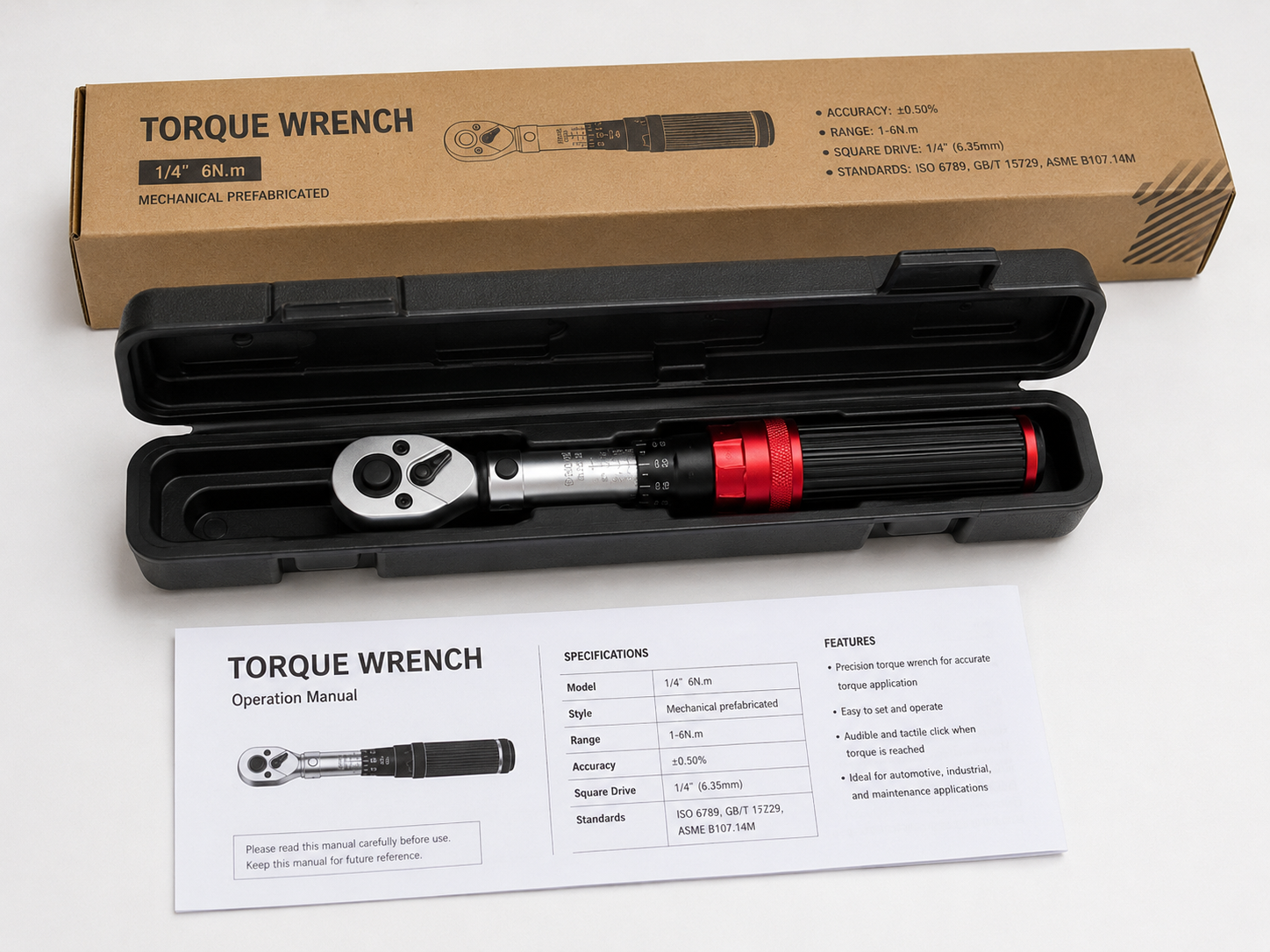
Click Torque Wrench
The click torque wrench is the most widely used type in automotive and industrial applications.
When the preset torque value is reached, the wrench produces a “click” sensation and sound.
Why buyers prefer click torque wrenches:
- Easy to operate
- Cost-effective
- High reliability
- Suitable for mass-market sales
- Ideal for automotive workshops
This type dominates global torque wrench demand because it balances affordability and performance.
Beam Torque Wrench
Beam torque wrenches use a pointer and scale system.
Advantages include:
- Simple structure
- Lower production cost
- Long mechanical lifespan
- Minimal calibration drift
However, beam torque wrenches are less convenient in confined workspaces because users must visually monitor the scale.
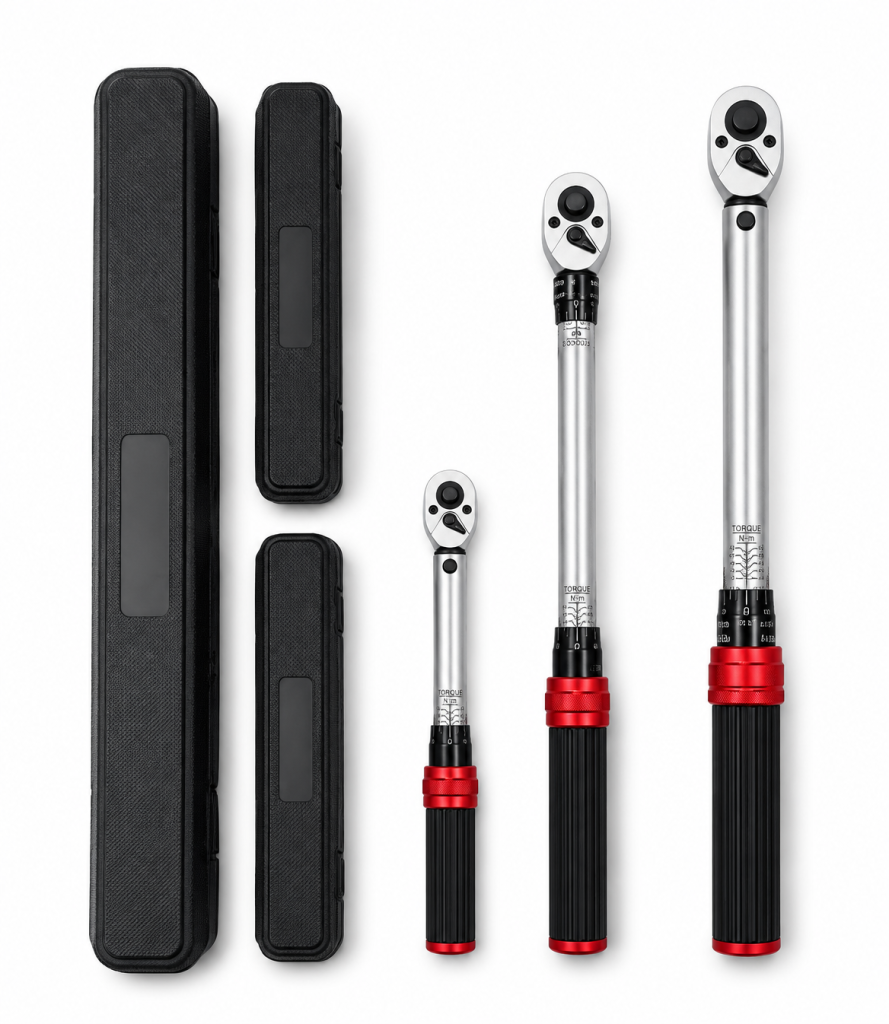
Digital Torque Wrench
Digital torque wrenches use electronic sensors and digital displays.
Features include:
- LCD display
- Audible alerts
- High precision
- Data storage capability
- Unit conversion
Digital models are popular in aerospace, laboratory environments, and high-end industrial applications.
Preset Torque Wrench
Preset torque wrenches are commonly used in production lines where operators repeatedly apply the same torque value.
Benefits include:
- Improved efficiency
- Reduced operator error
- Better process consistency
Many OEM factories use preset torque tools for assembly operations.
How to Choose the Right Torque Wrench
Choosing the correct torque wrench requires more than selecting a random model online.
Professional buyers should evaluate multiple factors before placing bulk orders.
1. Torque Range
The torque range determines what applications the tool can handle.
Examples:
| Drive Size | Typical Torque Range | Common Applications |
|---|---|---|
| 1/4″ | 1–20 Nm | Electronics, bicycles |
| 3/8″ | 10–100 Nm | Motorcycles, automotive |
| 1/2″ | 20–300 Nm | Automotive repair |
| 3/4″ | 100–1000 Nm | Heavy machinery |
Important: the best accuracy is usually achieved within the middle 20%–80% of the tool’s range.
Professional buyers should avoid selecting a wrench that constantly operates near its maximum limit.
2. Accuracy Level
Accuracy is one of the most important specifications.
Professional torque wrenches generally offer:
- ±4% clockwise accuracy
- ±6% counterclockwise accuracy
Industrial customers may require:
- ISO 6789 certification
- ASME standards
- Calibration reports
- Traceable inspection records
At KOLARWIN TOOLS, OEM torque wrenches can be supplied with calibration certificates and serial-number tracking.
3. Handle Design
Ergonomics affect operator comfort and torque consistency.
Features professional users prefer:
- Anti-slip handles
- Aluminum alloy grip sections
- Comfortable rotation adjustment
- Durable locking systems
For high-frequency workshop use, ergonomic handles significantly improve user experience.
4. Ratchet Mechanism Quality
The ratchet head directly affects durability and operating smoothness.
High-quality ratchet systems provide:
- Fine tooth count
- Smooth engagement
- Strong wear resistance
- Stable directional switching
Low-quality ratchet heads often fail after repeated industrial use.
5. Calibration Stability
Calibration stability determines long-term accuracy.
Professional buyers should ask suppliers:
- How often are tools calibrated?
- What testing equipment is used?
- Are calibration records available?
- Is batch inspection supported?
Factories with professional calibration equipment provide much more reliable product consistency.
How to Use a Torque Wrench Correctly
Even high-quality torque wrenches can produce inaccurate results if users operate them improperly.
Below is the professional procedure for correct usage.
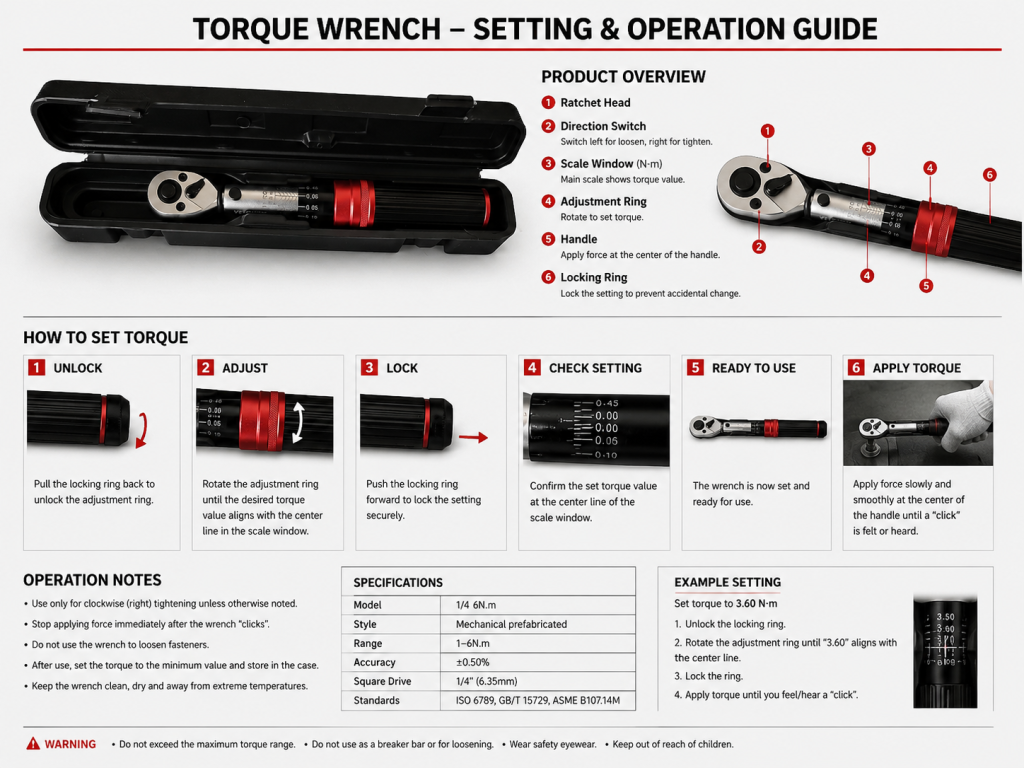
Step 1: Select the Correct Torque Value
Always follow manufacturer specifications.
Typical units include:
- Nm
- ft-lb
- in-lb
Never estimate torque by feel.
Step 2: Unlock the Handle
Most click torque wrenches include a locking ring or locking knob.
Unlock before adjustment.
Step 3: Rotate the Handle
Rotate the adjustment handle until the desired torque value aligns with the scale.
Professional users should carefully align:
- Main scale
- Micrometer scale
- Reference line
Step 4: Lock the Setting
Secure the locking mechanism before operation.
This prevents accidental adjustment during use.
Step 5: Apply Force Smoothly
This is critical.
Torque should be applied slowly and steadily.
Never:
- Jerk the handle
- Use impact force
- Add pipe extensions
- Strike the wrench
Step 6: Stop Immediately at the Click
Once the wrench clicks:
STOP.
Continuing to apply force after the click causes over-torque.
Common Torque Wrench Mistakes
Many torque wrench failures are caused by misuse rather than manufacturing defects.
Mistake 1: Using the Torque Wrench as a Breaker Bar
Torque wrenches are precision instruments.
Using them to loosen seized bolts damages internal calibration systems.
Mistake 2: Dropping the Tool
A dropped torque wrench may lose calibration accuracy.
Professional workshops should immediately recheck calibration after impact.
Mistake 3: Improper Storage
Always store the wrench:
- In its protective case
- In dry environments
- At minimum torque setting
Leaving spring-loaded click wrenches under tension shortens lifespan.
Mistake 4: Ignoring Calibration Intervals
Professional environments should recalibrate:
- Every 12 months
- Or every 5,000 cycles
Frequent-use workshops may require more frequent calibration.
Torque Wrench Calibration Explained
Calibration verifies that the torque wrench applies accurate force.
Professional calibration involves:
- Torque testing machines
- Controlled load measurement
- Multiple test points
- Accuracy verification
Calibration certificates typically include:
| Item | Description |
|---|---|
| Serial number | Product traceability |
| Torque values tested | Inspection range |
| Measured results | Accuracy confirmation |
| Test date | Calibration timing |
| Inspector signature | Quality control |
Calibration capability is a major advantage for OEM suppliers targeting professional markets.
Why Global Buyers Source Torque Wrenches from China
China has become one of the world’s largest manufacturing centers for precision hand tools.
Professional buyers choose Chinese OEM torque wrench manufacturers because of:
- Competitive production cost
- Mature supply chains
- Strong customization capability
- Scalable manufacturing
- Packaging flexibility
- Fast OEM development
However, not all suppliers provide the same quality level.
Professional buyers should evaluate:
- Factory experience
- Calibration equipment
- Material quality
- Heat treatment capability
- Assembly process
- QC systems
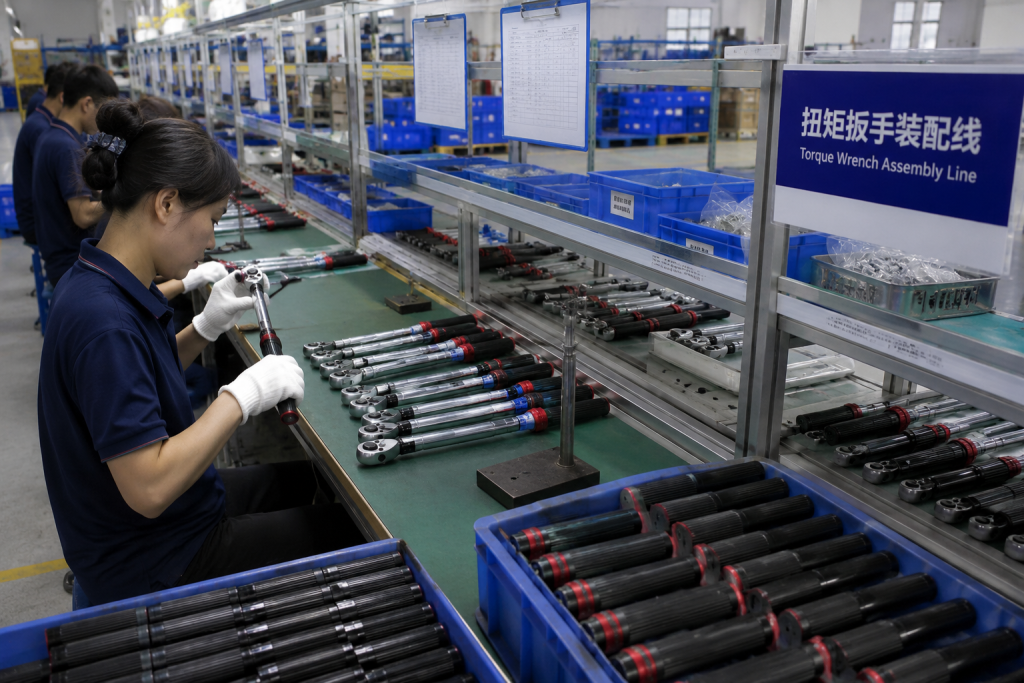
What OEM Services Are Available for Torque Wrenches?
At KOLARWIN TOOLS, we support comprehensive OEM and private label services.
Custom Logo Branding
Options include:
- Laser engraving
- Silk printing
- Molded logos
- Color customization
Custom Packaging
Packaging options:
- Blow mold cases
- Kraft paper boxes
- Color retail boxes
- EVA inserts
- Export cartons
Custom Manuals
OEM manuals can include:
- Customer branding
- Multiple languages
- QR codes
- Product specifications
Custom Torque Ranges
Professional buyers may request:
- Specialized torque ranges
- Industry-specific applications
- Unique scale layouts
Calibration Certificates
OEM calibration documents improve customer confidence and help distributors enter professional markets.
What Buyers Should Ask Before Ordering OEM Torque Wrenches
Professional sourcing teams should ask detailed technical questions.
Key Questions
| Question | Why It Matters |
|---|---|
| What standards are followed? | Quality assurance |
| Is calibration traceable? | Professional applications |
| What materials are used? | Durability |
| What is the ratchet tooth count? | User experience |
| What is the MOQ? | Cost planning |
| Can packaging be customized? | Brand development |
| Is sample testing available? | Product validation |
How Torque Wrench Quality Is Controlled
Professional factories use multiple quality control stages.
Incoming Material Inspection
Raw materials are checked for:
- Hardness
- Surface finish
- Dimensional accuracy
Heat Treatment Control
Proper heat treatment ensures:
- Ratchet durability
- Wear resistance
- Structural strength
Assembly Inspection
Assembly QC includes:
- Ratchet smoothness
- Scale accuracy
- Locking mechanism function
Final Calibration Testing
Each torque wrench should undergo:
- Torque accuracy testing
- Repeatability verification
- Visual inspection
Torque Wrench Market Trends
The global torque wrench market continues growing because industries demand higher fastening precision.
Current trends include:
- Smart digital torque tools
- Bluetooth torque tracking
- Industry 4.0 integration
- Lightweight aluminum designs
- Higher ergonomic standards
- Compact precision models
Professional distributors increasingly focus on premium products rather than low-cost commodity tools.
Why Professional Buyers Choose KOLARWIN TOOLS
As a professional torque wrench manufacturer in China, KOLARWIN TOOLS supports global customers with:
- OEM torque wrench manufacturing
- Private label customization
- Calibration support
- Stable production quality
- Competitive factory pricing
- Export experience
- Flexible packaging solutions
Our torque wrench products are widely suitable for:
- Automotive repair distributors
- Industrial tool wholesalers
- Hardware brands
- E-commerce sellers
- Workshop suppliers
- Professional mechanics
Conclusion
Torque wrenches are no longer optional tools in professional industries. They are precision instruments that directly affect safety, quality, and product reliability.
Whether you are a distributor, tool brand owner, or industrial sourcing company, choosing the correct torque wrench manufacturer is critical for long-term business success.
Professional buyers should focus on:
- Torque accuracy
- Calibration capability
- Ratchet durability
- OEM customization
- Factory quality systems
- Stable production consistency
At KOLARWIN TOOLS, we help global customers develop reliable OEM torque wrench solutions with professional manufacturing support and export-ready service.
If you are looking for a trusted torque wrench manufacturer in China, contact our team today for catalogs, OEM solutions, and factory quotations.
FAQ
Q1: What is the most common torque wrench type?
Click torque wrenches are the most widely used because they combine affordability, accuracy, and easy operation.
Q2: How often should a torque wrench be calibrated?
Professional workshops generally recalibrate every 12 months or every 5,000 usage cycles.
Q3: Can torque wrenches be customized with private labels?
Yes. OEM manufacturers can provide custom logos, packaging, manuals, and calibration certificates.
Q4: What drive size is best for automotive repair?
1/2″ drive torque wrenches are commonly used for wheel nuts and automotive repair applications.
Q5: Why should buyers source torque wrenches from China?
China offers mature manufacturing supply chains, competitive pricing, scalable production, and strong OEM customization capability.
Looking for a reliable mechanic tools manufacturer in China?
If you are sourcing hand tools, socket tools, automotive repair tools, mechanic tool sets or OEM private label tools, contact KOLARWIN Tools for factory-direct quotation, customization support and product consultation.