
Need OEM supplier support for this product type?
Contact KOLARWIN Tools for OEM mechanic tools, private label packaging, wholesale quotation and product range support. This gives overseas buyers a clear path from article reading to supplier discussion.
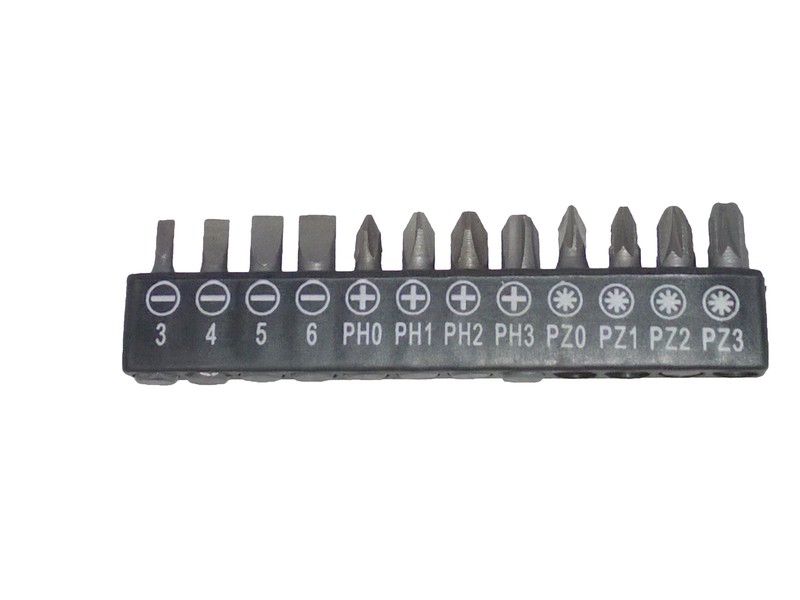
A bit that reaches a recessed fastener may be too long for stable work in a crowded assembly; a compact bit may leave the tool body outside the available clearance. Buyers need to specify more than a length printed on a pouch. Define how the measurement is taken, which holder and driver will be used, and what workpiece envelope must be reached. Manufacturer catalogues list multiple lengths and interfaces, while ISO defines bit-drive connections and profile specifications. This guide turns length choice into a practical assortment and RFQ decision.
1. What does screwdriver bit length describe?
Bit length usually refers to the bit itself, but suppliers may list overall length, working length, or a product code that combines both. Clarify the reference points on a dimensioned drawing. A bit inserted into a holder loses some exposed length inside the socket; the usable reach therefore depends on engagement depth and holder geometry. A buyer comparing two catalogue rows should not assume both lengths use the same measurement convention.
Use screwdriver sizes to keep profile-size terminology separate from overall length.
Start with the measurement datum.
- Ask the supplier to mark total length and exposed length separately on the drawing.
- Record nominal and working length as separate catalogue fields.
| Length label | Ask for | Why it matters |
|---|---|---|
| Nominal bit length | Reference points | Comparable quotes |
| Exposed reach | Holder engagement | Actual fastener access |
2. How does length interact with the holder?
The holder and bit form one assembly. A long bit in a short holder can offer different reach from a short bit in an extension holder, even when the exposed distance looks similar. The connection also affects stiffness and alignment. Confirm full bit seating and avoid reducing engagement simply to gain reach. If the supplier sells a fixed-length bit-holder combination, specify that assembly as its own item rather than combining separate catalogue dimensions informally.
The nut setter vs nut driver comparison clarifies when an attachment drives a nut rather than receiving a screwdriver bit.
Treat the holder as part of the dimension.
- Measure from holder nose to bit tip as one assembly.
- Preserve the insertion depth used for the approved sample.
| Configuration | Specification detail | Sample check |
|---|---|---|
| Bit only | Total and working length | Measure at stated datum |
| Holder plus bit | Holder model and insertion depth | Check exposed reach |
3. When does a short bit make sense?
Short bits reduce projection and can fit compact holders or cases. They are often convenient where the driver sits close to the fastener and the surrounding structure leaves little room for a long extension. Yet a short bit may be difficult to handle outside a holder and could leave the driver nose too close to a wall or fixture. The right check is clearance around both the tool body and fastener, not a blanket preference for the shortest item.
Check clearance before trimming reach.
- Check whether the driver body clears adjacent surfaces.
- Keep compact and extended formats as distinct SKUs.
| Short-bit situation | Potential advantage | Potential constraint |
|---|---|---|
| Compact kit | Less projection | May need holder access |
| Close fastener | Reduced assembly length | Driver body can obstruct |
4. When should buyers consider a longer bit?
Longer bits can reach fasteners behind a lip, inside a channel, or beyond a surrounding part. Added reach can also make alignment more sensitive, especially if the operator cannot keep the tool axis in line with the screw. Length alone does not prove a bit is suitable for torque or impact use. Keep any performance designation tied to the exact model and supplier documentation. For a long-reach SKU, ask how much of the bit is supported by the holder.
Long reach needs a real access test.
- Sketch the obstruction and the required working reach.
- Ask the supplier how much shank enters the holder.
| Long-bit check | Buyer question | Record |
|---|---|---|
| Reach | What obstruction is cleared? | Workpiece photo or sketch |
| Support | How much shank enters holder? | Drawing and sample |
5. How should reach be tested?
Create a simple fixture or use the customer component. Place fasteners at the near, recessed, and obstructed positions that represent normal work. Test each bit with the intended driver and holder, then check whether the bit seats fully, reaches without side loading, and can be withdrawn cleanly. A quick trial should inform fit, not create an unsupported life or strength claim. Keep samples identified by supplier and revision so feedback remains attached to the correct configuration.
Repeat the same fixture check across bids.
- Place samples at recessed and obstructed screw positions.
- Record seating, alignment and withdrawal for each length.
| Trial point | Observe | Record |
|---|---|---|
| Access | Can tip reach screw? | Position and clearance |
| Alignment | Can tool stay coaxial? | Operator feedback |
| Withdrawal | Does bit bind? | Release behavior |
6. What changes with screw profile and size?
Length does not correct a profile mismatch. A cross-recessed bit must match the screw recess family and size; ISO 2351-2 addresses machine-operated bits for cross-recessed screws and references compatible tip forms. Buyers should confirm profile and size before comparing lengths. A bit that reaches the screw but fits poorly can still cam out or damage the recess. Pair each length with a profile-size identifier in the assortment rather than labeling products by length alone.
Likewise, Torx vs Allen addresses profile compatibility independently of shaft length.
The distinction in Pozidriv vs Phillips must be resolved before reach trials begin.
Profile fit comes before added reach.
- Identify recess family and tip size before comparing lengths.
- Pair each bit SKU with its profile-size code.
| Selection order | Buyer action | Reason |
|---|---|---|
| 1 | Confirm profile | Prevents fit confusion |
| 2 | Confirm tip size | Controls engagement |
| 3 | Choose length | Fits access envelope |
7. How do powered drivers affect selection?
Powered-driver use introduces tool-class and duty questions beyond length. A bit’s shank format and stated application must match the driver and holder. ISO 1173 provides drive-end dimensions and torque-testing context, but a standards reference does not make every bit appropriate for every driver. Ask the manufacturer to identify any impact-use designation and limitations. Keep hand-driver, drill-driver, and impact-driver listings separate where the supplier distinguishes them.
Compare impact bits vs regular bits before approving a length for an impact-driver assortment.
Tool class changes the evidence request.
- Name the driver class and exact accessory model.
- Request impact-use evidence instead of inferring it.
| Buyer check | Evidence | Release condition |
|---|---|---|
| Drive end | Supplier declaration | Named interface |
| Tool class | Model datasheet | Application stated |
| Use limit | Written by supplier | No implied rating |
8. How should a distributor build a length range?
Start from repeat customer tasks, not a complete ladder of lengths. A practical range may include a compact option, a common working length, and a reach option if customer fixtures justify it. Avoid duplicating every profile at every length before demand is known. Group SKU data by profile, size, drive end, overall length, and intended use.
Storage planning in custom socket set design can help prevent long accessories from colliding with neighbouring tools.
Use recurring tasks from a complete mechanic tools list to decide which lengths deserve stock positions.
Let customer work define the range.
- Use replenishment data to shortlist lengths.
- Drop combinations that do not serve a recurring task.
| Assortment field | Keep distinct | Example |
|---|---|---|
| Profile | PH, PZ, slotted, hex, Torx | Separate SKU attribute |
| Length | Total / working | Document datum |
| Application | Hand / powered | Supplier-supported |
9. What belongs in a length-related RFQ?
A clear RFQ names the profile, size, drive-end format, bit length, measurement method, holder model, driver class, finish, marking, packaging, and sample quantity. Add a drawing or fastener sample if access is unusual. Ask the supplier to flag any length that changes shank engagement or intended application. For a private-label request, include item code, label language, barcode, and artwork approval. Require written notice before changes to the design, dimensions, source, or material.
Add the packaging and model-evidence requirements from OEM impact bit sets to the dimensional brief.
A complete RFQ makes quotes comparable.
- Attach a drawing with length endpoints and units.
- List holder, driver class, finish, label and package.
| RFQ field | Required detail | Approval artifact |
|---|---|---|
| Length | Total and datum | Drawing |
| Fit | Holder and driver | Sample trial |
| Packaging | SKU, label, quantity | Artwork sign-off |
10. How should buyers approve the final bit?
Approve a named bit-and-holder configuration only after sample fit, reach, alignment, and release meet the customer task. Keep a retained sample and current drawing with the purchasing record. If a supplier changes the bit length, holder, shank geometry, or application designation, compare the revision against the approved baseline. This control helps sales, purchasing, and quality teams describe the same product. Send an RFQ with profile, size, reach, interface, holder, driver class, packaging, quantity, and required documents.
Release the named configuration only.
- Keep the approved sample beside its drawing revision.
- Require review when shank, length or application changes.
FAQ
Send a sourcing inquiry with the application, required sizes, order quantity and documentation needs. Ask for model availability and a written specification before approval.
Q1: How is screwdriver bit length measured? Ask the supplier to define the measurement endpoints and distinguish total length from exposed working reach.
Q2: Does a longer bit provide more torque? Length alone does not establish a torque rating; follow the exact model’s application documentation.
Q3: Can one bit length fit every holder? No. Confirm insertion depth, bit shank and holder compatibility for the selected models.
Q4: What should a buyer test? Check access, alignment, full seating and clean withdrawal in a representative fixture.
Q5: Should profiles be grouped by length? Keep profile, size and length as separate SKU attributes so buyers can identify the correct tip.
For a product-specific quotation, send Kolarwin Tools the fastener profile and size, required dimensions, tool interface, intended application, sample or drawing, packaging needs, and expected quantity. Ask for a model-matched drawing and product documents before approving the configuration.
Looking for a reliable mechanic tools manufacturer in China?
If you are sourcing hand tools, socket tools, automotive repair tools, mechanic tool sets or OEM private label tools, contact KOLARWIN Tools for factory-direct quotation, customization support and product consultation.


