
Need OEM supplier support for this product type?
Contact KOLARWIN Tools for OEM mechanic tools, private label packaging, wholesale quotation and product range support. This gives overseas buyers a clear path from article reading to supplier discussion.
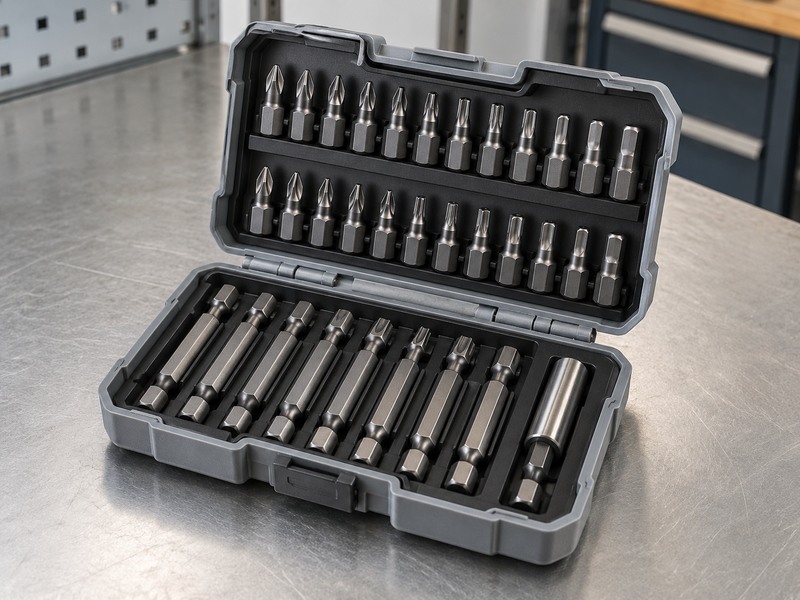
OEM impact bit sets are assortments of screwdriving bits and related holders built around specific fastening jobs. Buyers can prevent mismatches by defining profiles, lengths, and host interfaces in a BOM, then approving samples against that record. A screwdriving bit engages a recessed screw profile; a conventional hex socket engages an external hex fastener through a separate drive interface. Drill bits and manual impact screwdrivers also follow separate specifications.
Contents
- 1. What should an OEM impact bit set solve?
- 2. Which output profiles and sizes belong in the BOM?
- 3. How should input hex and output profile be specified?
- 4. How do length and access affect bit selection?
- 5. What holder and chuck compatibility should buyers check?
- 6. What does impact-duty suitability mean for a bit set?
- 7. What material and heat-treatment evidence is useful?
- 8. How should retention and magnetic features be assessed?
- 9. What sample checks should an OEM buyer request?
- 10. What should a China OEM RFQ and reorder file contain?
1. What should an OEM impact bit set solve?
An OEM impact bit set should cover a defined fastening job, not merely contain many pieces. List target users, fasteners, access limits, and host tools. A maintenance distributor may need varied profiles and lengths; an assembly buyer may need a narrow set matched to one fastener family. Those briefs call for different BOMs.
Start with the workbench, not the case. For each proposed item, name its application and expected user. Use channel feedback or sales history to separate proven demand from optional assortment ideas.
- Record target application and user.
- List profile, size, length, and quantity.
- Note host tool, holder, and access constraints.
- Mark optional items separately from the core BOM.
Compare the set’s role with your mechanics tool set planning. Draft one BOM line per bit, holder, and accessory before requesting quotes.
Keep the scope explicit
A drill bit cuts a hole, while a manual impact screwdriver is another tool assembly. State exclusions so suppliers do not quote adjacent products as substitutes.
BOM checkpoint
| Field | Specify |
|---|---|
| Application | Fastener and user context |
| Bit | Profile, size, length, quantity |
| Interface | Shank and intended holder/tool |
| Exclusions | Out-of-scope items |
2. Which output profiles and sizes belong in the BOM?
Specify the output profile and size for every piece. Broad labels such as “star bits” leave room for interpretation, and similar-looking profiles can differ. If your market uses alternate names, record the preferred term and accepted equivalent, then ask the supplier to confirm the drawing or sample.
Profile names need a physical reference. Check proposed profiles against fasteners your customers stock. These references can help distinguish Torx and Allen, Torx and triple-square, and Ribe and Torx forms.
- Separate family and size in the BOM.
- Identify single-ended or double-ended construction.
- Keep uncommon profiles on distinct lines.
- Supply a reference fastener or drawing if naming is ambiguous.
Do not assume one profile substitutes for another. Check fit on the intended fastener without applying torque to a mismatched sample. Attach a drawing or fastener reference for every potentially ambiguous line.
Match range to actual demand
More profiles add choice, labeling, and replenishment work. Use order history or buyer feedback to support less common pieces. If evidence is limited, show a proposed option separately rather than quietly adding it to the core set.
Profile decision table
| Check | Buyer record |
|---|---|
| Family and size | Exact per-piece designation |
| Reference | Drawing or fastener sample |
| Marking | Same notation as BOM |
| Change | No substitution without approval |
3. How should input hex and output profile be specified?
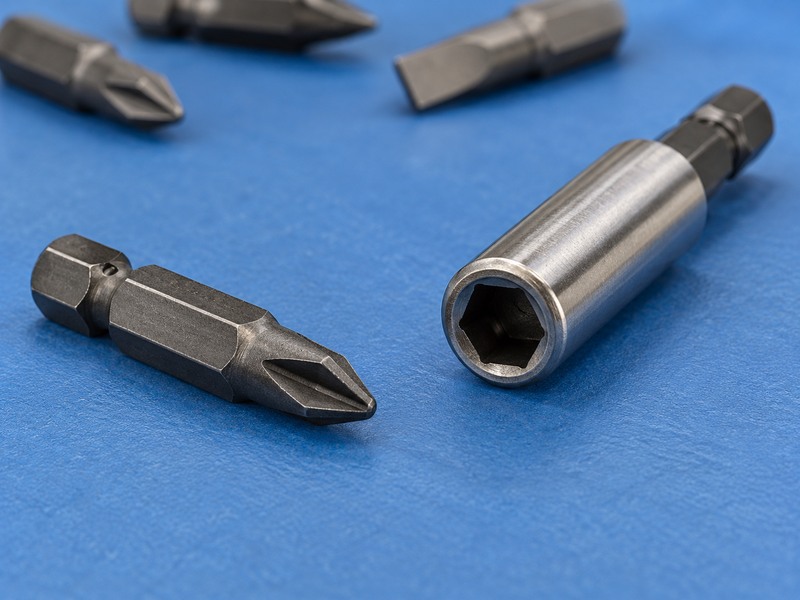
A bit has two interfaces: its input shank enters a holder or tool, while its output tip engages the fastener. Buyers often name the tip but leave the shank implied. Specify both, especially when a holder sits between bit and driver.
Treat the interface as two questions. Record the shank form and dimensions required by the host, then the tip family and size required by the fastener. A holder specification should state its host-facing drive shank and bit-receiving end separately, along with retention features; do not assume these details are universal.
- Identify direct-drive or holder-based use.
- Record input shank and output profile independently.
- Assign a separate line to every included holder.
- Request drawings or samples when dimensions are unclear.
Do not infer universal standards or fit from a familiar-looking hex shank. Add separate input-interface and output-profile fields, then verify both on the approved sample.
Map the connection chain
Write the chain as driver/chuck → holder, if used → bit shank → bit tip → fastener recess. Name host or holder references where available. This also separates screwdriver-bit systems from impact socket adapters, which connect socket-drive systems.
Interface checkpoint
| Part | Record | Verify against |
|---|---|---|
| Tool | Host type/model | Tool information |
| Holder | Host-facing shank and bit-receiving end | Drawing or sample |
| Bit | Shank and tip | BOM and sample |
| Fastener | Recess family and size | Application reference |
4. How do length and access affect bit selection?
Length is an access decision. A short bit may fit a compact setup; a longer one may reach a recessed screw or clear an obstruction. Specify length against an application rather than treating extra reach as an automatic upgrade.
Measure the whole stack. Consider fastener recess, surrounding clearance, holder length, and tool position together. A drawing or fixture sample can show whether the complete assembly reaches the fastener without interference.
- Record agreed length measurement points.
- Note if holder length adds to overall reach.
- Identify restricted clearance or recessed fasteners.
- Keep different lengths on separate BOM lines.
Length labels should use a measurement convention agreed before quoting. For long-reach or restricted-access pieces, send a dimensioned sketch and compare samples with it.
Length and access table
| Input | Record | Approval check |
|---|---|---|
| Location | Recess or obstruction | Assembly reaches fastener |
| Bit | Length and measurement points | Matches drawing |
| Holder | Included or supplied separately | Total reach works |
| Case | Slot and label | Item remains identifiable |
5. What holder and chuck compatibility should buyers check?
Compatibility depends on the bit, holder, and host tool as a combination. “Fits impact drivers” is too broad unless the intended input and retention details are clear. Identify direct-drive and holder-based pieces separately.
Compatibility belongs to a combination. List host or holder reference, bit shank, and required locking or retention feature. Request written confirmation, then verify fit with the named models. Unexpected movement, incomplete seating, or difficult release requires review before approval.
- Confirm intended host interface and holder.
- Record locking, retaining, or release features.
- Check full insertion and normal removal.
- Tie package compatibility claims to checked models.
A retaining ring or magnet on one holder does not establish fit across all tools. Approve a compatibility matrix for every included bit-holder combination before artwork release.
Compatibility matrix
| Pair | Record | Release gate |
|---|---|---|
| Tool/holder | Model and interface | Seating and release checked |
| Holder/bit | Shank and retention | Approved combination fits |
| Bit/fastener | Profile and size | Fit checked on reference |
| Package claim | Models and limits | Wording matches evidence |
6. What does impact-duty suitability mean for a bit set?
“Impact” suitability should attach to an identified bit or holder model and its stated use. Appearance does not prove suitability. Wera’s Impaktor system, for example, assigns torsion features to particular bits and holders. Other products need their own design and performance evidence.
Ask for evidence tied to each item. Request product designation, intended host conditions, technical drawing, and use instructions. For any test claim, ask for method, sample identity, tool setup, conditions, and report date.
- Tie impact-use wording to model or SKU identity.
- Request model-specific instructions and documents.
- Record test method and operating conditions.
- Exclude unsupported life multipliers and superiority claims.
Do not substitute a bit intended for another use solely because it fits a holder. Require model-specific evidence and sample approval for every proposed line.
Keep adjacent products separate
Impact sockets, drill bits, screwdriving bits, and manual impact screwdrivers serve different tasks. The manual impact screwdriver versus impact driver guide covers another tool decision. Nutsetters are related accessories, but have their own output geometry and impact-use review.
Evidence request table
| Claim | Request | Limit |
|---|---|---|
| Impact use | Model and instructions | Listed items only |
| Feature benefit | Basis and conditions | No assumed life gain |
| Test result | Method, setup, samples | Conditions stay attached |
| Compatibility | Host references | No blanket fit claim |
7. What material and heat-treatment evidence is useful?
Ask the supplier to identify proposed material and process evidence for the quoted item. Check whether documents identify a traceable lot and match the sample or production item. Use material grades, hardness values, or test results in a listing only when records support the quoted item.
Traceability starts with identity. Request document type, issuer, material or process designation, lot reference, and link to finished goods. If a record lacks an item or batch connection, ask how it ties to the quoted product.
- Request material designation and supporting record, if available.
- Ask how heat-treatment records identify item or lot.
- Match references to sample and production labels.
- Define handling for missing or inconsistent records.
Terms such as “premium steel” do not specify grade or verified result. Set document identity and lot-linkage requirements before commercial release, and claim certification only when records support it.
Evidence table
| Record | Review | Question |
|---|---|---|
| Material document | Designation and issuer | Which lot does it cover? |
| Process record | Item and revision | Is it tied to finished goods? |
| Sample log | Code and approval date | Does production match? |
| Change notice | Trigger and route | Is reapproval required? |
8. How should retention and magnetic features be assessed?
Magnets, rings, clips, and other features serve different retention roles. Specify whether you need bit retention in a holder, fastener pickup, or both. A holder magnet does not mean every bit is magnetic or every fastener will be retained.
Test the feature against its intended task. Identify the component, representative fastener, and orientation. For magnetic features, request the model description and check a sample with materials used by your customers. Avoid holding-force claims without a defined method and result.
- State whether retention applies bit-to-holder or bit-to-fastener.
- Identify the feature by item.
- Check insertion, use, and release in the target setup.
- State replacement availability only if confirmed.
A set may combine retention approaches, but the package should show which items have each feature. Document acceptance criteria before approving holder or case design.
Retention table
| Purpose | Check | Claim boundary |
|---|---|---|
| Bit in holder | Insert and release | Named combination |
| Fastener pickup | Sample material/orientation | No universal guarantee |
| Mechanical feature | Engagement and removal | Item-specific |
| Replacement | Part identification | Confirmed route only |
9. What sample checks should an OEM buyer request?
A sample review should verify the written specification, not create an unsupported performance claim. Agree sample identity, revision, test setup, acceptance criteria, and record owner. Define any powered-use or endurance protocol with the intended driver, settings, fastener, substrate, and stopping criteria.
Make the check repeatable. Use consistent reference fasteners, tools, and measurement points. Photograph labels and record fit observations or defects by SKU. If a sample differs from the drawing, request correction and a new review.
- Check profile, size, length, marking, and count.
- Confirm fit with named tools and holders.
- Define endurance protocol before testing.
- Record deviations and approval owner.
Keep buyer observations separate from marketing statements. Issue a checklist with pass, fail, and unresolved fields before prototypes arrive.
Sample protocol
| Gate | Record | Decision |
|---|---|---|
| Identity | SKU, code, revision | Correct sample? |
| Fit | Tool, holder, fastener | Intended combination fits? |
| Dimensions | Drawing points | Requirement met? |
| Use trial | Setup and observations | Buyer criteria met? |
10. What should a China OEM RFQ and reorder file contain?
A useful RFQ lets suppliers quote the same product definition. Send BOM, drawings or references, interface details, impact-use requirements, requested documents, sample gates, branding, packaging, and destination-market label needs. Ask suppliers to mark exceptions instead of silently substituting items. Confirm item availability, minimum order quantities, prices, and lead times in the written quotation.
Make every quotation answerable line by line. Request item identity, proposed specification, included documents, sample availability, packing proposal, and deviations against each BOM row. Ask for commercial terms against the actual brief and order conditions rather than assuming a standing commitment.
- Attach revision-controlled BOM and drawings.
- Define sample approval and change notice requirements.
- Request case, carton, label, and replenishment details.
- Save approved quotation, sample references, and deviations.
For broader category context, see socket tools and hand tools, while keeping this set’s scope distinct. Send one consolidated RFQ packet. For a supplier discussion, provide application, BOM, and interfaces through the contact page.
FAQs
Q1: What belongs in an OEM impact bit set specification?
List each bit’s profile, size, length, quantity, shank, intended host or holder, marking, and packaging position. Add sample criteria and required documents.
Q2: Are impact screwdriving bits the same as impact sockets?
No. Bits engage recessed screw profiles; impact sockets connect to square-drive tools and fit external fasteners.
Q3: Does a magnetic holder prove every bit is magnetic?
No. Identify which component has the feature and verify its function with representative samples.
Q4: What material or heat-treatment claims should buyers accept?
Use claims tied to an identified item and records connected to a sample or lot. Generic wording does not establish grade, hardness, or service life.
Q5: What should happen before a repeat order?
Compare the order with the approved BOM revision, sample, documents, labels, and packaging. Resolve proposed changes in writing first.
Looking for a reliable mechanic tools manufacturer in China?
If you are sourcing hand tools, socket tools, automotive repair tools, mechanic tool sets or OEM private label tools, contact KOLARWIN Tools for factory-direct quotation, customization support and product consultation.


