Need OEM supplier support for this product type?
Contact KOLARWIN Tools for OEM mechanic tools, private label packaging, wholesale quotation and product range support. This gives overseas buyers a clear path from article reading to supplier discussion.
Needle nose pliers uses include gripping, guiding, and positioning small parts where wider jaws cannot reach. Some models also bend wire or include cutters and strippers, so each feature needs its own rating. For workshop buyers, check jaw reach, contact surface, clearance, and documented functions.
Contents
- 1. What are needle nose pliers used for?
- 2. Why does a slim head help in restricted spaces?
- 3. Which gripping and positioning tasks fit this tool?
- 4. How do jaw surfaces change the work?
- 5. When do long reach and extra length help?
- 6. Which added features deserve separate checks?
- 7. Can ordinary needle nose pliers be used for electrical work?
- 8. How should buyers test reach and control?
- 9. What should a B2B RFQ specify?
- 10. How should a distributor build a needle nose assortment?
1. What are needle nose pliers used for?
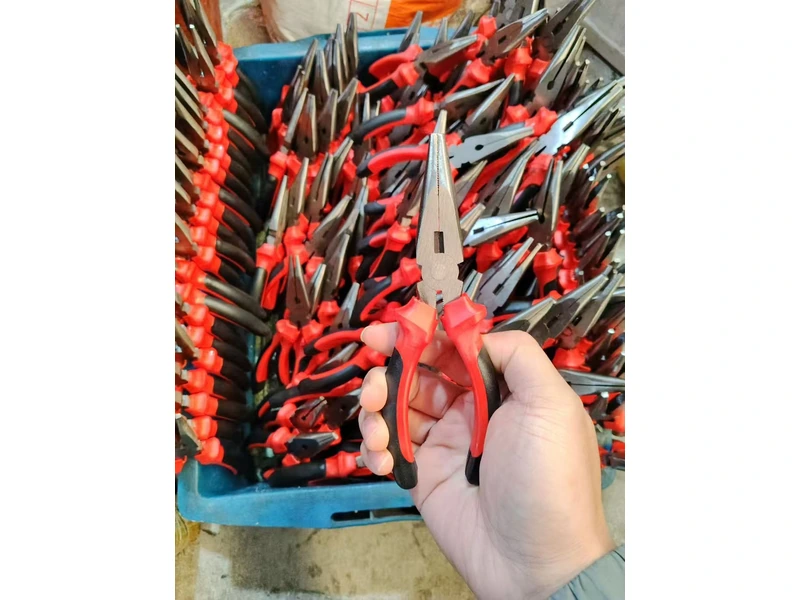
Needle nose and long nose usually describe overlapping narrow, tapered designs rather than standardized separate types. Compare actual jaw dimensions and features before treating either name as a buying category. Common uses include holding wire, guiding a component through a restricted opening, pulling a small part into place, bending a fine lead, and forming a simple loop. Some models add cutters, strippers, reaming ridges, or fish-tape features, but each function belongs to the exact SKU.
- Holding and guiding small wire or components.
- Positioning parts during assembly and rework.
- Pulling material through an accessible opening.
- Looping or bending when jaw geometry supports the task.
A narrow nose provides access while each extra function needs model-specific evidence.
Task labels make product pages more useful than a generic “multi-purpose” claim. A narrow tool may suit electronics assembly while another model suits rougher maintenance work. Jaw surface, tip envelope, and material limits decide whether a sample fits. Use the specialty pliers buying guide when comparing other gripping and forming tools.
Buyer summary
| Task | Why needle nose geometry helps | Check before listing |
|---|---|---|
| Hold a small wire | Narrow jaws reach the part | Jaw surface and tip alignment |
| Guide a component | Slim head enters limited space | Head envelope and reach |
| Loop a lead | Taper supports controlled bending | Jaw dimensions and material limit |
| Pull through an opening | Long nose can reach the work | Exact model guidance |
Label each candidate SKU with its primary task, jaw dimensions, and documented limits before adding broad use language.
2. Why does a slim head help in restricted spaces?
A slim head needs less room around a small component. That advantage appears in assembly fixtures, wiring paths, instrument housings, and mechanical spaces where fingers or broad jaws cannot align with the work. A narrow head does not guarantee deep access. Handle clearance, tip thickness, jaw length, and surrounding structure still control actual reach.
- Measure head width and tip thickness for the opening.
- Check handle clearance around the fixture.
- Confirm jaw opening at the reach point.
Clearance must accommodate the tool head and handle movement.
Request a dimensional drawing or a clear product sheet. “Slim” can describe a catalog family rather than a universal measurement. A long nose may improve reach while reducing control around a small workpiece. A compact electronics model may offer polished inner jaws, while a general assembly model may use knurled contact. Show those differences instead of promising access in every confined space.
Buyer summary
| Access field | Buyer question | Why it matters |
|---|---|---|
| Tip thickness | Can the nose enter the opening? | Controls entry |
| Head width | Will the part clear the jaw sides? | Controls lateral access |
| Jaw length | Can contact occur at the target depth? | Controls reach |
| Handle envelope | Can the user close the tool? | Controls practical clearance |
Test every slim model inside a representative fixture before assigning it a “confined-space” label.
3. Which gripping and positioning tasks fit this tool?
Needle nose pliers suit small-part gripping, wire guidance, light pulling, and positioning during assembly. They can hold a lead while another tool bends it, guide a component into a slot, or steady a finding while alignment is corrected. A knurled face may retain a defined part. A polished face may reduce nicking risk on selected wire, but it cannot guarantee mark-free contact.
- Gripping a small part during assembly.
- Guiding wire through a narrow route.
- Holding a component while another tool works.
- Positioning a lead or finding before final fastening.
Small-part handling often requires a holding tool followed by a dedicated cutting or assembly tool.
Do not substitute a needle nose tool for a dedicated crimper, cutter, or stripper because its nose reaches the work. For terminal forming, consult types of crimping tools. If insulation removal or cutting drives the job, use the wire stripper versus wire cutter guide.
Buyer summary
| Work phase | Needle nose role | Separate tool may be needed |
|---|---|---|
| Reach | Enter and contact small work | Access fixture or specialty tip |
| Hold | Stabilize wire or component | Clamp for higher loads |
| Position | Move part into alignment | Assembly guide or fixture |
| Finish | Maintain position | Crimper, cutter, or fastener tool |
Describe needle nose pliers as a holding and positioning tool unless a specific model document supports another function.
4. How do jaw surfaces change the work?
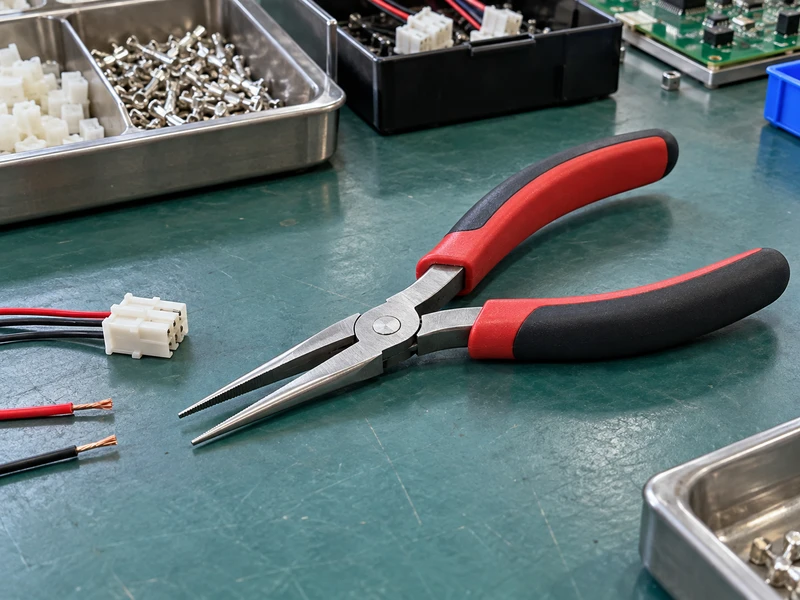
Jaw surface controls contact. Knurled or serrated faces can improve grip on a defined part, while smooth or polished faces may reduce marks on selected wire and finished components. Neither surface suits every material. Pressure, coating, alloy, and jaw condition still affect the workpiece.
- Use smooth contact for mark-sensitive parts when control remains adequate.
- Use knurled contact for defined grip where impressions are acceptable.
- Inspect tips for burrs before sample approval.
More aggressive jaw contact can leave visible marks on soft or finished work.
State surface type in plain language. Avoid “non-marring” unless a controlled test defines that result. Avoid “heavy-duty” unless exact model documentation gives material or capacity guidance. Surface polish also says nothing about corrosion proofing. Keep finish, storage, and care instructions separate from jaw-function claims.
Buyer summary
| Jaw surface | Useful starting task | Buyer caution |
|---|---|---|
| Smooth | Finished wire or delicate components | Pressure can still mark |
| Polished | Precision contact on selected work | Does not guarantee zero nicking |
| Knurled | Defined grip on a part | Teeth may leave impressions |
| Serrated | Controlled retention where allowed | Verify tooth pattern and tolerance |
Add a contact-mark test to your inspection plan, using the same workpiece your customer will handle.
5. When do long reach and extra length help?
Long-reach and extra-long needle nose designs help when a workpiece sits deeper inside a narrow assembly area. They also create a longer distance between hand and contact point, which can change visibility, control, and fatigue. A longer nose does not establish higher force capacity. Fine tips can bend or misalign when users pry or twist stuck hardware.
- Choose length from measured access depth.
- Check tip stiffness and alignment on the actual model.
- Keep reach claims separate from load claims.
Additional reach should be approved for clearance without loading the tip as a lever.
An assortment may include a standard model for general work and a long-reach model for deeper access. Choose from fixture dimensions and sample handling rather than a universal ranking. Record head envelope, jaw length, full tool length, tip size, and handle clearance for each SKU.
Buyer summary
| Variant | Advantage | Risk to check |
|---|---|---|
| Standard long nose | Balanced access and control | May not reach deep work |
| Long reach | Deeper contact point | Less control or tip deflection |
| Slim electronics style | Small head envelope | Lower tolerance for misuse |
| Extra-feature style | More functions in one tool | Feature limits vary by model |
Approve a longer model only after a depth test and a misuse review show that customers can reach the work without overloading the nose.
6. Which added features deserve separate checks?
Some needle nose pliers include cutters, wire strippers, reaming ridges, bolt-shearing holes, spring-loaded opening, or fish-tape pulling features. Those additions can help one workflow, yet they are not universal. Identify the exact feature and documented material range. “All-purpose” does not replace a capacity table.
- Confirm whether a cutter exists on the exact model.
- Record material class and diameter for any cutting claim.
- Verify stripper range and insulation assumptions separately.
- Treat spring action as an opening aid, not a force claim.
Each cutter, stripper, or reaming feature needs its own documented application limits.
A combination model may suit rough-in work, while a precision model should stay focused on small-part positioning. If cable cutting drives the job, use the cable cutter versus diagonal cutter comparison. If a retaining ring drives the job, use the dedicated internal versus external snap ring pliers guide instead of stretching a general needle nose claim.
Buyer summary
| Added feature | Verify | Do not assume |
|---|---|---|
| Cutter | Material class and diameter | Every needle nose cuts wire |
| Stripper | Insulation type and size range | Every cutter strips insulation |
| Reaming ridges | Intended application | Any nose can ream safely |
| Spring | Opening behavior | Spring action increases force |
| Fish-tape puller | Exact model construction | Long reach includes this feature |
Give every added feature its own approval line, capacity field, and sample test before publication.
7. Can ordinary needle nose pliers be used for electrical work?
Ordinary needle nose pliers with plastic-dipped or comfort handles should not be presented as insulated electrical tools. Handle material or color does not establish an insulation standard. For electrical work, specify a product explicitly marked and tested against the applicable standard, then follow procedures and voltage limits stated for that product.
- Check for explicit insulation marking.
- Request applicable test or compliance documentation.
- Keep ordinary tools away from live-circuit claims.
- Separate mechanical gripping from electrical safety status.
Grip comfort does not establish protection for energized electrical work.
Some needle nose models suit wiring tasks because they hold and route wire. That describes access and handling. It does not authorize work on live circuits. A B2B listing should state “not insulated” where supplied documentation says so, or omit electrical claims until exact tool status is documented. Buyers needing terminal work can review insulated versus non-insulated terminal crimpers for the correct product category. Here, insulated/non-insulated describes the terminal type, not tool electrical insulation.
Buyer summary
| Listing situation | Safe wording direction | Evidence needed |
|---|---|---|
| Comfort or dipped handle | Mechanical handling only | Product specification |
| Explicit insulated model | Electrical classification stated | Marking and applicable testing |
| Unclear status | Do not make electrical claim | Supplier clarification |
| Live-circuit request | Refer to qualified procedure | Tool and task documentation |
Add an electrical-status field to every SKU record, and block live-work copy when that field is blank.
8. How should buyers test reach and control?
Sample testing should reproduce the task rather than measure a tool on a desk. Place pliers inside a representative opening, grip the target wire or part, and repeat the motion. Record entry, visibility, tip alignment, hand clearance, and workpiece marks. If a model includes a cutter or stripper, test that function separately within its stated material range.
- Test the narrowest opening before wider ones.
- Repeat the task with the same workpiece.
- Check whether tips remain aligned after cycles.
- Record contact marks and handle interference.
A representative fixture checks whether a model can reach and release the intended part.
Do not turn one successful sample into a universal capacity claim. A model that reaches a small electronics housing may fail in a deeper mechanical cavity. A long nose that pulls well may feel unstable during fine positioning. Use a pass sheet with model number, task, workpiece, cycle count, and observed limits. Keep an approved sample for later shipments.
Buyer summary
| Test area | Record | Reason |
|---|---|---|
| Entry | Opening and head clearance | Confirms access |
| Grip | Surface and holding behavior | Confirms control |
| Reach | Contact depth | Confirms stated use |
| Repeatability | Alignment after cycles | Flags premature looseness |
| Finish | Marks or nicks | Protects workpiece expectations |
Require a fixture-based sample report before adding “deep reach” or “precision access” to a product page.
9. What should a B2B RFQ specify?
An RFQ should describe the work before naming the tool. State opening size, contact depth, workpiece material, surface tolerance, required features, electrical classification, package format, and replacement expectations. Ask for a dimensional drawing and model-specific capacity guidance. Those fields let suppliers answer with a comparable SKU rather than a broad family name.
- Define the task and representative workpiece.
- Request tip width, thickness, jaw length, and head envelope.
- State smooth, polished, knurled, or serrated preference.
- Separate cutter, stripper, spring, reamer, and puller requirements.
- Require electrical status where relevant.
The RFQ should identify the workpiece, working space, and required jaw dimensions.
For cutting decisions, compare end-cutting versus diagonal cutting pliers rather than asking needle nose pliers to cover every wire job. For broader maintenance sourcing, use the industrial maintenance and repair tools buyers guide for category planning.
Buyer summary
| RFQ field | Example requirement |
|---|---|
| Access | Opening width and contact depth |
| Geometry | Tip dimensions, jaw length, head envelope |
| Surface | Smooth, polished, knurled, or serrated |
| Function | Grip, guide, pull, cut, strip, or ream |
| Status | Insulated marking and applicable evidence |
| Commercial | Pack, label, sample, and replacement SKU |
Ask suppliers to return every RFQ field against a named model number, with no blank “multi-purpose” substitutions.
10. How should a distributor build a needle nose assortment?
Build the starter assortment around access, surface, and task frequency. A standard slim model can cover general holding and positioning. A long-reach version can serve deeper fixtures after a depth test. A combination model may cover customers needing a documented cutter or stripper, while a precision smooth-jaw model may suit mark-sensitive work. Each addition needs separate evidence.
- Start with one balanced gripping model.
- Add long reach only after fixture testing.
- Add cutters or strippers as separate documented options.
- Label electrical status clearly.
- Retain approved samples and replacement part numbers.
Each stocked model should have a defined task and a verified feature list.
Use the hand tools collection for category navigation and the contact page for drawings or sample questions. A needle nose plier earns shelf space through a defined access or handling task. That discipline protects workpieces and blocks unsupported claims about force, insulation, or capacity.
Approve new models only when a task sample, dimensional record, feature check, and electrical-status review are complete.
FAQs
Q1: What are needle nose pliers mainly used for?
They hold, guide, pull, position, and sometimes loop small wire or parts in restricted spaces.
Q2: Do all needle nose pliers cut or strip wire?
No. Cutting and stripping functions exist only on models that include and document those features.
Q3: Does a plastic-dipped handle make needle nose pliers insulated?
No. Electrical work requires explicit insulation marking and applicable testing for the exact tool.
Q4: Are long-reach needle nose pliers stronger?
No. Longer reach can improve access while changing control. It does not establish higher force capacity.
Q5: What should a buyer include in an RFQ?
Include task, opening, depth, jaw dimensions, surface, features, material limits, electrical status, sample method, and packaging details.
Looking for a reliable mechanic tools manufacturer in China?
If you are sourcing hand tools, socket tools, automotive repair tools, mechanic tool sets or OEM private label tools, contact KOLARWIN Tools for factory-direct quotation, customization support and product consultation.