
Home/Blog/ Internal vs External Snap Ring Pliers: A Selection Guide for Tool Buyers

Internal vs External Snap Ring Pliers: A Selection Guide for Tool Buyers

Get OEM Tool Catalog + Quote Back to Tool Sourcing Blog
Internal snap ring pliers compress a ring in a bore; external pliers expand a ring over a shaft
This KOLARWIN Tools article is written for overseas distributors, wholesalers, importers and private label tool brands sourcing mechanic tools, automotive repair tools, socket tools, hand tools and OEM tool sets from China. Use this guide to compare product options, check supplier quality points and move from reading to a faster B2B inquiry.

Need OEM supplier support for this product type?

Contact KOLARWIN Tools for OEM mechanic tools, private label packaging, wholesale quotation and product range support. This gives overseas buyers a clear path from article reading to supplier discussion.

Internal snap ring pliers compress a retaining ring so it can sit inside a bore. External snap ring pliers expand a ring so it can fit over a shaft. Choosing the wrong action can damage a ring or its groove. An unsuitable tool can also leave part of your required range uncovered.

For B2B buyers, selection starts with the ring drawing and assembly direction. This guide covers tip geometry, access, QC, spares, and RFQ evidence.

1. What do internal and external snap ring pliers do?

Internal pliers close their tips when handles move together, compressing a ring for placement inside a housing or bore. External pliers open a ring so it can pass over a shaft or pin. The tool direction follows the ring’s installation path.
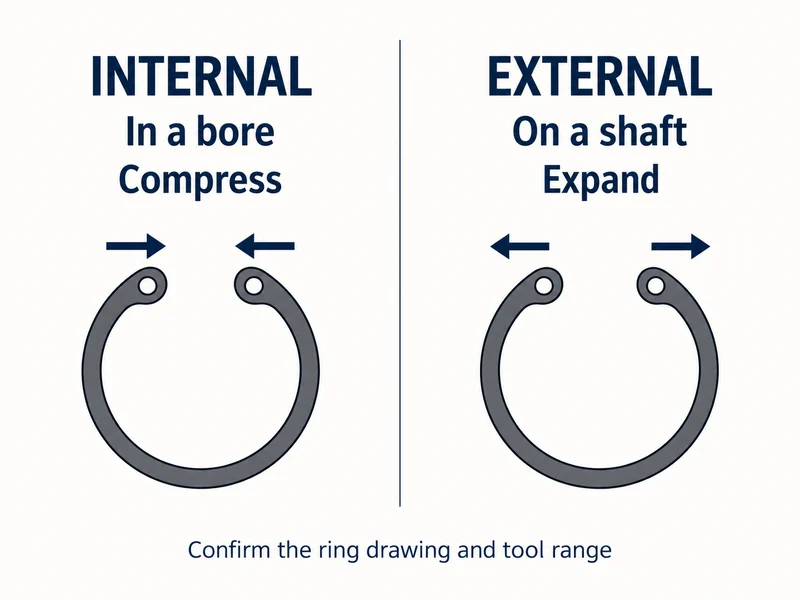
Internal snap ring pliers compress a ring in a bore; external pliers expand a ring over a shaft
Direction comparison only; confirm the ring drawing and specified tool range.

How does the operating direction differ?

Internal pliers enter lug holes and bring ring ends inward. External pliers enter lug holes and move ring ends outward.

Start with the groove location, then choose the plier action.

  • Internal ring: install inside a bore or housing groove.
  • External ring: install over a shaft, pin, or similar outside groove.
  • Axial ring with lug holes: typically accepts retaining-ring pliers.
  • Lugless, radial, or spiral ring: may require another applicator or hand method.

Why can a wrong direction cause trouble?

The wrong direction can push a ring from its groove or overstress its ends. Review assembly direction before comparing handle length or finish.

Use the hand tools range to classify this SKU within a broader assortment, then keep a ring-specific fit record.

What should a buyer record first?

Record ring type, groove location, holes, nominal shaft or bore, and installation direction. Keep the drawing with the purchase file.

Buyer check Internal pliers External pliers Evidence to retain
Groove location Inside bore or housing Outside shaft or pin Part drawing
Tip movement Compresses ring Expands ring Supplier specification
Typical interface Ring lug holes Ring lug holes Approved sample
Main error risk Ring pushed outward Ring pushed inward First-article check

Before requesting quotations, mark each SKU as internal, external, or another ring system.

2. How should buyers identify the ring before choosing a tool?

Ring names vary across shops and catalogs. “Snap ring,” “circlip,” and “retaining ring” can describe related products, yet hole layout, section shape, and installation method still decide tool fit.
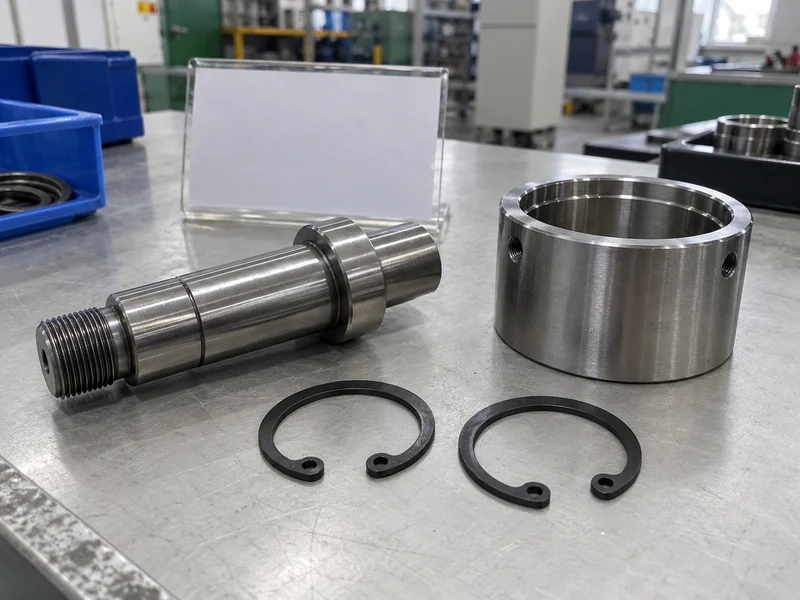
Retaining ring samples with lug holes arranged beside a shaft and housing for identification
AI-generated concept illustration; not a product specification or a photograph of Kolarwin facilities.

What features deserve a close look?

Check the ring’s ends, holes, cross-section, free diameter, and groove. Confirm axial or radial mounting. A drawing or physical sample carries more weight than a photograph.

Read the ring drawing before reading the plier label.

  • Confirm internal or external application.
  • Measure or verify hole diameter.
  • Check hole spacing and tip approach.
  • Identify any lug, notch, ear, or no-hole design.
  • Record shaft or bore size from the assembly drawing.

For automotive buyers, use the automotive repair tools page to place snap ring pliers beside adjacent service categories. Keep ring-specific records for each SKU.

Why does a photograph alone fall short?

A product photo rarely reveals spring load, hole diameter, permissible ring size, or whether tips are fixed. Treat images as orientation aids rather than approval evidence.

What does “size” mean in a catalog?

Size may mean ring, shaft, bore, tip, or plier length. Record groove and free-ring diameters separately; neither substitutes for nominal shaft or bore size. Ask suppliers to define each field. A model’s range applies only under documented conditions.

Ring identification field Why it matters Buyer evidence
Ring direction Selects internal or external action Assembly drawing
Hole diameter Controls tip engagement Ring drawing or sample
Hole spacing Controls jaw alignment Dimensional drawing
Nominal shaft or bore diameter Matches the stated tool range Assembly drawing and model chart
Groove diameter Controls seating geometry Groove drawing
Free diameter Separates loose-ring size from installed fit Supplier specification
Ring style May require another tool Manufacturer designation

Attach a ring drawing to each RFQ and request a filled compatibility table.

3. Which tip size and working range should a buyer specify?

Tip diameter and working range must match the ring, not a generic “small” or “large” label. A thin tip may slip; a thick one may not seat.
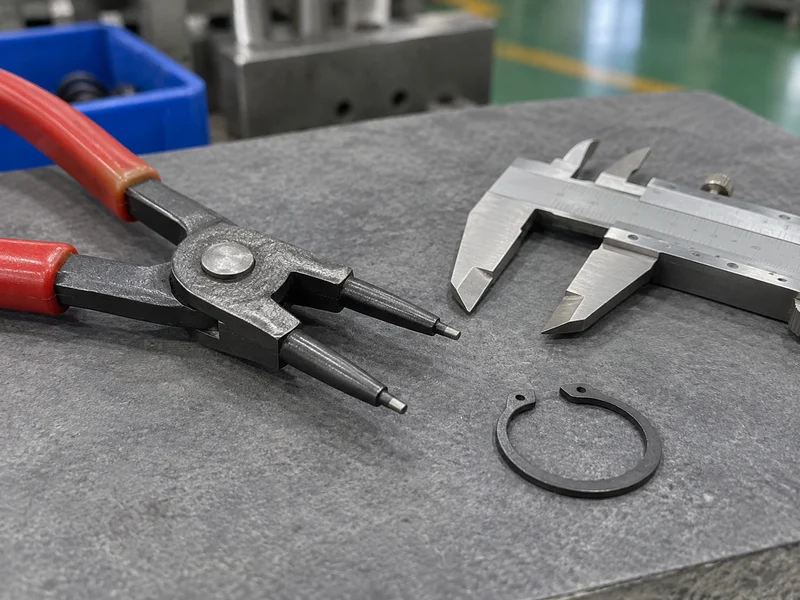
Snap ring plier pin tips beside measuring tools at a factory inspection bench
AI-generated concept illustration; not a product specification or a photograph of Kolarwin facilities.

How do tips affect engagement?

Tips need enough diameter and length for secure hole contact. Their shape, shoulder, and finish affect how well they stay seated while the ring moves. Excess clearance can let a tip slip; insufficient clearance can block entry.

The ring hole sets the starting point for tip selection.

  • Specify tip diameter at the working end.
  • Confirm tip insertion depth or usable length.
  • Check tip angle against the ring’s approach path.
  • Match tip strength with ring tension and service frequency.
  • Request replacement-tip part numbers when available.

Why should published size ranges stay model-specific?

One tool may cover a narrow diameter band while a ratchet or heavy-duty model covers larger rings. Use the manufacturer’s chart for each model.

How should buyers compare range claims?

Ask whether a range refers to bore, shaft, or ring diameter. Request limits for tip size, tension, and angle. Confirm the range with a production-intent sample.

Specification Question for supplier Approval evidence
Tip diameter What ring-hole sizes fit? Tip drawing
Tip angle Which approach angles are supported? Plier model and angle
Working range Which shaft or bore dimensions apply? Published model chart
Load condition What ring type and tension were assessed? Technical note or test method

Reject any range claim without a defined diameter basis and tip configuration.

4. Are straight, bent, and access-tip pliers interchangeable?

Straight tips suit direct axial access. Bent tips help when a housing wall, shaft shoulder, or adjacent component blocks a straight approach. They change reach and hand position, yet they do not change internal pliers into external pliers.
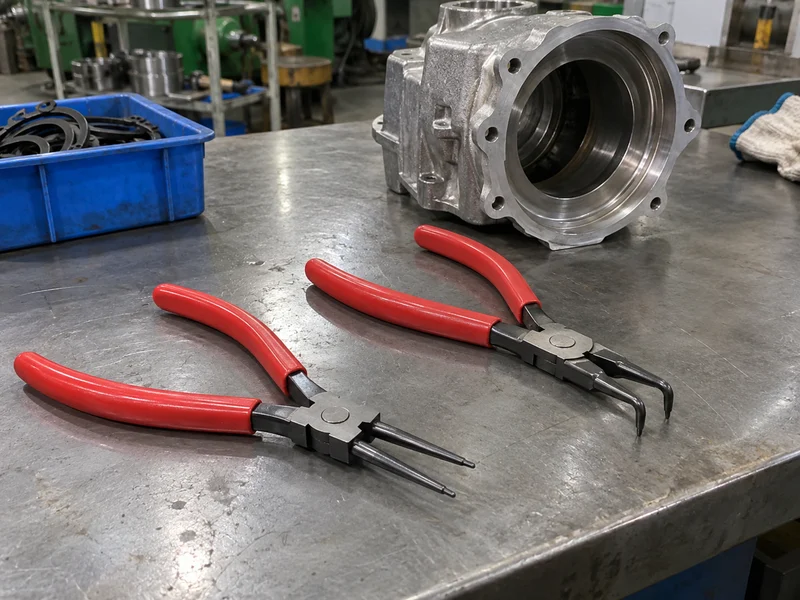
Straight and bent snap ring pliers laid beside a recessed metal housing
AI-generated concept illustration; not a product specification or a photograph of Kolarwin facilities.

When does a 45-degree or 90-degree tip help?

An angled tip can keep handles clear of a housing or align with a ring set deep inside an assembly. The bend adds a geometric constraint, so tip spacing still needs a sample check.

Choose the angle from the obstruction, not from a set-count promise.

  • Straight: direct line into accessible holes.
  • 45-degree: moderate offset around a shoulder.
  • 90-degree: side approach or deep access.
  • Long reach: recessed groove with enough handle clearance.
  • Narrow profile: crowded housing or nearby components.

What should an access trial include?

Use the production-intent ring, mating shaft or bore, nearby walls, and intended hand position. Check full tip seating, handle travel, ring visibility, and release space. Test removal as well as installation.

Access factor Straight tip Angled tip Sample check
Direct axial access Strong fit May add offset Tip seats squarely
Housing obstruction May foul wall Can clear wall Handle avoids part
Deep groove Depends on reach May improve approach Ring remains visible
Repeat removal Simple alignment Angle-dependent Operator can release safely

Put tip angle and reach in separate RFQ fields, then approve both on the actual assembly.

5. Fixed or convertible snap ring pliers: which model fits a range?

Dedicated-action pliers serve either internal or external rings. Convertible pliers switch between both actions. Check tip attachment separately. Volume, changeover, and spare strategy decide the fit.
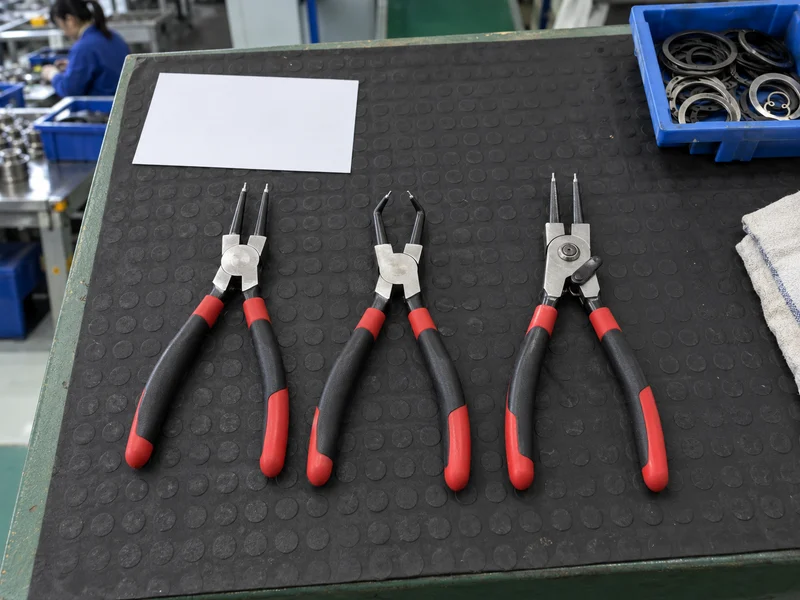
Dedicated snap ring pliers and a convertible plier arranged for a buyer comparison
AI-generated concept illustration; not a product specification or a photograph of Kolarwin facilities.

Where do fixed pliers make sense?

Fixed-action pliers suit a stable job where operators repeat one ring direction and size. Separate tools can reduce mode-switch mistakes. A dedicated body can still use replaceable tips.

A dedicated tool can be easier to control when work stays constant.

  • One direction per tool.
  • Clear visual identification.
  • No conversion step.
  • Separate wear and replacement path.

Where do convertible pliers help?

Convertible models can reduce the number of bodies in a mobile kit. Switching mechanisms, tip locking, and mode markings need inspection before approval.

What tradeoff should a buyer price?

Compare tool count, changeover time, tip inventory, storage, and operator error exposure. Ask for switching, locking, and service details.

Use the mechanics tool set page to compare kit packaging while choosing dedicated or convertible bodies. Keep a mode-specific fit record.

Buying condition Fixed pliers Convertible pliers Decision evidence
Repeated one-way job Dedicated fit May carry unused features Cycle and error review
Mixed field repairs More bodies required Fewer bodies possible Kit weight and storage
Mode changes No switch Switch and verify Mechanism inspection
Tip policy Fixed or replaceable Fixed or replaceable Tip part-number check

For a stable cell, start with dedicated action; for mixed work, approve a convertible model only after a documented mode-change check.

6. Do replaceable tips or modular kits improve purchasing?

Replaceable tips can extend a sound body’s service range. Modular kits reduce duplicated handles, yet add fastening checks.
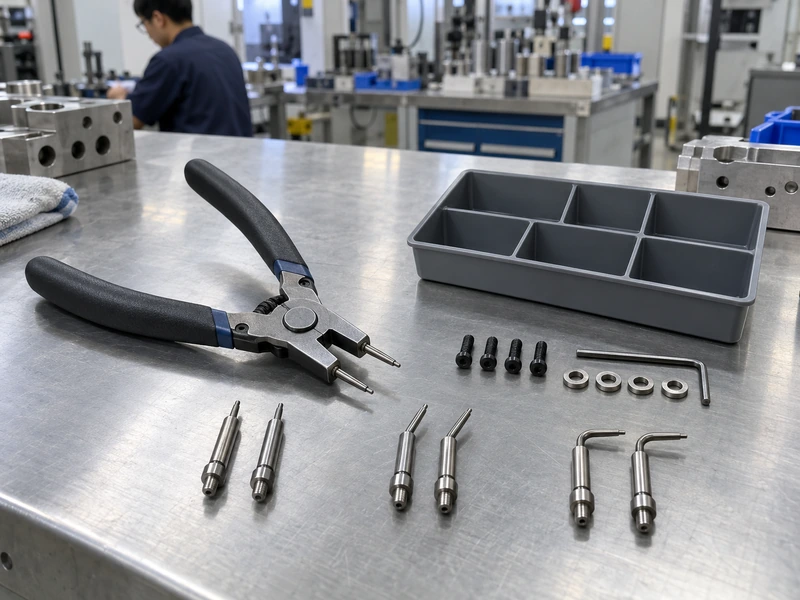
Snap ring plier body with separate straight and angled replacement pin tips on a factory service bench
AI-generated concept illustration; not a product specification or a photograph of Kolarwin facilities.

What should a modular kit include?

Ask for bodies, tip pairs, angles, fastening hardware, storage, and a compatibility chart. Include both directions only when demand supports them.

Modularity pays when spares and identification stay organized.

  • Replacement tip part numbers.
  • Fastener or set-screw specification.
  • Tightening or retention instruction.
  • Tip storage with size markings.
  • Service path for worn jaws or bodies.

What can go wrong with replaceable tips?

Loose fasteners, mixed tips, and damaged seats can create poor alignment. QC should verify each shipped configuration.

How should a distributor package modular options?

Create a base SKU with an explicit tip set. List replenishment tips by diameter and angle, then show both modes in product data.

Modular field Buyer question Control
Tip inventory Which diameters and angles ship? Count and label
Attachment How do tips lock? Fastener check
Replacement What part number reorders? Spare list
Configuration Which ring directions fit? Mode chart

Approve a modular kit after a parts-count check and one fit test for each listed configuration.

7. Which ring designs should not use standard snap ring pliers?

Standard snap ring pliers fit rings designed for their tips and lug holes. Radial, lugless, spiral, or self-locking rings may require an applicator, dispenser, mandrel, or hand method.
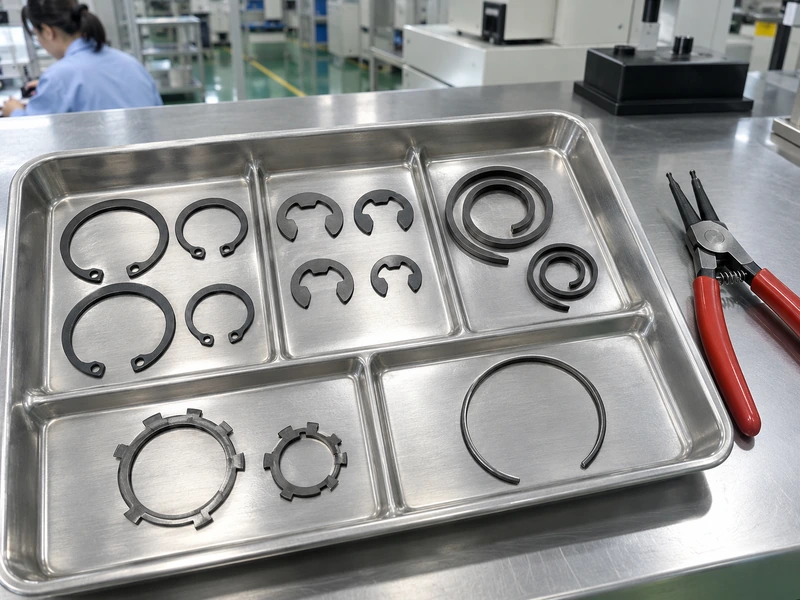
Different retaining ring designs arranged in separate compartments of a stainless inspection tray beside a two-pin snap-ring plier
AI-generated concept illustration; not a product specification or a photograph of Kolarwin facilities.

Why do ring designs change the tool choice?

Ring geometry controls how the part enters a groove. Axial rings with lug holes accept suitable retaining-ring pliers. Spiral rings may have a removal notch. Radial rings such as E-clips enter the groove from the side.

Match the tool with the ring’s installation method.

  • Axial ring with lug holes: retaining-ring pliers may fit.
  • Radial ring: use the specified applicator or dispenser.
  • Spiral ring: follow its notch and hand-installation method.
  • Self-locking ring: use the documented tool or plunger method.
  • Lugless constant-section ring: do not assume lug-hole engagement.

Use the industry tools overview to place this SKU beside other industrial categories when building an assortment. The ring maker’s method controls purchase approval.

What does this mean for product listings?

Listings should state ring style, holes, installation direction, and tool type. Avoid “fits all snap rings” without documented coverage.

How should QC handle a ring without lug holes?

Use the ring maker’s instruction and approved applicator. Check groove entry, seating, removal access, and deformation. Stop when the tool family is wrong.

Ring design Hole-based pliers? Typical tool path Listing control
Axial lug-hole ring Usually Internal or external pliers State direction and hole size
Radial E-clip No Applicator or dispenser State radial method
Spiral ring No lug-hole action Hand method or notch tool State removal feature
Self-locking ring Model-dependent Plunger or specified tool Cite ring instructions

Add a ring-style field to catalog data, and block “universal” wording without evidence.

8. What QC checks should a distributor require?

QC should connect tool geometry with an approved ring and assembly. Check dimensions, tip retention, operation, markings, and package completeness.
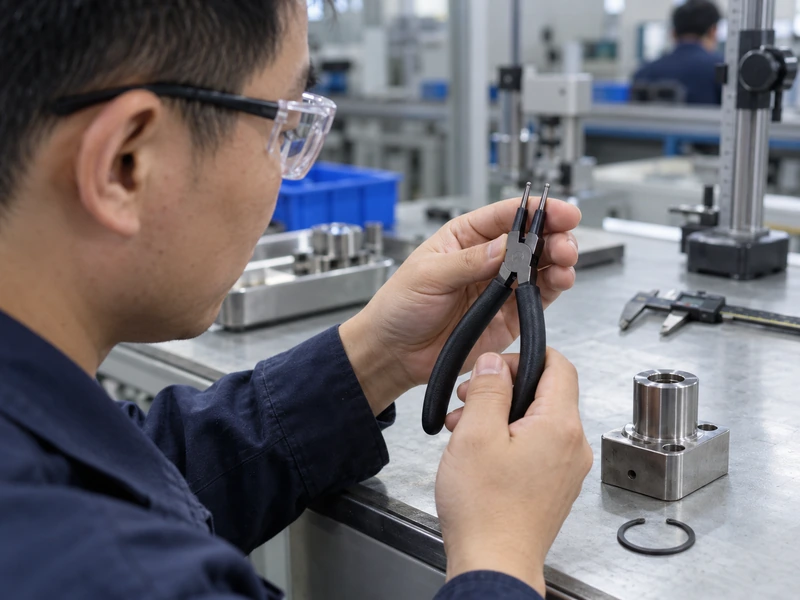
Asian QC inspector in safety glasses examining narrow two-pin snap-ring plier tips at a factory inspection station
AI-generated concept illustration; not a product specification or a photograph of Kolarwin facilities.

What should incoming inspection verify?

Inspect tip diameter, angle, alignment, jaw movement, spring return, handle condition, markings, and included accessories. Use gauges or drawings where the supplier specifies them. Check both internal compression and external expansion when a convertible model offers both.

A fit check carries more value than a polished product photograph.

  • Match model and revision against the order.
  • Verify tip size and angle.
  • Fit the approved ring on its actual bore or shaft.
  • Check full seating and release.
  • Record damage, slippage, and permanent ring deformation.

Which sample conditions matter?

Use production-intent rings, not a convenient substitute. Include the smallest and largest approved dimensions where a range is claimed. Follow the ring maker’s expansion or compression limits, and confirm full groove seating before operation. Any reuse decision follows the ring-series specification.

What belongs in a QC report?

Record model, ring part number, direction, shaft or bore, tip details, method, result, date, and inspector. Photos remain supporting evidence.

Use the contact page to request drawings or sample clarifications, and include model, ring, and diameter data in the message.

QC point Pass condition Record
Tip engagement Tips seat without slip Tip and ring dimensions
Operating action Compresses or expands correctly Internal or external mode
Access Handles clear nearby parts Assembly setup
Ring condition No harmful deformation Before and after check
Package Tools and spares complete Packing checklist

Require a production-intent fit sample before approving a claimed size range.

9. How should buyers plan replacement tips and service parts?

Replacement planning protects a range from small failures. Tips can wear, bend, or disappear. Bodies, springs, and fasteners may need separate part numbers.
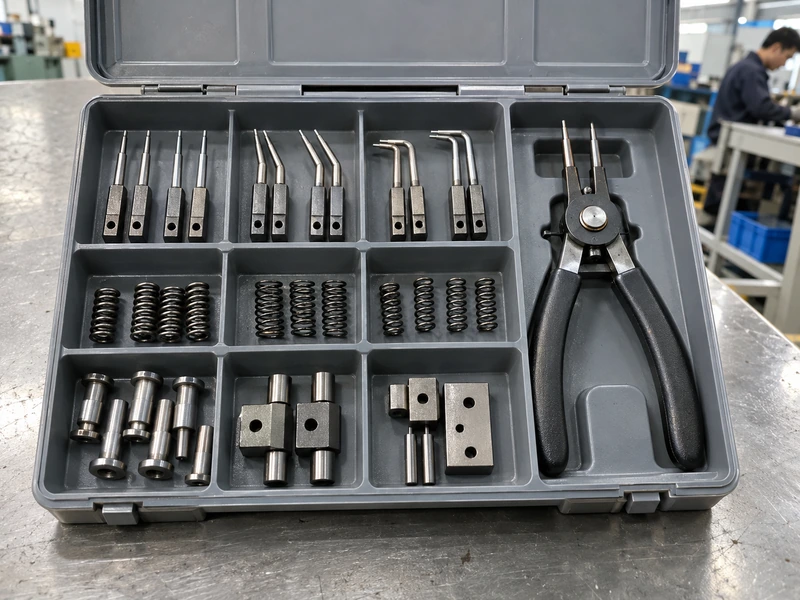
Organized replacement snap-ring plier tips, springs, fasteners, and conversion parts in an open service organizer
AI-generated concept illustration; not a product specification or a photograph of Kolarwin facilities.

Which spares deserve a line item?

List tip diameters, angles, hardware, springs, conversion parts, and cases. State pair or single quantities. Keep cross-references in the service document.

A spare part should be identifiable before a technician needs it.

  • Model and revision.
  • Internal or external mode.
  • Tip diameter and angle.
  • Pair or single quantity.
  • Installation hardware.
  • Service-life or inspection limit when documented.

How should distributors build a replacement range?

Start with tips matching active SKUs and common ring drawings. Add uncommon angles only where demand or access evidence supports them. Avoid carrying tips whose fit depends on an unverified body revision.

What should a service request include?

Provide a clear photo, model marking, tip measurement, ring drawing, and failure description. Ask for the approved replacement part instead of adapting an unrelated tip.

Review supplier scope on the about page before requesting a service-part pack. Base technical decisions on model documents and approved samples.

Spare item Identification fields Buyer control
Replacement tip Diameter, angle, mode Pair and part number
Fastener Thread or size, tool Approved hardware
Spring Model and position Service drawing
Conversion part Mode and revision Function check
Storage case Kit and insert Packing list

Add replacement parts, packaging quantities, and lead-time fields to the range plan.

10. What should an RFQ for internal vs external snap ring pliers include?

An RFQ should let a supplier prove fit from defined fields. State ring direction, holes, access, range, and evidence.
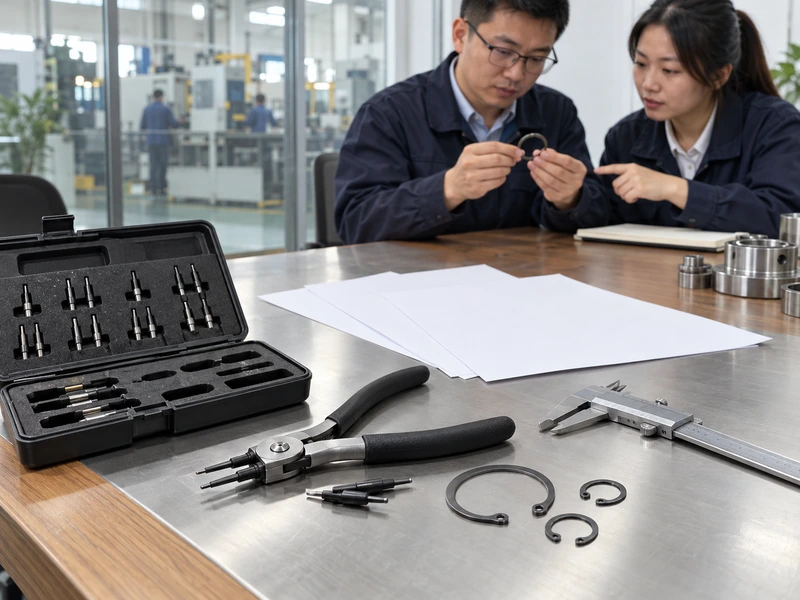
Snap-ring plier sample kit and blank RFQ sheets on a B2B review bench with Asian procurement staff in the background
AI-generated concept illustration; not a product specification or a photograph of Kolarwin facilities.

Which fields should appear in the request?

Include these fields in plain language:

  • Internal or external ring direction.
  • Ring style and holes.
  • Hole diameter and spacing.
  • Shaft or bore diameter range.
  • Tip diameter, length, and angle.
  • Straight, 45-degree, or 90-degree access.
  • Fixed or convertible body.
  • Replaceable-tip and spare-part requirement.
  • Sample, drawing, and QC evidence.
  • Packaging and service documentation.

A good RFQ makes compatibility answerable before price comparison.

What should a supplier return?

Request model numbers, drawings, ranges, tip charts, replacement parts, samples, and inspection records.

Place this SKU beside a complete mechanic tools list when planning coverage. Use the supplier-selection guide to structure supplier evidence, while ring fit remains a technical approval item.

What decision rule works for a mixed tool range?

Approve the smallest set covering documented rings, access, and service needs. Add dedicated action when conversion creates too many checks. Add interchangeable tips when the required configurations and replacement parts can be identified and stocked reliably.

Send the RFQ after attaching the ring drawing and assembly direction.

FAQs

Q1. Can internal pliers install an external snap ring?

A dedicated internal plier cannot provide external expansion. A convertible model can after switching to external mode. Confirm the drawing and model.

Q2. Are snap ring pliers the same as circlip pliers?

Many catalogs use both terms for similar axial retaining-ring tools. Names alone do not establish fit. Check holes, ring style, and installation method.

Q3. Do all retaining rings have holes for pliers?

No. Radial, spiral, self-locking, and some lugless rings use other methods. Follow the ring maker’s instructions.

Q4. Is a convertible plier always the best stocking choice?

No single format suits every range. Compare changeover checks, access, tool count, tips, and spares.

Q5. What should a buyer ask for before placing an order?

Request a model drawing, range, tip chart, sample result, replacement-tip details, and packaging checklist. Keep those records with the approved SKU.

Looking for a reliable mechanic tools manufacturer in China?

If you are sourcing hand tools, socket tools, automotive repair tools, mechanic tool sets or OEM private label tools, contact KOLARWIN Tools for factory-direct quotation, customization support and product consultation.


Internal snap ring pliers compress a retaining ring so it can sit inside a bore. External snap ring pliers expand a ring so it can fit over a shaft. Choosing the wrong action can damage a ring or its groove. An unsuitable tool can also leave part of your required range uncovered.

For B2B buyers, selection starts with the ring drawing and assembly direction. This guide covers tip geometry, access, QC, spares, and RFQ evidence.

1. What do internal and external snap ring pliers do?

Internal pliers close their tips when handles move together, compressing a ring for placement inside a housing or bore. External pliers open a ring so it can pass over a shaft or pin. The tool direction follows the ring’s installation path.

Internal snap ring pliers compress a ring in a bore; external pliers expand a ring over a shaft
Direction comparison only; confirm the ring drawing and specified tool range.

How does the operating direction differ?

Internal pliers enter lug holes and bring ring ends inward. External pliers enter lug holes and move ring ends outward.

Start with the groove location, then choose the plier action.

Why can a wrong direction cause trouble?

The wrong direction can push a ring from its groove or overstress its ends. Review assembly direction before comparing handle length or finish.

Use the hand tools range to classify this SKU within a broader assortment, then keep a ring-specific fit record.

What should a buyer record first?

Record ring type, groove location, holes, nominal shaft or bore, and installation direction. Keep the drawing with the purchase file.

Buyer check Internal pliers External pliers Evidence to retain
Groove location Inside bore or housing Outside shaft or pin Part drawing
Tip movement Compresses ring Expands ring Supplier specification
Typical interface Ring lug holes Ring lug holes Approved sample
Main error risk Ring pushed outward Ring pushed inward First-article check

Before requesting quotations, mark each SKU as internal, external, or another ring system.

2. How should buyers identify the ring before choosing a tool?

Ring names vary across shops and catalogs. “Snap ring,” “circlip,” and “retaining ring” can describe related products, yet hole layout, section shape, and installation method still decide tool fit.

Retaining ring samples with lug holes arranged beside a shaft and housing for identification
AI-generated concept illustration; not a product specification or a photograph of Kolarwin facilities.

What features deserve a close look?

Check the ring’s ends, holes, cross-section, free diameter, and groove. Confirm axial or radial mounting. A drawing or physical sample carries more weight than a photograph.

Read the ring drawing before reading the plier label.

For automotive buyers, use the automotive repair tools page to place snap ring pliers beside adjacent service categories. Keep ring-specific records for each SKU.

Why does a photograph alone fall short?

A product photo rarely reveals spring load, hole diameter, permissible ring size, or whether tips are fixed. Treat images as orientation aids rather than approval evidence.

What does “size” mean in a catalog?

Size may mean ring, shaft, bore, tip, or plier length. Record groove and free-ring diameters separately; neither substitutes for nominal shaft or bore size. Ask suppliers to define each field. A model’s range applies only under documented conditions.

Ring identification field Why it matters Buyer evidence
Ring direction Selects internal or external action Assembly drawing
Hole diameter Controls tip engagement Ring drawing or sample
Hole spacing Controls jaw alignment Dimensional drawing
Nominal shaft or bore diameter Matches the stated tool range Assembly drawing and model chart
Groove diameter Controls seating geometry Groove drawing
Free diameter Separates loose-ring size from installed fit Supplier specification
Ring style May require another tool Manufacturer designation

Attach a ring drawing to each RFQ and request a filled compatibility table.

3. Which tip size and working range should a buyer specify?

Tip diameter and working range must match the ring, not a generic “small” or “large” label. A thin tip may slip; a thick one may not seat.

Snap ring plier pin tips beside measuring tools at a factory inspection bench
AI-generated concept illustration; not a product specification or a photograph of Kolarwin facilities.

How do tips affect engagement?

Tips need enough diameter and length for secure hole contact. Their shape, shoulder, and finish affect how well they stay seated while the ring moves. Excess clearance can let a tip slip; insufficient clearance can block entry.

The ring hole sets the starting point for tip selection.

Why should published size ranges stay model-specific?

One tool may cover a narrow diameter band while a ratchet or heavy-duty model covers larger rings. Use the manufacturer’s chart for each model.

How should buyers compare range claims?

Ask whether a range refers to bore, shaft, or ring diameter. Request limits for tip size, tension, and angle. Confirm the range with a production-intent sample.

Specification Question for supplier Approval evidence
Tip diameter What ring-hole sizes fit? Tip drawing
Tip angle Which approach angles are supported? Plier model and angle
Working range Which shaft or bore dimensions apply? Published model chart
Load condition What ring type and tension were assessed? Technical note or test method

Reject any range claim without a defined diameter basis and tip configuration.

4. Are straight, bent, and access-tip pliers interchangeable?

Straight tips suit direct axial access. Bent tips help when a housing wall, shaft shoulder, or adjacent component blocks a straight approach. They change reach and hand position, yet they do not change internal pliers into external pliers.

Straight and bent snap ring pliers laid beside a recessed metal housing
AI-generated concept illustration; not a product specification or a photograph of Kolarwin facilities.

When does a 45-degree or 90-degree tip help?

An angled tip can keep handles clear of a housing or align with a ring set deep inside an assembly. The bend adds a geometric constraint, so tip spacing still needs a sample check.

Choose the angle from the obstruction, not from a set-count promise.

What should an access trial include?

Use the production-intent ring, mating shaft or bore, nearby walls, and intended hand position. Check full tip seating, handle travel, ring visibility, and release space. Test removal as well as installation.

Access factor Straight tip Angled tip Sample check
Direct axial access Strong fit May add offset Tip seats squarely
Housing obstruction May foul wall Can clear wall Handle avoids part
Deep groove Depends on reach May improve approach Ring remains visible
Repeat removal Simple alignment Angle-dependent Operator can release safely

Put tip angle and reach in separate RFQ fields, then approve both on the actual assembly.

5. Fixed or convertible snap ring pliers: which model fits a range?

Dedicated-action pliers serve either internal or external rings. Convertible pliers switch between both actions. Check tip attachment separately. Volume, changeover, and spare strategy decide the fit.

Dedicated snap ring pliers and a convertible plier arranged for a buyer comparison
AI-generated concept illustration; not a product specification or a photograph of Kolarwin facilities.

Where do fixed pliers make sense?

Fixed-action pliers suit a stable job where operators repeat one ring direction and size. Separate tools can reduce mode-switch mistakes. A dedicated body can still use replaceable tips.

A dedicated tool can be easier to control when work stays constant.

Where do convertible pliers help?

Convertible models can reduce the number of bodies in a mobile kit. Switching mechanisms, tip locking, and mode markings need inspection before approval.

What tradeoff should a buyer price?

Compare tool count, changeover time, tip inventory, storage, and operator error exposure. Ask for switching, locking, and service details.

Use the mechanics tool set page to compare kit packaging while choosing dedicated or convertible bodies. Keep a mode-specific fit record.

Buying condition Fixed pliers Convertible pliers Decision evidence
Repeated one-way job Dedicated fit May carry unused features Cycle and error review
Mixed field repairs More bodies required Fewer bodies possible Kit weight and storage
Mode changes No switch Switch and verify Mechanism inspection
Tip policy Fixed or replaceable Fixed or replaceable Tip part-number check

For a stable cell, start with dedicated action; for mixed work, approve a convertible model only after a documented mode-change check.

6. Do replaceable tips or modular kits improve purchasing?

Replaceable tips can extend a sound body’s service range. Modular kits reduce duplicated handles, yet add fastening checks.

Snap ring plier body with separate straight and angled replacement pin tips on a factory service bench
AI-generated concept illustration; not a product specification or a photograph of Kolarwin facilities.

What should a modular kit include?

Ask for bodies, tip pairs, angles, fastening hardware, storage, and a compatibility chart. Include both directions only when demand supports them.

Modularity pays when spares and identification stay organized.

What can go wrong with replaceable tips?

Loose fasteners, mixed tips, and damaged seats can create poor alignment. QC should verify each shipped configuration.

How should a distributor package modular options?

Create a base SKU with an explicit tip set. List replenishment tips by diameter and angle, then show both modes in product data.

Modular field Buyer question Control
Tip inventory Which diameters and angles ship? Count and label
Attachment How do tips lock? Fastener check
Replacement What part number reorders? Spare list
Configuration Which ring directions fit? Mode chart

Approve a modular kit after a parts-count check and one fit test for each listed configuration.

7. Which ring designs should not use standard snap ring pliers?

Standard snap ring pliers fit rings designed for their tips and lug holes. Radial, lugless, spiral, or self-locking rings may require an applicator, dispenser, mandrel, or hand method.

Different retaining ring designs arranged in separate compartments of a stainless inspection tray beside a two-pin snap-ring plier
AI-generated concept illustration; not a product specification or a photograph of Kolarwin facilities.

Why do ring designs change the tool choice?

Ring geometry controls how the part enters a groove. Axial rings with lug holes accept suitable retaining-ring pliers. Spiral rings may have a removal notch. Radial rings such as E-clips enter the groove from the side.

Match the tool with the ring’s installation method.

Use the industry tools overview to place this SKU beside other industrial categories when building an assortment. The ring maker’s method controls purchase approval.

What does this mean for product listings?

Listings should state ring style, holes, installation direction, and tool type. Avoid “fits all snap rings” without documented coverage.

How should QC handle a ring without lug holes?

Use the ring maker’s instruction and approved applicator. Check groove entry, seating, removal access, and deformation. Stop when the tool family is wrong.

Ring design Hole-based pliers? Typical tool path Listing control
Axial lug-hole ring Usually Internal or external pliers State direction and hole size
Radial E-clip No Applicator or dispenser State radial method
Spiral ring No lug-hole action Hand method or notch tool State removal feature
Self-locking ring Model-dependent Plunger or specified tool Cite ring instructions

Add a ring-style field to catalog data, and block “universal” wording without evidence.

8. What QC checks should a distributor require?

QC should connect tool geometry with an approved ring and assembly. Check dimensions, tip retention, operation, markings, and package completeness.

Asian QC inspector in safety glasses examining narrow two-pin snap-ring plier tips at a factory inspection station
AI-generated concept illustration; not a product specification or a photograph of Kolarwin facilities.

What should incoming inspection verify?

Inspect tip diameter, angle, alignment, jaw movement, spring return, handle condition, markings, and included accessories. Use gauges or drawings where the supplier specifies them. Check both internal compression and external expansion when a convertible model offers both.

A fit check carries more value than a polished product photograph.

Which sample conditions matter?

Use production-intent rings, not a convenient substitute. Include the smallest and largest approved dimensions where a range is claimed. Follow the ring maker’s expansion or compression limits, and confirm full groove seating before operation. Any reuse decision follows the ring-series specification.

What belongs in a QC report?

Record model, ring part number, direction, shaft or bore, tip details, method, result, date, and inspector. Photos remain supporting evidence.

Use the contact page to request drawings or sample clarifications, and include model, ring, and diameter data in the message.

QC point Pass condition Record
Tip engagement Tips seat without slip Tip and ring dimensions
Operating action Compresses or expands correctly Internal or external mode
Access Handles clear nearby parts Assembly setup
Ring condition No harmful deformation Before and after check
Package Tools and spares complete Packing checklist

Require a production-intent fit sample before approving a claimed size range.

9. How should buyers plan replacement tips and service parts?

Replacement planning protects a range from small failures. Tips can wear, bend, or disappear. Bodies, springs, and fasteners may need separate part numbers.

Organized replacement snap-ring plier tips, springs, fasteners, and conversion parts in an open service organizer
AI-generated concept illustration; not a product specification or a photograph of Kolarwin facilities.

Which spares deserve a line item?

List tip diameters, angles, hardware, springs, conversion parts, and cases. State pair or single quantities. Keep cross-references in the service document.

A spare part should be identifiable before a technician needs it.

How should distributors build a replacement range?

Start with tips matching active SKUs and common ring drawings. Add uncommon angles only where demand or access evidence supports them. Avoid carrying tips whose fit depends on an unverified body revision.

What should a service request include?

Provide a clear photo, model marking, tip measurement, ring drawing, and failure description. Ask for the approved replacement part instead of adapting an unrelated tip.

Review supplier scope on the about page before requesting a service-part pack. Base technical decisions on model documents and approved samples.

Spare item Identification fields Buyer control
Replacement tip Diameter, angle, mode Pair and part number
Fastener Thread or size, tool Approved hardware
Spring Model and position Service drawing
Conversion part Mode and revision Function check
Storage case Kit and insert Packing list

Add replacement parts, packaging quantities, and lead-time fields to the range plan.

10. What should an RFQ for internal vs external snap ring pliers include?

An RFQ should let a supplier prove fit from defined fields. State ring direction, holes, access, range, and evidence.

Snap-ring plier sample kit and blank RFQ sheets on a B2B review bench with Asian procurement staff in the background
AI-generated concept illustration; not a product specification or a photograph of Kolarwin facilities.

Which fields should appear in the request?

Include these fields in plain language:

A good RFQ makes compatibility answerable before price comparison.

What should a supplier return?

Request model numbers, drawings, ranges, tip charts, replacement parts, samples, and inspection records.

Place this SKU beside a complete mechanic tools list when planning coverage. Use the supplier-selection guide to structure supplier evidence, while ring fit remains a technical approval item.

What decision rule works for a mixed tool range?

Approve the smallest set covering documented rings, access, and service needs. Add dedicated action when conversion creates too many checks. Add interchangeable tips when the required configurations and replacement parts can be identified and stocked reliably.

Send the RFQ after attaching the ring drawing and assembly direction.

FAQs

Q1. Can internal pliers install an external snap ring?

A dedicated internal plier cannot provide external expansion. A convertible model can after switching to external mode. Confirm the drawing and model.

Q2. Are snap ring pliers the same as circlip pliers?

Many catalogs use both terms for similar axial retaining-ring tools. Names alone do not establish fit. Check holes, ring style, and installation method.

Q3. Do all retaining rings have holes for pliers?

No. Radial, spiral, self-locking, and some lugless rings use other methods. Follow the ring maker’s instructions.

Q4. Is a convertible plier always the best stocking choice?

No single format suits every range. Compare changeover checks, access, tool count, tips, and spares.

Q5. What should a buyer ask for before placing an order?

Request a model drawing, range, tip chart, sample result, replacement-tip details, and packaging checklist. Keep those records with the approved SKU.

Why Partner with Kolarwin Tools?

Factory-Direct Pricing Skip the middleman — access competitive wholesale prices and protect your margins
Private Label & OEM Ready Your brand, our expertise — full customization from logo to packaging
Fast Global Shipping Reliable delivery to 60+ countries with full export documentation support
Low MOQ, High Flexibility Start small, scale fast — flexible order quantities to fit your business
Dedicated B2B Support One-on-one account management from quote to delivery, every time

Get Your Free Quote in 24 Hours

Tell us your sourcing needs — we'll respond with a tailored quote, product specs, and the best pricing for your market. No commitment required.

Chat on WhatsApp Email Us Directly
