
Need OEM supplier support for this product type?
Contact KOLARWIN Tools for OEM mechanic tools, private label packaging, wholesale quotation and product range support. This gives overseas buyers a clear path from article reading to supplier discussion.
When a driver bit drops from a holder during a changeover, teams lose time; when a screw slips off the tip, an assembler may struggle to start it in a recess. Buyers often group both problems under “bit retention,” then compare locking and magnetic holders as though they solve the same task. They do not. Mechanical retention captures the bit inside the holder; a magnet may hold the bit, help position a compatible screw, or do both, depending on construction. A careful RFQ separates those functions, defines release behavior and tests intended parts together. That gives procurement a useful comparison without promising that either design suits every assembly line.
1. What does “retention” mean for a bit holder?
Retention can describe two different interfaces. First, the holder may retain its replaceable bit. Second, a magnetic feature may help retain a screw at the driver tip. A buyer who asks only for a “retaining holder” leaves room for mismatched expectations. Some magnetic holders help keep the bit from falling out; some designs use a ring, detent or sleeve; some combine a magnet with a mechanical feature. Each mechanism should be described separately in product data.
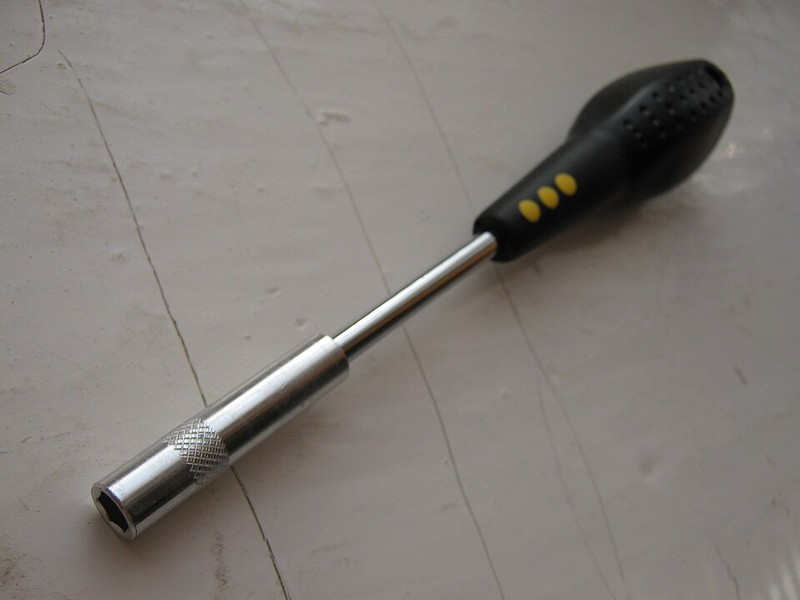
The nut setter vs nut driver comparison helps distinguish fastener-driving attachments from bit holders.
Name the retained part. If an assembler needs bits to stay in the holder while a tool points downward, ask for bit retention and release details. If an operator needs to start a screw with one hand, evaluate fastener pickup and positioning. If both are required, state both requirements and request a sample that demonstrates each function. A product photograph seldom clarifies whether the magnet acts on the bit, the screw, or both.
A useful procurement brief records the bit shank format, fastener material and shape, driver orientation, change frequency and workpiece access. These details reveal the failure mode buyers need to address. A magnetic feature may be useful for a ferrous screw but less useful for a nonferrous or weakly magnetic fastener. Mechanical bit capture does not automatically keep the screw at the tip.
- Define whether requirement concerns bit retention or screw holding.
- Identify whether both outcomes matter in one tool.
- Use product-specific diagrams or samples to clarify claims.
| Requirement | What it describes | How to verify |
|---|---|---|
| Bit retention | Bit remains engaged in holder | Insert, orient and release test |
| Fastener holding | Screw remains positioned at tip | Test actual fastener type and orientation |
| Dual function | Holder and screw retention both needed | Verify separately, then in one workflow |
2. How does mechanical locking retain a bit?
Mechanical designs use a physical feature to resist bit withdrawal. Depending on product, this may be a retaining ring, detent, sleeve-operated capture or another engagement geometry. Wera and other tool manufacturers list different holder arrangements, including rapid-change and ring-magnet models. Such catalogue examples show that named features can coexist; they do not prove that all holders using similar words behave identically.
Ask for the mechanism, not the label. The buyer should learn whether a sleeve must be moved before inserting or removing a bit, whether a detent engages a groove, and whether the holder accepts bits with a particular shank configuration. A “locking” label could refer to different designs across suppliers. Drawings or a transparent sample demonstration can settle the question faster than marketing copy.
Mechanical retention can suit workflows where a bit should remain captured during repositioning or overhead work. The cost is a release action and a moving or contacting part that requires inspection. If users change bits repeatedly, test release effort with the gloves they normally wear. If they rarely change bits, the convenience penalty may be minor. Avoid choosing a design solely because it feels harder to pull a bit out; an excessively difficult release can slow maintenance or damage components during removal.
A robust sample check includes the full intended bit range. Different bit shanks may engage differently. Record insertion depth, engagement consistency, release action and any visible wear after a defined trial. Do not call a short sample trial a durability test unless a controlled method supports that claim.
- Request a cutaway, drawing or mechanism explanation.
- Verify compatibility across each intended bit style.
- Balance secure engagement against practical release effort.
| Mechanical feature | Buyer question | Sample check |
|---|---|---|
| Retaining ring | Which shank feature does it engage? | Seat and remove approved bits |
| Detent | Is a groove or recess required? | Check engagement across suppliers |
| Release sleeve | What action releases the bit? | Test with typical gloves and posture |
3. What does magnetic retention actually do?
A magnet creates attraction to compatible ferrous material. A bit holder may use a magnet near the bit socket, a ring magnet around a bit, or another arrangement. Depending on position and product, the magnet can assist bit retention, screw pickup or screw alignment. These outcomes should not be treated as interchangeable. Wera’s official product descriptions identify universal holders with ring magnets, while ISO standards describe bit drive interfaces rather than magnetic force. Buyers must therefore verify magnetic behavior for the product and fastener combination they intend to sell.
Test the assembly, not the adjective. Choose the actual screws, driver orientation and working position. Check whether a screw stays on the tip during approach and whether the bit remains seated during withdrawal. A single screw pick-up demonstration may not represent different sizes, coatings or materials. Ask the supplier for product-specific magnetic specifications if a numeric force claim will appear in a catalogue. If no specification exists, use functional wording and sample testing instead of inventing a rating.
Magnetic attraction can create trade-offs. In environments where ferrous debris is present, a magnet may collect particles. A customer may also handle components for which magnetism is undesirable. These are process questions, not reasons to reject magnetic holders universally. Ask users whether their assembly includes sensitive components, metal filings or nonferrous fasteners before assigning a default.
Avoid implying that magnetic holders provide a positive mechanical lock. A magnet may keep a bit in place under ordinary handling, yet only documentation and testing establish the intended behavior. If a buyer requires physical capture, specify mechanical retention explicitly.
- Confirm whether the magnet targets bit, fastener or both.
- Test representative screw materials and sizes.
- Ask about ferrous debris and magnet-sensitive operations.
| Magnetic question | Why it matters | Evidence |
|---|---|---|
| Where is magnet located? | Predicts which part it influences | Drawing or sample inspection |
| Which fasteners work? | Material changes attraction | Test actual screw assortment |
| What force is claimed? | Numeric claims need evidence | Model-specific supplier data |
4. Which design helps with fastener placement?
Screw holding is useful when an operator needs to position a fastener before the threads engage. A magnetic holder can help with compatible screws, especially where access is awkward or the screw must be held near the driver during approach. But screw retention depends on contact and orientation. A holder may pick up a screw in one direction and release it when the tool angles sideways. For a high-volume process, a retention sleeve or other mechanical fastener-holding accessory might be more appropriate, depending on fastener geometry.
A retained bit still needs the correct recess. Use Pozidriv vs Phillips when identifying cross-head fasteners.
Recreate the work position. Test the screw at the angle and depth used on the job. Include the actual recess, fixture and neighboring surfaces. Watch whether the operator can start the fastener without touching the point, whether the screw remains aligned and whether the holder obstructs the work area. A product that performs well with a large screw on an open bench may behave differently with a small fastener in a narrow recess.
For product assortments, ask whether customers need a general holder for bit changes or a screw-starting aid. Those should be separate use cases in descriptions and comparison charts. If a magnet only supports the screw under certain conditions, state those limits in accessible language. Do not describe it as “hands-free fastening” without a verified application and appropriate safety review.
- Select actual fasteners and workpiece geometry for trials.
- Evaluate start alignment, not just pickup from a tray.
- Distinguish screw holding from bit locking in product copy.
| Placement scenario | Magnetic option | Mechanical option |
|---|---|---|
| Ferrous screw, open approach | Test pickup and alignment | May retain bit but not necessarily screw |
| Nonferrous screw | Magnet may not help | Evaluate dedicated fastener-retaining design |
| Narrow recess | Test tip clearance and angle | Check sleeve/access geometry |
5. How do bit changes affect the choice?
Changeover frequency changes the value of each mechanism. A production cell using multiple profiles may benefit from fast, repeatable bit exchanges. A field kit may value secure bit storage during movement. A repair bench might prioritize compatibility with a mixed bit set. Buyers should map how often a user changes bits and what happens when a bit is dropped, misplaced or hard to remove.
The workflow comparison in ratcheting screwdriver vs standard screwdriver helps buyers separate handle operation from bit-release speed.
Count the changeovers before adding cost. Observe a representative task or ask the line owner to estimate bit changes per cycle. Then test insertion and release with the intended bit assortment. A quick-change mechanism can help when frequent exchanges matter, but a complex release collar could add a step. Magnetic holders may simplify ordinary insertion in some designs, yet they may not offer the same positive capture as a mechanical lock.
Release force deserves attention. Very loose retention can let the bit fall during handling; very tight retention can frustrate bit swaps. A supplier should explain how the mechanism is intended to work and provide acceptance criteria where available. For private label, document what counts as acceptable release behavior and how the finished lot will be checked.
Think about serviceability too. If a holder is sold in a kit, users may replace bits rather than replace the whole holder. If a retention feature wears or jams, can the component be cleaned or replaced? Do not assume serviceability without a product manual or supplier confirmation.
- Map bit changes per task before comparing price.
- Test insertion and release using intended bits and gloves.
- Ask about cleaning, service and replacement options.
| Workflow | Main buyer priority | Trial observation |
|---|---|---|
| Frequent profile changes | Smooth, repeatable release | Time and ease across many swaps |
| Occasional changes | Secure handling and simplicity | Bit remains seated during movement |
| Mobile field kit | Bit security during transport | Check holder and case organization |
6. What material and workpiece conditions matter?
Magnetic behavior depends on the fastener material and geometry, while mechanical bit capture depends on the holder and bit interface. Workpiece access, orientation, cleanliness and nearby components also affect selection. These variables explain why a holder that suits one assembly may disappoint in another. Buyers should collect application information before committing to a universal description.
For non-cross-head fasteners, Torx vs Allen explains another profile distinction that a magnet cannot resolve.
Make the use case concrete. Record screw material or grade where known, head style, size range, coating, approach angle and whether users work around ferrous debris. If the end user cannot provide a material specification, collect representative production screws. Test the holder with clean and typical in-process parts. Do not use a magnet test on one sample and generalize to every customer fastener.
Some customers may restrict magnetic tools near sensitive components or instrumentation. Others may appreciate screw pickup in an overhead or confined task. The supplier can describe holder construction, but the user must confirm process suitability. Where risk matters, route the sample to the customer’s engineering or safety review rather than asking sales to infer compatibility.
Mechanical locking also has environment-related questions. Dust, debris or wear can affect moving sleeves and detents. A sample evaluation should reflect normal cleaning practices and work exposure. If a supplier specifies limits, preserve them in documentation and packaging.
- Gather representative screws and workpiece fixtures.
- Ask customers about magnet-sensitive operations and debris.
- Review mechanical movement under realistic shop conditions.
| Application factor | Magnetic concern | Mechanical concern |
|---|---|---|
| Fastener material | Attraction may vary | Shank engagement remains primary |
| Ferrous debris | Particles may collect | Debris may affect moving parts |
| Confined approach | Pickup may aid placement | Sleeve may need clearance |
| Frequent cleaning | Verify cleaning guidance | Check release mechanism after cleaning |
7. How should buyers test holder samples?
A useful sample trial separates the two retention jobs. Start with the bit: insert each planned bit, orient the tool in likely positions, and check whether the bit remains engaged. Then test screw holding with representative fasteners and the actual approach angle. Finally, combine both into a short task that includes a bit change, screw start and withdrawal. This sequence shows where performance comes from and prevents a successful screw pickup from masking weak bit retention.
The dimensional-checking approach in impact socket dimensions illustrates why a nominal interface name alone cannot establish clearance; use the actual holder drawing here.
Write down the pass criteria first. A trial should state which bits and screws are included, how the holder is oriented and what counts as an acceptable result. For example, users may require consistent seating and deliberate release without damage. Avoid arbitrary force thresholds unless the supplier and buyer have agreed on a measurement method. For higher-volume programmes, ask quality staff to define sampling and lot acceptance separately.
Include multiple operators when fit and release depend on hand strength or gloves. Record task conditions and any failure, such as a bit not fully seating, a screw falling during approach or a sleeve not returning. Re-test after ordinary cleaning if that forms part of the workflow. Keep samples identified by supplier model and revision so feedback does not get attached to an ambiguous product family.
A bench test informs selection; it does not prove a service life or safety rating. Those claims need appropriate data and documented methods. If the holder will be used in a regulated or critical assembly, the customer’s engineering requirements govern qualification.
- Test bit capture and screw holding as separate functions.
- Use agreed criteria and identify each sample revision.
- Escalate performance claims requiring formal validation.
| Trial stage | Procedure | Record |
|---|---|---|
| Bit engagement | Insert intended bits, orient and release | Seating and release observations |
| Screw pickup | Test actual fasteners in work position | Pickup consistency and alignment |
| Combined task | Change bit, start screw, withdraw tool | Workflow issues and operator notes |
8. What should an RFQ and quality plan specify?
An RFQ should name the retained component and intended task. State holder interface, accepted bit shanks, mechanical feature, magnet placement if applicable, intended fastener range, application, length, finish, marking and package format. Ask the supplier to identify any model limitations and provide drawings or datasheets. If marketing will use a numeric magnetic or pull-out claim, request model-specific evidence and a method that explains how the result was measured.
Specify the intended driver class separately, using impact bits vs regular bits to distinguish bit-duty questions from retention.
Keep quality checks observable. Incoming inspection can verify the model, dimensions, visual condition, sleeve movement and sample fit. A functional sample test can check bit engagement and screw pickup against approved samples. These checks should not be misrepresented as proof of long-term performance unless designed for that purpose. Record acceptance limits and requalification triggers for material, supplier or design changes.
For private label, include label claims in the approval process. The carton, online listing and product insert should distinguish mechanical locking from magnetic screw holding. A clear diagram can show where the mechanism operates. Product names should match SKU data and reorder codes. If a supplier proposes a substitute magnet, ring, sleeve or bit interface, require review before release.
- List each required function separately in the RFQ.
- Request drawings, use limits and evidence for numerical claims.
- Align inspection, packaging and online language with approved samples.
| RFQ/quality field | Example requirement |
|---|---|
| Bit retention | State mechanical feature and compatible shanks |
| Screw holding | Specify fastener samples and orientation |
| Documentation | Drawing, model datasheet and stated limitations |
| Change control | Approval required for design or component changes |
9. How should distributors position each option?
Distributors can reduce returns by describing the problem each holder solves. Mechanical-retention products should be presented around keeping the bit captured and defining release behavior. Magnetic products should explain whether their magnet assists bit retention, screw positioning or both. A combined design should name both features without implying that magnetism replaces a mechanical lock.
The order checklist in OEM impact bit sets provides context for packaging, marking and model-specific evidence.
Apply the contents-and-storage planning questions in custom socket set design when packaging holders with an assortment.
Use comparison language that buyers can verify. Instead of broad claims such as “strongest hold,” specify the feature and direct customers to model documentation. Product listings can ask users to check fastener material, bit interface and work orientation. A comparison table should disclose when information comes from manufacturer documentation and when it reflects a distributor’s sample evaluation.
Build a short range rather than duplicating every size-feature combination. One common mechanical-retention option, one magnetic option and a combined model may be enough for initial evaluation, depending on customer demand. Keep alternate lengths or bit interfaces where real customer work requires them. Review returns and sales questions after launch to identify a missing feature or confusing label.
- Describe mechanism before describing benefit.
- Label magnetic and mechanical functions separately.
- Review customer feedback and returns before expanding the range.
| Product description | Useful detail | Avoid |
|---|---|---|
| Mechanical lock | Capture style and bit compatibility | Universal fit without evidence |
| Magnetic holder | Magnet location and tested fasteners | Guaranteed pickup across materials |
| Combined design | Both functions and limits | Implying magnet equals positive lock |
10. What is the purchase decision rule?
Choose mechanical retention when the primary requirement is capturing a bit inside the holder and the mechanism suits the bit-change workflow. Choose a magnetic option when users need magnetic assistance for compatible fasteners or bits and the work environment permits it. Select a combined holder only after testing each function separately. These are decision rules, not guarantees; product-specific geometry and user conditions remain decisive.
Close the loop with a production sample. Confirm the exact model, compatible bits, representative screws, release action, packaging and claims before approving a purchase order. Keep the sample and technical file under revision control. Ask the supplier to disclose any component or design change that may alter retention. A short approval record can prevent later confusion between a magnetic holder and a mechanically locking holder.
For a quote, send Kolarwin Tools the driver connection, required bit formats, fastener samples or material details, holder length, desired retention function, intended work position, packaging requirements and target quantity. Ask us to confirm product availability and provide model-level documentation before committing to a specification. If screw pickup and bit capture are both required, state both explicitly.
- Choose based on the part that must be retained.
- Verify the exact assembly in the real work position.
- Keep claims within documented product evidence.
FAQ
Send a sourcing inquiry with the application, required sizes, order quantity and documentation needs. Ask for model availability and a written specification before approval.
Q1: Does a magnetic bit holder mechanically lock a bit? Not by default. Verify whether the model includes a separate retaining feature.
Q2: Can a locking holder keep a screw on the tip? A bit lock alone does not establish screw-holding behavior.
Q3: Will a magnet hold every screw? No. Attraction depends on the fastener material and working geometry.
Q4: What should a buyer test first? Test bit retention and screw pickup separately with production parts.
Q5: What belongs in an RFQ? State interfaces, retention function, fastener range, work position, documentation and packaging.
For a product-specific RFQ, provide the intended bit interface, whether the requirement concerns bit capture or screw holding, sample fasteners, working orientation, desired release behavior, packaging and estimated order quantity. Request a sample and matching technical file before approval.
Looking for a reliable mechanic tools manufacturer in China?
If you are sourcing hand tools, socket tools, automotive repair tools, mechanic tool sets or OEM private label tools, contact KOLARWIN Tools for factory-direct quotation, customization support and product consultation.



