Need OEM supplier support for this product type?
Contact KOLARWIN Tools for OEM mechanic tools, private label packaging, wholesale quotation and product range support. This gives overseas buyers a clear path from article reading to supplier discussion.
Bolt-cutter listings often compress three different measurements into one size label: tool length, jaw opening, and rated cutting capacity. Choosing from length or a product photo alone can leave buyers with a cutter that reaches the work but cannot cut its stock. This guide separates those figures using published manufacturer examples, then turns them into practical selection and RFQ checks.
1. What does a bolt-cutter size label measure?
Many product ranges use a nominal size such as 14, 18, 24, or 36 inches. Depending on the maker, that label may represent a size class rather than a precise end-to-end measurement. RIDGID, for example, lists model S14 at 15 inches overall and model S24 at 24 inches overall. Ronix lists its RH-3302 as an 18-inch cutter with a 470 mm overall length. Buyers should capture both the catalog size and the manufacturer’s stated overall length.
Length helps describe reach, handling space, storage, and mechanical advantage. It does not specify how far open jaws spread or which stock diameter the model can cut at a given hardness. A useful comparison keeps those fields separate from the start. If a cutter is one part of a wider maintenance range, see this industrial maintenance tool buyer guide for assortment context.
- Record nominal size and exact overall length as separate fields.
- Ask whether length runs from handle end to jaw tip or follows another convention.
- Treat any capacity figure as model-specific unless the catalog says otherwise.
Read past the size badge. Start with the maker’s dimension table, then match a rated capacity table to the intended stock.
Size-label checkpoint
| Catalog field | What it describes | What it does not prove |
|---|---|---|
| Nominal size | Maker’s size class or product label | Exact assembled length or capacity |
| Overall length | Stated end-to-end dimension | Jaw opening or hardness rating |
| Jaw opening | Maximum stated separation or entry gap | Safe cutting diameter by itself |
| Cutting capacity | Permitted stock limit under stated conditions | Reach, access, or storage fit |
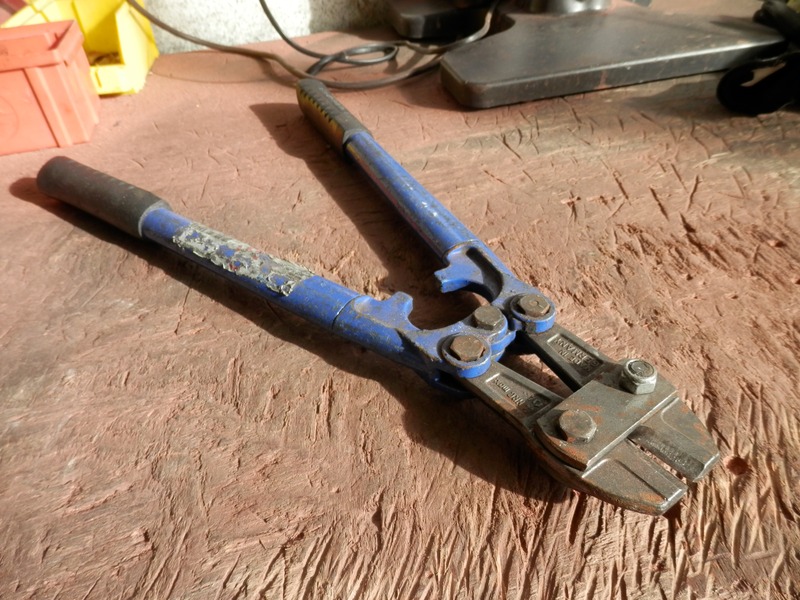
2. How does overall length differ from jaw opening?
Overall length describes the tool’s end-to-end dimension. Jaw opening describes the gap available between cutting edges or jaws in an open position, when the maker publishes that value. The terms answer separate fit questions: length tells a buyer whether the tool can be handled and stored in available space; opening helps screen whether a workpiece can enter the head.
Jaw opening still does not guarantee that stock can be cut. A large piece may fit between open jaws yet exceed the maker’s rated capacity for its material hardness. Some bolt-cutter catalogs omit an opening measurement entirely and publish only diameter capacities by hardness. In that case, do not infer jaw opening from a photograph or handle length. Request a dimensioned head drawing or written maximum opening from the manufacturer.
- Check the open-jaw dimension when stock must enter a restricted head.
- Check the rated cutting table for the same model before accepting the stock.
- Keep jaw opening, closed-edge adjustment gap, and cutting capacity as distinct fields.
Fit and cutting are separate tests. Ask suppliers to label each measurement rather than using “jaw capacity” for several different values.
Measurement distinction checkpoint
| Measurement | Sample question | Purchase use |
|---|---|---|
| Overall length | Will the tool fit the work area and storage rack? | Reach, handling, package dimensions |
| Maximum jaw opening | Will the stock enter the open head? | Physical access and insertion |
| Cutting capacity | Can the model cut this material at its hardness? | Rated application limit |
| Edge adjustment gap | What clearance should remain between closed edges? | Model-specific setup or service |
3. What does rated cutting capacity mean?
Cutting capacity is a manufacturer’s stated limit for a specified tool and stock condition. It may appear as maximum diameter, sometimes separated into material-hardness bands. A capacity table can show different limits for one cutter as workpiece hardness changes. That value belongs to the named model and stated rating method; it should not migrate to another brand because handle length looks similar.
Keep workpiece hardness distinct from cutter-jaw hardness. Ronix’s RH-3302 page lists cutter hardness at 58–62 HRC, then separately gives a 6 mm cutting capacity. Cutter hardness describes the tool edge. It does not state that stock may be 58–62 HRC. KNIPEX publishes capacities for material at HRC 19, HRC 40, and HRC 48. When a maker does not pair diameter with stock grade or hardness, that condition remains unknown.
- Capture the maker, exact model, stock category, hardness basis, and diameter.
- Check whether the figure applies to round stock, bolts, wire, or a named material.
- Flag missing hardness conditions rather than filling them with an assumption.
Keep the rating attached to its conditions. Store the source table with the SKU record so later substitutions do not inherit an unsupported limit.
Capacity terminology checkpoint
| Specification | Refers to | Example wording |
|---|---|---|
| Jaw or blade hardness | Cutter material | “Blade hardness 58–62 HRC” |
| Workpiece hardness | Stock material | “Capacity at HRC 40” |
| Cutting diameter | Stock size under a stated rating | “6 mm capacity” |
| Material category | Maker’s named stock group | “Soft / medium / hard metal” |
4. Can jaw opening be larger than rated cutting capacity?
Yes. One manufacturer example makes the distinction concrete. Ronix identifies model RH-3302 as an 18-inch bolt cutter with a 470 mm overall length, 19 mm maximum jaw opening, and 6 mm cutting capacity. These are three separate specifications for one model, not three ways to write the same size. The page lists several intended stock examples but does not assign its 6 mm figure to a specific workpiece hardness.
This means a workpiece may pass the physical opening check and still fall outside the published capacity. It also means two products with equal jaw openings may have different rated limits. Before quoting a cutter, ask whether its capacity represents a tested diameter for a defined material condition or a general catalog value. Do not present jaw opening as a cutting rating or infer a cut diameter from an image.
- Compare opening and capacity for the exact model, not a product family.
- Record any unreported stock-hardness basis as “not stated.”
- Request written confirmation when customer stock exceeds a published example.
The manufacturer’s table controls the claim. Keep a copy of this RH-3302 model specification with its source date and avoid extrapolating to sibling sizes.
One model, separate dimensions
| Maker/model | Catalog size | Overall length | Max jaw opening | Published cutting capacity | Stock hardness basis |
|---|---|---|---|---|---|
| Ronix RH-3302 | 18 in | 470 mm | 19 mm | 6 mm | Not stated alongside capacity |
5. How does stock hardness change bolt-cutter capacity?
A diameter limit can shrink as rated stock gets harder. RIDGID’s S-series table shows this directly. For model S24, the manufacturer lists 7/16 inch for metals labeled soft at 15 RC, 3/8 inch at medium 31 RC, and 5/16 inch at hard 42 RC. A single “24-inch cutter capacity” would hide those meaningful distinctions.
Use the precise hardness bands printed by the maker. Do not convert “soft bolt,” “medium steel,” or a tensile-strength description into one of those bands without evidence. If a customer supplies only diameter, ask for material type and hardness or grade. A buyer can then compare that stock description with the exact model’s rating. MARSHALLTOWN’s HIT bolt-cutter listing offers sizes from 14 to 42 inches and states a maximum metal hardness of Brinell 400/Rockwell C42, but it does not publish a diameter limit by size. A buyer should request that missing model-level capacity. For setup and cutting procedure, consult the earlier bolt-cutter operating guide. Before purchase, match the stock description to a model-specific capacity table.
- Match stock diameter and hardness to one model row.
- Retain the maker’s labels rather than relabeling them as generic steel grades.
- Refer uncertain material to the supplier or engineering owner before listing capacity.
One model can carry several different limits. Use the following RIDGID examples as source-specific references, not as a conversion chart for other brands.
RIDGID S-series examples
| RIDGID catalog/model | Overall length | Soft metal, 15 RC | Medium metal, 31 RC | Hard metal, 42 RC |
|---|---|---|---|---|
| 14213 / S14 | 15 in (379 mm) | 5/16 in (7.9 mm) | 1/4 in (6.4 mm) | 3/16 in (4.8 mm) |
| 14223 / S24 | 24 in (610 mm) | 7/16 in (11.0 mm) | 3/8 in (9.5 mm) | 5/16 in (7.9 mm) |
| 14238 / S42 | 44 in (1,115 mm) | 11/16 in (17.5 mm) | 9/16 in (14.3 mm) | 1/2 in (12.7 mm) |
6. What do model-specific size tables show across brands?
Manufacturer tables can share a general pattern while using different models, lengths, stock bands, and rating language. KNIPEX lists four 71 72 models by length in millimeters and publishes separate diameters for stock at HRC 19, HRC 40, and HRC 48. For the 610 mm model, the listed limits are 9 mm, 8 mm, and 7 mm respectively. The table’s hardness categories apply to that product series.
Do not rank KNIPEX and RIDGID by comparing only one diameter. Their tables use different hardness labels and tool models. A reliable comparison either matches the exact hardness condition and measurement method or keeps the makers’ tables side by side. The KNIPEX operating manual’s technical table is the primary source for this series; its product code also identifies replacement head assemblies.
- Compare exact model length and stock hardness, not just nominal inch size.
- Preserve units and manufacturer rounding in product records.
- Check replacement-head availability for frequently used sizes.
A model table beats a rule of thumb. Use the maker’s original units and label any conversion as rounded.
KNIPEX 71 72 series examples
| Model | Length | Capacity at HRC 19 | Capacity at HRC 40 | Capacity at HRC 48 |
|---|---|---|---|---|
| 71 72 460 | 460 mm | 8 mm | 6 mm | 5 mm |
| 71 72 610 | 610 mm | 9 mm | 8 mm | 7 mm |
| 71 72 760 | 760 mm | 11 mm | 9 mm | 8 mm |
| 71 72 910 | 910 mm | 13 mm | 10 mm | 9 mm |
7. How should access and head design affect size choice?
The longest cutter in a product family may increase mechanical advantage or extend reach, but a bulky head can still fail to enter a narrow work area. Jaw profile, head thickness, cutting-edge angle, and opening width affect access. Buyers should compare a dimensioned head drawing with the part or fixture, especially where a cut sits near a wall, plate, or adjacent fastener. A photo can suggest shape; it cannot prove a clearance dimension.
Consider whether a manual bolt cutter is the right category at all. Cables and wire rope need purpose-designed cutters; compare the site’s cable-cutter versus diagonal-cutter guide and wire-rope cutter comparison. A saw may suit a different stock and access condition; the hacksaw use guide can help buyers keep product categories distinct without repeating operation instructions here.
- Measure working clearance around the jaws and handle arc.
- Ask for head width, thickness, opening, and cutting-edge orientation.
- Check stock category before substituting a cable or saw tool.
Clearance belongs on the drawing. Send the supplier a dimensioned cut location when head access could decide the model.
Access and head checkpoint
| Application condition | Dimension to check | Selection implication |
|---|---|---|
| Close to a wall or flange | Head thickness and jaw approach | May need a slimmer head pattern |
| Large stock must enter jaw | Maximum opening | Confirms fit only, not rated cutting capacity |
| Cut lies behind a guard or frame | Handle arc and total length | Confirms operating space and access |
| Cable or wire rope | Intended stock category | Select a purpose-designed cutter |
8. Is a longer bolt cutter always the better size?
No. A longer handle can change mechanical advantage and reach, but it also needs more swing room, weighs more in many product ranges, and takes more storage space. Rated capacity remains model-specific. Even within one brand, do not assume each length increases capacity in a straight line; compare its own table. A 36-inch cutter that cannot fit between a machine frame and a wall may be less useful than a shorter head with suitable rated capacity.
Think about the full work pattern. A maintenance team may need one compact model for close access and another longer model for a defined heavy-stock category. A distributor may stock overlapping lengths if buyers need different capacity bands, but each SKU should have a reason in order history, customer drawings, or verified work requirements. General assortment planning can sit alongside a mechanic tool list for distributors and a types-of-pliers guide.
- Balance rated capacity against access, handling, weight, and storage.
- Avoid stocking duplicate sizes without a distinct buyer use case.
- Test samples in the intended work area before approving a range.
Choose the shortest model that meets the verified job. Confirm that rule against its capacity row and actual clearance, not handle length alone.
Length-choice checkpoint
| Buyer condition | Prefer a shorter size when… | Consider a longer size when… |
|---|---|---|
| Access | Handle swing or storage is restricted | Extra reach fits the work area |
| Capacity | Smaller model’s exact rating covers stock | Maker’s table shows required higher rating |
| Handling | Repeated movement or weight is a concern | Work position and tool weight remain manageable |
| Assortment | Existing model already covers recurring jobs | A documented stock class requires another model |
9. What should buyers verify before choosing a model?
Begin with the workpiece specification: material, grade or hardness, outside diameter, and cut location. Then select a model whose maker table covers those exact conditions. Confirm overall length and head dimensions independently. If capacity is missing, described only as “heavy duty,” or disconnected from a material condition, record that gap and request written clarification before promoting the product for that use.
For distributor listings, publish model-level capacity and its rating basis together. Do not infer diameter from handle length, product photography, jaw opening, or an adjacent size in the same family. Also check included heads, adjustment method, replacement parts, package dimensions, and any material exclusions. The existing bolt-cutter operating guide covers the operating sequence; use it as the next reference after selecting a rated model.
- Keep a source document or link beside every capacity claim.
- Separate tool hardness, stock hardness, jaw opening, and rated diameter.
- Get written manufacturer confirmation when an RFQ exceeds published data.
Require a traceable rating before a catalog claim. A model-number record lets purchasing and technical staff review substitutions against the same evidence.
Pre-purchase verification checkpoint
| Verify | Record | Do not substitute with |
|---|---|---|
| Material condition | Type, grade, hardness, diameter | “Metal” alone |
| Model | Manufacturer part number and series | Similar photo or handle length |
| Physical fit | Opening and head dimensions | Cutting-capacity number |
| Rated limit | Capacity row and hardness basis | Jaw hardness or generic family claim |
| Lifecycle | Included/replacement head and instructions | Assumed interchangeability |
10. What should a bolt-cutter RFQ include?
An RFQ should describe the stock and the clearance problem before asking a supplier to recommend a size. Include material grade or hardness, diameter, cut location, head access, work frequency, target market, and whether a sample or drawing is available. Ask suppliers to identify the exact model and return its overall length, maximum jaw opening, head dimensions, and capacity by stated material or hardness category.
Request a current product specification or manual, not a verbal length-to-capacity rule. If a maker gives jaw opening but no rated capacity for your stock, ask for written confirmation or mark the application unresolved. Include packaging, label, spare-head, and replacement-part needs only where those affect the purchasing decision. For a technical sourcing inquiry, send the verified stock data through KOLARWIN’s contact page.
- Attach a part drawing or stock specification.
- Ask for model-specific dimensions and hardness-linked capacity.
- Record exclusions, document revision, spare parts, and sample approval.
Make the model earn its size label. Approve the cutter only when its capacity evidence and physical dimensions both match the work.
The practical rule is simple: length describes the tool, jaw opening describes entry, and capacity describes rated cutting limits. Treat each as a separate purchasing field. Compare exact maker tables by material condition, preserve every model number, and request written data when a rating is absent. That approach gives procurement a defensible selection instead of a guess based on handle length.
Q1: Does bolt-cutter length tell me its cutting capacity?
No. Match the exact model’s published capacity to stock material, hardness, and diameter.
Q2: Is jaw opening the same as cutting capacity?
No. Opening describes physical clearance; capacity describes the maker’s rated cutting limit under stated conditions.
Q3: Why do capacity numbers change with hardness?
In the RIDGID and KNIPEX tables, harder stock classes have lower permitted diameters for each listed model.
Q4: What does HRC 40 mean in a product table?
It identifies a workpiece hardness condition when the manufacturer labels the capacity that way. Confirm the scale and exact model.
Q5: What information should I send a supplier?
Provide stock material, grade or hardness, diameter, cut location, access dimensions, target market, and any drawing.
Looking for a reliable mechanic tools manufacturer in China?
If you are sourcing hand tools, socket tools, automotive repair tools, mechanic tool sets or OEM private label tools, contact KOLARWIN Tools for factory-direct quotation, customization support and product consultation.