
Need OEM supplier support for this product type?
Contact KOLARWIN Tools for OEM mechanic tools, private label packaging, wholesale quotation and product range support. This gives overseas buyers a clear path from article reading to supplier discussion.
Tool labels can mislead a buyer when one describes face material and another describes impact behavior. A rubber mallet may have a solid rubber head; a dead-blow model may use rubber, nylon, or another contact material. This guide separates those attributes and compares maker-documented examples from Thor, TOPTUL, Wilton, GEDORE, and USAG.
1. What does “rubber mallet” describe?
“Rubber mallet” usually identifies the material at the striking surface or across the head. It does not, by itself, tell a buyer whether a head is solid, contains an internal weight, or has a particular rebound-control design. Product pages may use “rubber mallet,” “rubber hammer,” or “soft-face mallet” differently, so the model description needs a closer read.
TOPTUL’s HABF series is described as having a solid rubber head, round striking surfaces, and a hickory handle. Hultafors lists its GU model as a solid black rubber-head mallet with hardness of 80/90 Shore A. Those are specific products. Other rubber-headed mallets can use different geometry, hardness, or head construction. The broader hammer types guide can help place mallets within a shop’s striking-tool category.
- Record head or face material from the exact model specification.
- Check whether the maker calls the head solid, hollow, or internally weighted.
- Note face geometry, hardness scale, and replacement options.
Start with the contact surface. Ask for a cutaway or written construction note when internal design affects the purchasing decision.
Rubber-mallet specification checkpoint
| Field | What it tells the buyer | Example evidence |
|---|---|---|
| Head/face material | Surface contacting the work | Rubber, polyamide, nylon, polyurethane |
| Head construction | Solid or internally weighted design | Maker description or section drawing |
| Face geometry | Contact shape and size | Round, flat, replaceable insert |
| Hardness | Maker’s stated material value | Shore A or Shore D, as specified |
2. What does “dead blow” describe?
“Dead blow” describes a maker’s intended impact behavior, often reduced rebound, rather than one required face material. Some maker specifications identify hollow heads partly filled with steel shot, microbeads, or pellets. Thor’s 20-1010 Thorace model has steel shot and screw-in nylon faces. GEDORE’s 248 ST line is described as a recoilless soft-face hammer with polyamide heads and a hollow, steel-shot-filled head. Thor’s brochure also describes resilient soft-faced surfaces as reducing rebound; such a behavior description does not establish internal fill.
USAG’s 374 G uses steel microbeads in a steel body overmolded with polyurethane, while its 374 N model has a head partially filled with metal pellets and interchangeable plastic tips. These maker examples show multiple designs. They do not establish that every dead-blow hammer contains steel shot, or that every model has identical rebound performance. Check the exact model’s construction and the maker’s claim.
- Ask what material or mechanism inside the head controls rebound.
- Identify which surface strikes the workpiece.
- Treat “dead blow,” “recoilless,” and “non-rebound” as maker-specific labels.
The construction note matters more than the color. Verify it against the model number and current product sheet.
Dead-blow construction checkpoint
| Maker example | Maker-described construction | Contact face |
|---|---|---|
| Thor 20-1010 | Head cavity partially filled with steel shot | Replaceable nylon; optional polyurethane faces |
| GEDORE 248 ST | Hollow head filled with steel shot | Replaceable polyamide heads |
| USAG 374 G | Steel microbeads; steel body overmolded with polyurethane | Polyurethane surface, Shore D45 ± 5 |
| USAG 374 N | Head partially filled with metal pellets | Interchangeable plastic tips |
3. Can a rubber mallet also be a dead-blow hammer?
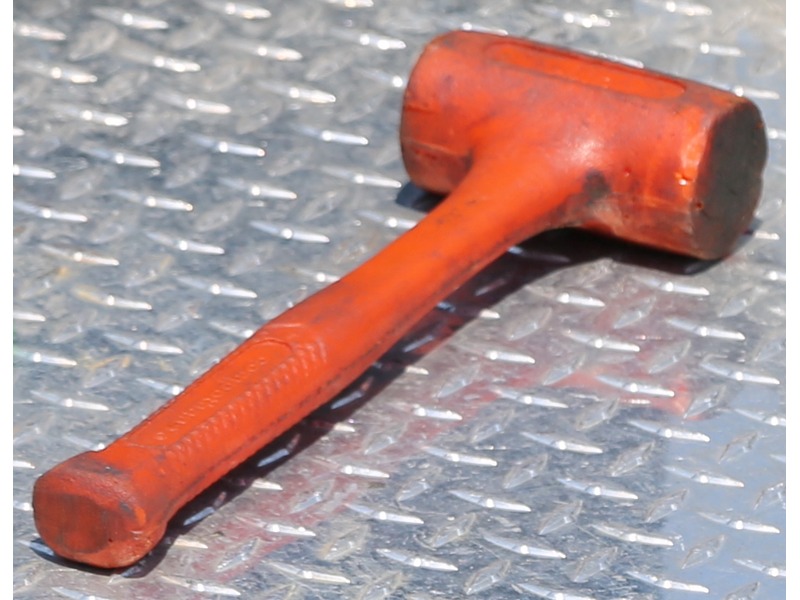
Yes, a model can combine a rubber striking surface with a dead-blow construction. Wilton’s B.A.S.H. 2-pound model 55214 is one documented example: its product page describes a shot-filled head, a vulcanized-rubber head, a 14-inch handle, and a 1¾-inch face. The maker uses “zero rebound” wording for that particular product. Those specifications belong to that model; they are not a category-wide promise.
The reverse question also matters. Thor’s 61-952 rubber mallet is listed with a rubber head, but its page does not describe internal shot. Thor’s brochure says its rubber mallets give a firm blow with little rebound. That class-level statement does not prove an internal shot design for model 61-952. Face material and rebound-control construction are separate fields, so a catalog can describe both on one product. For a closer distinction from a different hammer geometry, see the existing ball-peen versus dead-blow buyer guide.
- Use “rubber” for the specified contact material.
- Use “dead blow” only where maker documentation supports that construction or behavior.
- Keep product names flexible enough for combination models.
These labels can overlap. Build product filters around both face material and impact design.
Category-overlap checkpoint
| Product description | Face material | Internal/rebound detail | Buyer reading |
|---|---|---|---|
| Solid rubber mallet | Rubber | No internal fill stated by maker | Rubber describes contact/head material |
| Shot-filled dead blow with nylon faces | Nylon | Shot-filled head | Dead blow describes construction; face is nylon |
| Shot-filled dead blow with rubber head | Vulcanized rubber | Shot-filled head | One model can meet both descriptions |
4. How do face hardness and workpiece finish affect the choice?
Face hardness is one useful data point, but it cannot guarantee a mark-free strike. Hultafors gives a 80/90 Shore A hardness description for its solid-rubber GU mallet. GEDORE specifies 75 Shore D polyamide faces for its 248 ST recoilless hammer. Those values use different Shore scales, so do not compare the numbers directly or treat either as a universal performance grade.
Marking risk also depends on the workpiece finish, force, contact geometry, contamination, face wear, and whether a hard insert or handle component can touch the part. Even a product sold for surface-sensitive work needs approval on the actual coating or finish. The buyer’s sample record should identify both the striking surface and target material.
- Record the maker’s face material and hardness scale, if provided.
- Trial the face on representative finish and substrate.
- Inspect for embedded grit, worn covers, exposed cores, or damaged faces.
A soft label is not a surface guarantee. Approve a sample on the same finish and support used in production.
Surface-protection checkpoint
| Workpiece condition | Face detail to verify | Approval method |
|---|---|---|
| Painted or coated part | Material, hardness, and face condition | Trial on a finish-matched sample |
| Machined surface | Contact geometry and contamination risk | Controlled test on representative stock |
| Delicate assembly | Head mass, face compliance, and support | Assembly trial against drawing or work instruction |
| Soft substrate | Face shape, hardness, and contact area | Check for dents, compression, or transfer |
5. Which hammer suits assembly, seating, and alignment?
Choose by the interface and the consequence of a mark or rebound. A mallet with a solid rubber head may suit tasks where a broad rubber contact surface matches the work. A dead-blow hammer may suit applications where the maker’s rebound-control design is desired, but face material still decides what touches the component. A dead-blow model with nylon faces and one with vulcanized rubber faces are not interchangeable merely because both reduce rebound.
On a line fitting metal housings, for example, the buyer might compare contact area, face hardness, head mass, and the fixture’s ability to support the housing. For a decorative finish or painted panel, a replaceable face can be an advantage only when the replacement material is confirmed. For a heavy seating task, head weight and workholding may matter more than whether the product name says “rubber mallet.” Document the intended task and test conditions instead of picking a winner by category.
- State the assembly or seating task and workpiece finish.
- Confirm the face material and maker-declared rebound design.
- Match head mass and handle access to the fixture.
Let the interface decide. Run a short, controlled sample trial before choosing a standard line item.
Task-to-feature checkpoint
| Task condition | Feature to compare | Evidence needed |
|---|---|---|
| Broad tapping on a finish | Face material and contact diameter | Trial mark assessment |
| Component seating | Head mass and rebound-control description | Manufacturer data plus assembly trial |
| Tight access | Head width and handle length | Dimensioned drawing or sample |
| Different contact materials required | Replaceable faces or inserts | Exact spare part numbers and fit |
6. What do manufacturer examples show about face and head construction?
Product details show why category names need a model-level specification. Hultafors GU is a solid-rubber mallet with a stated hardness of 80/90 Shore A. Thor 20-1010 is a 550-gram dead-blow hammer with a shot-filled cavity and 32 mm replaceable nylon faces. GEDORE 248 ST-40 is a 40 mm recoilless soft-face hammer with polyamide faces at 75 Shore D and a shot-filled head. Wilton 55214 combines a vulcanized-rubber head with shot-filled dead-blow construction. Halder’s SIMPLEX reinforced mallet system offers rubber, nylon, plastic, copper, and other replaceable inserts; the body and the chosen contact insert are separate specification fields.
The sizes and weights below are reference examples, not a performance ranking. A face diameter does not show workpiece compatibility; a head’s total weight does not identify its internal ballast. Keep each record linked to its maker and product code. A woodworking clamp buyer guide provides a related view of workholding for assembly trials, while hammer and face approvals remain model-specific.
- Capture exact model, face/head material, and any internal fill description.
- Keep Shore A and Shore D figures in separate fields.
- Store replacement-face part numbers with the hammer model.
Compare the data in parallel. These examples show different combinations without defining every rubber mallet or dead blow.
Manufacturer example matrix
| Maker/model | Weight | Face or head | Internal description |
|---|---|---|---|
| Hultafors GU 55 / 823052 | 320 g | Solid rubber, 80/90 Shore A | No internal fill stated |
| Thor 20-1010 | 550 g | 32 mm replaceable nylon faces | Cavity partially filled with steel shot |
| GEDORE 248 ST-40 | Weight omitted; confirm current specification | 40 mm polyamide, 75 Shore D | Hollow head filled with steel shot |
| Wilton B.A.S.H. 55214 | 2 lb head; 14 in overall | 1¾ in face diameter; vulcanized rubber | Shot-filled, maker describes zero rebound |
7. How do mass, face size, and access affect selection?
Head mass, whole-tool weight, face diameter, and handle length affect different parts of the task. A larger face can spread contact over a broader area; it does not automatically prevent marking or deliver a particular impact. A longer handle requires room for its swing. A heavier head changes handling effort and should match the work and operator. Compare actual specifications, then review the tool in the fixture or assembly area.
Thor’s model data illustrates why product labels do not predict weight: its 61-952 rubber mallet lists a 54 mm head and 320 g weight, while its 20-1010 dead-blow model lists a 32 mm face and 550 g weight. Wilton 55214 pairs a 14-inch overall length with a 2-pound head. These individual numbers do not establish which type always weighs more. For range planning, the complete mechanic tool list for distributors can help place striking tools alongside complementary items.
- Compare head weight separately from complete-tool weight.
- Check handle length, grip, and required swing clearance.
- Trial balance and control in the intended position.
Do not buy by silhouette. Request a drawing or sample when access around the head or handle is tight.
Size and access checkpoint
| Dimension | What to compare | Why it matters |
|---|---|---|
| Head/face diameter | Actual contact width | Contact area and access |
| Head weight | Maker-listed head mass | Handling and impact selection |
| Overall tool weight | Complete tool mass | Repeated handling and control |
| Handle length | Published length and grip | Reach, swing path, storage |
8. What should buyers check for safe use and inspection?
Buyers should include inspection and face replacement in the product decision. A loose head, cracked handle, damaged rubber, worn insert, or exposed hard core can change control and contact. Thor’s safety guidance says to wear safety goggles and inspect striking tools before use, including secure replacement faces. That manufacturer guidance applies to its range; follow the selected model’s current manual and site procedures.
This guide compares product selection, not the operating sequence for every hammer. During approval, confirm the workpiece is stable, nearby people are clear, and the face matches the intended surface. Do not use a hammer to strike another hammer unless both makers permit that use. Avoid any claim of universal non-marring, non-sparking, or zero-rebound performance; request the exact model’s limits instead. For broader maintenance planning, see the industrial maintenance tool buyer guide.
- Inspect head, handle, face, and any replaceable insert.
- Confirm replacement parts and approved uses from current instructions.
- Remove damaged tools from service and record the issue.
Add inspection to sample approval. Check the tool again after a representative trial.
Inspection checkpoint
| Component | Check | Buyer follow-up |
|---|---|---|
| Face/insert | Wear, cracks, embedded debris, looseness | Confirm replacement part and retention |
| Head/body | Cracks, distortion, exposed core | Reject or request maker service guidance |
| Handle/grip | Looseness, splits, oil, surface damage | Verify fit and replacement options |
| Product documents | Limits and inspection notes | Keep current model-specific instructions |
9. How should distributors build a hammer assortment?
Organize products by both contact material and impact design. A channel may need solid rubber mallets, dead-blow tools with specified nylon or polyurethane faces, and combination products with vulcanized rubber faces and shot-filled heads. Avoid sorting every rubber-faced dead-blow model into only one bucket if the catalog needs both attributes for search and comparison.
Use customer applications, handle length, face size, head mass, replaceable components, and package format to set range boundaries. One compact model may suit trim work; a larger, heavier model may fit a different assembly line. These are buying scenarios, not universal recommendations. The auto mechanic tools category guide and household tool-kit buyer guide can support channel-level assortment planning.
- Create separate catalog filters for face material and rebound-control design.
- Add model-specific weight, face size, and handle length.
- Include replacement faces when makers sell them as service parts.
Build the list from work orders. Approve only SKUs with a defined application and a readable construction record.
Assortment checkpoint
| Catalog field | Example values | Range decision |
|---|---|---|
| Face/head material | Rubber, nylon, polyamide, polyurethane | Match contact surface needs |
| Impact design | Solid head, shot-filled, microbeads, maker-described damping | Keep construction explicit |
| Size | Head mass, face size, handle length | Support access and handling |
| Service | Replaceable face, insert, or handle | Compare part availability |
10. What should a rubber-mallet or dead-blow RFQ include?
Ask suppliers to separate surface material from head construction. Give each intended workpiece, finish, assembly task, contact area, access limit, target head mass, and handle length. Request a model-specific product sheet or drawing that identifies solid versus internally weighted design, the material touching the work, any face-hardness scale, and replaceable parts. If internal construction is not stated, leave it unverified rather than inferring from a photograph.
- Specify rubber, nylon, polyamide, polyurethane, or another required face material.
- State whether rebound-control construction is required and what evidence is acceptable.
- Request head mass, complete-tool weight, face diameter, handle length, and replacement-part codes.
- Ask for a sample check on the actual workpiece finish.
- Keep claims such as non-marring tied to the approved model and test.
Make the model prove its fit. Send the workpiece and finish details through KOLARWIN’s contact page when requesting a sourcing review.
Rubber describes the striking material; dead blow describes a maker’s impact-control design or claim. Some hammers carry both labels, while many product records reveal only one attribute. Separate the fields, compare the actual contact surface, and approve a model on representative work before adding it to a range.
Q1: Are rubber mallets and dead-blow hammers mutually exclusive?
No. A model can combine a rubber face or head with a maker-described dead-blow construction.
Q2: Do all dead-blow hammers contain steel shot?
No. Some examples use steel shot or microbeads; others may use a different maker-described design. Check the exact model.
Q3: Is every rubber mallet solid?
No category-wide assumption is safe. Some makers specify a solid rubber head; others may use different constructions.
Q4: Does a rubber face guarantee a non-marring strike?
No. Test the specific face on the actual finish and inspect it for wear or embedded debris.
Q5: What should I ask a hammer supplier?
Request face material, internal design, mass, dimensions, replacement parts, approved uses, and model-specific instructions.
Looking for a reliable mechanic tools manufacturer in China?
If you are sourcing hand tools, socket tools, automotive repair tools, mechanic tool sets or OEM private label tools, contact KOLARWIN Tools for factory-direct quotation, customization support and product consultation.



