
Need OEM supplier support for this product type?
Contact KOLARWIN Tools for OEM mechanic tools, private label packaging, wholesale quotation and product range support. This gives overseas buyers a clear path from article reading to supplier discussion.
“Pipe wrench size” can describe handle length, a maker’s pipe-capacity label, or the space needed around jaws and fittings. Those measurements answer different questions. Compare manufacturer model data by its printed labels, then check actual pipe outside diameter, jaw clearance, and access separately. This guide uses exact RIDGID and REED examples; it does not turn nominal pipe size into outside diameter or a universal length-to-capacity formula.
1. What does pipe wrench size mean?
A pipe wrench size line can mix several dimensions that should stay separate. A catalog may name a wrench by nominal handle length, then list pipe capacity as a nominal pipe diameter. Another maker may show an in-nominal capacity range beside an actual outside-diameter range and a length field. Those labels cannot be compared as if each measured the same thing. For broader wrench families, see types of wrenches; this page focuses on how pipe-wrench size labels work.
Begin with the maker’s model name and column headings. Record the wrench length, capacity label, actual pipe OD if listed, jaw gap if documented, and access dimensions as distinct fields.
Read maker labels before comparing their values.
- Identify the maker and exact model or catalog number.
- Separate wrench length from pipe capacity.
- Check whether the capacity field is nominal or actual OD.
- Request jaw and access dimensions if your fixture needs them.
Size fields at a glance
| Field | What it describes | What it does not establish |
|---|---|---|
| Wrench length | Maker-labeled length or nominal handle length | Pipe OD or jaw opening |
| Pipe capacity | Maker-defined pipe size range | Physical jaw gap unless separately specified |
| Actual pipe OD | Outside diameter field, when printed | Wrench length or swing clearance |
| Access dimension | Required room around head, handle, and pipe | Nominal pipe size |
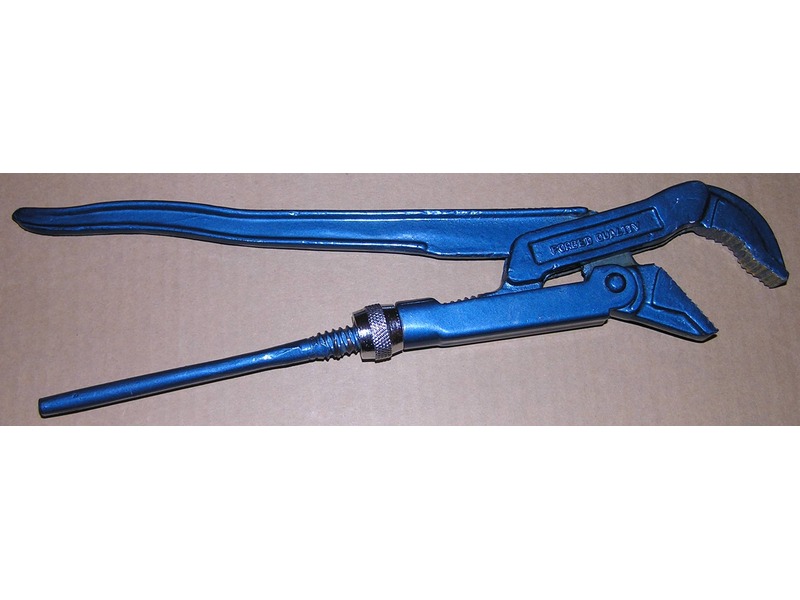
2. What do RIDGID and REED list for named models?
The official RIDGID table defines “Nom. Size” as nominal handle length and “Nom. Pipe Capacity” as maximum nominal diameter of steel pipe. Its catalog number 31025 shows 18 inches (450 mm) under Nom. Size and 2½ inches (65 mm) under Pipe Capacity. Those are the maker’s printed values and meanings; 65 mm is not a jaw-gap measurement.
REED’s official 2025 catalog uses different headings for straight model RW18, item code 02160. It shows Pipe Capacity as 1/4–2½ inches nominal, actual O.D. as 14–75 mm, and Length as 18 inches (457 mm). Keep the O.D. range tied to REED’s exact entry. The maker does not label it as a jaw opening. Notice the two catalogs print different metric values beside an 18-inch length; do not silently replace either with a converted number.
Use the manufacturer’s own column names in your comparison.
- Keep catalog number and model designation exact.
- Copy nominal and actual fields into separate columns.
- Preserve each maker’s printed units and conversions.
- Do not use this small comparison as an interchangeability claim.
Manufacturer-listed examples
| Maker and exact identifier | Length field as printed | Pipe-capacity field as printed | Actual O.D. field as printed |
|---|---|---|---|
| RIDGID catalog No. 31025, Heavy-Duty Straight Pipe Wrench | Nom. Size: 18 in / 450 mm | Pipe Capacity: 2½ in / 65 mm; maximum nominal steel-pipe diameter | Not listed in this row |
| REED straight pipe wrench RW18, item code 02160 | Length: 18 in / 457 mm | Pipe Capacity: 1/4–2½ in-nom. | Actual O.D.: 14–75 mm |
3. How does nominal pipe size differ from actual outside diameter?
Nominal pipe size names a designation; it does not state actual outside diameter. REED’s RW18 row lists nominal capacity beside actual O.D. RIDGID defines its capacity as maximum nominal steel-pipe diameter but gives no row-specific OD.
Keep the two figures in separate columns on drawings, product pages, and purchase orders. If pipe standard or actual OD affects fit, consult its specification or ask the supplier to confirm. Avoid converting nominal labels with a generic multiplier. A wrench sizes reference covers across-flats wrench sizing; that measurement system differs from pipe-wrench capacity labels.
Nominal size names a pipe; OD measures its outside surface.
- Confirm pipe standard and actual OD from the job documentation.
- Record the maker’s capacity label exactly as printed.
- Do not calculate OD from a wrench-capacity number.
- Escalate any mismatch between drawings and supplied pipe.
Pipe data fields
| Data point | Source to use | Record separately as |
|---|---|---|
| Nominal pipe size | Pipe schedule or drawing | Nominal designation and standard |
| Actual OD | Pipe specification or measurement | Physical outside diameter and unit |
| Wrench capacity | Wrench maker’s catalog | Exact nominal label and range |
| Fit result | Approved wrench and pipe sample | Model, sample, and observed fit |
4. Is pipe capacity the same as jaw opening?
No, a maker’s capacity label may name the maximum nominal pipe diameter a tool is designed to grip. Jaw opening describes a physical space between jaw surfaces under a defined condition. That label does not provide jaw gap unless maker calls it jaw opening or supplies a dimensioned drawing. Do not copy a reseller’s “max opening” description into the maker’s specification field without checking its meaning and source.
Jaw geometry also affects how a pipe wrench grips. RIDGID guidance says a visible gap must remain between hook-jaw shank and pipe for proper tooth engagement. That operating clearance is a different relationship from the maker’s maximum pipe-capacity label. For jaw-opening comparisons on adjustable wrenches, see adjustable wrench sizes; those measurements do not define pipe-wrench capacity.
Capacity, opening, and gripping clearance need separate fields.
- Ask whether a published value means capacity, jaw gap, or clearance.
- Request a drawing with the jaw position and measurement points defined.
- Record hook-shank clearance separately from outside opening.
- Link every dimension to its model and source revision.
If a tight assembly depends on jaw fit, request a dimensioned drawing or sample measurement before final selection.
Opening and clearance terms
| Term | Measurement question | Use in selection |
|---|---|---|
| Pipe capacity | What nominal pipe range does maker state? | Capacity screening |
| Actual OD | What physical diameter must fit? | Workpiece compatibility |
| Jaw opening | What is the jaw gap at a defined position? | Physical fit, if maker provides it |
| Hook-shank clearance | What gap remains at the pipe during engagement? | Correct gripping condition |
5. Does a longer wrench always fit larger pipe?
A catalog may show larger capacities beside longer wrenches, but that product lineup does not establish a universal rule. Compare exact model rows and their footnotes. RIDGID 31025 and REED RW18 both carry an 18-inch label, yet their catalogs use different length headings, metric values, capacity fields, and actual-OD reporting. The similarities do not prove identical geometry or interchangeability.
Length affects storage, reach, and room for the handle to move. Record style and material separately when comparing straight, offset, end, or aluminum models. A pipe wrench vs adjustable wrench guide covers a tool-family decision; it should not be used as a conversion chart for pipe sizes.
Treat each model as its own specification.
- Compare exact product codes, not just inch numbers.
- Keep weight and material separate from length and capacity.
- Check maker notes for design or range differences.
- Avoid inferring torque or capacity from a longer handle.
For multi-length ranges, ask makers to identify intended capacity and access data for every model.
Model comparison discipline
| Compare | Keep separate from | Evidence needed |
|---|---|---|
| Length | Capacity and jaw opening | Exact maker label and unit |
| Weight | Reach and gripping range | Model-level specification |
| Wrench style | Straight, offset, end, or other design | Drawing or named product family |
| Handle material | Capacity rating | Manufacturer’s model data |
6. Which access dimensions should buyers check?
A nominal wrench length is not the space required to use or store it. Head width and height add bulk; handle swing needs clear room, while nearby fittings or parallel pipes restrict approach. A wrench can match the printed capacity and still fail a cramped access check. Record available room around a pipe and planned operator or fixture position.
When layout demands more detail, request head dimensions, jaw envelope, hook projection, and handle swing data. If a product page omits these values, use a dimensioned drawing or sample instead of estimating from a photo. REED notes that offset wrenches provide longer swing and access in hard-to-reach areas, but that description is not a dimension for every model.
The work envelope can rule out a wrench before capacity does.
- Measure radial room around the pipe.
- Check axial approach and handle swing clearance.
- Note nearby walls, fittings, supports, and parallel lines.
- Ask for a model drawing where geometry is critical.
Access review
| Site condition | Dimension to check | Selection impact |
|---|---|---|
| Wall beside pipe | Head width and approach room | May favor another head style |
| Parallel pipe run | Handle swing arc and overlap | May restrict wrench movement |
| Tight fitting cluster | Jaw envelope and hook projection | May prevent seating or adjustment |
| Storage rack | Overall length and head bulk | Affects kit layout |
7. How should you choose among pipe-wrench sizes?
Start with the pipe specification and actual installation envelope. Match maker-stated pipe capacity to documented pipe designation; confirm actual OD where fit requires it. Next compare jaw and access dimensions. Only after those checks should length, weight, and wrench style enter the decision. This avoids choosing a tool by handle length alone.
Do not infer material compatibility, service conditions, or safe force from a capacity row. Follow equipment and tool makers’ instructions for application. For operation, see how to use a pipe wrench; this sizing guide does not repeat setup or turning steps. If another gripping style may fit better, compare water pump pliers vs pipe wrench against workpiece and tool instructions.
Screen by fit first, then choose a practical model.
- Match nominal capacity to the pipe specification.
- Confirm actual OD if physical fit is critical.
- Check jaw opening and access as separate dimensions.
- Verify product style, weight, and storage needs.
List model codes against applications and keep maker documentation with each item.
Selection sequence
| Step | Question | Evidence |
|---|---|---|
| 1 | What nominal pipe range does the maker list? | Current maker table |
| 2 | What actual OD must fit? | Pipe specification or sample measurement |
| 3 | What jaw and access dimensions are required? | Drawing or approved sample |
| 4 | What length, weight, and style suit the kit? | Exact model data and layout review |
8. How should teams verify a wrench against pipework?
Use the exact wrench model and a representative pipe or fitting. Confirm its identity, maker capacity label, and condition, then check any project-specific jaw or access measurements. A sample review can expose a tight clearance that a nominal-capacity table cannot show. Record measurements, units, model revision, and reviewer.
Drawings must distinguish nominal pipe designation from measured OD. Resolve document conflicts with the pipe or wrench supplier; never alter a capacity label to match a measured opening. For maintenance planning, use the industrial maintenance repair tools guide to place a selected wrench in broader range.
A sample can confirm fit; it cannot rewrite the maker’s rating.
- Verify the product code against its current data sheet.
- Use the specified pipe or fitting sample.
- Record opening, clearance, and access separately.
- Escalate mismatches instead of adjusting published labels.
Save the approved record with procurement documents for later replacements.
Sample approval record
| Record field | Example of what to capture |
|---|---|
| Wrench | Maker, model, catalog number, revision |
| Pipe | Nominal designation, standard, actual OD source |
| Fit | Capacity label, jaw gap, hook-shank clearance |
| Access | Wall, fitting, swing, and storage limits |
| Approval | Reviewer, date, decision, open issues |
9. What should a pipe-wrench RFQ include?
An RFQ should name tool type and exact task, then request current maker data. Include catalog number or model, length label, capacity label, actual-OD data if available, weight, material, and product style. Ask for jaw-opening and access dimensions as separate fields when drawings or installation clearances require them. Do not ask suppliers to convert a nominal pipe-capacity label into a physical gap.
Specify documentation, sample review, labeling, packaging, and acceptance records. A mechanic tools list can support broader range planning, while pipe-wrench dimensions remain SKU-specific.
A precise RFQ keeps unlike measurements from collapsing into one “size.”
- State pipe designation and actual OD separately.
- Request manufacturer label definitions and current catalog data.
- Add jaw, clearance, and access dimensions only as separate fields.
- Review a sample where fit depends on the real assembly.
RFQ dimension checklist
| RFQ field | Required entry |
|---|---|
| Wrench identification | Maker, model, catalog or item code |
| Length | Exact maker label, value, and unit |
| Capacity | Exact maker label and nominal range |
| Pipe OD | Actual value and source, when needed |
| Jaw/access | Dimension name, measurement points, and drawing |
| Review | Sample criteria and approval record |
10. What is the safest way to compare pipe-wrench sizes?
Compare the exact model data and preserve every label. “Length,” “Nom. Size,” “Pipe Capacity,” “in-nom.,” and “actual O.D.” are distinct fields. Jaw opening and access need separate evidence. The RIDGID and REED examples show why two 18-inch entries can carry different metric length values and differently labeled capacity data.
Do not convert nominal pipe capacity into OD, jaw gap, wrench reach, or load. Use current maker data and request a sample or dimensioned drawing when fit matters. For operating instructions, use the separate pipe wrench use guide. Questions about product specifications or sourcing can go through Contact Us.
Make each size field traceable to a source and a purpose.
- Retain model identifiers and maker labels.
- Keep nominal size, OD, jaw gap, and access distinct.
- Confirm current data before approving a replacement.
- Escalate any unverified dimension before purchase.
Q1: Does an 18-inch pipe wrench fit 18-inch pipe?
Not necessarily; an 18-inch label may describe wrench length. Compare maker’s pipe-capacity field with pipe specification.
Q2: Is pipe capacity the same as jaw opening?
No, pipe capacity may be a nominal pipe-size rating. Jaw opening is a physical dimension and needs its own maker value or drawing.
Q3: Does nominal pipe size equal outside diameter?
No, nominal pipe size names a designation while actual OD measures the pipe’s exterior. Use a pipe specification or drawing.
Q4: Why do RIDGID and REED show different metric values for 18 inches?
Their reviewed tables print 450 mm and 457 mm beside separate 18-inch fields. Preserve each maker’s printed values and confirm exact model data.
Q5: What should I send with a pipe-wrench RFQ?
Include pipe designation, actual OD if known, model or style, required capacity, access dimensions, and sample acceptance criteria.
Looking for a reliable mechanic tools manufacturer in China?
If you are sourcing hand tools, socket tools, automotive repair tools, mechanic tool sets or OEM private label tools, contact KOLARWIN Tools for factory-direct quotation, customization support and product consultation.



