
Need OEM supplier support for this product type?
Contact KOLARWIN Tools for OEM mechanic tools, private label packaging, wholesale quotation and product range support. This gives overseas buyers a clear path from article reading to supplier discussion.
A pipe wrench and an adjustable wrench may share a handle and moving jaw, yet they grip different work. Choose by contact shape: toothed jaws bite round pipe, while smooth adjustable jaws fit hex fasteners. Buyers can prevent damaged samples and returns by specifying application, size, force direction, and surface limits. This guide turns that distinction into an approval checklist.
1. What does each wrench grip?
A pipe wrench grips round pipe or threaded fittings with hook and heel jaws. The hook pivots as teeth bite the surface, which can leave marks. An adjustable wrench uses parallel jaws on nut or bolt flats; its knurl sets opening but does not create pipe-style grip.
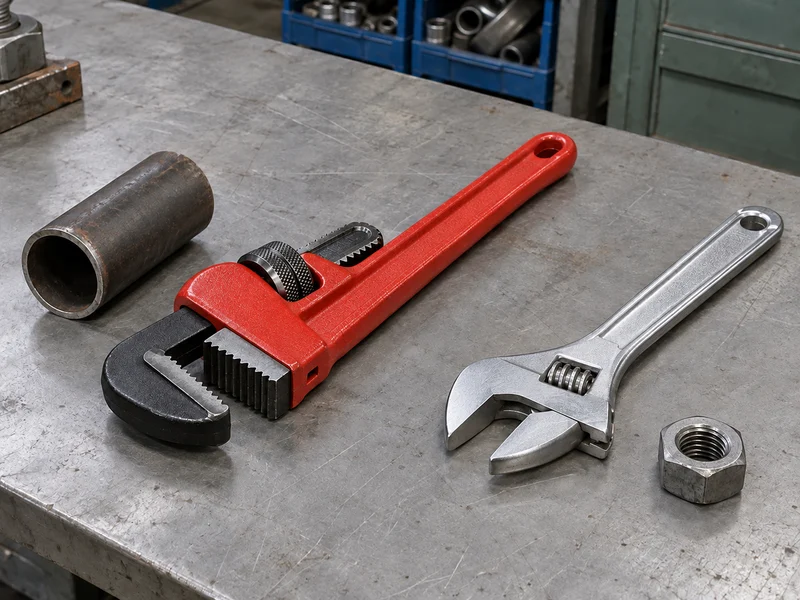
For a distributor, the name alone is a poor assortment label. A pipe wrench belongs with pipe-working tools, while an adjustable wrench covers mixed-size hex fasteners. Both require proper size and a secure workpiece. Buyers can compare adjacent oil-filter wrench types, which use their own contact methods and limits.
Check the shape before reviewing handle length:
- Round pipe or fitting with permission for tooth marks: pipe-wrench family.
- Hex nut or bolt with usable flats: adjustable wrench or a correctly sized fixed wrench.
- Finished, plated, or fragile surfaces: confirm whether teeth or smooth jaws are appropriate.
- Unsupported workpiece: stabilize it before selecting a wrench.
Start with the surface, not the silhouette. Ask the supplier to identify intended workpiece shapes and prohibited applications on each product sheet.
Contact and application matrix
| Workpiece | Pipe wrench | Adjustable wrench | Buyer check |
|---|---|---|---|
| Round threaded pipe | Intended contact for suitable size and material | No stable hex flats to engage | Pipe size and jaw rating |
| Hex nut or bolt | Teeth can damage corners; use only if a product maker explicitly permits | Jaws fit across flats | Opening, jaw fit, and force direction |
| Thin-wall round tube | Teeth and force may mark or deform it | Smooth jaws may still lack secure geometry | Wall and surface requirements |
| Polished round part | Standard teeth can leave marks | Not a substitute for a purpose-built strap interface | Surface protection method |
2. How does a pipe wrench grip round pipe?
A conventional pipe wrench uses a toothed heel and movable hook jaw. Adjust the opening so the hook pivots against pipe; a gap under its shank helps both gripping points engage. An undersized or angled tool can slip.
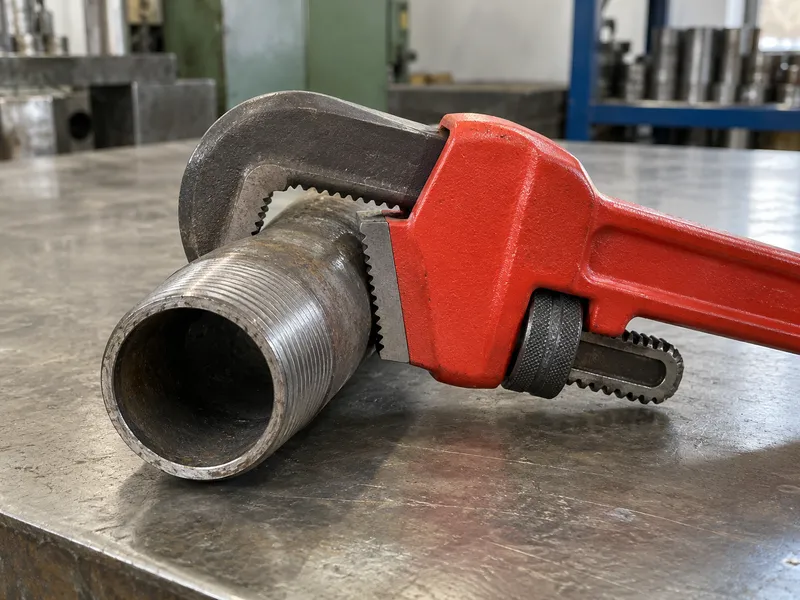
Set the head square and orient its hook for intended rotation. Apply force in that direction without side-loading. Stable footing and work support still matter; an adjustable hook does not make the tool suitable for hex fittings.
Before approval or use, check:
- Hook and heel teeth are clean, sharp, and undamaged.
- A visible gap remains between hook shank and pipe.
- Pipe sits squarely; the wrench is not cocked sideways.
- The workpiece has support against turning, tipping, or falling.
Let the jaw geometry do its job. Match capacity to the pipe and follow the wrench maker’s instructions for direction, support, and force.
Pipe-wrench setup checks
| Check | Correct setup | Warning sign |
|---|---|---|
| Jaw orientation | Hook and heel engage for intended rotation | Tool is reversed or loaded sideways |
| Shank clearance | Hook shank remains clear of workpiece | Shank contacts pipe and reduces bite |
| Alignment | Head sits square to round stock | Wrench contacts at an angle |
| Work support | Pipe or fitting is restrained | Work can shift, tip, or fall |
| Teeth | Clean and serviceable | Worn, chipped, or oily teeth |
3. Why does an adjustable wrench suit hex fasteners?
An adjustable wrench has fixed and movable jaws, with opening set by a worm screw. Adjust both faces snugly across the fastener flats and seat the nut or bolt deep in the throat.
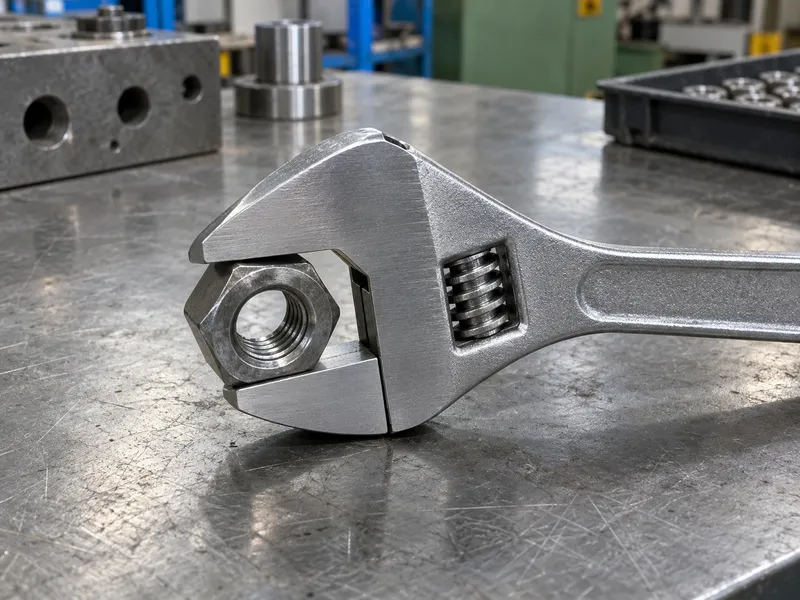
A close fit matters. Excessive jaw clearance lets the tool rock, which can round corners or make the movable jaw spread. Manufacturer guidance recommends snug jaws on fastener flats and force against the fixed jaw. Check each model’s instructions for direction during tightening and loosening.
A correctly sized fixed wrench may suit repeated work better. Adjustable models cover varied sizes but still require fastener identification. The flare-nut wrench comparison explains why a fastener’s shape and access can call for another wrench profile.
- Measure across flats rather than estimating from a photo.
- Set the movable jaw snug before applying load.
- Keep both jaws fully engaged on flat faces.
- Use a dedicated wrench where repeat fit or special access requires it.
A snug jaw is a controllable jaw. Include opening range, jaw depth, jaw play, and instructions with an adjustable-wrench sample.
Adjustable-wrench approval matrix
| Approval point | What to inspect | Why it matters |
|---|---|---|
| Jaw opening | Maximum opening and scale readability | Establishes supported fastener range |
| Jaw play | Movement under hand pressure | Loose fit increases rocking risk |
| Jaw depth | Contact area on the fastener flats | Shallow engagement can slip |
| Knurl action | Smooth adjustment without binding | Supports repeatable setup |
| Instructions | Load direction and use limits | Avoids assumptions across designs |
4. What can go wrong when a pipe wrench meets a hex nut?
A pipe wrench bites round material. Its teeth can mar a hex nut or chew corners. On hard square or hex stock, teeth may slip or chip. Damaged flats can complicate removal and inspection.
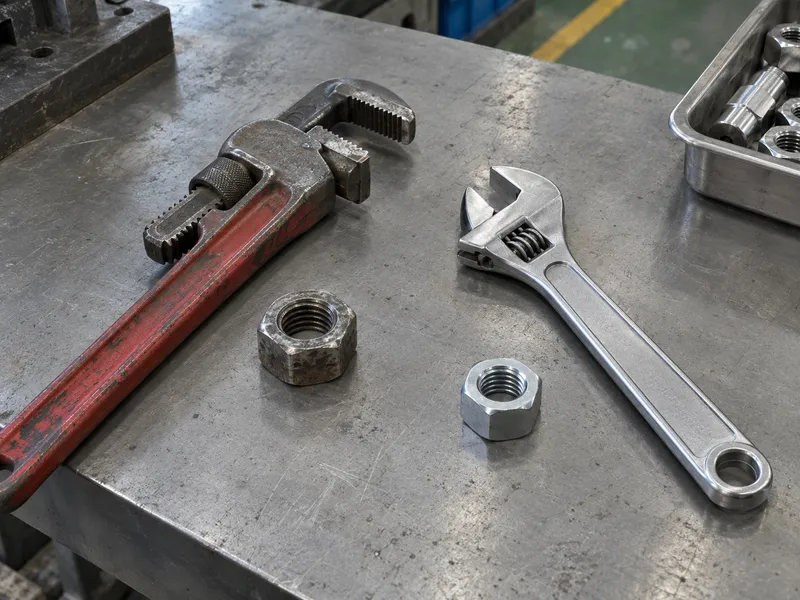
Catalog photos can imply misuse. Show pipe wrenches with round threaded work and hex fasteners beside adjustable or fixed wrenches. For a buyer’s broader fastener-interface reference, the 6-point versus 12-point socket guide covers another way socket contact differs.
- Do not present serrated jaws as a general-purpose grip for hex stock.
- Keep tooth marks away from parts requiring a clean finish.
- Remove worn or chipped pipe wrenches from service.
- Choose a smooth-jaw tool only when its jaw opening and load rating fit.
A fast grip can create a slow repair. Review sample photographs and package copy for unintended hex-fastener claims before approving a pipe wrench SKU.
Misuse risk matrix
| Misuse | Possible result | Better buyer decision |
|---|---|---|
| Pipe wrench on hex nut | Marred flats or damaged corners | Specify an adjustable, fixed, or socket wrench |
| Pipe wrench on hardened square stock | Slippage or chipped teeth | Check tool maker’s stated material limits |
| Teeth on finished surface | Permanent marks or sharp burrs | Select a smooth or protected contact tool |
| Worn teeth kept in service | Reduced grip and greater slip risk | Inspect and replace damaged jaws |
5. Can an adjustable wrench replace a pipe wrench on round stock?
Usually, no. Smooth parallel jaws close on flats. Round stock lacks opposing flats, so the wrench may rotate rather than hold. Its adjustment screw does not make it a pipe or strap wrench.
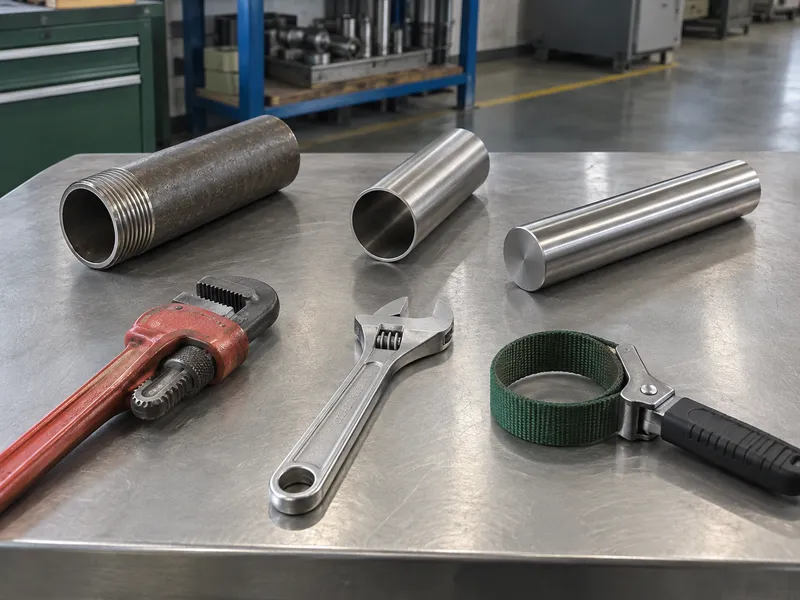
Round materials vary: a hard shaft, thin-wall tube, coated fitting, and threaded pipe present different risks. Teeth can mark or oval thin-wall pipe; smooth jaws may slip. Strap tools may suit some finished parts, subject to model instructions and fit evidence.
If the workpiece has flats, select a wrench based on those flats and access. If it remains round, specify diameter, material, finish, wall condition, and acceptable marking. A product line that serves mixed workshop tasks can connect its automotive repair tools range with a precise application note rather than a broad claim.
- Identify whether the contact area is round, hexagonal, or irregular.
- Record finish and wall thickness when deformation matters.
- Check if surface marks are acceptable.
- Use a tool designed and rated for the specific shape.
Grip starts with contact area. Ask for a sample test on representative stock before assigning a round-work application.
Round-stock decision table
| Round work condition | Main concern | Buyer evidence |
|---|---|---|
| Threaded pipe | Connection may need controlled turning | Size range and support method |
| Thin-wall tube | Crushing or ovaling | Material and wall-specific test |
| Polished round surface | Teeth can mark finish | Approved non-marring interface |
| Smooth shaft with flats nearby | Tool may seat on wrong area | Drawing showing intended contact |
6. How do material and finish change the choice?
A pipe wrench’s teeth dig into round stock. A pipe-wrench use guide warns that teeth can mark round stock and high force can crush thin-wall pipe. It excludes hard, square, hexagonal, and other non-round material.
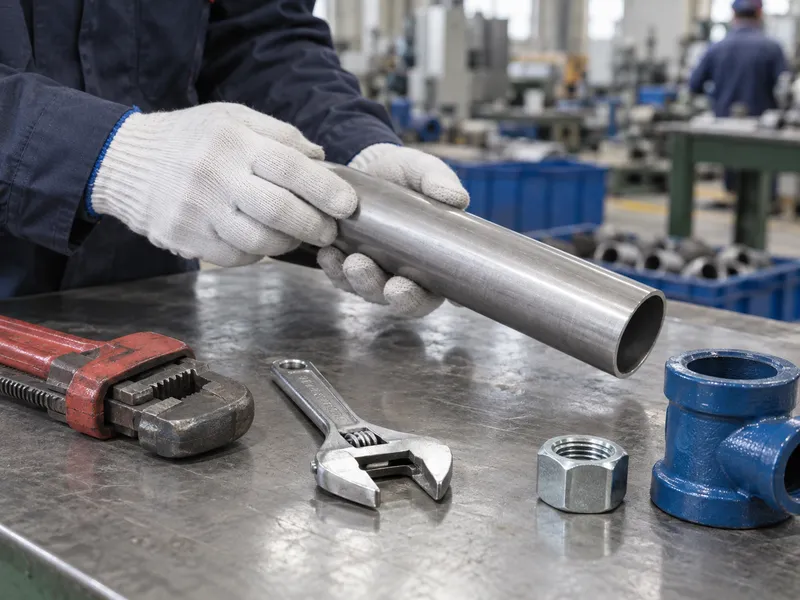
An adjustable wrench presses smooth jaws against flats, yet loose fit can damage corners. Plated, soft, or painted surfaces may need a dedicated tool or approved protection. Do not add a sleeve or pad unless the maker permits it; it can change fit.
A receiving checklist should separate tool material from workpiece material. Ask for the wrench’s rated use, jaw condition, finish, and cleaning instructions. The hand-tools category can help organize the wider line, while individual SKU data must still explain which surfaces each wrench contacts.
- Record workpiece hardness or material only when relevant to the intended use.
- Note plating, paint, polish, and acceptable marks.
- Reject damaged teeth, spread jaws, or a bent handle.
- Keep any surface-protection claim tied to a tested configuration.
Surface quality belongs in the specification. Request a sample image and a real contact check on the buyer’s material.
Material and finish matrix
| Workpiece condition | Pipe-wrench concern | Adjustable-wrench concern |
|---|---|---|
| Thin-wall round pipe | Teeth may mark or deform wall | May not grip round shape securely |
| Hard round stock | Grip may slip or damage teeth | Jaw geometry may not fit securely |
| Plated hex fastener | Serrated teeth damage flats | Loose jaw can round corners |
| Painted or polished surface | Tooth bite leaves marks | Smooth jaw can still scuff under movement |
7. How should buyers compare size, capacity, and access?
Handle length alone cannot establish fit. Pipe wrenches have rated pipe capacity and need head and handle clearance. Manufacturer ranges are model-specific. Adjustable wrenches have jaw opening and depth as well as handle length.
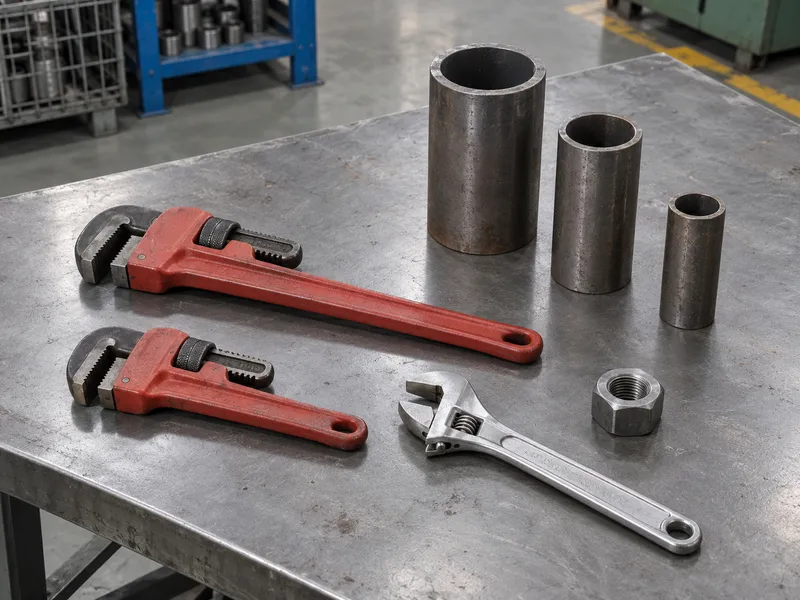
Access can decide the model. A wall, adjacent fitting, engine bay, or pipe vise may block a full swing. Offset, end, straight, or narrow-head forms exist in some product families, but confirm each design with its maker. The socket-drive size guide covers drive interfaces for adjacent socket tools; those drive sizes should not be mistaken for wrench jaw capacity.
Compare workpiece size, approach angle, handle path, and obstructions. Request a drawing and sample test in the tightest expected position.
- List pipe capacity or jaw opening as appropriate to the tool.
- Record head width, jaw depth, and total length.
- Show the handle’s available swing path.
- Check if an adjacent fitting blocks square engagement.
Size the working envelope, too. Approve range and access separately; one dimension cannot prove both.
Sizing and access matrix
| Field | Pipe wrench | Adjustable wrench | Evidence |
|---|---|---|---|
| Working range | Rated pipe size | Maximum jaw opening | Maker’s specification |
| Engagement depth | Hook and heel contact | Jaw depth on flats | Drawing or sample |
| Access | Head clearance and handle arc | Head thickness and jaw reach | Fit check in use position |
| Load path | Rotation around round work | Force through fixed and movable jaws | Instructions and inspection |
8. How should force and inspection be controlled?
Both tools need stable support and force aligned with intended rotation. Pipe-wrench instructions warn against side-loading or adding extensions. A bent handle signals overload. Adjustable-wrench guidance calls for a close fit on fastener flats.
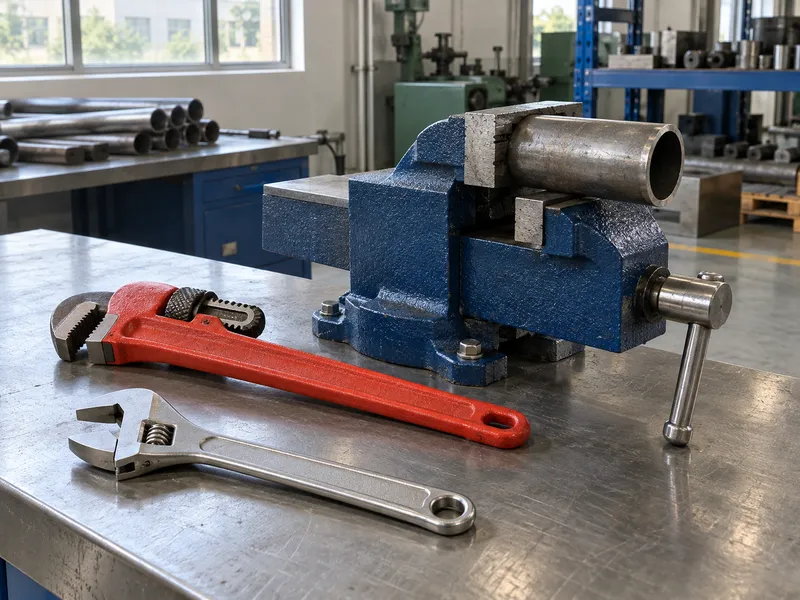
Do not add a handle extension. If the connection needs more force than the tool permits, stop and follow an approved method. Keep hands clear of the slip path and support the workpiece.
- Inspect teeth, hook movement, adjustment nut, jaws, knurl, and handle.
- Keep hands, face, and bystanders clear of the likely slip direction.
- Pull only from stable footing when the task permits.
- Quarantine a bent, cracked, spread, or altered wrench.
Control the load before the turn. Ask suppliers for an inspection checklist and model-specific limits with each sample.
Inspection and force matrix
| Item | Pipe wrench | Adjustable wrench |
|---|---|---|
| Contact surfaces | Hook/heel teeth and jaw pivot | Fixed jaw, movable jaw, and knurl |
| Overload clue | Bent or twisted handle, chipped teeth | Spread jaw, damaged knurl, bent handle |
| Force direction | Intended rotation, avoid side load | Maker-directed loading against jaw face |
| Unsafe workaround | Extension or powered drive | Extension, hammering, or loose fit |
9. What should a distributor request before choosing a range?
Map use cases, not just lengths and finishes. For pipe wrenches, request rated diameters, exclusions, inspection points, and service parts. For adjustable models, request opening, jaw depth, play, scale, handle length, and load direction.
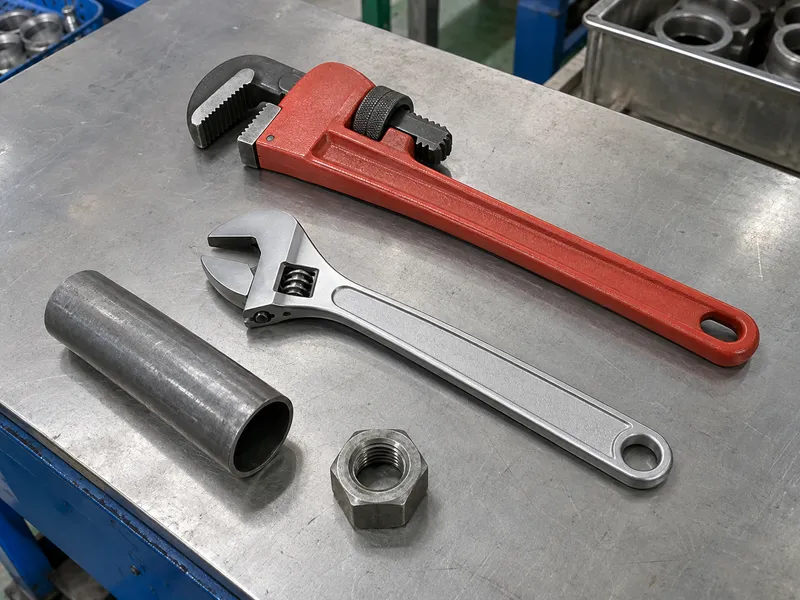
Compare each sample with its workpiece type. Record fit, access, handle path, surface effects, and binding. Do not turn one sample into a strength rating or broad claim. Buyers can place the new SKUs within a complete mechanic tool list or a current mechanic-tool assortment guide, but keep product limits on the wrench listing itself.
- Request drawings and model-specific instruction sheets.
- Confirm finish, material, replacement jaws, and packaging details.
- Approve claims only for tested, documented conditions.
- Retain sample ID and revision with the acceptance record.
Build the range around documented fit. Start with actual customer applications and add a model only when it closes a clear coverage gap.
Range planning table
| SKU field | Pipe wrench | Adjustable wrench |
|---|---|---|
| Application | Round pipe or fitting | Hex fastener or stated alternative |
| Size data | Rated pipe capacity | Opening and jaw depth |
| Exclusions | Hard or non-round stock where maker warns | Loose fit, unsupported load or use |
| Service details | Jaws, hook, adjustment parts | Jaw, knurl, pin, scale |
| Approval record | Pipe sample and contact check | Fastener sample and jaw-fit check |
10. What belongs in a pipe-wrench or adjustable-wrench RFQ?
State tool family, pipe material and outside diameter or fastener size across flats. Add finish, access, rotation, handle clearance, marking limits, packaging, and sample references.
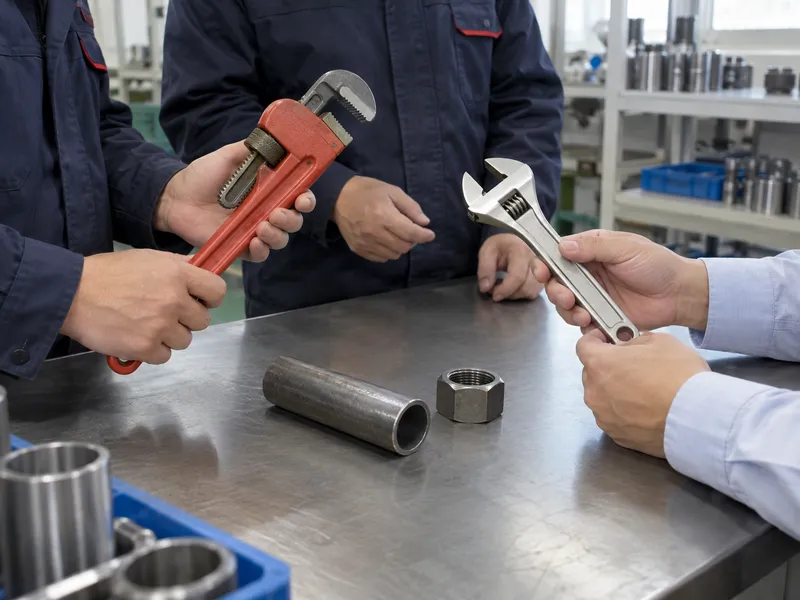
For a pipe wrench, ask for rated capacity, head style, tooth and jaw details, operating instructions, inspection points, and replacement-part information. For an adjustable wrench, ask for maximum opening, jaw depth, jaw play, scale, adjustment action, finish, and use guidance. Do not request a universal-fit statement where applications differ.
- Identify three representative samples or applications.
- Ask which claims are supported by the product’s instructions.
- Define how fit and damage will be reviewed at sample approval.
- Keep final copy aligned with the approved SKU and evidence.
Make the application auditable. Send the RFQ with workpiece drawings, photos, sizes, and a written note on acceptable surface contact.
Q1: Can a pipe wrench replace an adjustable wrench? No. Their jaw geometry and intended work differ; teeth can damage hex flats.
Q2: Can an adjustable wrench turn pipe? Do not assume so. Smooth jaws may not grip round stock securely; follow the model’s stated use.
Q3: Why does a pipe wrench leave marks? Its teeth bite into round stock to grip. That contact can mark the surface.
Q4: Which jaw should carry force on an adjustable wrench? Follow its maker’s instructions; common guidance seats force against the fixed jaw and fastener flats.
Q5: What information helps select a pipe wrench size? Pipe size, wrench capacity, workpiece material, access, and the product’s rated range.
Looking for a reliable mechanic tools manufacturer in China?
If you are sourcing hand tools, socket tools, automotive repair tools, mechanic tool sets or OEM private label tools, contact KOLARWIN Tools for factory-direct quotation, customization support and product consultation.


