
Home/Blog/ Types of Oil Filter Wrenches: A Selection Guide for Tool Buyers

Types of Oil Filter Wrenches: A Selection Guide for Tool Buyers

Get OEM Tool Catalog + Quote Back to Tool Sourcing Blog
Cap, metal band, and fabric strap oil filter wrenches arranged on a product sample bench
This KOLARWIN Tools article is written for overseas distributors, wholesalers, importers and private label tool brands sourcing mechanic tools, automotive repair tools, socket tools, hand tools and OEM tool sets from China. Use this guide to compare product options, check supplier quality points and move from reading to a faster B2B inquiry.

Need OEM supplier support for this product type?

Contact KOLARWIN Tools for OEM mechanic tools, private label packaging, wholesale quotation and product range support. This gives overseas buyers a clear path from article reading to supplier discussion.

Buying oil filter wrenches by a product photo creates fit complaints. Cap, band, strap, chain, plier, and three-jaw tools each transfer force through a different interface. Match that interface with filter shape, access, housing, and service instructions.

Specify a tool that seats fully, turns in available space, and leaves an approval record.

1. What types of oil filter wrenches should buyers compare?

Families include cap or cup, metal band, flexible strap, chain, plier, and adjustable three-jaw wrenches. Some use exact profiles; others use adaptable contact.

Record whether the filter is a disposable spin-on canister or cartridge housing, available clearance, and the manufacturer’s procedure. An exposed-filter wrench may fail in a recessed bay.

Review the automotive repair tools range when planning adjacent categories.

  • Is the filter round, fluted, smooth, damaged, or protected by a housing cap?
  • Can a rigid cup reach the end face, or must the tool approach from the side?
  • Does the technician need a narrow head, long handle, or square drive?
  • Will the assortment serve one profile or many models?

The buyer’s decision is the contact method. Exact tools reward fit; adjustable tools reward range.

Add filter family, profile, access direction, and service method to every brief. Compare sample engagement before discussing packaging.
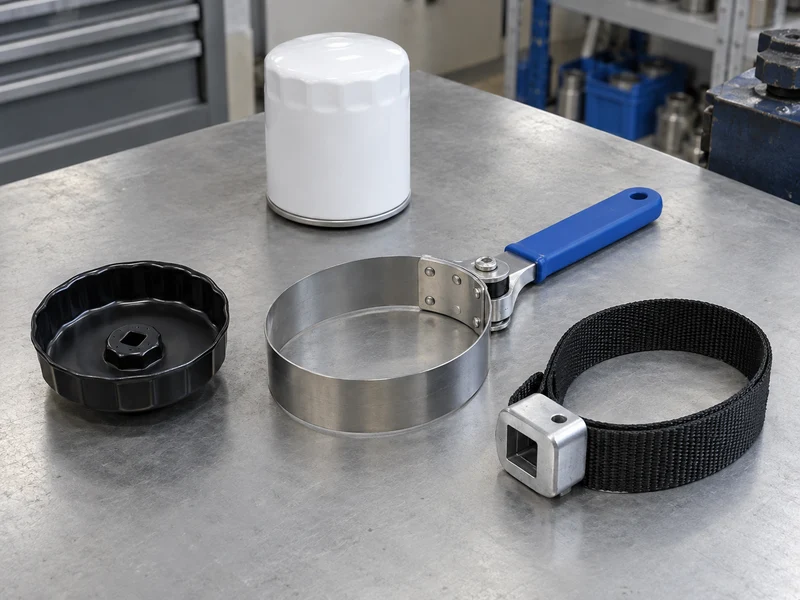
Cap, metal band, and fabric strap oil filter wrenches arranged on a product sample bench
Product illustration; confirm actual model specifications and fit.

Decision table: oil filter wrench families

Wrench family Contact method Best starting use Main buying check
Cap or cup Exact profile Known spin-on family Profile, diameter, drive
Metal band Tensioned loop Smooth canister, side access Range, linkage, clearance
Fabric strap Woven-loop friction Mixed diameters Width, material, drive
Chain Link engagement Difficult removal Length, hook, connection
Oil filter pliers Opposed jaws Side access Jaw, reach, grip
Three-jaw adjustable Three-point grip Round filters Range, centering, clearance

2. How do cap and cup oil filter wrenches fit?

Cap and cup wrenches are shallow sockets that engage a filter end or cap profile. A square drive, ratchet, or extension turns them. Because shape is fixed, fit deserves more attention than nominal size.

Document:

  • Outside diameter or across-profile measurement, taken from an approved sample.
  • Flute, rib, face, or other engagement pattern.
  • Cup depth and whether the tool seats over the whole intended face.
  • Drive size, wall clearance, and access for a ratchet or extension.
  • Filter model or application list when application-specific.

A shallow cup can suit a tight bay, yet a wrong flute pattern leaves partial contact. Show the working face, back drive, and fit reference.

Exact fit turns a small socket into a dependable service tool. Treat profile, engagement depth, and driver access as separate approval fields.

Request a drawing and sample filter or cap. Check full seating by hand, then approve the shown profile and drive.
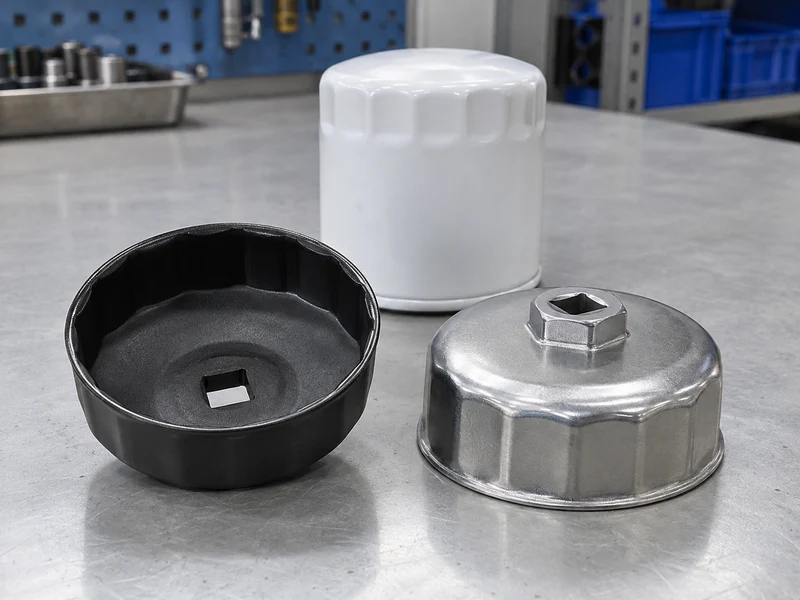
Two fluted cap oil filter wrenches showing their internal profiles beside an unmarked spin-on filter
Product illustration; confirm actual model specifications and fit.

Decision table: cap-wrench approval

Approval point Evidence to request Reason for rejection
Profile engagement Sample or section drawing Tool rocks or contacts few flats
Diameter Measured filter or cap No reference condition
Flutes or ribs Profile image and count “Universal” claim without proof
Cup depth Side view and seated sample Cup bottoms before seating
Drive connection Drive opening and specification Ratchet cannot align

3. When does a metal band wrench make sense?

A metal band wrench uses a thin loop around a filter. A handle or linkage tightens it as the tool turns. It suits smooth spin-on filters with loop and swing clearance.

Inspect the band:

  • Band material, width, edge finish, and connections.
  • Adjustment range and tension method.
  • Pivot movement and handle angle.
  • Clearance around the handle and nearby parts.
  • Whether instructions cover removal or installation.

Band tools can lose purchase on oily, crushed, recessed filters or near obstructions. Their limitation is tension and swing clearance.

Do not transfer removal use into an installation claim without written support.

A band wrench earns its place when the loop can close evenly and the handle can complete its stroke. Buyers should approve the whole working envelope, not a static image of the band.

Test a clean filter in tight clearance. Record handle angle, loop seating, and contact points.
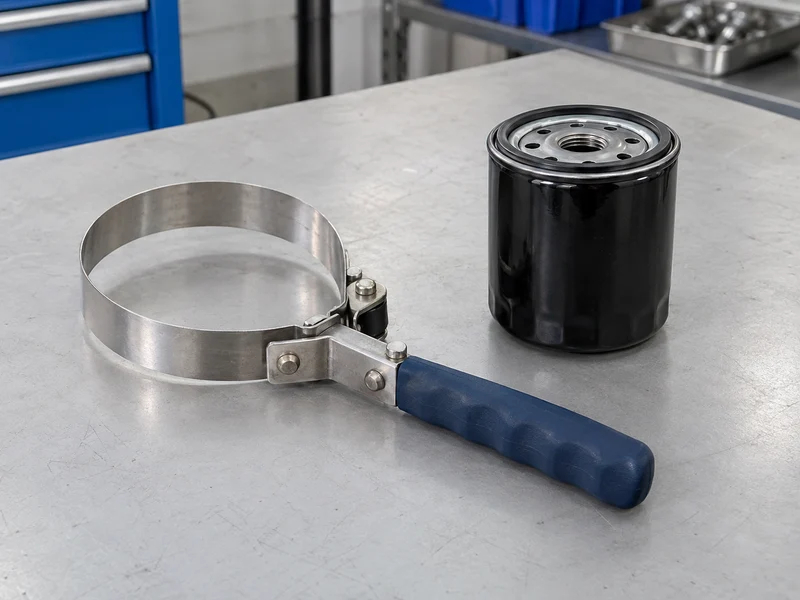
Metal band oil filter wrench with a pivoting handle beside an unmarked filter
Product illustration; confirm actual model specifications and fit.

Decision table: metal band review

Condition Good indication Concern
Filter surface Smooth shell with loop access Damaged or contaminated shell
Band seating Loop closes evenly Edge climbs or folds
Handle path Full swing is clear Handle hits nearby parts
Linkage Pivot moves smoothly Loose or sharp connection

4. Where does a flexible strap wrench work best?

A flexible strap wrench uses woven webbing around a cylindrical filter. A drive body, handle, or square-drive opening applies tension. The strap can enter spaces that reject a rigid cup or bulky plier.

For buyer evaluation, inspect:

  • Strap width, weave, stitching, and edge finish.
  • Strap-to-body connection.
  • Loop length and adjustment.
  • Contact on oily or smooth surfaces under stated conditions.
  • Cleaning, replacement, and packaging requirements.

A twisted loop reduces strap contact area.

Strap tools cover a broad assortment, but avoid fixed diameter promises without a documented test. Shape, surface finish, oil, and access affect grip.

A strap wrench buys access and coverage at the cost of a more condition-sensitive grip. That trade-off belongs in the product description and sample report.

Ask for a loop diagram and check approved profiles. Record slippage, tracking, and drive access.
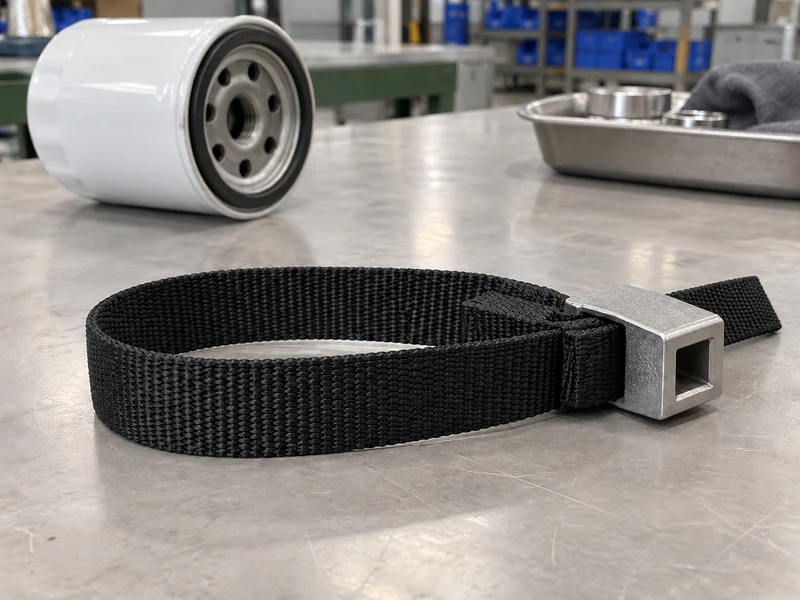
Woven strap oil filter wrench laid out with its loop and square-drive body visible
Product illustration; confirm actual model specifications and fit.

Decision table: strap-wrench sourcing

Check What to inspect Acceptance evidence
Webbing Flat, even weave with protected edges Sample photos and physical inspection
Attachment Strap remains secured in drive body Pull and movement check under approved setup
Loop adjustment Loop can be positioned without twisting Demonstration on representative filters
Service range Listed only for tested conditions Test note tied to filter samples

5. What are the limits of a chain oil filter wrench?

A chain wrench uses linked metal chain around a cylindrical filter, connected to a handle or drive body. It can help on a smooth or awkwardly placed filter, but links and hooks need room to seat.

Before adding chain tools, check:

  • Chain length, link size, hook or anchor, and body connection.
  • Whether the chain sits squarely rather than rides onto an edge.
  • Handle swing and engine-bay clearance.
  • Replacement-chain and spare-part availability.
  • Instructions defining removal use and filter conditions.

Chain tools can mark or crush a disposable shell. That may suit controlled removal, but not installation. A chain is poor near a cartridge housing, reusable cap, wiring, or fragile component.

Chain engagement helps with difficult access, yet it carries contact risk. Present it as controlled removal for suitable round filters.

Approve only after stable sample seating and documented exclusions for caps and fragile nearby parts.
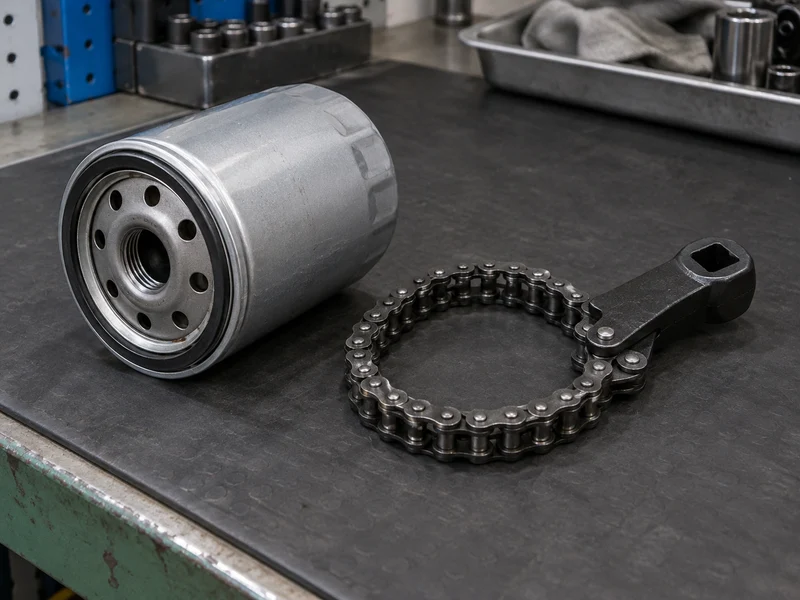
Chain-type oil filter wrench and a separate plain metal spin-on filter on a workshop bench
Product illustration; confirm actual model specifications and fit.

Decision table: chain-wrench limits

Condition Potential benefit Limit to state
Smooth round canister Chain can wrap around a side surface Needs enough circumference and swing room
Damaged filter shell May still engage during removal Crushing or marking can increase
Tight engine bay Flexible chain may approach from the side Links and handle still need clearance
Reusable cap or cartridge housing Usually a poor interface match Use the specified cap tool instead

6. How should buyers assess oil filter pliers?

Oil filter pliers use opposed jaws, often shaped or toothed, to grip a filter from the side. Long handles provide reach around obstructions. Value depends on jaw position, access, and contact behavior.

Inspect these fields in a sample:

  • Jaw opening, tip geometry, tooth profile, and edge finish.
  • Handle length, pivot, grip texture, and return action.
  • Reach without fouling nearby components.
  • Whether force stays centered rather than on a seam or edge.
  • Removal-use language and cap or housing exclusions.

Pliers suit mixed service work, yet they are not an exact cap wrench. A jaw for a steel shell may damage a reusable cap or slide on a weak surface. Identify construction and side-grip orientation.

Kits can place pliers beside hand tools or within a mechanics tool set; keep the oil-filter application clear.

Pliers solve access through reach, while their grip depends on controlled jaw placement. Buyers should verify contact on the actual filter family instead of inferring capability from handle length.

Use a fit sheet with jaw placement, seam clearance, handle angle, and exclusions.
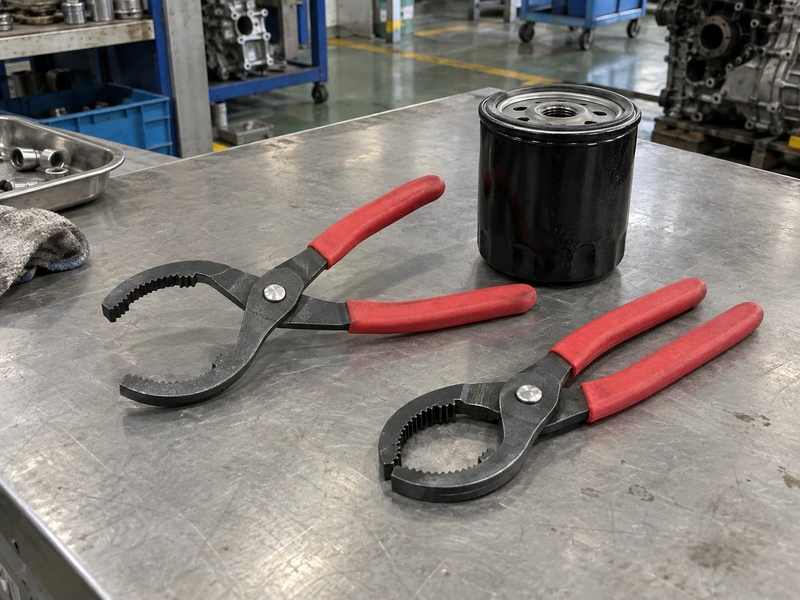
Unbranded red-grip oil filter pliers with curved serrated jaws beside a plain spin-on filter
Product illustration; confirm actual model specifications and fit.

Decision table: oil filter pliers

Buyer question Positive sign Concern
Can jaws reach the shell? Jaws seat from a clear side position Tips contact an edge or seam
Does the pivot hold alignment? Both jaws meet the shell squarely One jaw carries the load
Is handle access adequate? Handles clear nearby parts Required grip angle is blocked
Is use stated correctly? Removal application is specific Listing implies universal installation

7. When should a three-jaw adjustable wrench be specified?

A three-jaw adjustable oil filter wrench uses three contact points around a round filter. It may use a square-drive socket or another driver. Its selling point is coverage; its challenge is keeping all jaws engaged in available space.

Some three-jaw tools remove disposable spin-on filters only. Confirm loading direction, removal direction, and installation permission in the maker’s instructions.

Record these variables:

  • Tested filter profiles and conditions.
  • Jaw shape, contact surface, travel, and adjustment method.
  • Centering behavior and required clearance.
  • Drive size, tool thickness, and extension clearance.
  • Filter limits and manufacturer instructions.

Three jaws can center a suitable round filter, but the mechanism does not make every diameter or housing universal. A fluted cap, recessed cover, irregular shell, or fragile housing calls for an exact interface. Tie any range to samples.

For distributors building a socket tools program, a drive-compatible three-jaw model can share driver expectations. Fit still needs evidence.

Adjustability improves coverage only when each jaw reaches a stable, centered contact. Treat the range as a test result, not a promise inferred from the mechanism.

Require a fit matrix with profile, jaw setting, contact photo, and clearance note.
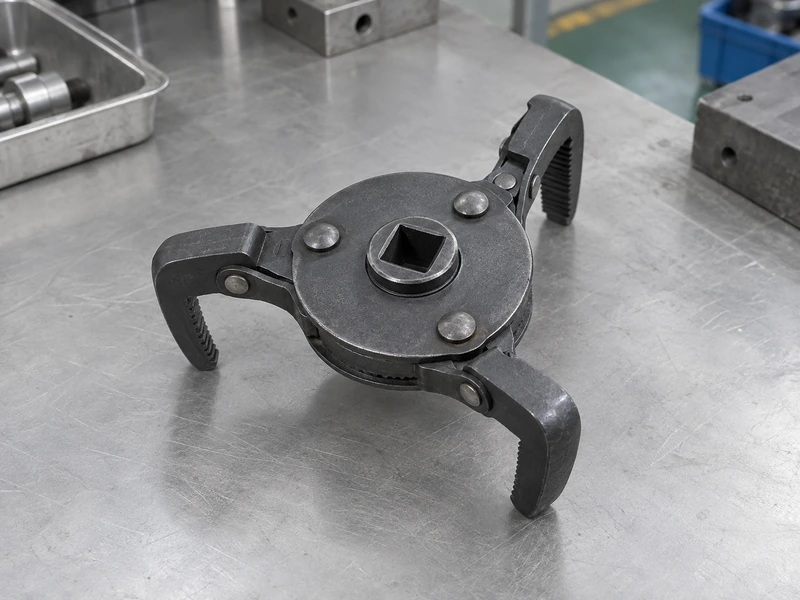
Unbranded three-jaw adjustable oil filter wrench with a visible square drive on a clean inspection bench
Product illustration; confirm actual model specifications and fit.

Decision table: three-jaw specification

Specification What it answers Evidence needed
Tested profile range Which filters can be engaged Sample list or fit matrix
Jaw movement How the tool adjusts Drawing and adjustment demonstration
Centering Whether contact stays balanced Seated photos from several profiles
Drive access Which driver works in the bay Drive drawing and clearance check

8. How do spin-on filters differ from cartridge housings?

Spin-on filters present a disposable canister. Cartridge systems place a replaceable element inside a reusable housing, often under a cap. A side grip may suit a spin-on shell; cartridge service often needs an exact cap tool.

Confirm:

  • Filter type and service-part number or cross-reference.
  • End-face, flute, hex, or cap profile.
  • Housing material and driver restrictions.
  • Installation procedure stated by the vehicle or component maker.
  • Access depth, drive clearance, and direction.

Do not describe one wrench as universal across spin-on and cartridge systems. A socket set may provide a familiar drive ecosystem, but the filter interface still controls the cap. Show it on the product drawing.

For cartridge service, use the professional torque-wrench guide for torque documentation questions. It does not replace the service procedure.

Filter type determines the contact surface, while service instructions determine the allowed operation. Keep those two approval steps separate in product data.

Split spin-on and cartridge groups. Require a profile drawing, application reference, and approved installation instruction.
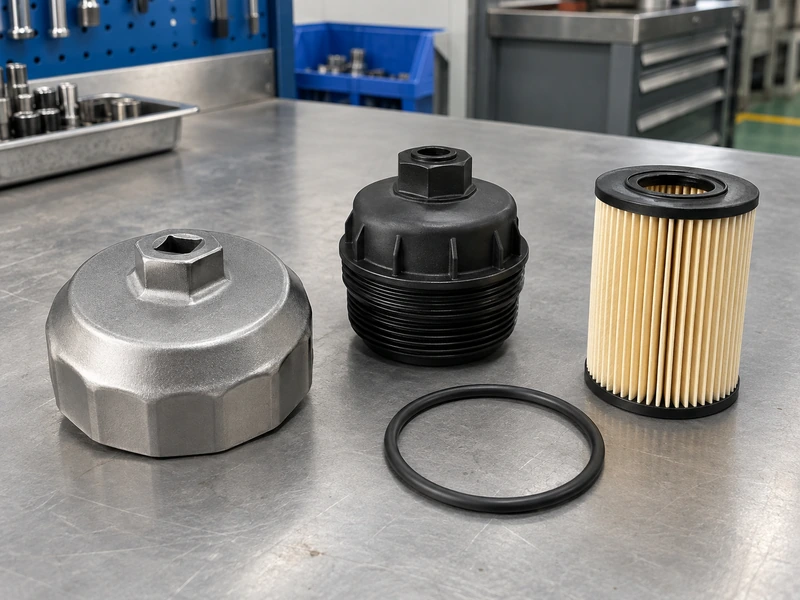
Metal cup oil filter wrench beside a reusable cartridge cap, separate O-ring, and pleated filter element
Product illustration; confirm actual model specifications and fit.

Decision table: spin-on versus cartridge sourcing

Application Typical contact decision Buyer evidence Common listing error
Disposable spin-on canister Side loop, plier, chain, strap, or exact cup Canister profile and access test Calling every adjustable tool universal
Known fluted spin-on Matching cap or cup Flute and diameter fit Showing a similar-looking cup
Cartridge housing cap Exact cap profile Housing reference and service procedure Treating it like a disposable shell
Cap with specified torque Approved drive plus torque method Service information and tool drawing Giving an invented torque value

9. How should a B2B buyer build an oil-filter wrench assortment?

A distributor does not need every style in every size. Start with demanded applications, then add coverage where contact or access changes. A documented range is easier to replenish.

Use a category worksheet that groups tools by:

  • Spin-on or cartridge application.
  • Exact profile or adjustable contact method.
  • Access: end, side, recessed, or limited swing.
  • Driver interface and accessories.
  • Replacement parts, packaging, and private-label data.

For a first sample, compare one exact-fit cup, one band or strap, one plier or chain, and one adjustable model where demand justifies them. Tie each SKU to a fit photo, drawing, and exclusion.

A complete mechanic tools list helps place oil-filter tools in a kit or display.

Assortment quality comes from documented application coverage, not SKU count. Add models when a real fit gap appears.

Build a gap matrix with customer references and wrench families. Keep an application unsupported until evidence closes the gap.
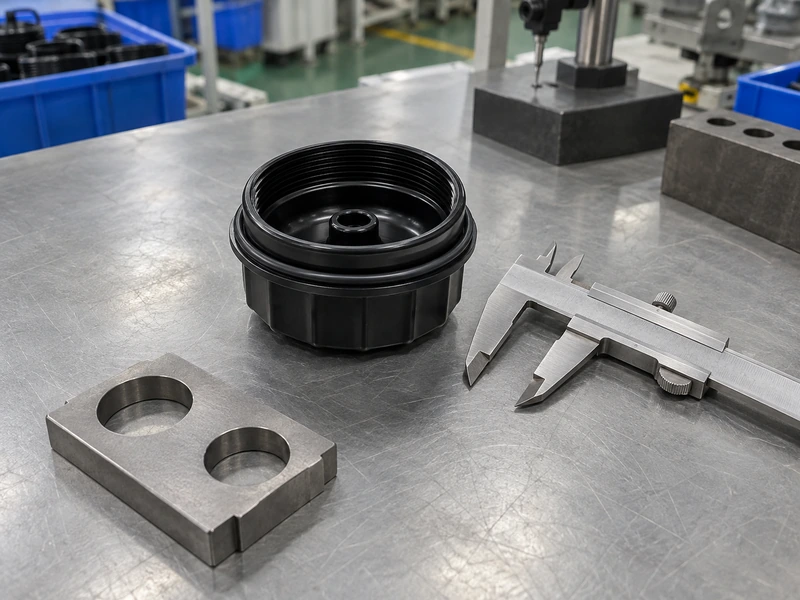
Unbranded oil filter cap sample with a caliper and separate go/no-go inspection gauge on a factory bench
Product illustration; confirm actual model specifications and fit.

Decision table: assortment planning

Assortment goal Starting family Evidence to retain Add another SKU when
Known high-volume filter Exact cap or cup Profile, sample, application note New profile or access condition appears
Mixed smooth canisters Band or strap Tested filter list and clearance notes Grip or access fails in service samples
Damaged filter removal Pliers or chain Controlled removal-use statement Shell or nearby-part risk excludes the tool
Broad workshop coverage Selected adjustable model Fit matrix and exclusions Customer demand shows a documented gap

10. Which fields belong in an oil-filter wrench RFQ?

An RFQ should let a supplier quote fit, mechanism, packaging, and evidence together. Send the filter reference or sample, access sketch, and service method.
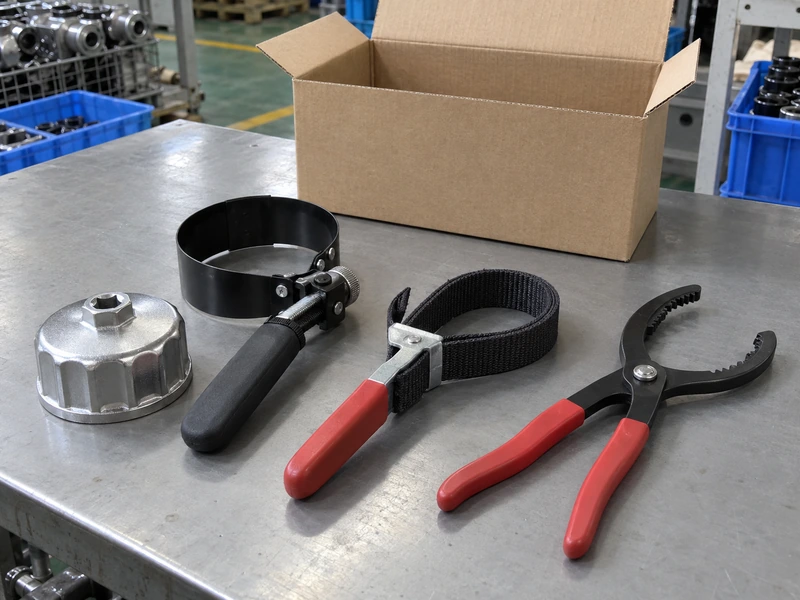
Organized unbranded buyer assortment of cup, band, strap, and plier oil filter wrenches beside a blank packing box
Product illustration; confirm actual model specifications and fit.

Include these fields:

  • Product family: cap, cup, band, strap, chain, plier, or three-jaw.
  • Filter system: spin-on canister or cartridge housing.
  • Filter reference, profile, and contact pattern.
  • Tightest access, working direction, and driver clearance.
  • Material, finish, handle, drive, and spares.
  • Removal-only or removal-and-installation use, with procedure.
  • Fit sample, drawing, inspection photo, packaging, and label.
  • Quantity, market, carton details, and approval stages.

A strong RFQ makes fit auditable after sample approval. Keep evidence with the SKU record.

Send these fields with one representative filter or housing and request a marked drawing. Use the mechanical-tool supplier checklist and contact the supplier.

Q1. What is the most accurate oil filter wrench for a known filter?

An exact cap or cup wrench is the clearest starting point when profile and drive are documented. Approve full seating before listing it.

Q2. Are strap and band oil filter wrenches interchangeable?

They use side access, but loop material, tension, adjustment, and tested conditions differ. Treat them as separate SKUs and verify each.

Q3. Can one oil filter wrench fit spin-on and cartridge systems?

Do not assume that. Spin-on shells and cartridge caps use different interfaces. Each application needs documented fit.

Q4. Should a buyer specify installation torque for a filter wrench?

Specify the manufacturer’s installation procedure. Do not invent torque; retain the service source with the SKU.

Q5. What should a distributor ask for before approving a private-label wrench?

Ask for a marked drawing, fit sample, tested applications, usage limits, material, drive, packaging, and spares. Tie approval to the model.

Looking for a reliable mechanic tools manufacturer in China?

If you are sourcing hand tools, socket tools, automotive repair tools, mechanic tool sets or OEM private label tools, contact KOLARWIN Tools for factory-direct quotation, customization support and product consultation.


Buying oil filter wrenches by a product photo creates fit complaints. Cap, band, strap, chain, plier, and three-jaw tools each transfer force through a different interface. Match that interface with filter shape, access, housing, and service instructions.

Specify a tool that seats fully, turns in available space, and leaves an approval record.

1. What types of oil filter wrenches should buyers compare?

Families include cap or cup, metal band, flexible strap, chain, plier, and adjustable three-jaw wrenches. Some use exact profiles; others use adaptable contact.

Record whether the filter is a disposable spin-on canister or cartridge housing, available clearance, and the manufacturer’s procedure. An exposed-filter wrench may fail in a recessed bay.

Review the automotive repair tools range when planning adjacent categories.

The buyer’s decision is the contact method. Exact tools reward fit; adjustable tools reward range.

Add filter family, profile, access direction, and service method to every brief. Compare sample engagement before discussing packaging.

Cap, metal band, and fabric strap oil filter wrenches arranged on a product sample bench
Product illustration; confirm actual model specifications and fit.

Decision table: oil filter wrench families

Wrench family Contact method Best starting use Main buying check
Cap or cup Exact profile Known spin-on family Profile, diameter, drive
Metal band Tensioned loop Smooth canister, side access Range, linkage, clearance
Fabric strap Woven-loop friction Mixed diameters Width, material, drive
Chain Link engagement Difficult removal Length, hook, connection
Oil filter pliers Opposed jaws Side access Jaw, reach, grip
Three-jaw adjustable Three-point grip Round filters Range, centering, clearance

2. How do cap and cup oil filter wrenches fit?

Cap and cup wrenches are shallow sockets that engage a filter end or cap profile. A square drive, ratchet, or extension turns them. Because shape is fixed, fit deserves more attention than nominal size.

Document:

A shallow cup can suit a tight bay, yet a wrong flute pattern leaves partial contact. Show the working face, back drive, and fit reference.

Exact fit turns a small socket into a dependable service tool. Treat profile, engagement depth, and driver access as separate approval fields.

Request a drawing and sample filter or cap. Check full seating by hand, then approve the shown profile and drive.

Two fluted cap oil filter wrenches showing their internal profiles beside an unmarked spin-on filter
Product illustration; confirm actual model specifications and fit.

Decision table: cap-wrench approval

Approval point Evidence to request Reason for rejection
Profile engagement Sample or section drawing Tool rocks or contacts few flats
Diameter Measured filter or cap No reference condition
Flutes or ribs Profile image and count “Universal” claim without proof
Cup depth Side view and seated sample Cup bottoms before seating
Drive connection Drive opening and specification Ratchet cannot align

3. When does a metal band wrench make sense?

A metal band wrench uses a thin loop around a filter. A handle or linkage tightens it as the tool turns. It suits smooth spin-on filters with loop and swing clearance.

Inspect the band:

Band tools can lose purchase on oily, crushed, recessed filters or near obstructions. Their limitation is tension and swing clearance.

Do not transfer removal use into an installation claim without written support.

A band wrench earns its place when the loop can close evenly and the handle can complete its stroke. Buyers should approve the whole working envelope, not a static image of the band.

Test a clean filter in tight clearance. Record handle angle, loop seating, and contact points.

Metal band oil filter wrench with a pivoting handle beside an unmarked filter
Product illustration; confirm actual model specifications and fit.

Decision table: metal band review

Condition Good indication Concern
Filter surface Smooth shell with loop access Damaged or contaminated shell
Band seating Loop closes evenly Edge climbs or folds
Handle path Full swing is clear Handle hits nearby parts
Linkage Pivot moves smoothly Loose or sharp connection

4. Where does a flexible strap wrench work best?

A flexible strap wrench uses woven webbing around a cylindrical filter. A drive body, handle, or square-drive opening applies tension. The strap can enter spaces that reject a rigid cup or bulky plier.

For buyer evaluation, inspect:

A twisted loop reduces strap contact area.

Strap tools cover a broad assortment, but avoid fixed diameter promises without a documented test. Shape, surface finish, oil, and access affect grip.

A strap wrench buys access and coverage at the cost of a more condition-sensitive grip. That trade-off belongs in the product description and sample report.

Ask for a loop diagram and check approved profiles. Record slippage, tracking, and drive access.

Woven strap oil filter wrench laid out with its loop and square-drive body visible
Product illustration; confirm actual model specifications and fit.

Decision table: strap-wrench sourcing

Check What to inspect Acceptance evidence
Webbing Flat, even weave with protected edges Sample photos and physical inspection
Attachment Strap remains secured in drive body Pull and movement check under approved setup
Loop adjustment Loop can be positioned without twisting Demonstration on representative filters
Service range Listed only for tested conditions Test note tied to filter samples

5. What are the limits of a chain oil filter wrench?

A chain wrench uses linked metal chain around a cylindrical filter, connected to a handle or drive body. It can help on a smooth or awkwardly placed filter, but links and hooks need room to seat.

Before adding chain tools, check:

Chain tools can mark or crush a disposable shell. That may suit controlled removal, but not installation. A chain is poor near a cartridge housing, reusable cap, wiring, or fragile component.

Chain engagement helps with difficult access, yet it carries contact risk. Present it as controlled removal for suitable round filters.

Approve only after stable sample seating and documented exclusions for caps and fragile nearby parts.

Chain-type oil filter wrench and a separate plain metal spin-on filter on a workshop bench
Product illustration; confirm actual model specifications and fit.

Decision table: chain-wrench limits

Condition Potential benefit Limit to state
Smooth round canister Chain can wrap around a side surface Needs enough circumference and swing room
Damaged filter shell May still engage during removal Crushing or marking can increase
Tight engine bay Flexible chain may approach from the side Links and handle still need clearance
Reusable cap or cartridge housing Usually a poor interface match Use the specified cap tool instead

6. How should buyers assess oil filter pliers?

Oil filter pliers use opposed jaws, often shaped or toothed, to grip a filter from the side. Long handles provide reach around obstructions. Value depends on jaw position, access, and contact behavior.

Inspect these fields in a sample:

Pliers suit mixed service work, yet they are not an exact cap wrench. A jaw for a steel shell may damage a reusable cap or slide on a weak surface. Identify construction and side-grip orientation.

Kits can place pliers beside hand tools or within a mechanics tool set; keep the oil-filter application clear.

Pliers solve access through reach, while their grip depends on controlled jaw placement. Buyers should verify contact on the actual filter family instead of inferring capability from handle length.

Use a fit sheet with jaw placement, seam clearance, handle angle, and exclusions.

Unbranded red-grip oil filter pliers with curved serrated jaws beside a plain spin-on filter
Product illustration; confirm actual model specifications and fit.

Decision table: oil filter pliers

Buyer question Positive sign Concern
Can jaws reach the shell? Jaws seat from a clear side position Tips contact an edge or seam
Does the pivot hold alignment? Both jaws meet the shell squarely One jaw carries the load
Is handle access adequate? Handles clear nearby parts Required grip angle is blocked
Is use stated correctly? Removal application is specific Listing implies universal installation

7. When should a three-jaw adjustable wrench be specified?

A three-jaw adjustable oil filter wrench uses three contact points around a round filter. It may use a square-drive socket or another driver. Its selling point is coverage; its challenge is keeping all jaws engaged in available space.

Some three-jaw tools remove disposable spin-on filters only. Confirm loading direction, removal direction, and installation permission in the maker’s instructions.

Record these variables:

Three jaws can center a suitable round filter, but the mechanism does not make every diameter or housing universal. A fluted cap, recessed cover, irregular shell, or fragile housing calls for an exact interface. Tie any range to samples.

For distributors building a socket tools program, a drive-compatible three-jaw model can share driver expectations. Fit still needs evidence.

Adjustability improves coverage only when each jaw reaches a stable, centered contact. Treat the range as a test result, not a promise inferred from the mechanism.

Require a fit matrix with profile, jaw setting, contact photo, and clearance note.

Unbranded three-jaw adjustable oil filter wrench with a visible square drive on a clean inspection bench
Product illustration; confirm actual model specifications and fit.

Decision table: three-jaw specification

Specification What it answers Evidence needed
Tested profile range Which filters can be engaged Sample list or fit matrix
Jaw movement How the tool adjusts Drawing and adjustment demonstration
Centering Whether contact stays balanced Seated photos from several profiles
Drive access Which driver works in the bay Drive drawing and clearance check

8. How do spin-on filters differ from cartridge housings?

Spin-on filters present a disposable canister. Cartridge systems place a replaceable element inside a reusable housing, often under a cap. A side grip may suit a spin-on shell; cartridge service often needs an exact cap tool.

Confirm:

Do not describe one wrench as universal across spin-on and cartridge systems. A socket set may provide a familiar drive ecosystem, but the filter interface still controls the cap. Show it on the product drawing.

For cartridge service, use the professional torque-wrench guide for torque documentation questions. It does not replace the service procedure.

Filter type determines the contact surface, while service instructions determine the allowed operation. Keep those two approval steps separate in product data.

Split spin-on and cartridge groups. Require a profile drawing, application reference, and approved installation instruction.

Metal cup oil filter wrench beside a reusable cartridge cap, separate O-ring, and pleated filter element
Product illustration; confirm actual model specifications and fit.

Decision table: spin-on versus cartridge sourcing

Application Typical contact decision Buyer evidence Common listing error
Disposable spin-on canister Side loop, plier, chain, strap, or exact cup Canister profile and access test Calling every adjustable tool universal
Known fluted spin-on Matching cap or cup Flute and diameter fit Showing a similar-looking cup
Cartridge housing cap Exact cap profile Housing reference and service procedure Treating it like a disposable shell
Cap with specified torque Approved drive plus torque method Service information and tool drawing Giving an invented torque value

9. How should a B2B buyer build an oil-filter wrench assortment?

A distributor does not need every style in every size. Start with demanded applications, then add coverage where contact or access changes. A documented range is easier to replenish.

Use a category worksheet that groups tools by:

For a first sample, compare one exact-fit cup, one band or strap, one plier or chain, and one adjustable model where demand justifies them. Tie each SKU to a fit photo, drawing, and exclusion.

A complete mechanic tools list helps place oil-filter tools in a kit or display.

Assortment quality comes from documented application coverage, not SKU count. Add models when a real fit gap appears.

Build a gap matrix with customer references and wrench families. Keep an application unsupported until evidence closes the gap.

Unbranded oil filter cap sample with a caliper and separate go/no-go inspection gauge on a factory bench
Product illustration; confirm actual model specifications and fit.

Decision table: assortment planning

Assortment goal Starting family Evidence to retain Add another SKU when
Known high-volume filter Exact cap or cup Profile, sample, application note New profile or access condition appears
Mixed smooth canisters Band or strap Tested filter list and clearance notes Grip or access fails in service samples
Damaged filter removal Pliers or chain Controlled removal-use statement Shell or nearby-part risk excludes the tool
Broad workshop coverage Selected adjustable model Fit matrix and exclusions Customer demand shows a documented gap

10. Which fields belong in an oil-filter wrench RFQ?

An RFQ should let a supplier quote fit, mechanism, packaging, and evidence together. Send the filter reference or sample, access sketch, and service method.

Organized unbranded buyer assortment of cup, band, strap, and plier oil filter wrenches beside a blank packing box
Product illustration; confirm actual model specifications and fit.

Include these fields:

A strong RFQ makes fit auditable after sample approval. Keep evidence with the SKU record.

Send these fields with one representative filter or housing and request a marked drawing. Use the mechanical-tool supplier checklist and contact the supplier.

Q1. What is the most accurate oil filter wrench for a known filter?

An exact cap or cup wrench is the clearest starting point when profile and drive are documented. Approve full seating before listing it.

Q2. Are strap and band oil filter wrenches interchangeable?

They use side access, but loop material, tension, adjustment, and tested conditions differ. Treat them as separate SKUs and verify each.

Q3. Can one oil filter wrench fit spin-on and cartridge systems?

Do not assume that. Spin-on shells and cartridge caps use different interfaces. Each application needs documented fit.

Q4. Should a buyer specify installation torque for a filter wrench?

Specify the manufacturer’s installation procedure. Do not invent torque; retain the service source with the SKU.

Q5. What should a distributor ask for before approving a private-label wrench?

Ask for a marked drawing, fit sample, tested applications, usage limits, material, drive, packaging, and spares. Tie approval to the model.

Why Partner with Kolarwin Tools?

Factory-Direct Pricing Skip the middleman — access competitive wholesale prices and protect your margins
Private Label & OEM Ready Your brand, our expertise — full customization from logo to packaging
Fast Global Shipping Reliable delivery to 60+ countries with full export documentation support
Low MOQ, High Flexibility Start small, scale fast — flexible order quantities to fit your business
Dedicated B2B Support One-on-one account management from quote to delivery, every time

Get Your Free Quote in 24 Hours

Tell us your sourcing needs — we'll respond with a tailored quote, product specs, and the best pricing for your market. No commitment required.

Chat on WhatsApp Email Us Directly
