Need OEM supplier support for this product type?
Contact KOLARWIN Tools for OEM mechanic tools, private label packaging, wholesale quotation and product range support. This gives overseas buyers a clear path from article reading to supplier discussion.
Adjustable wrench sizes usually refer to overall length, such as a 6-, 8-, 10-, or 12-inch label. Jaw opening is a separate, model-specific dimension. Use the nominal-length chart below for unit conversion. Then compare exact opening, head size, and access before choosing a wrench or assortment.
Contents
- 1. What do common nominal wrench sizes mean in millimeters?
- 2. What does an adjustable wrench size actually describe?
- 3. Is an 8-inch wrench always smaller in every useful way?
- 4. How should buyers read jaw opening and capacity?
- 5. Why do wide-jaw models need separate treatment?
- 6. How do jaw shape and surface finish affect size selection?
- 7. What access dimensions belong in an RFQ?
- 8. How should buyers compare adjustable wrenches with fixed or torque-controlled tools?
- 9. What inspection checks should accompany a size sample?
- 10. What should a distributor request before approving an adjustable-wrench range?
1. What do common nominal wrench sizes mean in millimeters?
These are arithmetic label conversions. Six inches equals about 152 mm, 8 inches about 203 mm, 10 inches about 254 mm, and 12 inches about 305 mm. Those figures do not measure a finished tool and do not predict jaw opening, torque, or fastener coverage.
- Label converted values as nominal inch-to-millimeter equivalents.
- Keep measured total length in a separate model field.
- Never convert nominal length into opening or load capability.
- Confirm whether package copy uses inch, metric, or both.
Metric cross-reference helps international buyers when it stays separate from measured dimensions. Put a conversion chart beside a model-specific drawing. This keeps a rounded label from becoming an invented product measurement.
Nominal length conversion reference
| Nominal label | Approximate arithmetic conversion | Proper use |
|---|---|---|
| 6 in | 152 mm | Catalog cross-reference |
| 8 in | 203 mm | Catalog cross-reference |
| 10 in | 254 mm | Catalog cross-reference |
| 12 in | 305 mm | Catalog cross-reference |
2. What does an adjustable wrench size actually describe?
An adjustable-wrench size usually names nominal total length. It gives a useful first sorting signal, yet it does not set a universal jaw opening or fastener range. Two 10-inch models can have different heads, adjustment travel, jaw depth, and clearances.
- Record nominal length for assortment and storage planning.
- Request maximum jaw opening for each named model.
- Add jaw depth, head width, head thickness, and handle clearance.
- Measure a target fastener across flats before requesting samples.
Length narrows the shortlist, while jaw geometry decides fit. Review the hand-tools category when arranging a broad range, then keep each wrench’s dimensions in its own SKU record. A photograph can suggest a tool family, but it cannot prove a model opening or load limit.
Size terms buyers should separate
| Term | What it describes | Why a buyer needs it |
|---|---|---|
| Nominal length | Label for total tool size | Storage, reach, and range planning |
| Jaw opening | Stated maximum gap | Fastener coverage for that model |
| Jaw depth | Contact reach from jaw nose | Seating inside or around a fastener |
| Head thickness | Material around working jaws | Clearance beside nearby parts |
| Handle clearance | Space needed for a swing | Usable movement in the application |
3. Is an 8-inch wrench always smaller in every useful way?
An 8-inch wrench normally occupies less handle space than a 10- or 12-inch model. Dimensions do not scale evenly, though. One compact model may enter a crowded service area better, while another has a broad head that blocks access. Length also says little about opening.
- Compare total length with head width and depth.
- Check whether the jaw reaches the fastener without catching an edge.
- Measure available handle swing beside walls, pipes, and brackets.
- Review adjustment travel and scale visibility on the exact sample.
A shorter body can improve access and still miss the required flats. Ask for a dimensioned drawing plus a representative fit check. The industrial maintenance repair tools buyers guide can help organize applications, but wrench approval still depends on actual geometry.
Compact-size comparison fields
| Review field | Buyer question | Evidence to retain |
|---|---|---|
| Reach | Can jaws reach the fastener? | Side-view drawing or sample |
| Head envelope | Will nearby parts clear the head? | Width and depth dimensions |
| Opening | Does the gap cover the flats? | Named maximum opening |
| Swing | Can the handle move through the arc? | Application mock-up |
| Storage | Does the body fit the planned tray? | Packed and unpacked dimensions |
4. How should buyers read jaw opening and capacity?
Jaw opening measures the available gap when a movable jaw reaches its stated limit. Capacity belongs to the named product, its measurement method, and its operating conditions. A large opening does not promise safe contact on every shape or surface.
- Ask for maximum opening with units and a measurement reference.
- Record jaw depth and parallel-contact details.
- Note adjustment scale, knurl action, or other setting aid.
- Keep exclusions for damaged flats, pipe work, or unsupported loads.
A capacity number earns trust only beside its model and conditions. Put the model number beside every opening claim. Avoid a catalog row that treats “10-inch wrench” as a capacity specification.
Jaw-data approval table
| Data point | Request | Common error |
|---|---|---|
| Maximum opening | Exact model value and units | Treating length as opening |
| Contact geometry | Parallel-jaw description | Assuming all jaws match |
| Jaw depth | Reach into the fastener | Approving a shallow contact |
| Setting aid | Scale or adjustment details | Reading a photo mark as a spec |
| Conditions | Stated use limits | Presenting capacity as universal |
5. Why do wide-jaw models need separate treatment?
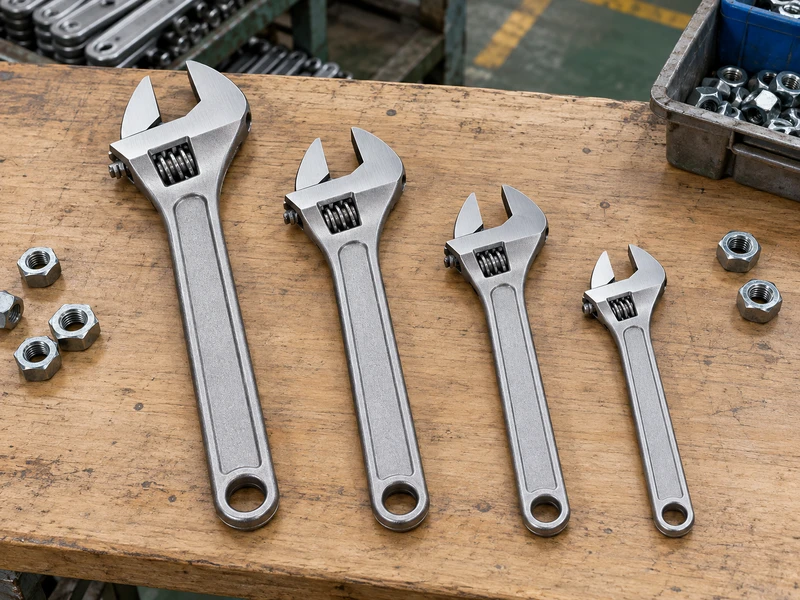
Wide-jaw variants may provide a larger opening within a familiar nominal length. That can help a buyer cover a wider fastener without adding a longer handle. The benefit belongs to a named model family; it does not create a universal rule for all adjustable wrench sizes.
- Compare the exact opening with a standard model at the same label.
- Check added head width around obstructions.
- Confirm jaw depth and contact at the wider setting.
- Keep “next-size coverage” language tied to documented model data.
A wider jaw changes the head envelope along with the opening. Request side-by-side samples on representative flats. For a separate tool-role decision, use the pipe wrench versus adjustable wrench comparison.
Wide-jaw review table
| Question | Standard model | Wide-jaw model |
|---|---|---|
| Opening | Record model value | Record model value |
| Head width | Check normal access | Check added obstruction risk |
| Length | Record nominal label | Record nominal label |
| Use claim | Fastener fit by model | Wider opening only where documented |
| Sample check | Fit across flats | Fit plus clearance |
6. How do jaw shape and surface finish affect size selection?
Smooth, parallel jaws suit flat fastener contact better than serrated gripping jaws. They can still mark plated or polished surfaces when fit is loose, force is high, or the workpiece already has damage. Surface protection depends on contact and conditions, not appearance alone.
- Record plated, painted, polished, or bare workpiece finish.
- Define an acceptable marking level for sample review.
- Check jaw parallelism and depth at the intended setting.
- Choose a fixed or protected interface where finish risk is unacceptable.
Controlled contact protects a finish better than a smooth-looking tool by itself. Test a sample against the buyer’s actual finish and keep the result with the SKU record. Do not describe any model as universally non-marring without evidence.
Finish and jaw-fit table
| Workpiece condition | Selection concern | Evidence to request |
|---|---|---|
| Plated hex fastener | Loose contact may mark corners | Close-fit sample |
| Painted fastener | Movement can scuff coating | Finish-specific sample |
| Polished flat | Serrated contact is unsuitable | Smooth-jaw fit review |
| Corroded flat | Jaw may not seat securely | Exclusion or alternate-tool note |
7. What access dimensions belong in an RFQ?
An RFQ should describe both fastener and surrounding space. Total length cannot show whether a head enters a recess or whether the handle can turn. Give suppliers a measurable fit problem instead of a generic request for “10-inch adjustable wrench sizes.”
- State width across flats and approximate fastener depth.
- Show approach direction and nearby obstructions.
- Give required opening, head clearance, and handle swing.
- Name surface finish and acceptable marking level.
Access is a dimensional problem with a workpiece attached. Send a simple sketch or application photograph and ask suppliers to mark jaw contact. The complete mechanic tools list for distributors and importers can support assortment planning, while the RFQ should remain application-specific.
RFQ access fields
| RFQ field | Buyer input | Supplier response |
|---|---|---|
| Width across flats | Measured fastener size | Confirm opening coverage |
| Approach | Straight, offset, or restricted | Confirm head entry |
| Obstruction | Wall, bracket, hose, or part | Confirm clearance |
| Swing arc | Available handle movement | Confirm usable length |
| Surface limit | Marks allowed or prohibited | Confirm contact fit |
8. How should buyers compare adjustable wrenches with fixed or torque-controlled tools?
An adjustable wrench can cover varied fastener sizes in a mixed maintenance kit. A fixed wrench provides a dedicated size fit. A torque-controlled tool performs a different job where a specified setting and procedure matter. Longer handle length does not create torque control.
- Use adjustable models for documented varied-size fastening work.
- Use fixed tools where repeatable single-size fit matters.
- Use torque-controlled tools where a tightening value is specified.
- Keep calibration and setting language with that tool family.
A broader opening range does not make an adjustable wrench a torque tool. Consult the torque wrench guide for professional buyers when assortment buyers need that distinction.
Tool-role comparison
| Tool role | Main selection field | Copy boundary |
|---|---|---|
| Adjustable wrench | Opening, depth, access | Do not imply torque control |
| Fixed wrench | Exact size and fit | Dedicated size coverage |
| Torque-controlled tool | Setting and procedure | Separate specification and evidence |
| Serrated pliers | Workpiece shape and finish | Not a smooth-jaw substitute |
9. What inspection checks should accompany a size sample?
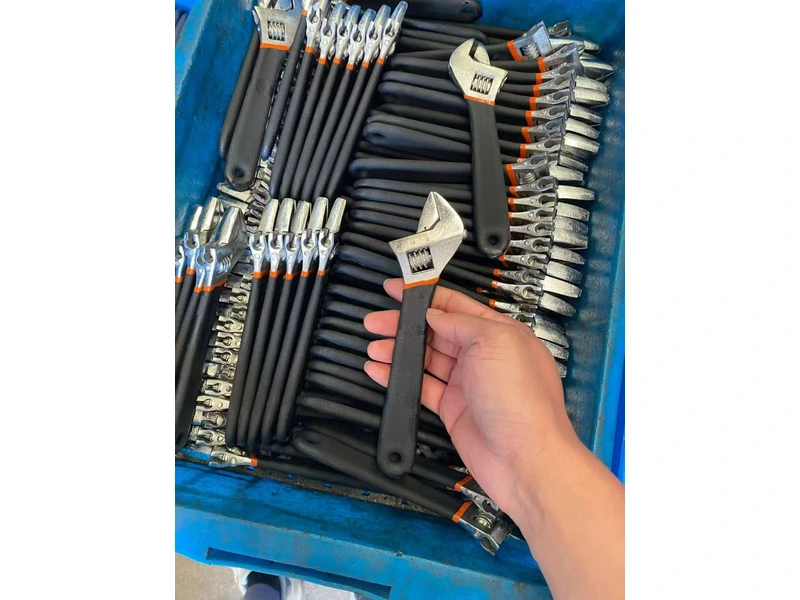
Sample approval should verify the model that will ship. Check total length, jaw opening, jaw depth, head clearance, adjustment action, jaw alignment, and finish. Record each measurement beside sample ID and drawing revision so packaging cannot drift into unsupported claims.
- Move the jaw through its usable adjustment range.
- Check knurl action for binding or excessive play.
- Inspect jaw faces for burrs, damage, and alignment.
- Fit the tool in a representative application mock-up.
A sample record turns a size claim into a purchasing decision that can be audited. Keep photographs, dimension sheets, and approved use notes together. Use the supplier about page for general company context, not as a substitute for model data.
Sample inspection table
| Check | Record | Escalate when |
|---|---|---|
| Total length | Measured model value | It differs from approved sheet |
| Jaw opening | Measured or maker-stated value | Target flats remain uncovered |
| Jaw alignment | Parallel seating | Jaw rocks or contacts unevenly |
| Adjustment | Travel and smoothness | Binding or excess play appears |
| Head access | Fit in mock-up | Head or handle cannot clear |
10. What should a distributor request before approving an adjustable-wrench range?
Build the request around applications rather than an attractive list of handle lengths. State target fasteners, access limits, surface finish, storage needs, and evidence required for each claim. Ask for named model numbers, measured dimensions, instructions, packaging fields, and sample approval criteria.
- Separate nominal length from maximum opening in every SKU row.
- Request jaw depth, head dimensions, and handle clearance.
- Tie wide-jaw wording to a named model family.
- Define fit and finish checks before approval.
A precise RFQ gives a supplier a testable fit problem. Send three representative fastener examples and request a model-specific recommendation with dimensions attached. For broader kit planning, compare the range with the household tool kit buying guide, then remove duplicate lengths or unsupported coverage before placing an order. Contact the supplier through the contact page when a drawing or application answer remains incomplete.
Q1: Does a 10-inch adjustable wrench always have the same jaw opening? No. Nominal length does not establish a universal opening; verify the named model.
Q2: Can inch length be converted directly into jaw capacity? No. Arithmetic conversion applies to nominal length only.
Q3: Are wide-jaw models better for every fastener? No. A wider head may create clearance problems, so check the model and application.
Q4: What should a buyer measure first? Measure fastener width across flats, then record depth, access, finish, and handle swing.
Q5: Can an adjustable wrench replace a torque-controlled tool? No. Adjustable opening does not provide a specified setting or calibration process.
Looking for a reliable mechanic tools manufacturer in China?
If you are sourcing hand tools, socket tools, automotive repair tools, mechanic tool sets or OEM private label tools, contact KOLARWIN Tools for factory-direct quotation, customization support and product consultation.