Need OEM supplier support for this product type?
Contact KOLARWIN Tools for OEM mechanic tools, private label packaging, wholesale quotation and product range support. This gives overseas buyers a clear path from article reading to supplier discussion.
Snap ring pliers sizes can describe tool length, tip dimensions or the ring application range. Those numbers answer different questions. Buying a “7-inch” pair without checking its tips and ring range can leave a technician with a tool that reaches the part but cannot engage it properly. This guide separates those dimensions and shows how to build a useful sizing request from manufacturer data.
1. Which dimensions define snap ring pliers sizes?
Record at least three fields: overall tool length, the maker’s tip-size specification and its application range. Add jaw angle and reach when the ring sits inside an assembly. None of these fields replaces the others. A long handle does not identify a particular tip diameter, and a tip that enters a hole does not prove the tool covers that ring’s required movement.
Keep the application label with its measurement. An internal-ring range may refer to bore diameter; an external-ring range may refer to shaft diameter. The manufacturer’s wording controls how that number should be read. The internal versus external snap ring pliers guide explains the basic operating distinction.
Write each dimension beside its name. Ask a supplier to complete separate fields instead of quoting one unspecified size.
- Tool length and unit
- Tip-size field and tip form
- Internal bore or external shaft application range
- Jaw angle and required access
Sizing vocabulary
| Field | What it describes | What it does not establish |
|---|---|---|
| Tool length | Physical tool envelope | Exact ring range |
| Tip size | Maker-labeled tip dimension | Every detail of engagement |
| Application range | Compatible ring/shaft/bore class | Free-ring outside diameter |
| Reach and angle | Access geometry | A load or force rating |
2. Does overall length determine ring capacity?
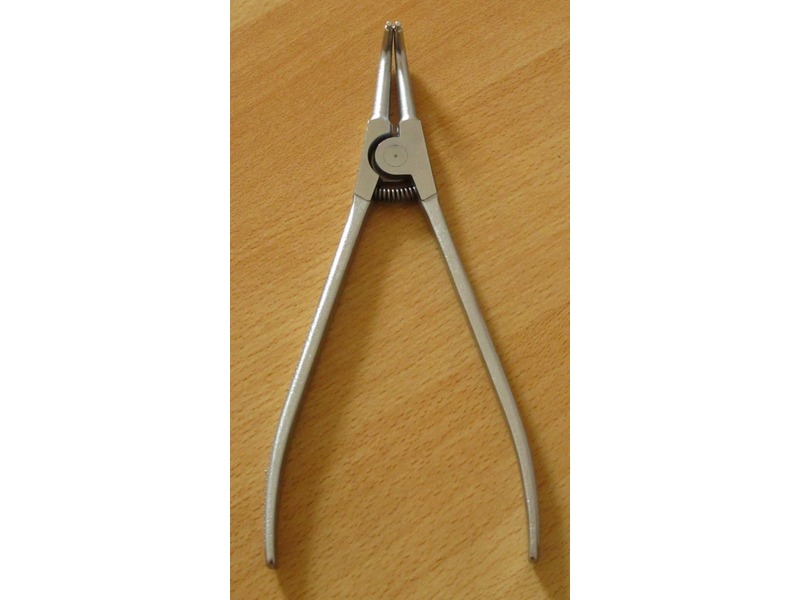
Length alone does not determine capacity. Two tools can share a nominal length while serving different ring applications. For example, the official KNIPEX pages for 46 11 A0 and 46 11 A1 both list 5½-inch length. Their external-shaft ranges differ, as shown below.
Use these as named examples, not a conversion chart for another brand. A catalog may change jaw proportions, joint geometry or tip construction within one handle-length class. Compare the complete product row and keep its model number with any numbers copied into a purchasing sheet.
Match the model, not just the length. Approve a specific tool against the ring and access requirements before ordering a larger quantity.
- Keep model identifiers in size tables.
- Compare application range separately.
- Treat similar-looking tools as different until checked.
Same-length manufacturer examples
| KNIPEX model | Published length | Published external-shaft range |
|---|---|---|
| 46 11 A0 | 5½ in | 1/8–25/64 in |
| 46 11 A1 | 5½ in | 25/64–1 in |
3. How should tip diameter or tip width be read?
Preserve the manufacturer’s field name. Some pages state tip diameter, while others label a dimension as tip width. Do not silently rename either field or assume that a nearby nominal value means interchangeable tips. The engaged portion, taper and angle can also affect contact with a ring’s holes.
For a practical example, TEKTON’s PRR90100 set lists four tip sizes across three tool lengths. The maker offers internal/external and straight/90-degree versions within that assortment. These entries describe that set, not a universal relationship between handle length and tip size.
Copy the label with the number. Request a tip drawing or sample when hole engagement controls the choice.
- Preserve inch or metric units.
- Record tip form and angle.
- Confirm fit against the specified ring.
TEKTON set examples
| Listed tip size | Tool length in this set | Scope |
|---|---|---|
| 0.037 in | 5 in | PRR90100 component family |
| 0.047 in | 5 in | PRR90100 component family |
| 0.070 in | 7 in | PRR90100 component family |
| 0.090 in | 9 in | PRR90100 component family |
4. Which ring dimension belongs in the quotation?
Use the ring specification and assembly drawing. A loose ring’s outside diameter is not automatically its nominal application size. Record whether the requested tool serves an internal ring in a bore or an external ring on a shaft. Then provide the ring reference and the corresponding dimension used by the tool manufacturer.
For inspection planning, the digital versus dial caliper comparison covers common dimensional tools. Measuring equipment must suit the feature and required tolerance. A photograph, estimated ruler reading or nominal part name should not substitute for a controlled drawing when fit is critical.
Start with the assembly record. Give the supplier the ring part number and relevant shaft or bore information before asking for a size recommendation.
- Identify internal or external application.
- Provide the ring drawing or part number.
- Retain the maker’s range definition.
Application data sheet
| Assembly feature | Useful record | Avoid |
|---|---|---|
| Internal ring | Ring reference and bore specification | Treating loose-ring OD as bore size |
| External ring | Ring reference and shaft specification | Choosing from handle length alone |
| Engagement holes | Drawing and tip-fit requirement | Guessing fit from photographs |
| Groove location | Access depth and nearby obstructions | Ignoring the surrounding assembly |
5. How do straight and angled jaws affect sizing?
Jaw angle changes the approach path. Straight tips may enter directly, while angled versions can approach a ring behind a shoulder or inside a confined assembly. That choice also affects clearance for the tool body and handle movement. Selecting an angle without checking the full motion envelope can create a tool that reaches the ring but cannot complete its travel.
Compare a dimensioned side view with the actual assembly. Record the required reach, obstruction locations and available hand space. Do not infer reach from overall length. The specialty pliers buying guide provides broader context for specifying an application-specific geometry.
Check the whole movement. Sample review should include access and controlled travel, not just whether tips enter the holes.
- Record the approach angle.
- Check tool-body and handle clearance.
- Use the selected model’s reach dimensions.
Access comparison
| Feature | Question for review | Evidence |
|---|---|---|
| Jaw angle | Can tips approach the ring? | Drawing or assembly sample |
| Reach | Can the working tips reach the groove? | Model dimension |
| Body clearance | Does the joint clear nearby features? | Side-view comparison |
| Handle travel | Is controlled operation possible? | Approved sample review |
6. Can interchangeable tips cover every ring size?
A replaceable-tip system needs a verified compatibility list. Tip shank, attachment method, working geometry and permitted application range must match the tool body. A box containing many tips does not prove that every combination is approved. Fixed-tip tools also differ: some have integral tips while others use separate tips that are permanently retained.
Keep spare tips tied to their exact tool model. Record any fasteners, orientation and service instructions required for replacement. The broader pliers types guide helps distinguish tool mechanisms, but a replacement decision needs the selected product’s documentation.
Treat the tip and body as a system. Ask the supplier to identify approved combinations and replacement references in writing.
- Separate fixed and serviceable designs.
- Request exact replacement part numbers.
- Confirm application limits after a tip change.
Tip-system review
| Design | Buyer needs | Unsupported shortcut |
|---|---|---|
| Integral tip | Complete tool specification | Assuming a replaceable insert exists |
| Permanently retained tip | Manufacturer service policy | Pulling or modifying the tip |
| Replaceable tip | Approved parts and instructions | Fitting any similar diameter |
| Multi-tip kit | Compatibility schedule | Treating piece count as full coverage |
7. How should a size range be planned for a service kit?
Build a matrix from recurring ring applications. List internal and external tasks separately, then identify tip sizes, angles and access requirements. This shows whether a proposed set leaves a real gap or merely adds another tool with a similar description. Size labels on a storage roll should match the actual included tools.
The industrial maintenance tools guide helps place the range in a broader service kit. Keep general gripping tools in separate slots. For example, needle-nose pliers uses belong to a different task list; a pointed appearance does not establish retaining-ring suitability.
Plan coverage from the jobs. Ask technicians which rings and access problems recur before deciding the set count.
- Map recurring ring references.
- Separate direction, tip size and angle.
- Include individual replenishment requirements.
Coverage matrix
| Task group | Required fields | Kit decision |
|---|---|---|
| External rings | Shaft range, tip and access | Dedicated listed tools |
| Internal rings | Bore range, tip and access | Separate coverage check |
| Confined positions | Angle and reach | Confirm clearance by sample |
| Frequent replacement | Tool or approved spare-tip SKU | Maintain reorder references |
8. What should be checked before sample approval?
Inspect tip condition, joint action, markings and handle condition. Follow the maker’s instructions for any service or adjustment. Bent, damaged or poorly engaging tips require assessment rather than extra force. Retaining rings can release stored spring energy, so use approved eye protection and the specified installation or removal procedure.
An acceptance check should use the actual ring specification or an agreed representative sample. Confirm that tips engage as intended and that the tool remains controllable through the permitted movement. Do not set an arbitrary over-expansion test. Record the ring, tool model, reviewer and inspection result so a later order can be compared with the same reference.
Approve fit with a traceable sample. Preserve the drawing revision and selected tool identification alongside the record.
- Inspect tips and joint condition.
- Follow the ring and tool instructions.
- Document fit without inventing a load test.
Sample review record
| Check | Record | If uncertain |
|---|---|---|
| Tip engagement | Ring reference and tool model | Request supplier confirmation |
| Movement | Approved range and method | Stop the assessment |
| Access | Assembly or fixture used | Obtain a better reference |
| Condition | Tip, joint and handle inspection | Remove the suspect sample |
9. How should sizes appear on packaging and catalogs?
Use separate fields for length, tip specification, application range and jaw angle. Keep the internal/external description beside the range instead of hiding it in a footnote. A customer should be able to distinguish two similar tools from the item list without estimating dimensions from a product image.
For larger assortments, the mechanic tool set guide for distributors provides set-planning context. Ask for a packed sample with labels and tool positions visible. Confirm that a replacement SKU can be identified after a tool has been removed from its original packaging.
Approve the item list before artwork. Packaging should reproduce the agreed specification rather than introduce a new size shorthand.
- Keep measurement units visible.
- State application range and direction together.
- Identify each component in a set.
Catalog field order
| Field | Example format | Purpose |
|---|---|---|
| Function | Internal or external | Prevents direction confusion |
| Tip | Exact maker dimension and unit | Supports engagement selection |
| Range | Maker-labeled bore/shaft range | Defines application coverage |
| Geometry | Length, jaw angle and reach | Supports access review |
| Identity | Model and replacement reference | Supports replenishment |
10. What should a snap-ring-pliers RFQ include?
Send the ring reference, internal or external application, relevant bore or shaft dimensions, tip requirements and access drawing. State the preferred fixed or replaceable-tip design only when the application or maintenance plan calls for it. For sets, attach the coverage matrix rather than requesting a vague “complete range.”
Make fit the basis of the enquiry. Ask which model meets the stated requirements and what documents or samples can support that choice. Confirm quantities, packaging, availability and commercial terms through the quotation process.
- Ring and assembly references
- Tip dimensions, geometry and application range
- Required reach and operating clearance
- Documentation, inspection and packing requirements
Send the specification through KOLARWIN’s contact page. Keep the agreed model data and approved sample with the purchase record so repeat orders use the same fit criteria.
Q1: Is a 7-inch snap ring plier suitable for every medium-size ring?
No. Tool length, tip specification and application range are separate fields. Match the exact model with the ring and assembly.
Q2: Should I measure the loose ring’s outside diameter?
Use the ring specification and the tool maker’s range definition. Internal ranges can refer to bore size and external ranges to shaft size.
Q3: Are two equal tip-size numbers enough to prove compatibility?
No. Check the stated dimension, tip shape, engagement and approved ring range as a system.
Q4: Do angled tips change the ring size?
They change access geometry. Confirm the angled model’s own application range instead of borrowing another model’s data.
Q5: What helps a supplier recommend the right pliers?
Provide the ring part number, bore or shaft specification, required tip fit, access drawing and intended operating procedure.
Looking for a reliable mechanic tools manufacturer in China?
If you are sourcing hand tools, socket tools, automotive repair tools, mechanic tool sets or OEM private label tools, contact KOLARWIN Tools for factory-direct quotation, customization support and product consultation.