Need OEM supplier support for this product type?
Contact KOLARWIN Tools for OEM mechanic tools, private label packaging, wholesale quotation and product range support. This gives overseas buyers a clear path from article reading to supplier discussion.
Choosing plier jaws affects both grip and surface damage. This guide compares smooth and serrated faces by workpiece, finish, contact geometry, and buyer evaluation criteria.
1. What do smooth and serrated jaws mean?
Smooth jaws present an un-toothed gripping face; serrated jaws have formed ridges intended to engage a workpiece. Jaw surfaces can also use cross-hatching or other patterns. Selection depends on material and task, as KNIPEX explains in its jaw-design reference. Smooth jaws often suit finished or softer surfaces where tooth marks are undesirable, provided the user can maintain control without excessive squeeze. Serrations can improve purchase on suitable parts, though they can leave marks. Neither surface guarantees a slip-free grip. Buyers should identify materials and finish requirements before choosing pliers. Use the pliers category guide to name the base tool before adding its jaw texture to a specification.
Start with the finish the customer must preserve.
- Record whether tooth impressions are acceptable on the actual component.
- Inspect the sample jaw faces closely enough to distinguish smooth, grooved and cross-hatched surfaces.
| Jaw face | Typical selection reason | Check before approval |
|---|---|---|
| Smooth metal | Avoid tooth impressions | Pressure marks on sample |
| Straight serrations | Engage suitable stock | Tooth orientation and wear |
| Cross-hatched | Textured contact in multiple directions | Marking on actual finish |
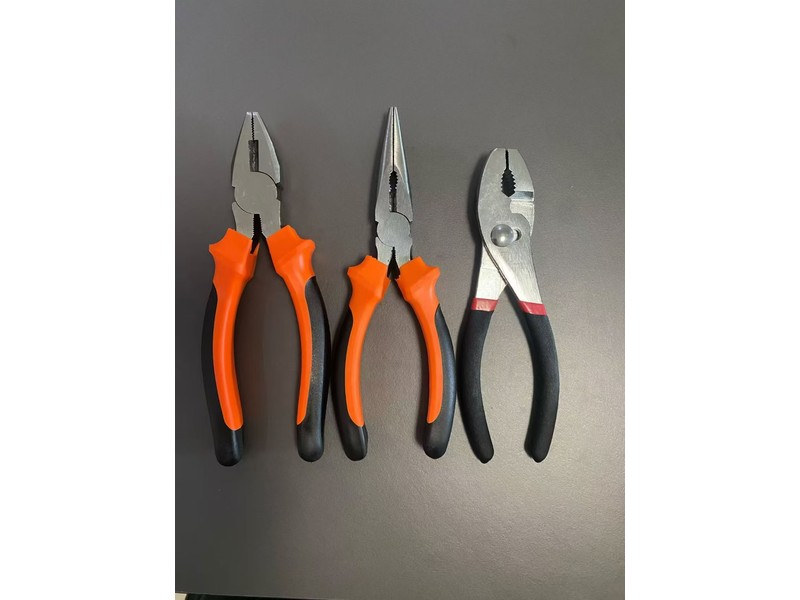
2. How do the contact surfaces grip a part?
Grip comes from jaw geometry, contact area, force, friction, and how the tool aligns with a part. Serrations create edges that can catch or bite into certain surfaces; smooth faces depend more on friction and fit. Actual behavior changes with oil, scale, coatings, jaw wear, and operator force. Plier joint design also affects force transmission, while jaw length and shape set reach. Avoid reducing selection to a simplistic “serrated grips more” rule; a poor fit can slip or damage a part regardless of texture. The difference between pliers wrenches and water-pump pliers illustrates why motion and jaw geometry belong beside texture in the buying brief.
Fit changes grip before texture does.
- Seat the workpiece across the intended gripping area rather than at an unsupported corner.
- Repeat the holding trial under the surface conditions customers actually encounter.
| Contact condition | Likely concern | Evaluation focus |
|---|---|---|
| Broad flat seating | Pressure distribution | Even contact |
| Corner-only seating | Local deformation | Jaw profile mismatch |
| Oil or residue | Changed friction | Controlled service-condition trial |
3. When are smooth jaws the better choice?
Smooth jaw pliers can suit polished fittings, plated hardware, soft metals, plastics, and decorative surfaces where tooth marks carry a cost. They can also help during delicate assembly when users need to hold a component without cutting into its finish. Correct jaw width and parallel contact remain important. A narrow smooth jaw can concentrate pressure and dent a soft part, while an undersized tool may encourage excessive force. Protective jaw covers may help in some applications, if compatible with the task and manufacturer instructions. Buyers should test on representative material and record acceptable marks. For finish-sensitive applications outside standard gripping tools, use the specialty pliers guide to narrow the tool family.
Prove the finish on a sacrificial sample.
- Use a part with the same coating and wall thickness as production material.
- Inspect under consistent lighting after release, including areas hidden while clamped.
| Workpiece | Smooth-jaw concern | Acceptance evidence |
|---|---|---|
| Plated fitting | Scratches or impressions | Before-and-after photographs |
| Soft flat stock | Local denting | Surface and dimensional check |
| Thin hollow part | Flattening | Post-grip shape inspection |
4. When do serrated jaws make sense?
Serrated jaws can be useful for holding rough, unfinished, or robust components where surface marking is acceptable. Tooth pattern, depth, spacing, and jaw profile affect engagement; one pattern does not suit every workpiece. Serrations can also trap debris and wear with use, so inspection and cleaning matter. Do not use ordinary gripping pliers on precision sealing surfaces, finished fasteners, or thin tubing unless the tool maker and application procedure allow it. For buyers, the product brief should state which materials may contact the teeth and whether cosmetic damage is acceptable. When customers intend to turn robust pipe, review pipe wrench use rather than assuming any serrated plier will serve.
Decide where tooth marks are acceptable.
- Identify the permitted gripping zone on a component drawing or photograph.
- Keep teeth away from sealing lands and finished bearing surfaces.
| Surface zone | Serrated-jaw decision | Reason |
|---|---|---|
| Unfinished gripping allowance | Evaluate on sample | Marks may be acceptable |
| Precision sealing land | Use specified dedicated method | Marks can affect function |
| Thin tubing wall | Check dedicated tool requirement | Concentrated contact can deform it |
5. How does jaw shape change the decision?
Surface texture is only one part of jaw selection. Flat jaws distribute contact across a broader face; long-nose jaws reach recessed areas but provide a smaller contact zone near their tips. Round jaws suit different contours, while adjustable designs accommodate varied sizes. KNIPEX notes jaw shape depends on access and whether the task involves gripping, holding, or bending. Buyers should therefore specify both texture and profile. Check opening range, jaw length, alignment, and clearance around the component. Compare bent-nose and straight-nose designs when access dictates jaw shape before texture.
Specify the outline as carefully as the face.
- Check nose width against the smallest access gap at the work site.
- Compare jaw contact at the intended opening rather than judging closed jaws alone.
| Jaw outline | Access advantage | Contact tradeoff |
|---|---|---|
| Broad flat | Open flat work | Needs lateral clearance |
| Long nose | Recessed work | Small tip contact area |
| Curved gripping profile | Compatible round stock | Poor fit on some flats |
6. Can jaw texture damage a workpiece?
Yes. Serrations may mark a finish, cut into a soft surface, or distort thin material when force concentrates at tooth peaks. Smooth jaws can also leave pressure marks or flatten a hollow section if users squeeze too hard. Slippage can create scratches when a tool shifts under load. The risk depends on workpiece hardness, coating, shape, grip force, and tool condition. Use purpose-designed tools for precision parts and follow component instructions. A sample inspection should include visible marks and functional checks after gripping. If a task combines force and finish sensitivity, ask for a dedicated tool recommendation rather than relying on jaw texture alone.
A clean surface can still show a pressure dent.
- Inspect for permanent deformation as well as visible scratches after a trial.
- Stop a slipping grip and reset the contact instead of compensating with more hand force.
| Damage pattern | Investigate | Inspection method |
|---|---|---|
| Tooth impressions | Texture compatibility | Close visual check |
| Broad dent | Pressure and wall thickness | Shape or dimension comparison |
| Drag scratch | Slip or trapped debris | Inspect both jaw and workpiece |
7. What maintenance keeps both jaw types usable?
Keep gripping faces clean and inspect them regularly. Smooth jaws should remain flat and aligned; dents or burrs can concentrate pressure. Serrated jaws should retain a consistent tooth profile and remain free of packed debris. Check pivot movement, looseness, corrosion, and handle damage. Do not grind or file jaws without the manufacturer’s approval because geometry and hardness may change. Remove damaged tools from service. For distributors, incoming inspection should cover jaw alignment, finish, and obvious defects, while field feedback can flag premature wear. Check gripping and cutting zones separately on multipurpose tools; our combination plier guide explains those distinct functions.
Inspect the contact faces before blaming the finish.
- Remove packed debris using the maker's approved cleaning method.
- Quarantine jaws with burrs, damaged teeth or visible misalignment instead of reshaping them casually.
| Tool condition | Effect on contact | Maintenance decision |
|---|---|---|
| Burr on smooth face | Concentrated scratching | Remove from use pending assessment |
| Packed serrations | Unpredictable engagement | Clean as instructed |
| Loose pivot | Changing jaw alignment | Inspect before further service |
8. How should buyers compare plier samples?
Use a repeatable evaluation with representative materials and realistic access. Record whether jaws seat fully, whether the tool slips, what marks appear, and how much hand force the task requires. Compare samples at the same opening and with the same operator where practical. Include clean and lightly contaminated surfaces only if those reflect actual service conditions. Do not improvise destructive load tests or infer a rating from a brief trial. Ask suppliers for technical documents that support material and process claims.
Compare the same task with both samples.
- Mark a consistent grip location and use matching workpieces for each jaw type.
- Record slippage and damage separately so a firm grip cannot hide an unacceptable finish.
| Trial record | What to capture | Why it separates samples |
|---|---|---|
| Fit | Contact location and opening | Exposes geometry differences |
| Holding | Movement during intended task | Reveals control |
| Finish | Marks after release | Reveals component damage |
9. How should product listings describe jaw texture?
Use plain, application-specific wording: “smooth gripping faces for reduced marking risk on suitable finished components” or “serrated gripping faces for engagement with compatible robust surfaces.” Avoid absolute promises such as “no damage” or “never slips.” Include jaw profile, dimensions, opening range, and intended use when confirmed by product data. Images should show the jaw surfaces at enough scale for customers to distinguish texture. Explain that technique and workpiece condition affect results. Keep texture descriptions consistent across the mechanic tool assortment so customers can distinguish similar-looking SKUs.
Show customers the gripping face clearly.
- Photograph the actual jaw texture rather than relying on a generic plier silhouette.
- Remove absolute non-marring or no-slip claims unless evidence supports the stated conditions.
| Listing field | Useful content | Avoid |
|---|---|---|
| Jaw face | Smooth or specified serration | Unclear premium-grip wording |
| Dimensions | Jaw width and opening | Tool length alone |
| Application | Named compatible surfaces | Universal damage-free claim |
10. Which jaw type should a B2B buyer choose?
Start with the workpiece, finish, access, and consequence of marking. Smooth jaws generally fit situations where surface care ranks highly; serrated jaws can fit suitable parts where stronger mechanical engagement is needed and marks are acceptable. Then verify jaw shape, opening, alignment, and tool size. If buyers serve multiple sectors, stocking both types may make sense, but each SKU needs a defined task and clear product copy. Ask for sample tools and documented specifications before approving a range. Send workpiece material, finish and contact dimensions through our sourcing contact for an application-based discussion.
Choose each SKU for a defined workpiece.
- Separate finish-sensitive assembly demand from rough-stock gripping demand in the buying brief.
- Approve jaw geometry and surface acceptance together before placing repeat orders.
Q1: Do smooth jaws prevent all marks? No. Pressure can still dent soft material, and debris can scratch a finish.
Q2: When are serrated jaws useful? They can engage compatible rough or robust workpieces where tooth impressions are acceptable.
Q3: Can jaw texture alone determine grip? No. Fit, force, surface condition, jaw geometry, and alignment also affect holding.
Q4: How can a buyer compare samples? Use representative workpieces and inspect for slip, marking, jaw alignment, and pressure needed.
Q5: Should pliers grip precision sealing surfaces? Only when the tool and procedure are intended for that surface; otherwise use a suitable dedicated tool.
Looking for a reliable mechanic tools manufacturer in China?
If you are sourcing hand tools, socket tools, automotive repair tools, mechanic tool sets or OEM private label tools, contact KOLARWIN Tools for factory-direct quotation, customization support and product consultation.