
Need OEM supplier support for this product type?
Contact KOLARWIN Tools for OEM mechanic tools, private label packaging, wholesale quotation and product range support. This gives overseas buyers a clear path from article reading to supplier discussion.
A pin that moves under impact can bend, flare, or stay wedged if its punch does not match its construction. For maintenance teams and tool buyers, the practical distinction is tip contact: a flat pin punch bears on a solid pin face, while a roll pin punch has a small pilot that supports a hollow spring pin around its opening. The choice still depends on pin dimensions, access, and equipment instructions. Starrett and Mayhew both caution against using a standard pin punch on roll or spring pins. Use the checks below to specify the right tool for a general industrial application.
1. What is the difference between a pin punch and a roll pin punch?
A conventional pin punch has a flat working end. It transfers a blow across a pin face, making it suitable for many solid pins once they have started moving. That differs from a center punch, which marks a drilling location; see center punch vs prick punch for the distinction between marking tools. A roll pin punch has a small raised pilot centered on its working end. That pilot enters the hollow center while the surrounding face bears on the pin’s rim.
This difference follows pin construction. A solid dowel can accept contact across its end. A hollow spring pin has a thin wall around an opening, so a flat punch may distort its edge or slip into its bore. Starrett describes this risk and advises selecting a roll pin punch no larger than the pin’s compressed diameter. Mayhew likewise says regular pin punches should not be used on roll or spring pins.
- Flat end: generally for compatible solid pins.
- Raised pilot: designed to support compatible hollow pin ends.
- Neither style substitutes for the machine maker’s specified tool or procedure.
Start with the pin cross-section. Check the drawing or service manual, then confirm the tip against the actual pin family before striking.
Quick distinction
| Feature | Flat pin punch | Roll pin punch |
|---|---|---|
| End geometry | Flat face | Center pilot with supporting shoulder |
| Typical fit | Solid pins, subject to application | Compatible hollow spring or roll pins |
| Main concern | Slipping off or marking nearby surfaces | Pilot mismatch or oversized punch |
2. What kinds of pins suit each punch?
Pin names alone do not settle punch choice. A solid dowel pin and a coiled spring pin have different cross-sections, even when their outside diameters appear similar. Slotted spring pins and coiled pins also differ in wall shape and resilience. Follow the pin manufacturer’s nomenclature or equipment drawing where available.
For solid pins, a flat pin punch often suits removal after the pin has been released or moved enough for the punch to stay centered. For hollow spring pins, choose a roll pin punch or a dedicated driver whose pilot and face fit the pin. Some assemblies use proprietary or tightly controlled pin systems; their service instructions take precedence.
- Identify solid, slotted, coiled, or other hollow construction.
- Confirm whether the task inserts, removes, or starts a pin.
- Check whether the pin is reusable and whether replacement is required.
A label can hide a geometry mismatch. Do not assume every “spring pin punch” has a pilot that fits every spring pin. Confirm the tip dimensions against the pin specification.
Pin construction and starting choice
| Pin construction | Common contact concern | Initial tool direction |
|---|---|---|
| Solid dowel | Centered face contact | Flat pin punch, if specified |
| Slotted spring pin | Thin wall and slot | Compatible roll/spring-pin punch |
| Coiled spring pin | Curved layers and hollow center | Confirm dedicated punch geometry |
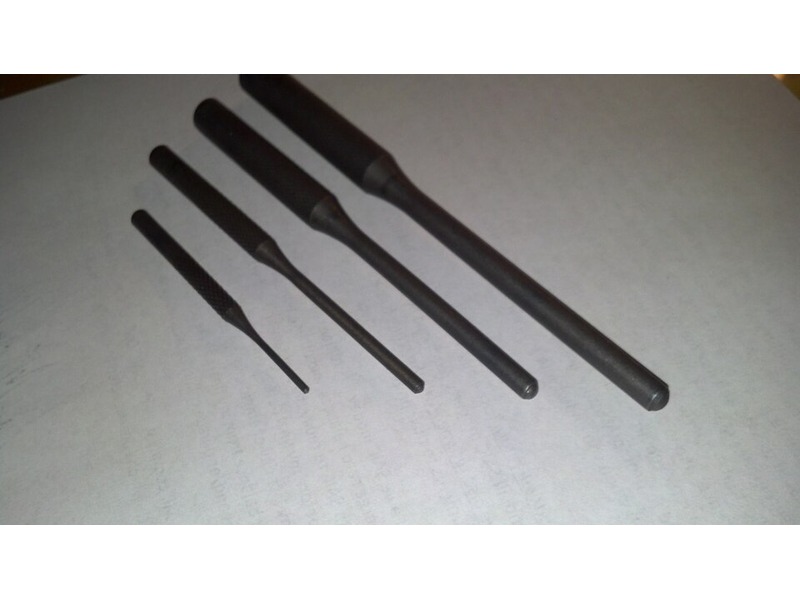
3. How does a roll pin punch support a hollow pin?
A roll pin punch’s raised center pilot locates in the pin opening. Its surrounding face supports the outer rim, distributing the blow more appropriately than a plain flat face that can slip into the hollow center. Starrett identifies this pilot as the feature that supports a roll pin’s circumference. Mayhew describes a rounded end intended to fit within roll pins and other hollow tension pins.
That geometry does not make sizing optional. A pilot that is too large may not enter the opening; a face that is too wide can contact surrounding material or fail to seat squarely. Pin construction and manufacturer guidance still govern fit. Never infer universal compatibility from the name “roll pin punch.”
- Inspect pilot diameter and shoulder condition.
- Compare punch size with the pin drawing or maker’s chart.
- Stop if the pilot binds, rocks, or contacts the assembly around the pin.
Fit is a measured question. Confirm both the pin’s outside dimension and the punch’s working-end geometry before production use.
Tip feature and fit check
| Check | What to compare | Stop condition |
|---|---|---|
| Pilot | Pin opening and specified punch tip | Pilot binds or cannot locate |
| Face | Pin rim and surrounding clearance | Face contacts housing or fixture |
| Overall size | Pin dimension under specified condition | Punch exceeds maker’s limit |
4. When should a flat pin punch be used?
A flat pin punch is commonly used on compatible solid pins, especially after initial movement has freed the pin. If the task calls for cutting or chipping material instead of driving a pin, compare cold chisels and wood chisels for that separate operation. Its full face can transfer force evenly when punch and pin diameters match and the punch stays square. It also works for other pin designs only when their manufacturer or equipment procedure approves a flat face.
The risk grows when a hollow spring pin is mistaken for a solid pin. A flat end may deform a thin edge, slip into the center, or load a small area. The result can be a damaged pin, a marked bore, or a punch wedged in the pin. For removal, start by confirming load direction, retainers, and any interference fit specified by the assembly designer. Do not increase impact blindly when a pin does not move.
- Select a face that bears squarely on the pin end.
- Keep the punch aligned with the pin axis.
- Protect adjacent machined or finished surfaces with approved fixtures.
Use the flat punch where its face belongs. For a solid pin, verify diameter and alignment; for a hollow pin, confirm a dedicated compatible driver.
Operation and punch selection
| Operation condition | Suitable direction | Buyer or operator check |
|---|---|---|
| Solid pin, already moving | Flat pin punch if approved | End face and bore alignment |
| Hollow spring pin | Pilot-style punch if compatible | Pilot, pin family, clearance |
| Pin will not move | Stop and diagnose retention | Manual, fixture, corrosion, load |
5. Do you need a starter punch or pin holder?
A starter punch has a shorter working length or a design intended to begin pin movement while maintaining control. A pin holder or retaining feature can help locate a loose pin during initial assembly, particularly where fingers cannot safely hold it near an impact point. Choose a hammer suited to the operation; the hammer types guide covers adjacent impact tools. These tools address handling and starting; they do not change the required contact geometry for the pin.
In an industrial assembly, the right sequence may use a starter punch followed by a longer punch once the pin has moved. Some equipment instead specifies a fixture, press, or dedicated installation tool. Secure the work with a suitable fixture or clamp when the procedure calls for it; review clamp types for workholding context. Keep the sequence tied to the service manual and risk assessment. A starter with a flat tip is not automatically safe for a hollow spring pin. Verify the nose design and pin fit before use.
- Starter punch: controls the beginning of travel.
- Pin holder: supports placement or retention during initial engagement.
- Long punch: reaches farther after alignment, if procedure permits.
Choose by the stage of work. Specify whether operators need starting control, reach, retention, or a particular pin-supporting tip.
Tool role comparison
| Tool | Primary role | Confirm before purchase |
|---|---|---|
| Starter punch | Begin pin movement | Tip profile and pin compatibility |
| Pin holder | Hold or locate pin | Retention method and access |
| Long pin/roll pin punch | Continue travel at reach | Length, stiffness, tip and alignment |
6. How should punch size be matched to pin size?
Use the pin drawing or equipment manual as the reference. Measure the pin only where measurement is appropriate, since spring pins can compress and their condition can affect readings. Compare nominal pin diameter, opening or slot geometry, punch face, and pilot dimensions. Starrett advises keeping a roll pin punch no larger than a pin’s compressed diameter; the exact selection still depends on the pin specification and punch design.
Buyers should not convert a nominal pin size into a punch size by assumption. Manufacturers may list tip size, body diameter, or both, and those dimensions serve different purposes. A long punch with a body that clears the opening may still have a tip that does not fit correctly. Where sizes use metric and inch systems, request the drawing and tolerance basis to prevent near-size substitutions.
- Record pin type and nominal dimensions.
- Request working-tip dimensions, not only handle or body size.
- Confirm units, tolerance, and any compressed-diameter reference.
Compare like dimensions. Send the pin drawing to the tool supplier and ask for a written match to its proposed tip.
Dimensions to confirm
| Dimension | Why it matters | Source to consult |
|---|---|---|
| Pin nominal outside diameter | Identifies size family | Pin drawing or catalog |
| Hollow opening / slot | Pilot entry and support | Pin maker data, sample |
| Punch tip and pilot | Contact and clearance | Punch drawing |
7. Which material and finish details matter?
Punch material and finish should suit the force, duty cycle, and workpiece. Hardened steel punches are common for impact service, while softer materials such as brass may be selected where reduced marring or sparking concerns matter. These choices require application approval; a non-marring claim does not mean a tool can contact every hardened component without risk. Mayhew’s brass pilot punch listing, for example, describes its own product and intended use. That product detail should not be generalized to all brass punches.
Ask about heat treatment, tip hardness, corrosion protection, and replacement criteria when those features affect the job. Avoid selecting by color or surface appearance alone. A plated finish does not establish impact rating, while a dark finish does not identify alloy or hardness. For repetitive work, confirm inspection intervals and discard criteria in the site’s tool-control procedure.
- Match material to workpiece hardness and surface sensitivity.
- Confirm manufacturer guidance for impact duty.
- Set inspection and replacement rules for damaged tips.
Treat finish as identification, not proof. Request documented specifications where material, hardness, or coating affects the process.
Selection questions
| Requirement | Ask the supplier | Evidence to review |
|---|---|---|
| Impact service | Is this punch designed for the specified use? | Product data or drawing |
| Surface protection | What workpiece limits apply? | Material-specific guidance |
| Corrosion control | What finish and care are specified? | Finish description |
8. What changes in confined or production access?
Restricted access changes length, handle clearance, sightline, and alignment. A longer punch can reach past an obstruction but may flex more under side loading; a short starter can offer better control but may not clear a fixture. Confirm the operator can keep the punch on-axis and avoid striking adjacent parts.
For production, repeatability may require a guided fixture, press, or purpose-built installation tool. If a manual punch is approved, identify a safe hammering position and a way to retain the pin. The exact method belongs to the machine builder or plant procedure. Inspection should catch bent shafts, chipped or mushroomed heads, and damaged tips before tools return to service.
- Map the access path and available swing clearance.
- Check whether a fixture or guided tool is specified.
- Review repeatability and inspection needs for recurring operations.
Access can dictate the tool family. Provide a photo or drawing of the assembly and clearance envelope during sourcing.
Access constraints
| Constraint | Selection impact | Useful input |
|---|---|---|
| Limited swing | Handle and impact access | Clearance drawing |
| Deep bore or recess | Working length and guidance | Depth and alignment axis |
| Repeated cycle | Fixture and inspection plan | Process frequency, approved method |
9. How can buyers inspect punches and specify replacements?
Inspect working tips for rounding, chipping, deformation, and fit-related wear. Check shafts for bends and striking ends for mushrooming or cracks. Remove damaged impact tools from service under the site’s tool-control rules. A worn pilot can stop locating a hollow pin; a mushroomed striking end can shed material. Keep punches identified by size and type so flat pin punches do not get mixed with roll pin punches.
For an RFQ, provide the pin family, drawing, dimensions, material, application, insertion or removal direction, access limits, and relevant equipment instructions. Buyers can place replacements within an industrial maintenance tool plan and mechanic tool assortment. Ask suppliers to state tip size, pilot shape, overall length, body size, material, finish, and packaging. If the pin type remains uncertain, send a sample or clear section drawing for review. Do not accept a generic assortment as proof that every pin will fit.
- Check tip, shaft, and striking end before each use.
- Label and store punch types separately.
- Tie replacement part numbers to drawings and approved procedures.
Make the RFQ reproducible. Ask for a dimensioned drawing and sample approval tied to the exact pin specification.
Inspection and RFQ checklist
| Item | Record or inspect | Acceptance basis |
|---|---|---|
| Punch condition | Tip, shaft, striking end | Plant tool-control rule |
| Pin interface | Type, dimensions, sample | Pin drawing or maker data |
| Purchase spec | Tip, length, body, material | Approved drawing and sample |
10. What should a buyer decide before ordering?
A reliable selection starts with pin construction, then moves through operation, dimensions, access, and tool requirements. Confirm whether a pin is solid or hollow, identify its specific spring-pin design, and determine whether the job inserts, starts, or removes it. Then compare the punch’s working end with the pin and assembly drawing. If any detail remains uncertain, stop at the sourcing stage and request a technical match review.
Browse hand tools for broader category context. Send pin drawings, application details, and sourcing questions through Contact Us.
- Confirm the pin family and manufacturer instructions.
- Specify tip and body dimensions separately.
- Approve samples against the drawing before rollout.
Make the drawing the decision record. Send the pin specification, operation, and access constraints with your inquiry, then approve a matching punch before ordering.
FAQs
Q1: Can a standard pin punch be used on a roll pin?
Avoid that substitution unless the pin maker or equipment procedure explicitly approves it. A flat punch can deform a hollow pin or slip into its opening.
Q2: Is a roll pin punch the same as a spring pin punch?
Names vary by supplier. Confirm whether the tool has a pilot and whether its dimensions match the particular spring pin.
Q3: Do all roll pin punches fit every coiled or slotted spring pin?
No. Compare the pin construction, opening, compressed diameter where relevant, and punch tip dimensions with manufacturer data.
Q4: Should I use a starter punch before a roll pin punch?
Use a starter only when its tip suits the pin and the service procedure allows that sequence. Some assemblies require a fixture or dedicated driver.
Q5: What information should I send when sourcing punches?
Send the pin drawing or sample details, dimensions, operation, material, access limits, units, and any machine instructions. Request a dimensioned punch drawing for approval.
Looking for a reliable mechanic tools manufacturer in China?
If you are sourcing hand tools, socket tools, automotive repair tools, mechanic tool sets or OEM private label tools, contact KOLARWIN Tools for factory-direct quotation, customization support and product consultation.



