
Need OEM supplier support for this product type?
Contact KOLARWIN Tools for OEM mechanic tools, private label packaging, wholesale quotation and product range support. This gives overseas buyers a clear path from article reading to supplier discussion.
Selecting between a 2-jaw and 3-jaw bearing puller looks easy until access, alignment, and load distribution conflict. A compact two-arm tool may reach a crowded component, while a three-arm design can hold a round part more evenly. This guide helps distributors, importers, workshop suppliers, and private-label buyers define a practical assortment without treating jaw count as a quality grade.
1. What Is the Basic Difference Between 2-Jaw and 3-Jaw Pullers?
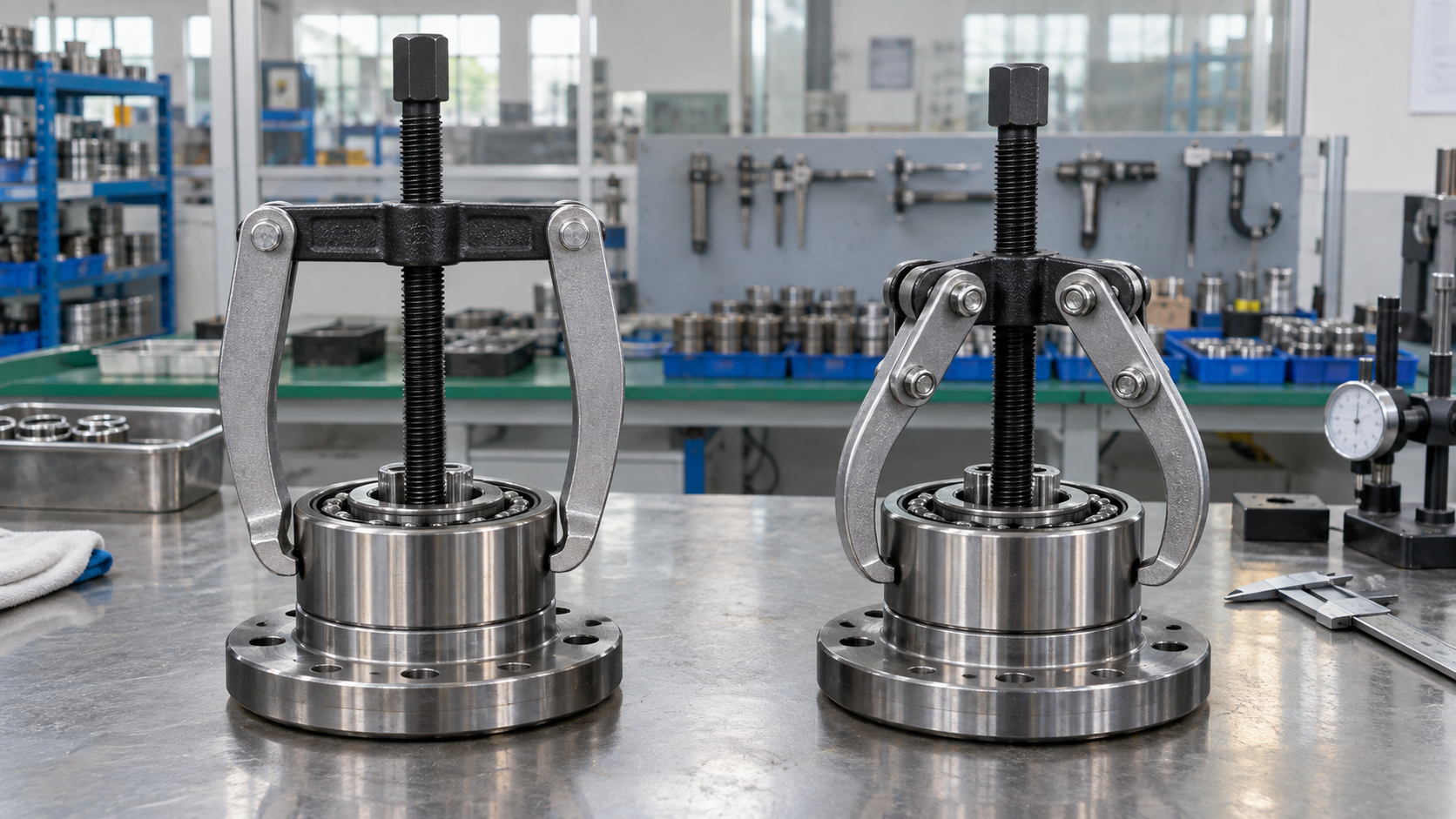
A 2-jaw puller grips a component at two opposing points. Its narrow layout often fits around pulleys, gears, bearings, or hubs where nearby structures block a third arm. A 3-jaw puller contacts three points spaced around a round component. That arrangement usually improves centering and distributes pulling load across more contact areas.
Start with geometry, not habit. Jaw count changes access and stability, yet neither format automatically provides greater rated force. Capacity depends on frame design, arm section, forcing-screw size, heat treatment, reach, spread, and manufacturer ratings.
Buyers should separate four questions:
- Can each jaw reach a solid gripping surface?
- Can the forcing screw remain centered on the shaft?
- Does the tool fit without contacting nearby housings?
- Does its rated spread, reach, and capacity cover each planned job?
Action recommendation: specify both jaw configuration and operating envelope on every RFQ.
| Comparison point | 2-jaw puller | 3-jaw puller | Buyer implication |
|---|---|---|---|
| Contact points | Two opposing jaws | Three distributed jaws | Three jaws often center more readily |
| Access need | Narrower | Requires more radial clearance | Two jaws suit crowded assemblies |
| Setup sensitivity | Higher | Usually lower | Training matters more with two jaws |
| Typical role | Restricted access | General round-component removal | Mixed kits cover more jobs |
2. When Does a 2-Jaw Puller Make Better Sense?
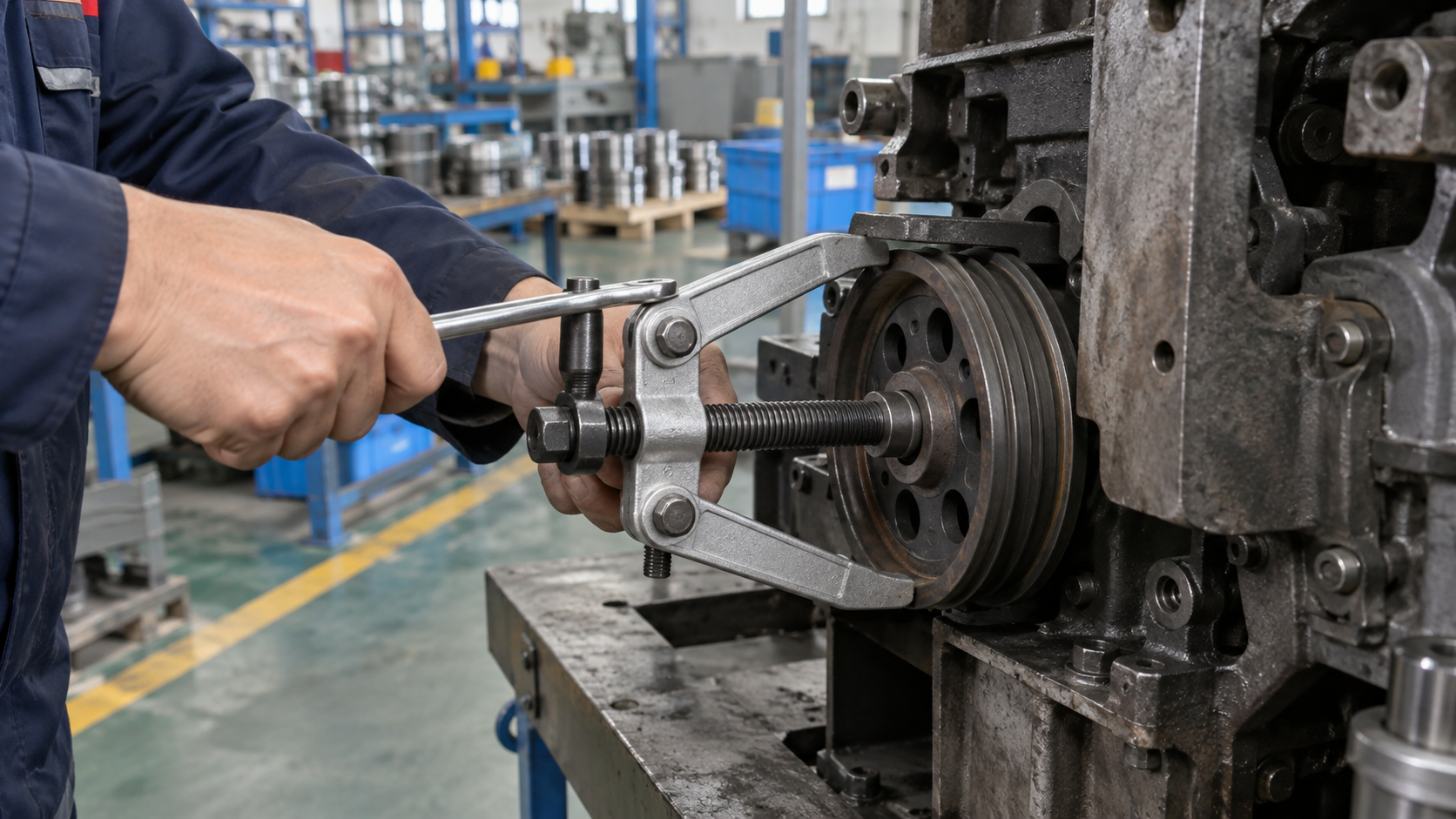
A two-arm layout earns its place where housings, brackets, shields, or adjacent parts leave only two usable access windows. Mechanics can rotate its crosshead until both jaws reach behind a component. This flexibility may prevent unnecessary disassembly around alternator pulleys, small gears, steering components, and compact industrial shafts.
The trade-off sits in setup discipline. Two contact points provide less natural resistance against side movement. Both jaws must sit at equal depth, while the forcing screw must stay coaxial with the shaft. An offset setup can cock a component, damage a shaft end, or let one jaw slip.
Useful purchasing checks include:
- Reversible jaws for internal or external pulling where rated;
- Locking or cage features that restrain arm movement;
- Thin but adequately supported jaw tips;
- Several arm lengths rather than makeshift extensions;
- Replaceable forcing-screw tips for different shaft ends.
Action recommendation: buy two-jaw models for verified clearance problems, not as a universal substitute.
| Application condition | Suitability | Procurement note |
|---|---|---|
| Third side blocked | Strong fit | Confirm two secure grip points remain |
| Deep component | Conditional | Match reach with actual working diameter |
| Fragile thin flange | Poor without support | Consider a bearing separator |
| High off-axis resistance | Poor | Reassess alignment and puller style |
3. Why Does a 3-Jaw Puller Usually Offer Better Stability?
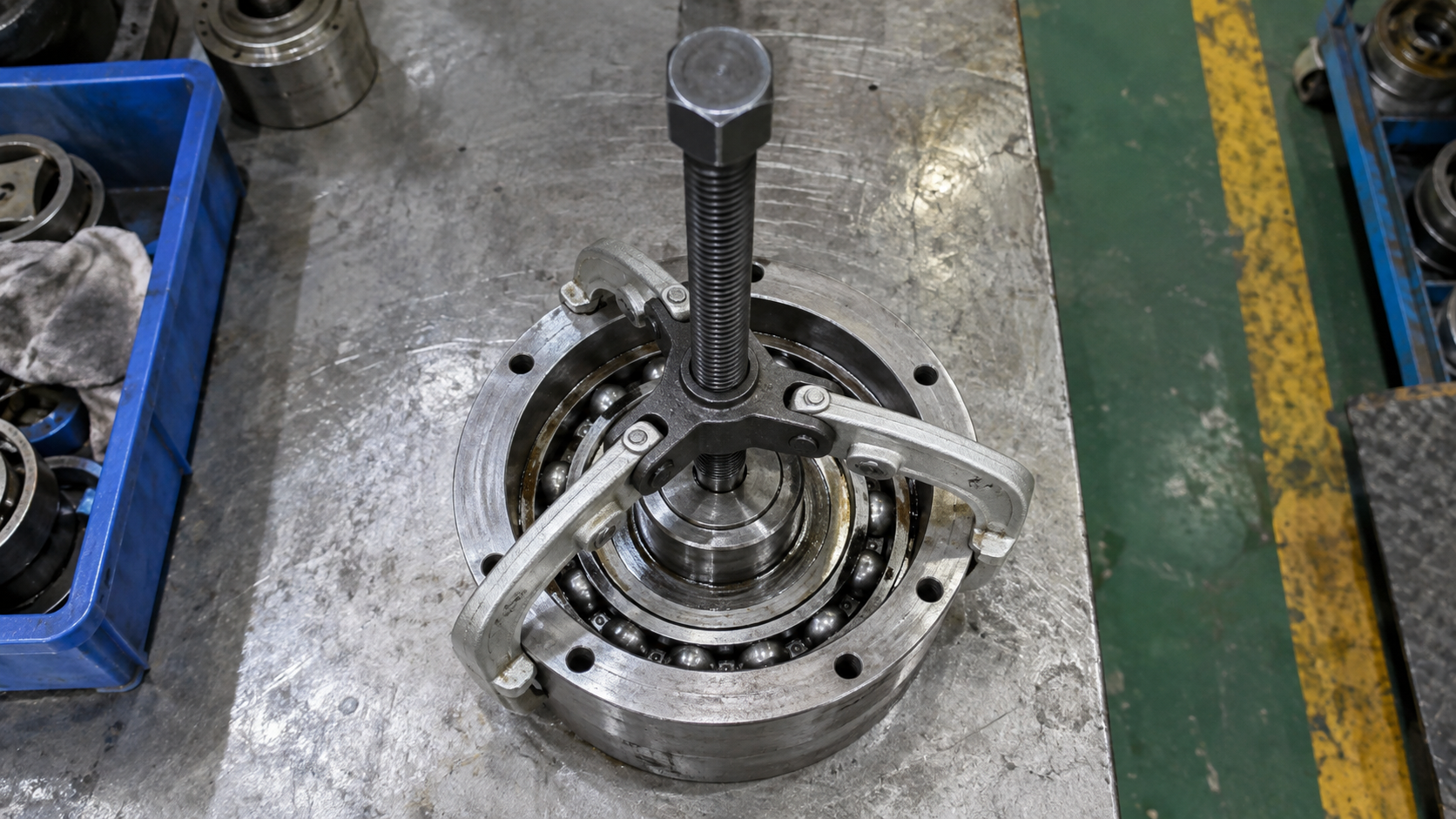
Three jaws surround a circular workpiece and resist tilting from several directions. When their positions synchronize correctly, the forcing screw stays nearer the shaft centerline. More even contact also reduces the load carried by each individual jaw, provided every tip engages the same surface at equal depth.
Stable does not mean foolproof. A poorly sized three-arm tool can still slip, bend, or overload a component. One jaw may land on a weak casting rib while two jaws contact a stronger flange. Deep reach can also reduce useful spread and increase bending stress within long arms.
Buyers should examine:
- Whether all arms move together or require individual adjustment;
- How a cage, strap, or locking nut prevents spreading;
- Whether jaw tips maintain parallel contact under load;
- How replacement arms are identified and matched;
- Whether rated capacity changes with optional long arms.
OTC safety guidance recommends a three-jaw puller where practical because it provides a better grip and more even pulling action. Action recommendation: position three-jaw versions as the default round-component option when clearance permits.
| Stability factor | Desired condition | Warning sign |
|---|---|---|
| Jaw spacing | Even around component | One arm noticeably offset |
| Grip depth | Equal at all three tips | One shallow contact point |
| Screw alignment | Centered on shaft | Screw approaches at an angle |
| Locking control | Arms held securely | Jaws spread while loading |
4. How Should Buyers Compare Capacity, Reach, and Spread?
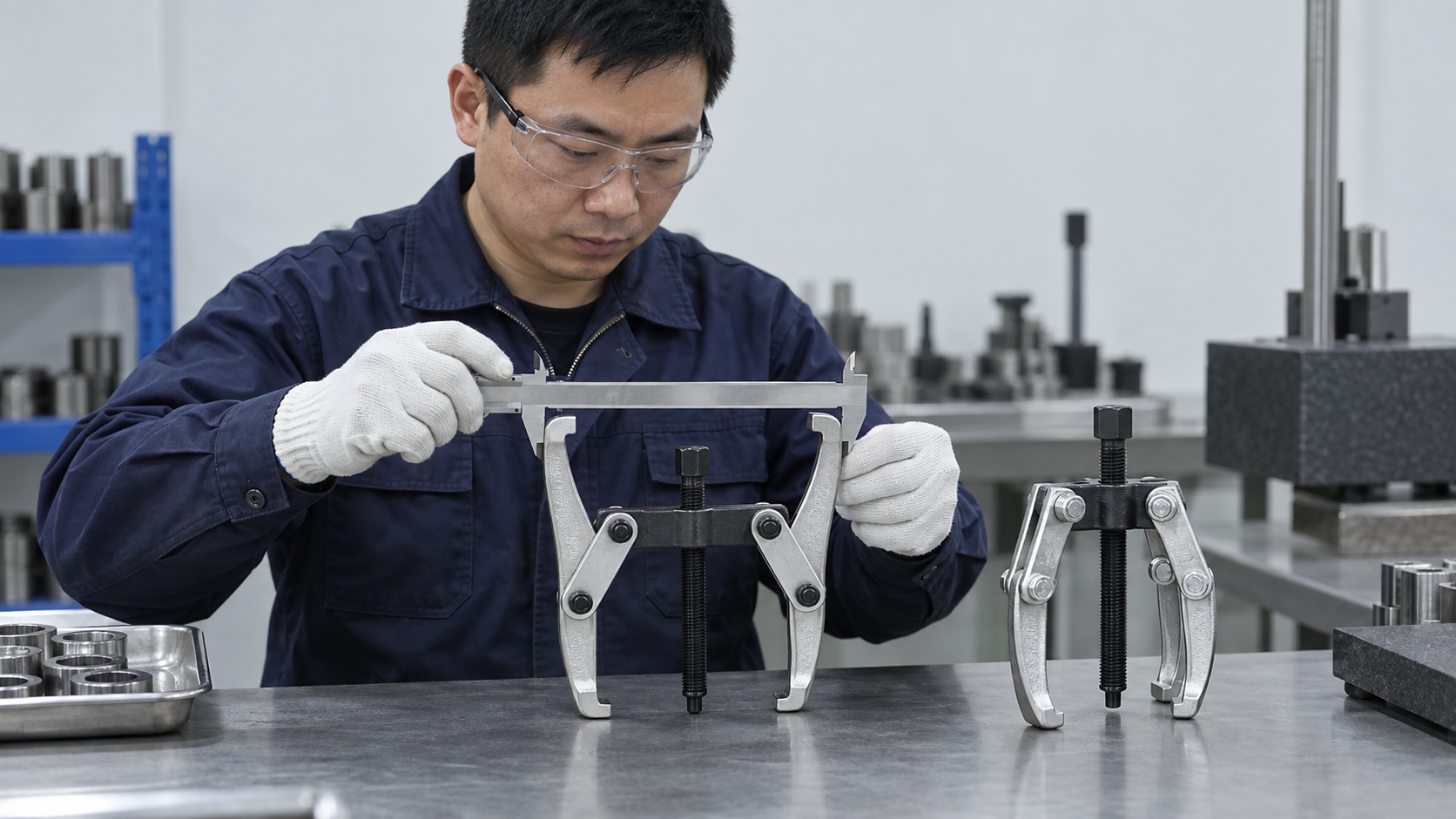
Jaw count never replaces dimensional selection. Capacity describes rated pulling force under defined conditions. Reach measures distance from jaw gripping surface toward the puller head. Spread covers the diameter or width that jaws can surround. All three figures must fit one application at the same working position.
Catalog maximums can mislead a rushed buyer. A puller may reach its widest spread only with reduced reach. Long arms may also lower allowable force. Procurement teams should request a range chart rather than three isolated maximum values.
Record these application inputs:
- Component outside diameter;
- Distance from grip surface to shaft end;
- Available radial clearance;
- Shaft-end shape and center-hole condition;
- Estimated interference or removal resistance;
- Required internal or external configuration.
Enerpac selection guidance treats capacity, reach, and spread as the three basic specifications. Action recommendation: test size coverage against representative parts before approving an assortment.
| Parameter | Measurement source | Acceptance rule |
|---|---|---|
| Spread | Component outside diameter | Working range must exceed part width |
| Reach | Grip surface to shaft end | Rated reach must cover full distance |
| Capacity | Approved application method | Never exceed supplier rating |
| Clearance | Surrounding assembly | Every arm must move without obstruction |
5. Which Jaw and Forcing-Screw Details Affect Service Life?
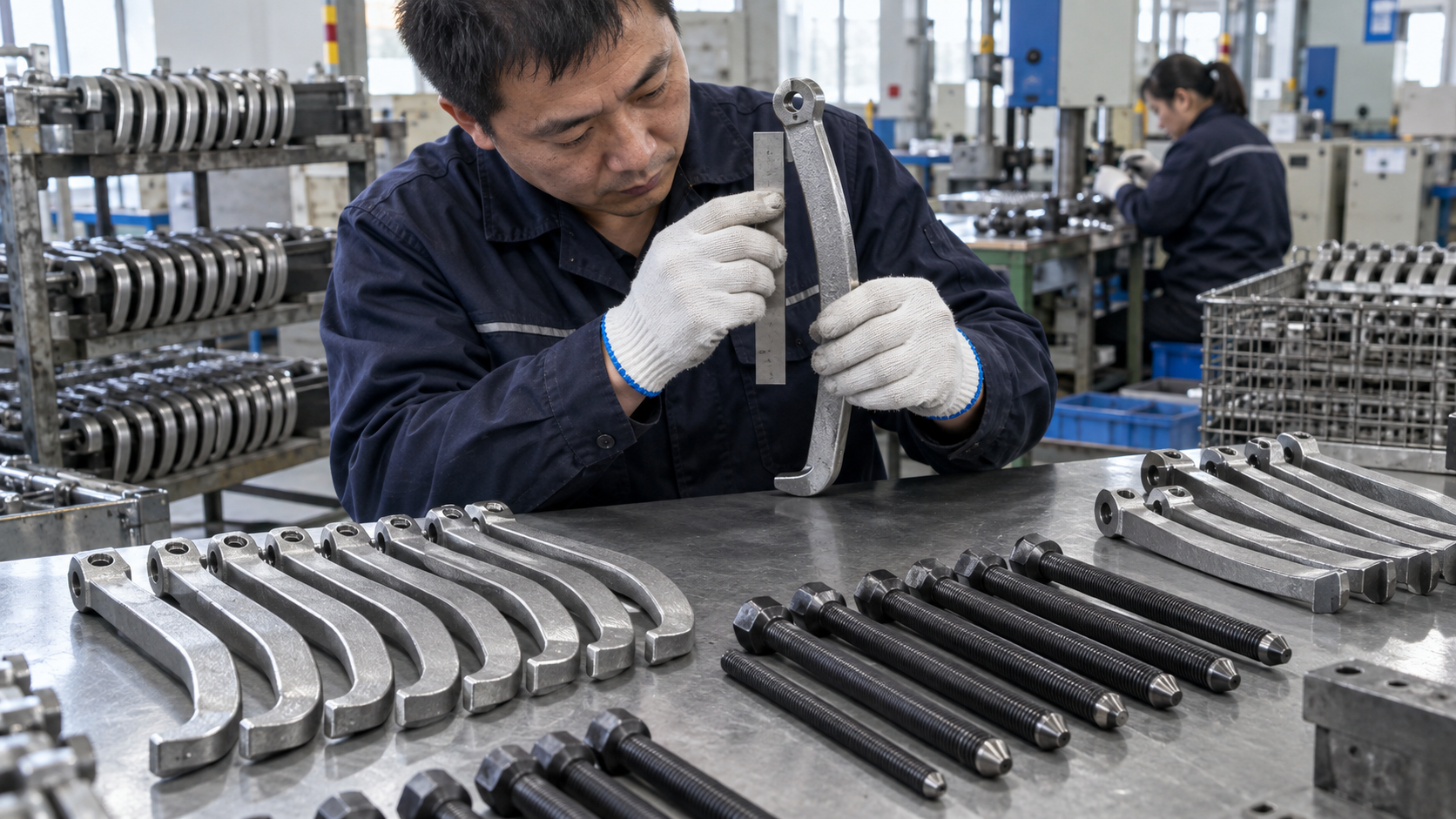
Jaw arms face bending stress while their tips carry concentrated contact loads. A suitable alloy, controlled heat treatment, consistent section thickness, and smooth transition radii all affect durability. A hard tip without adequate toughness may chip. A soft arm may permanently open under load.
Forcing screws need accurate threads, a sound thrust end, and a finish that resists galling. Lubrication guidance must match supplier instructions because dry or damaged threads raise torque without delivering proportional pulling force.
Small details expose weak production control. Compare paired arms for length, tip position, hole alignment, and free movement. Mixed geometry can push a correctly mounted puller off center.
Factory inspections should cover:
- Arm symmetry and jaw-tip profile;
- Thread fit and visible surface defects;
- Crosshead bore alignment;
- Retaining hardware and locking parts;
- Traceable material and heat-treatment records;
- Functional assembly under a controlled sample load.
Action recommendation: approve complete assemblies, not isolated parts from separate samples.
| Component | Inspection focus | Common risk |
|---|---|---|
| Jaw arm | Symmetry and straightness | Unequal loading |
| Jaw tip | Profile and edge condition | Slip or flange damage |
| Forcing screw | Thread fit and tip | Galling or shaft marking |
| Crosshead | Bore position and strength | Off-axis loading |
6. How Do Locking and Self-Centering Features Change Use?
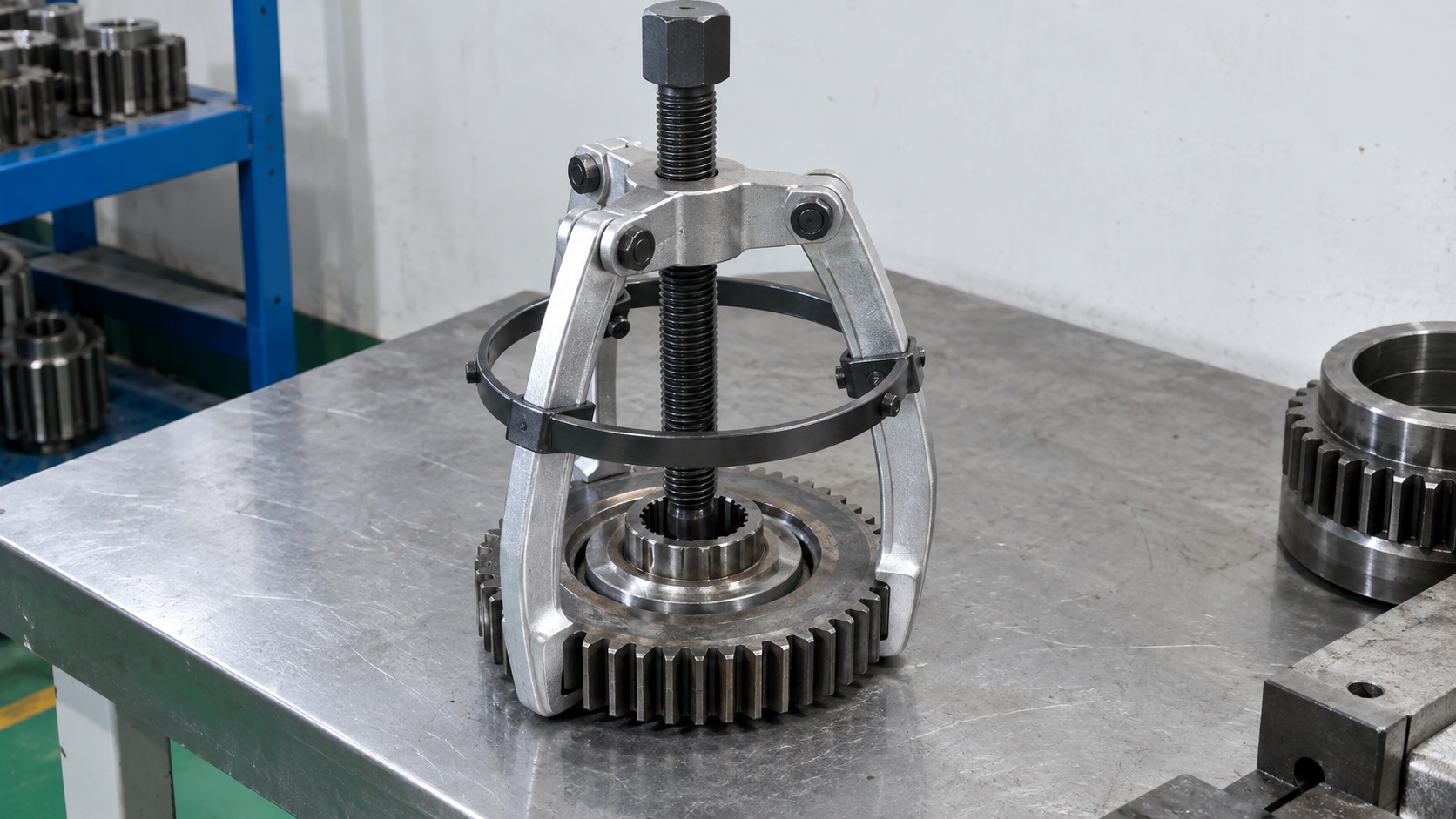
A locking mechanism holds jaws against a component before meaningful force develops. Designs may use a cage, strap, adjusting cone, nut, or synchronized linkage. These features reduce setup movement and can help one technician position a larger tool.
Self-centering systems move jaws together around a common axis. They save adjustment time and discourage a skewed setup, though they cannot correct an unsuitable gripping surface. Buyers should inspect how much play exists across joints and whether mechanisms still move freely after repeated loading and contamination.
Convenience must remain serviceable. A clever linkage becomes a liability when replacement pins, springs, cages, or arms cannot be ordered. Private-label programs need drawings, spare-part codes, and assembly instructions before launch.
Compare these points:
- One-hand positioning versus separate arm adjustment;
- Positive jaw restraint before screw loading;
- Backlash across pivots and sliding parts;
- Ease of cleaning and lubrication;
- Availability of matched replacement arms.
Action recommendation: include lifecycle parts within product approval, not only initial samples.
| Feature | Buyer benefit | Validation method |
|---|---|---|
| Locking cage | Reduces jaw spread | Mount on several diameters |
| Synchronized arms | Faster centering | Check equal movement |
| Retained hardware | Fewer loose parts | Cycle and transport test |
| Replaceable pivots | Longer service life | Review spare-parts list |
7. What Safety Requirements Belong in a B2B Specification?
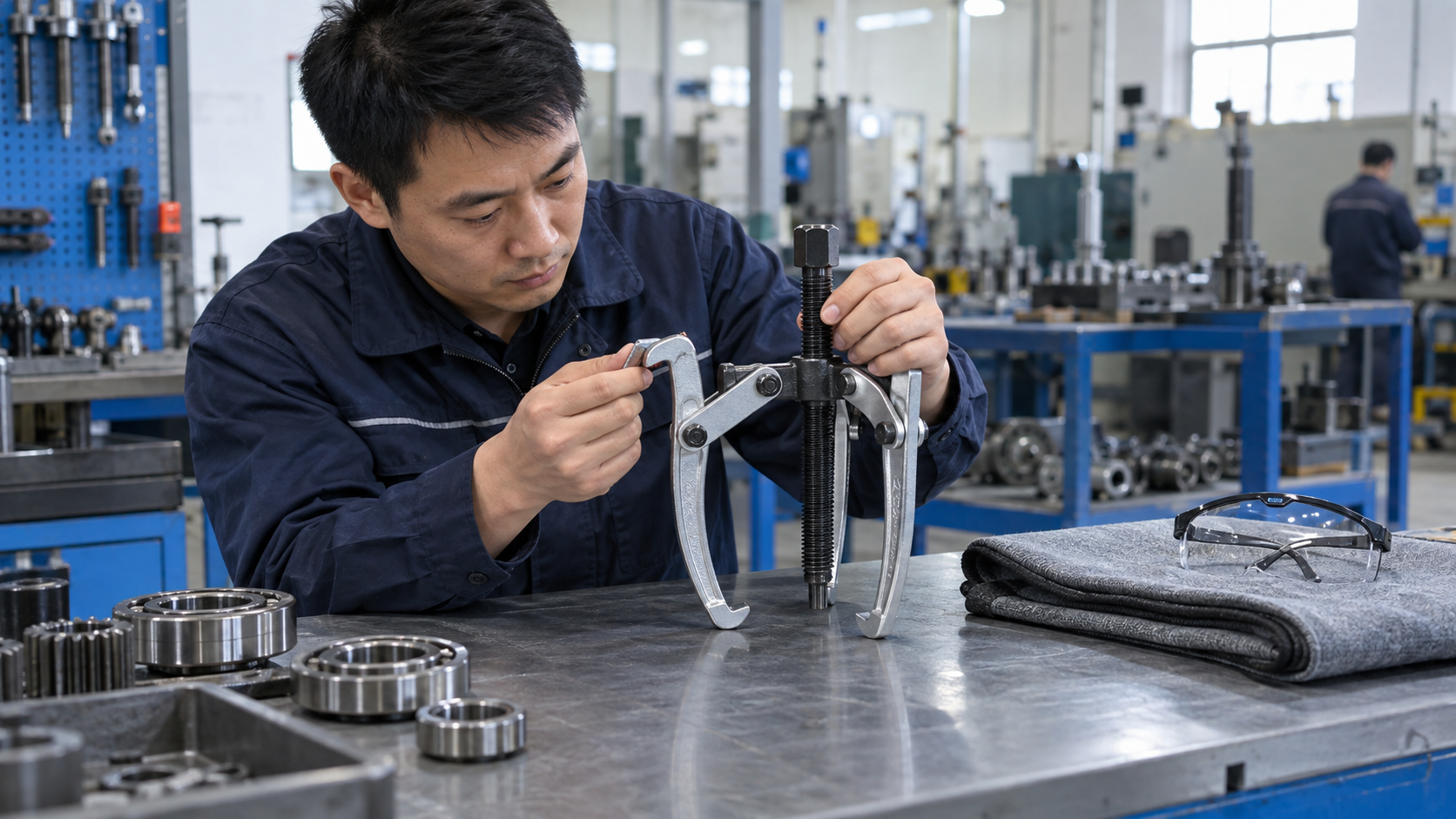
Pullers store considerable energy as force rises. A slipping jaw, fractured arm, or released component can cause injury and equipment damage. Product selection, operator training, inspection, and guarding work together; no single feature removes risk.
Rated limits are operating boundaries. Never use pipe extensions, improvised legs, mixed arm sets, or an impact wrench unless a specific puller carries written approval for that method. Keep reach as short as practical. Apply force gradually, and stop when a part fails to move within rated conditions.
A buyer specification should require:
- Permanent model and capacity identification;
- Legible operating and inspection instructions;
- Eye-protection and guarding warnings;
- Defined lubrication and maintenance steps;
- Replacement criteria for cracks, galling, deformation, or wear;
- Packaging that protects threads and jaw tips during transit.
OTC guidance also recommends a protective blanket or shield where flying debris presents a risk. Action recommendation: review manuals during sample approval instead of after an incident.
| Safety control | Purpose | Buyer evidence |
|---|---|---|
| Capacity marking | Prevent overload | Permanent product mark |
| Setup instructions | Support alignment | Illustrated manual |
| Inspection criteria | Remove damaged tools | Service checklist |
| Protective guidance | Control released debris | Warning and shield advice |
8. Should a Distributor Stock Separate Tools or Combination Kits?
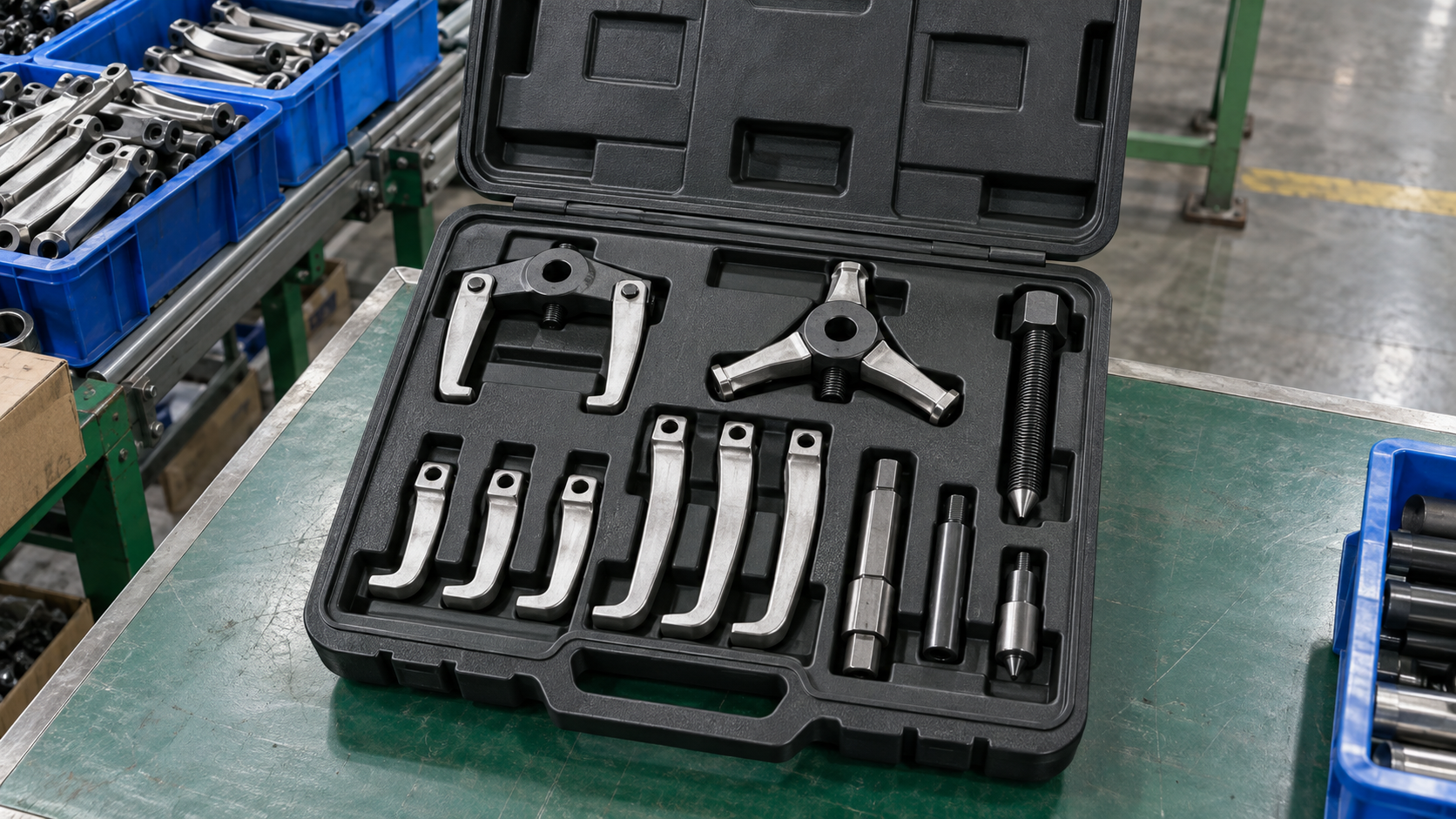
Separate pullers can target clear market segments and reduce unused components. Combination kits offer two-way and three-way heads, shared arms, forcing screws, extensions, and adapters. A modular set suits workshops handling many vehicles or industrial parts, though poor component organization can cause mismatched assemblies.
Assortment design should follow actual jobs. A compact retail kit may need short arms and common automotive spreads. An industrial program may need deeper reach, hydraulic actuation, separators, and replacement hardware. More pieces do not automatically create better coverage.
Evaluate each kit for:
- Genuine two-jaw and three-jaw configurations;
- Short and long matched arm sets;
- Case locations that prevent missing parts;
- Clear capacity limits for every assembly;
- Adapter compatibility and thread identification;
- Spare-part ordering without buying a full kit.
Relevant category planning can also connect with a broader automotive repair tools range or mechanics tool set program. Action recommendation: build kits around verified application clusters.
| Assortment format | Best fit | Main control |
|---|---|---|
| Separate 2-jaw tool | Restricted-access niche | Clear application labeling |
| Separate 3-jaw tool | General round parts | Broad size coverage |
| Combination kit | Multi-job workshops | Assembly-specific ratings |
| Hydraulic master set | Heavy service | Hose, pump, gauge, and safety control |
9. What Quality-Control Evidence Should Importers Request?
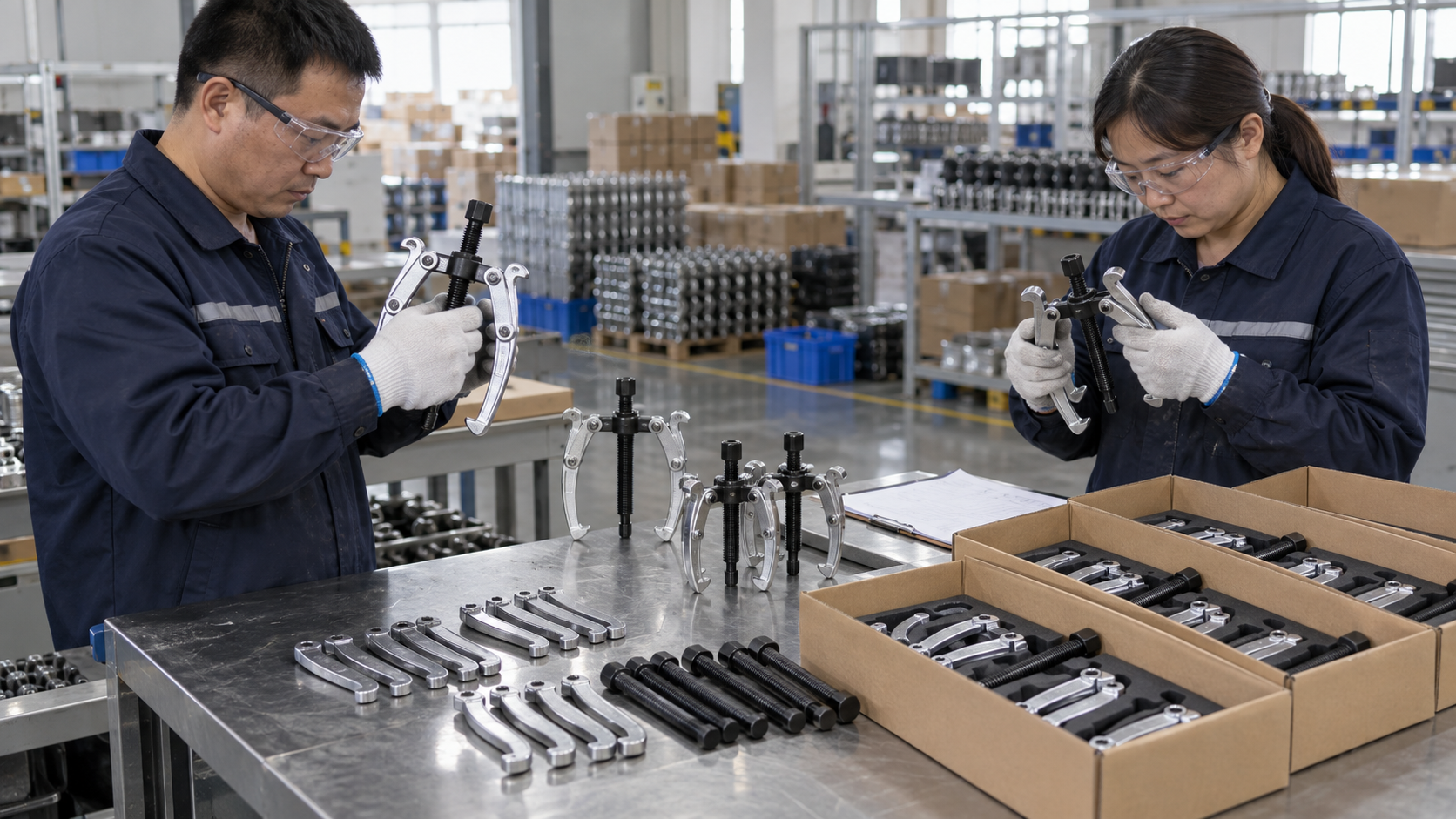
Visual samples cannot prove production consistency. A purchase specification should connect drawings, materials, heat treatment, dimensional checks, load validation, and packaging inspection. Sampling plans must reflect order size and product risk.
Ask for records that match shipped lots. Generic test reports or undated certificates provide little traceability. Each report should identify model, batch, inspection date, method, equipment, acceptance criteria, and result.
Useful evidence includes:
- Approved drawings with controlled revisions;
- Material certificates for arms, crossheads, and screws;
- Heat-treatment and hardness records where specified;
- Dimensional reports for spread, reach, threads, and symmetry;
- Functional testing under documented fixtures;
- Surface-finish, corrosion, case, and labeling checks;
- Pre-shipment photos showing random finished samples.
Buyers planning private-label supply can pair these controls with a broader tool sourcing guide and relevant socket-set manufacturing considerations. Action recommendation: define evidence before quotation comparison.
| Evidence item | What it confirms | Weak submission |
|---|---|---|
| Drawing report | Dimensional conformity | Uncontrolled sketch |
| Material record | Specified steel family | Verbal claim only |
| Functional test | Assembly performance | Unidentified photo |
| Packaging check | Shipment protection | Empty case image |
10. How Should a Buyer Write the Final RFQ?
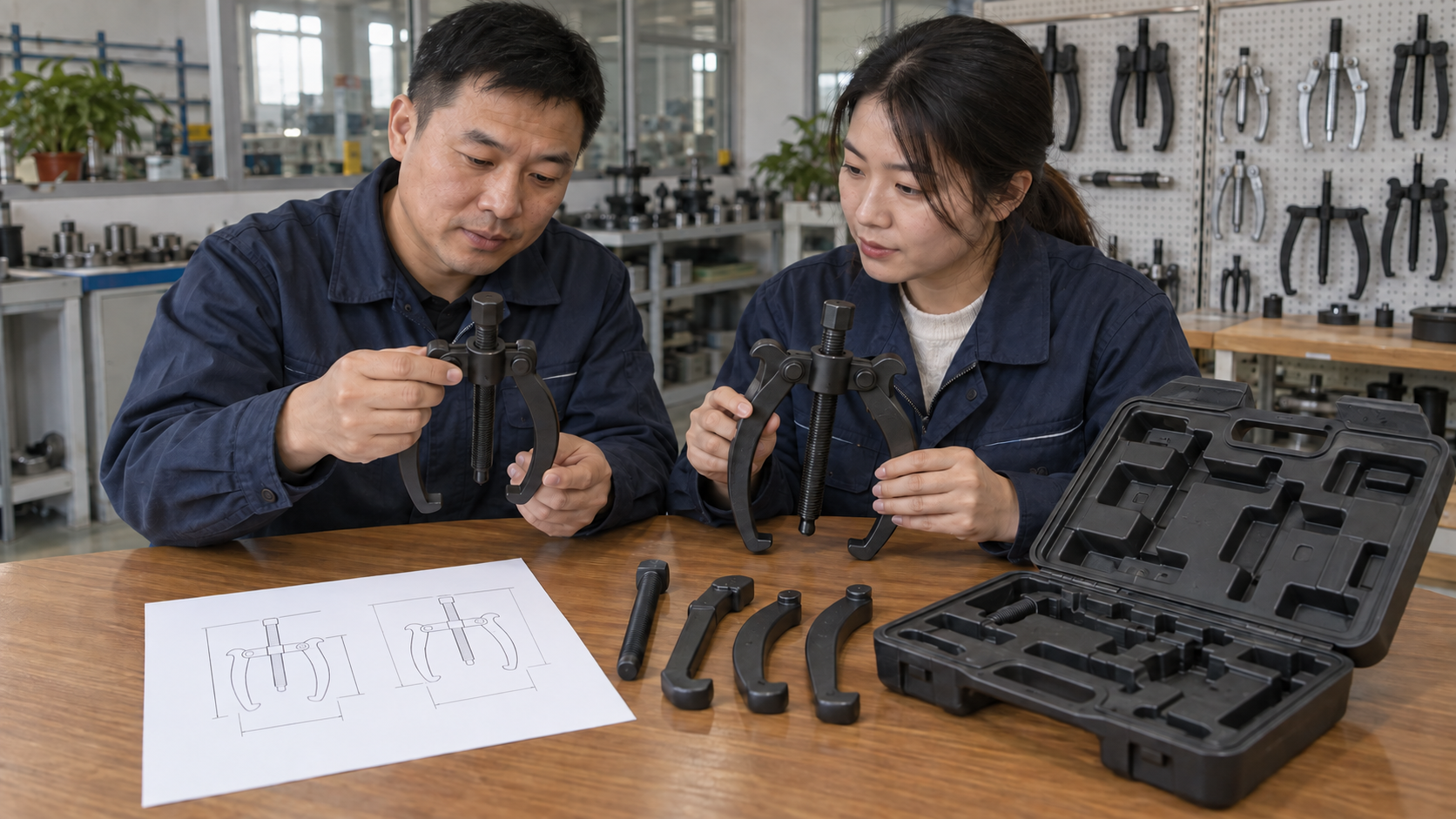
A useful RFQ states what each puller must do, how suppliers should describe ratings, and which evidence supports approval. Avoid phrases such as “heavy duty” without measurable requirements. Jaw count, spread, reach, rated capacity, arm length, locking system, finish, markings, case layout, spare parts, and testing should appear as separate fields.
A precise RFQ makes quotations comparable. Include representative component dimensions or approved application families. Ask suppliers to flag every exception rather than quietly substituting arm material, screw geometry, or case contents.
Final RFQ fields should include:
- Required 2-jaw, 3-jaw, or combination configuration;
- Mechanical or hydraulic actuation;
- Working spread and reach ranges;
- Rated capacity with applicable arm restrictions;
- Jaw-tip dimensions and reversible use;
- Material, finish, marking, packaging, and manual needs;
- Sample, inspection, spare-parts, and private-label requirements.
Related buying decisions may benefit from guides on bearing separators versus pullers, mechanical versus hydraulic pullers, bearing-race pullers, blind-hole pullers, pilot-bearing pullers, and axle-bearing pulling methods.
Action recommendation: send dimensional application data with each inquiry and approve one documented configuration at a time.
Q1: Is a 3-jaw puller always better than a 2-jaw puller?
No. Three jaws generally improve centering and load distribution, while two jaws fit spaces that block a third arm. Correct choice depends on access, grip surfaces, alignment, reach, spread, and rated capacity.
Q2: Can a 3-jaw puller be used with only two jaws?
Only when its manufacturer approves a two-jaw configuration and supplies matching assembly instructions and ratings. Removing one arm from an unapproved design can create imbalance or overload remaining parts.
Q3: Which puller is safer for round bearings and gears?
A properly sized three-jaw puller usually provides a more stable grip when radial clearance allows all three arms to seat evenly. Setup, condition, guarding, and rated capacity still control safety.
Q4: What measurements should buyers provide in an RFQ?
Provide component diameter, grip-to-shaft-end distance, available clearance, shaft-end details, expected resistance, required orientation, and internal or external pulling needs.
Q5: Should distributors buy a combination 2/3-jaw kit?
Combination kits suit mixed workshop demand when every permitted assembly has clear ratings, matched arms, organized storage, and available spare parts. Focused markets may benefit from separate tools.
Looking for a reliable mechanic tools manufacturer in China?
If you are sourcing hand tools, socket tools, automotive repair tools, mechanic tool sets or OEM private label tools, contact KOLARWIN Tools for factory-direct quotation, customization support and product consultation.


