
Need OEM supplier support for this product type?
Contact KOLARWIN Tools for OEM mechanic tools, private label packaging, wholesale quotation and product range support. This gives overseas buyers a clear path from article reading to supplier discussion.
A pilot bearing puller removes a press-fit bearing or bushing when outside jaws cannot reach it. The buyer’s real problem is fit: a partly engaged collet can slip, mark a shaft, or damage a bearing seat. This guide compares screw-type, collet/internal, and slide-hammer designs, then gives a B2B approval checklist based on measured dimensions, vehicle data, and safe limits.
1. What does a pilot bearing puller remove?
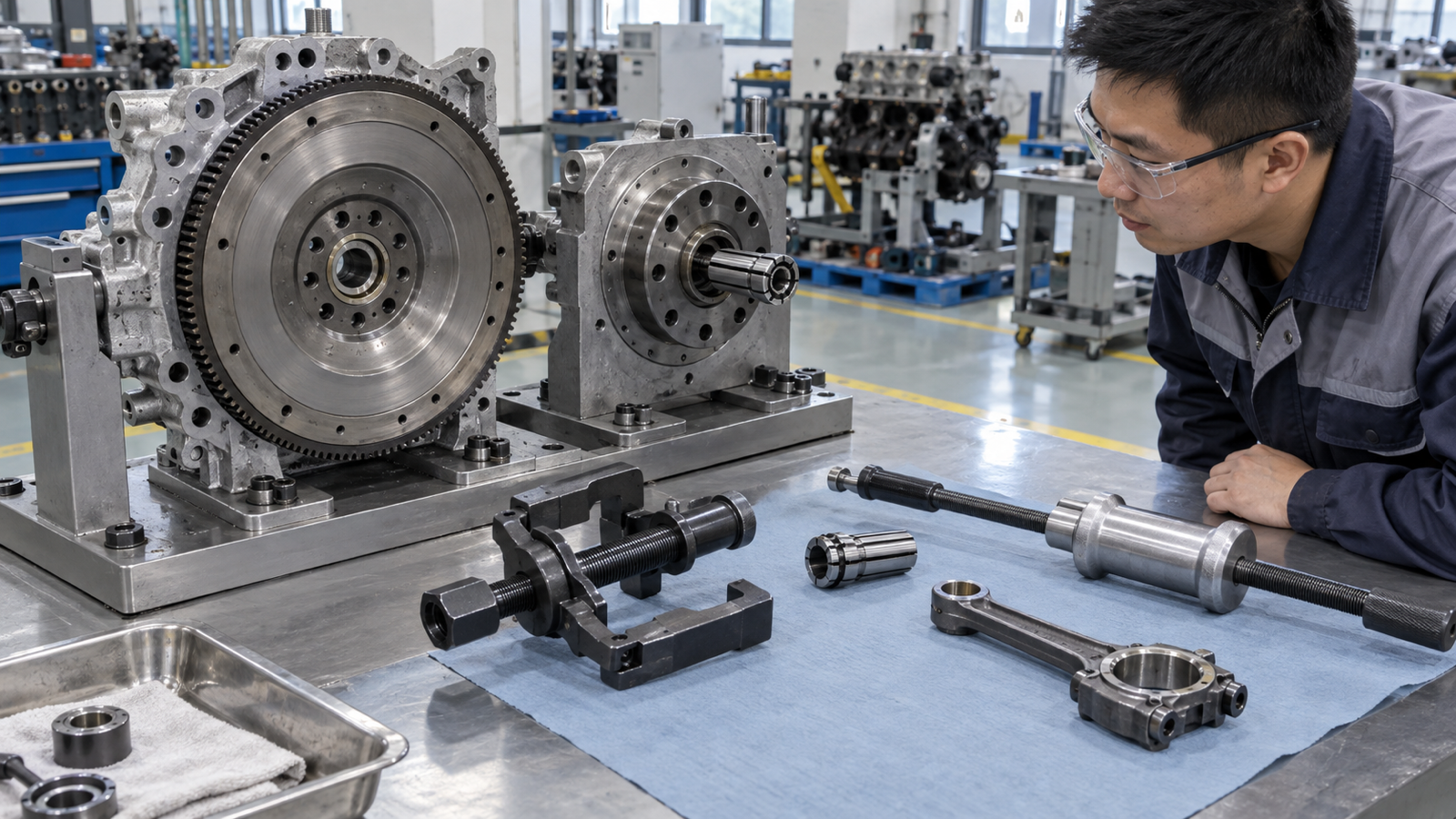
A pilot bearing supports a manual-transmission input shaft near the crankshaft or flywheel. Some applications use a rolling bearing. Others use a bushing. Location and service method vary by vehicle, so buyers should treat “pilot bearing” as an application description rather than universal geometry.
Here’s the practical point: outside jaws cannot reach a bearing inside a bore. A pilot-bearing puller enters and grips an internal surface, sending force along the bearing axis.
Before quotation, collect:
- target part: bearing, bushing, race, or sleeve;
- installed location and removal direction;
- available bore access after clutch or transmission parts are removed;
- shaft, seal, and crankshaft protection needs;
KOLARWIN’s automotive repair tools range gives useful category context for distributors building a drivetrain-tool line.
Practical action: ask your customer for a vehicle or equipment list plus a measured target interface before choosing a kit.
Pilot-bearing job definition
| Buyer question | Why it matters | Hold point |
|---|---|---|
| What part must move? | Defines gripping surface | Part identity remains unclear |
| Where does it sit? | Defines access and reach | Location differs from catalogue assumption |
| What stays fixed? | Defines reaction path | No stable reaction surface |
2. How does an internal collet create grip?
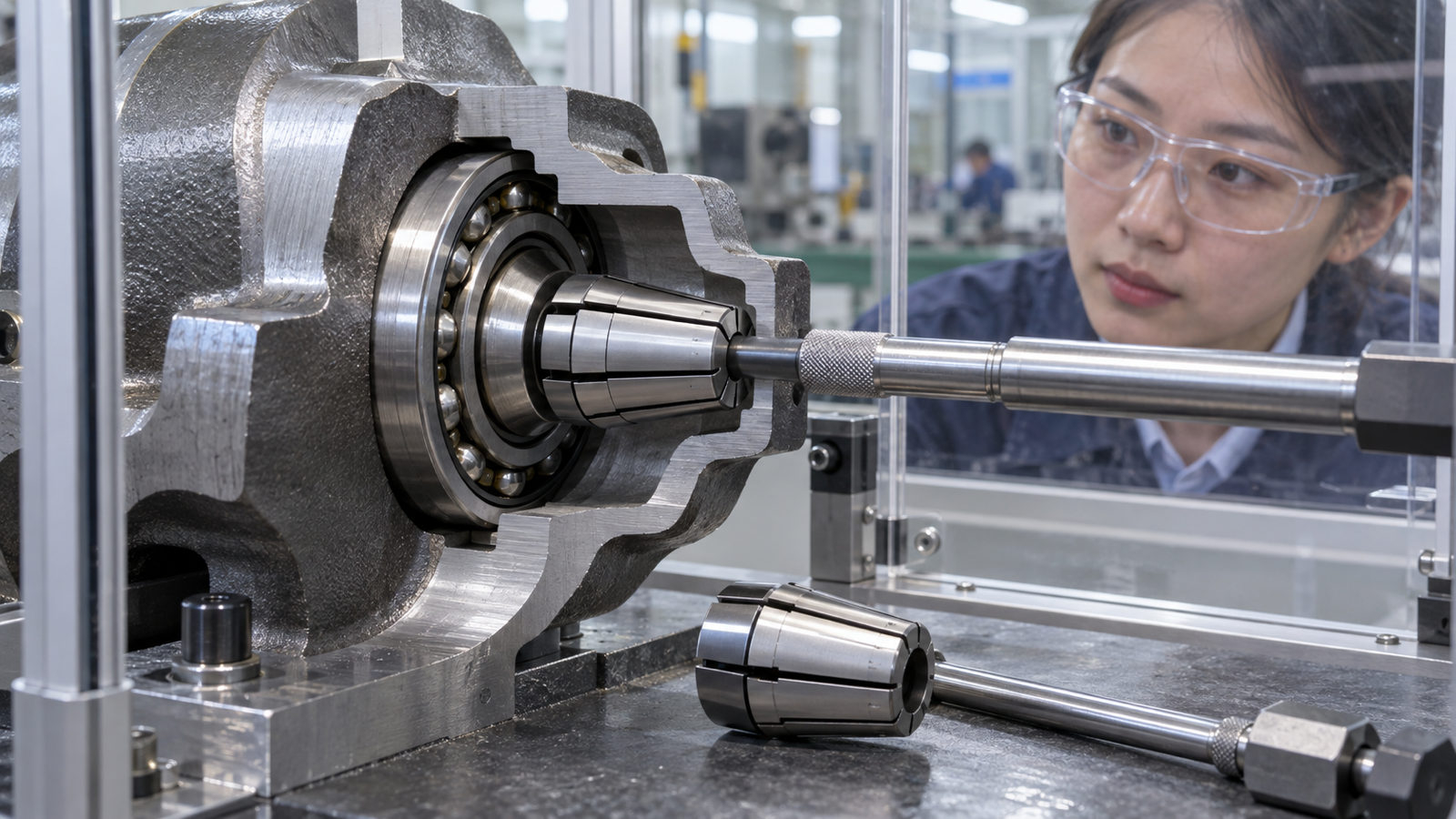
An internal collet or expanding jaw starts smaller than the bearing bore. After insertion, a taper, cone, threaded actuator, or similar mechanism moves jaws outward. Correct engagement places gripping edges behind a suitable shoulder or race surface. Force then acts axially through a rod, bridge, or slide-hammer attachment.
Fit comes before force: a collet touching a chamfer or seal does not provide reliable purchase. Confirm bore diameter, usable depth, collet range, jaw profile, and minimum engagement with a sample or drawing.
Look for these design details:
- tapered expansion that stays centered during tightening;
- jaw edges that seat on the intended bearing surface;
- positive connection between collet and puller body;
- clearance for the shaft and nearby casting;
The specialty pullers in a mechanic tool list helps position internal pullers beside other removal tools without calling one kit universal.
Practical action: approve collet engagement with a physical interface sample, not a case label alone.
Internal-grip review
| Feature | Buyer check | Risk if missed |
|---|---|---|
| Bore range | Actual inside diameter | Collet cannot enter or expand correctly |
| Engagement depth | Surface behind bearing edge | Jaw slips under load |
| Jaw profile | Race, shoulder, or bushing contact | Seal or chamfer carries force |
3. How does a screw-type pilot bearing puller work?
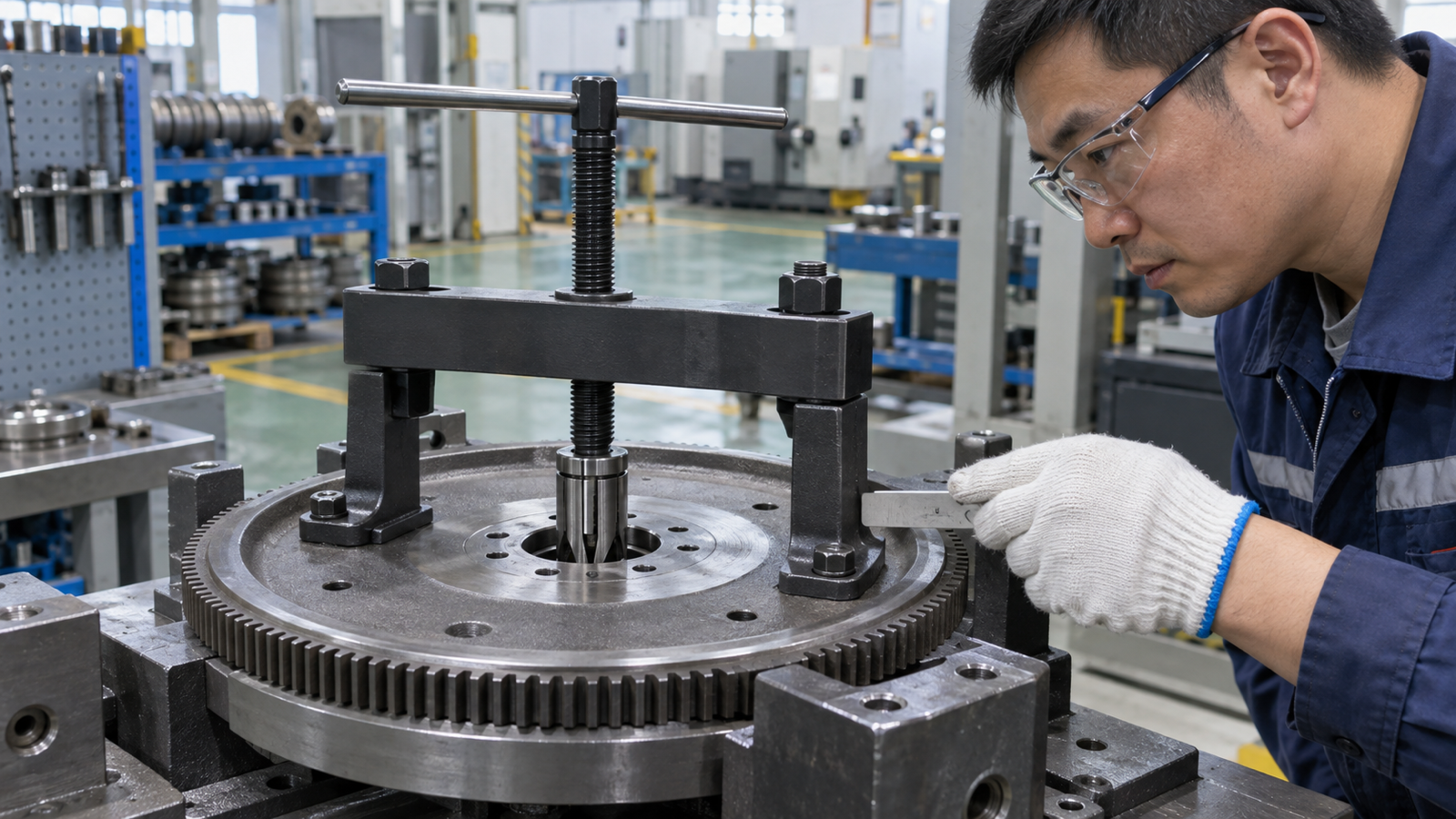
A screw-type design combines an internal collet or jaw adapter with a bridge and forcing screw. Once the adapter grips the bearing, the bridge reacts against a flywheel or crankshaft face. Turning the screw creates axial force that draws the bearing toward the operator. This suits close quarters where a hammer cannot travel safely.
Controlled force still needs a clear path: the bridge must sit on a strong, stable surface. Contact with a thin casting, seal, or unsupported edge can distort parts before movement.
Specify these items in a purchase request:
- bridge opening and reaction-face geometry;
- screw thread, drive interface, and approved actuation method;
- collet range and replacement parts;
- clearance around flywheel, crankshaft, or housing;
Do not infer force from screw diameter, tool weight, or a “heavy duty” label. Current documentation must define allowable use.
Practical action: request a drawing showing bridge contact, screw axis, and each supplied adapter before approving production.
Screw-type approval fields
| Field | What to confirm | No-go sign |
|---|---|---|
| Bridge | Full, flat reaction support | Bridge rocks or bridges a void |
| Screw | Straight axis and compatible drive | Screw leans or threads bind |
| Adapter | Correct internal engagement | Jaw contacts only a chamfer |
4. How does a slide-hammer pilot bearing puller work?
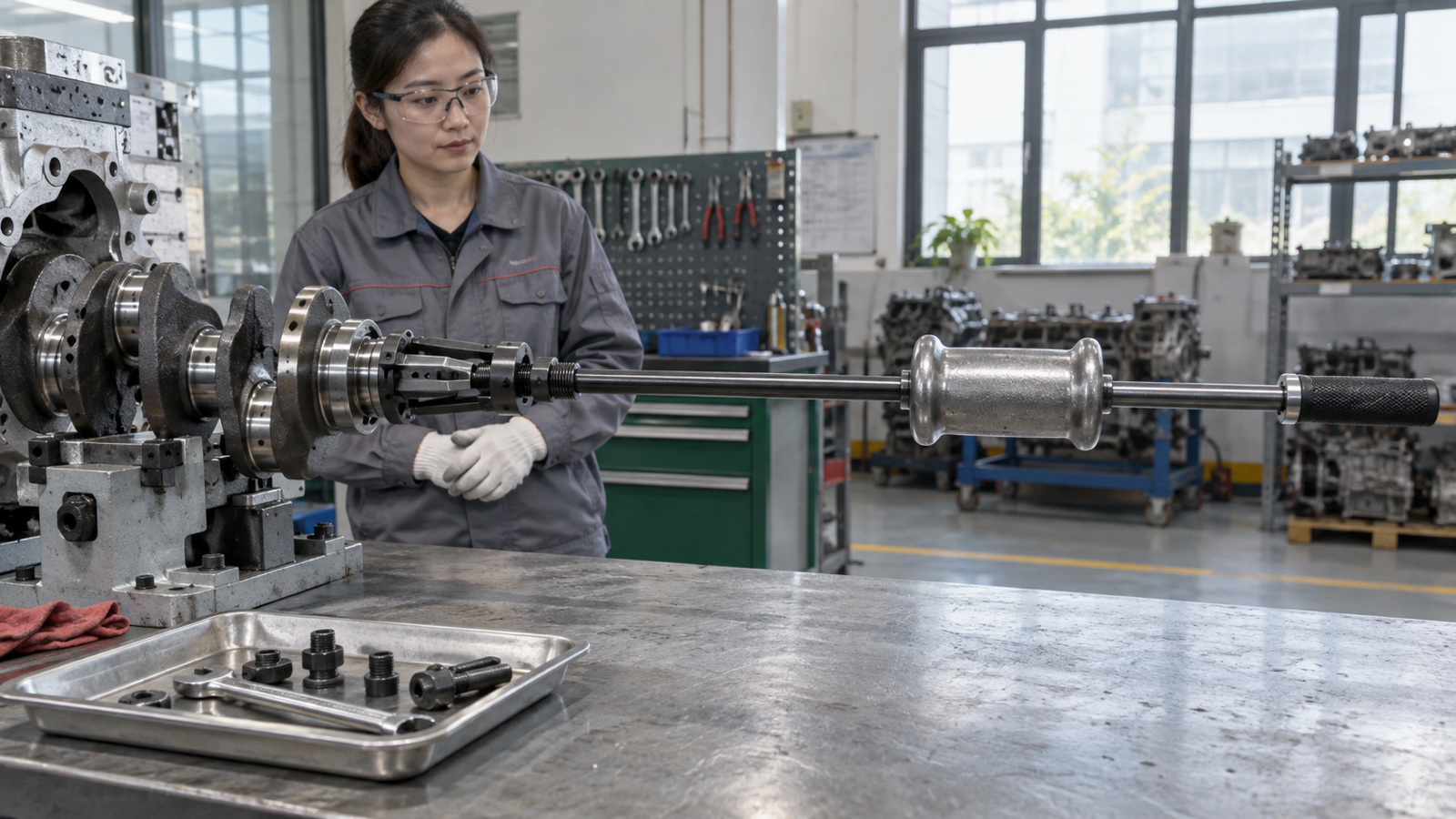
A slide-hammer puller connects an internal collet to a rod and moving hammer. After expansion inside the bearing, the operator moves the hammer against a fixed stop. Each stroke sends axial impulse through the rod and collet. Release depends on aligned grip and force path.
The hammer does not fix a poor fit: repeated impact against a slipping collet can damage the bearing seat or eject the tool. Stroke length, hammer mass, handle shape, collet seating, and operator clearance all belong in the product review.
Check for:
- a positive collet-to-rod connection;
- a stop that remains secure during use;
- a handle that keeps hands away from the moving mass;
- a storage case that prevents jaw mixing;
- clear warnings about eye protection and pinch points.
A slide hammer may suit a blind bearing without a bridge surface. It may not suit an area without stroke clearance.
Practical action: confirm the complete stroke envelope with a fixture that represents your customer’s tightest application.
Slide-hammer decision table
| Condition | Slide-hammer fit | Buyer check |
|---|---|---|
| Blind bore, open stroke | Often suitable starting option | Collet engagement and clearance |
| Bridge can react safely | Compare screw type | Required control and access |
| Very tight axial space | May be unsuitable | Stroke and hand clearance |
5. What access and fit data should buyers check?
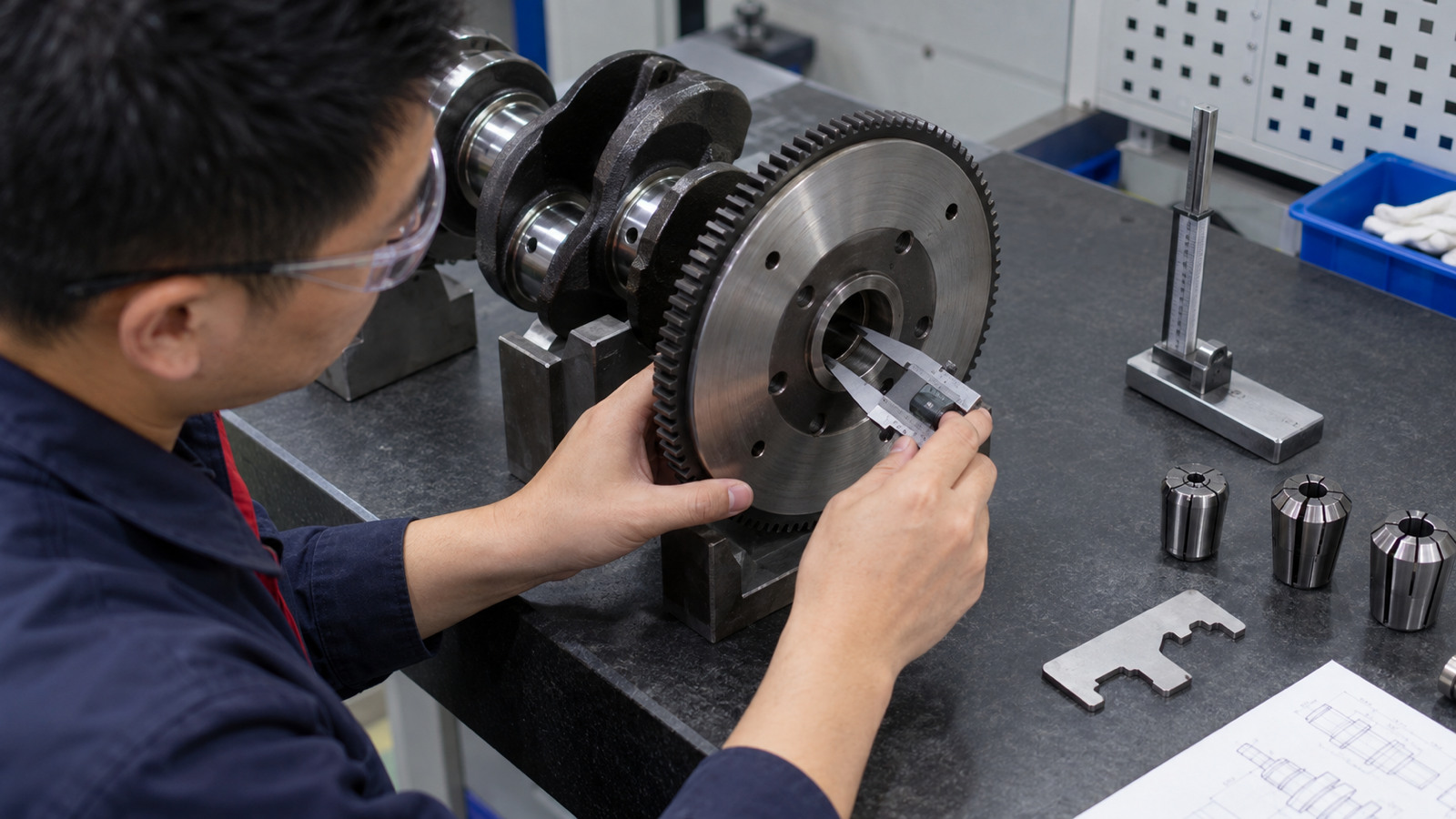
Purchasing files fail when “fits 10–32 mm” replaces an interface description. A size range cannot show bore depth, shoulder location, wall thickness, clearance, or seal interference.
Measure the interface, then match the tool: use current vehicle service information and approved samples. Keep metric and inch dimensions explicit when a program serves mixed markets.
Record:
- inside diameter at the gripping zone;
- usable bore depth and rear shoulder position;
- bearing or bushing width;
- access opening and nearby obstruction;
- removal direction and reaction surface;
Do not convert nominal size into an interchange promise. Tolerance, corrosion, damage, and wear can change fit.
Practical action: add a dimensioned interface sketch or photos with scale to every pilot-puller RFQ.
Fit-data checklist
| Measurement | Use in selection | Question for supplier |
|---|---|---|
| Bore diameter | Collet entry and expansion | What range applies at full engagement? |
| Bore depth | Jaw reach | How much usable depth remains behind the edge? |
| Bearing width | Contact area | Which surface carries the pull? |
6. What vehicle-specific cautions apply?
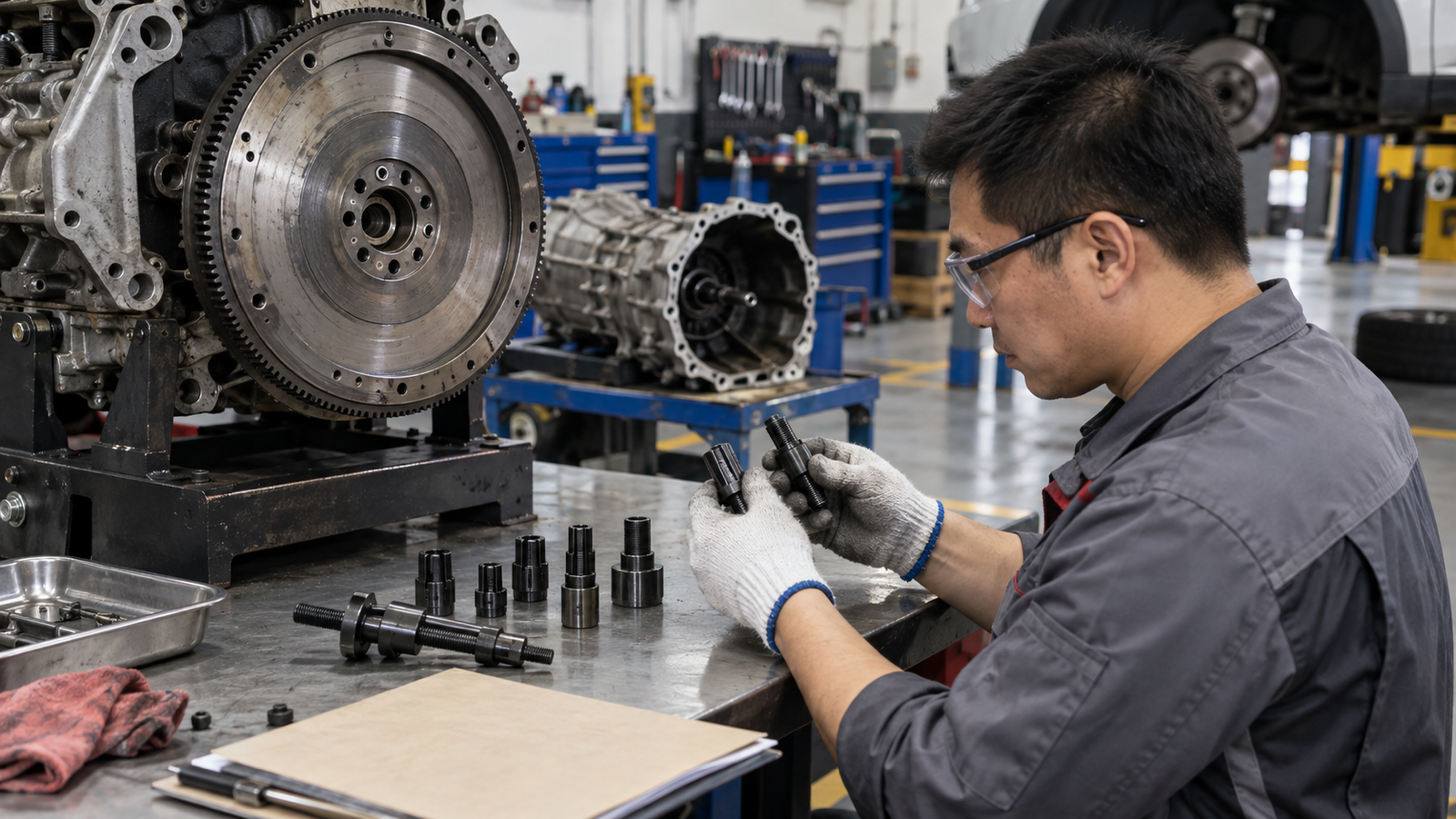
A pilot bearing appears in many manual-transmission jobs, yet vehicles differ in bearing type, location, access, retention, and replacement method. One model may use a sealed roller bearing. Another may use a bushing. A service procedure may identify a special adapter or support arrangement.
Vehicle coverage must be documented: a puller can be mechanically sound yet wrong for a named application. Do not publish “fits all cars,” and do not turn a generic tool description into a universal repair sequence.
For each target application, check:
- transmission and clutch configuration;
- bearing or bushing part identity;
- approved removal and installation tools;
- nearby sensors, seals, and machined surfaces;
- discard or reuse instructions for removed parts;
Customer instructions should direct technicians to current vehicle service information, not replace it.
Practical action: separate application coverage into verified, sample-fit, and unverified rows in your catalogue.
Application-control table
| Coverage status | Evidence | Catalogue wording |
|---|---|---|
| Verified | Current service data plus sample fit | Name application and limits |
| Sample-fit | Physical interface check only | Mark as sample-validated |
| Unverified | Size assumption or old listing | Do not claim coverage |
7. How should buyers choose a puller configuration?
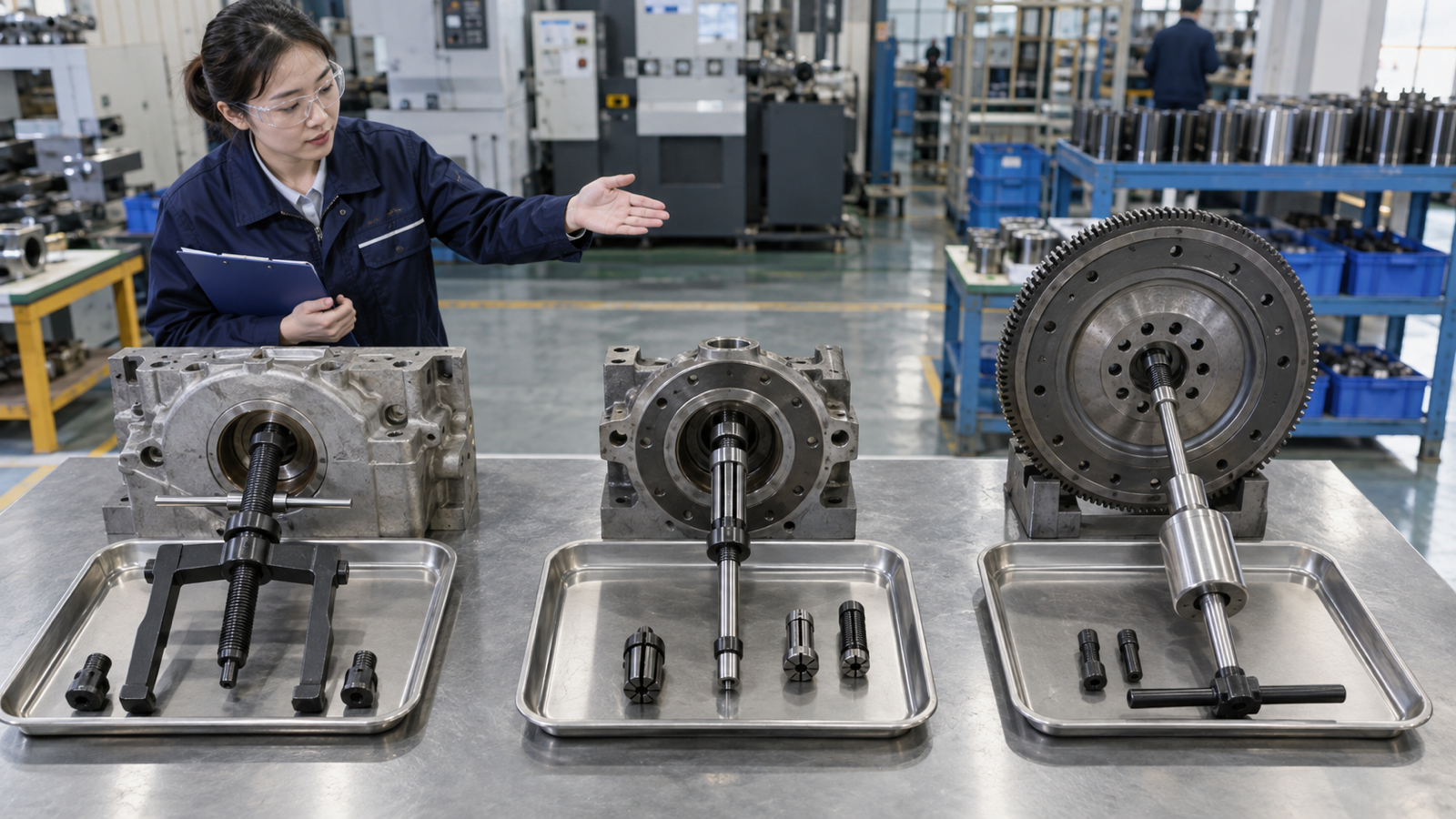
Choose from access, grip, control, and repeat workload. A screw/bridge tool gives deliberate force where the bridge can react. A slide hammer helps when one-sided access leaves no bridge location. A multi-collet set can cover more measured bores, yet extra sizes add inventory and inspection work. A vehicle-specific adapter may reduce fit uncertainty for a defined application.
The best configuration is the one you can prove: compare the complete force path, not just collet count or tool appearance.
Use this sequence:
- establish target component and access direction;
- measure bore, depth, and surrounding envelope;
- decide whether screw control or slide impact suits the work area;
- confirm compatible adapters and spares;
- compare documentation, sample fit, and stated limits;
Complementary socket-tools system components support adjacent tasks, but socket-drive compatibility does not validate a pilot-bearing puller.
Practical action: score each candidate against fit, access, control, safety documentation, and serviceability before price comparison.
Configuration comparison
| Configuration | Strength | Main buyer check |
|---|---|---|
| Screw/bridge | Controlled axial loading | Reaction surface and screw rating |
| Collet plus rod | Flexible internal grip | Collet range and engagement |
| Slide hammer | One-sided access with impulse | Stroke, stop, and pinch control |
8. What quality checks belong in an RFQ?
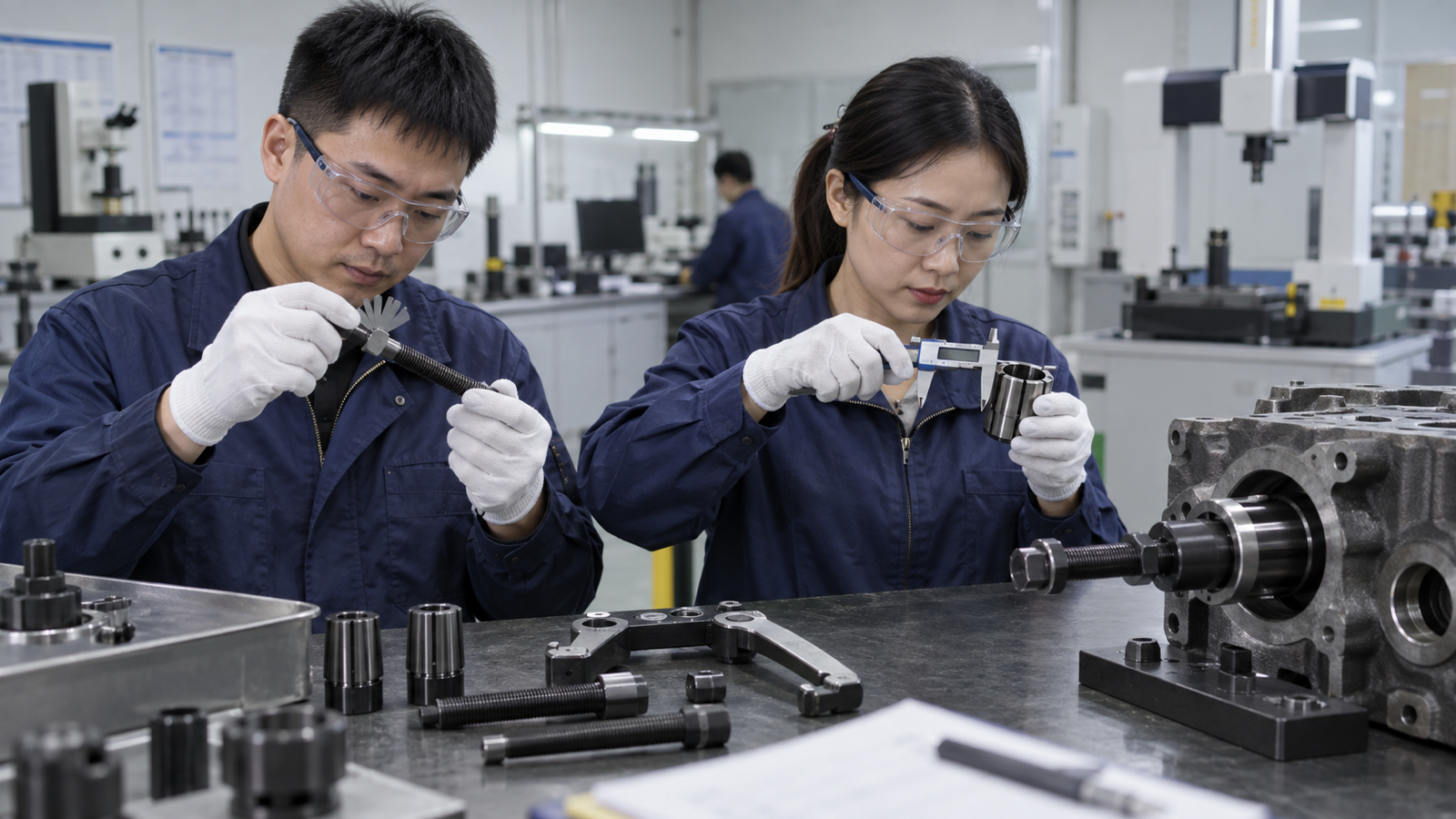
A serious RFQ connects drawings with material, process, inspection, packaging, and change control. “Strong steel” or “professional quality” cannot tell a buyer whether a collet expands evenly, a thread runs cleanly, or a bridge remains square under load.
Quality starts with measurable acceptance points: write them before sample production.
Include:
- approved drawing and bill of materials;
- material or grade requirement by load-bearing component;
- thread, jaw, and collet dimensional checks;
- hardness or heat-treatment evidence only where specified;
- functional fit check using representative interfaces;
- inspection sample size and nonconformance rule;
- spare-part and substitution approval;
The China OEM auto-tools sourcing guide offers broader supplier and packaging questions for mixed automotive-tool programs.
Practical action: require a signed sample report that links each measured result with a drawing revision.
RFQ quality gate
| RFQ line | Evidence | Acceptance decision |
|---|---|---|
| Geometry | Drawing and measured sample | Release or revise |
| Material/process | Approved specification and records | Accept only documented route |
| Function | Representative fit check | Approve application or limit claim |
9. What should a product kit include?
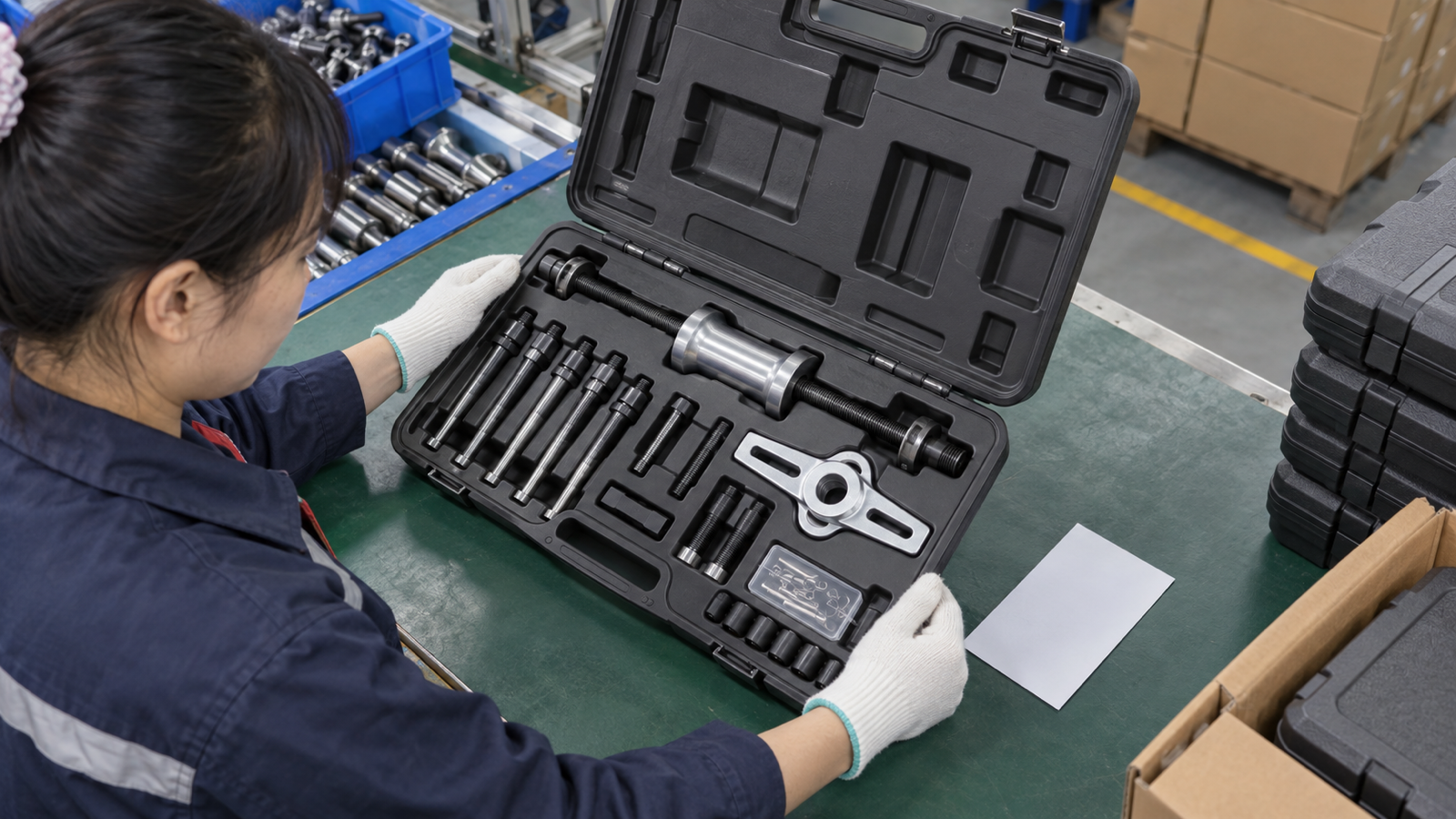
A distributor-ready kit needs more than a puller body and loose adapters. Count each collet, jaw, rod, bridge, screw, pin, wrench, spacer, cap, and instruction sheet. Replacement parts can determine serviceability.
A complete BOM prevents a partial tool from reaching a customer: case layout and component identification should match the approved sample.
Review:
- exact collet or jaw sizes and identification marks;
- compatible bridge, rod, screw, and slide hammer parts;
- spare wear parts and order codes;
- protective pieces for shafts and threads;
- instructions with fit limits and stop conditions.
Use the mechanics tool-set range and mechanic tool-set selection guide for case planning. List pilot-puller components separately.
Practical action: approve the tool, BOM, tray, labels, and instruction sheet as one sample package.
Kit completeness table
| Kit element | Buyer check | Complaint prevented |
|---|---|---|
| Puller body | Correct thread and connection | Incompatible assembly |
| Collets/jaws | Count, range, and identification | Missing application size |
| Spares | Part numbers and availability | Early kit downtime |
10. How should a buyer approve pilot-bearing pullers?

Approve a pilot-bearing puller through a repeatable sample gate. Start with a named application or measured fixture. Confirm collet entry, full engagement, axial alignment, reaction support, and clearance. Then check the complete BOM, replacement parts, packaging, instructions, and change-control process. A sample that fits one loose bearing does not prove vehicle coverage.
The final approval should be easy to audit: someone outside the original buying conversation must be able to see which interface, configuration, and evidence released the SKU.
Use this final sequence:
- attach target drawings, photos, or service references;
- record measured bore, depth, shoulder, and clearance;
- test each supplied collet or adapter on its assigned fixture;
- record abnormal movement, slippage, or interference;
- confirm stated operating limits and prohibited methods;
- approve BOM, case, spares, and instructions together;
- freeze drawing and change-notice requirements before production.
For a wider OEM package, review OEM socket-set packaging options without transferring socket claims to pullers. Related buyer guidance is available through the B2B tool sourcing blog. For measured dimensions, target quantity, packaging, and private-label requirements, use the contact page for a pilot-puller RFQ.
Practical action: release a pilot-bearing puller only after fit, force path, documentation, and kit completeness pass the same approval record.
FAQs
1. Is a pilot-bearing puller the same as a blind-bearing puller?
They can use a similar internal-collet principle. “Pilot-bearing puller” describes an application, while “blind-bearing puller” describes access. Confirm bore, depth, grip surface, and vehicle data before treating them as interchangeable.
2. Should buyers choose a slide hammer or screw-type puller?
Choose from stroke clearance, reaction support, required control, and approved tool instructions. A slide hammer helps where one-sided access limits bridge placement. A screw type may suit close quarters with a sound reaction face.
3. Can one collet kit fit every pilot bearing?
No universal fit should be assumed. Collet range, jaw shape, bore depth, shoulder position, and nearby clearance vary. Request application evidence or test a representative fixture.
4. Can a technician use an impact wrench on a screw-type puller?
Not unless current instructions expressly permit that method. An impact wrench can change loading speed and peak force. Follow the tool maker’s stated actuation method and limit.
5. What should appear in a pilot-bearing puller RFQ?
List target applications, measured bore and depth, access envelope, grip surface, configuration, dimensions, materials or process requirements, inspection evidence, spare parts, packaging, instructions, and change-control rules.
Looking for a reliable mechanic tools manufacturer in China?
If you are sourcing hand tools, socket tools, automotive repair tools, mechanic tool sets or OEM private label tools, contact KOLARWIN Tools for factory-direct quotation, customization support and product consultation.


