
Need OEM supplier support for this product type?
Contact KOLARWIN Tools for OEM mechanic tools, private label packaging, wholesale quotation and product range support. This gives overseas buyers a clear path from article reading to supplier discussion.
Axle-bearing jobs stall when buyers compare a puller body with a slide hammer as if both describe the same thing. A puller defines grip and support. A slide hammer defines axial force. This guide helps B2B buyers specify the complete system without universal fit or invented ratings.
Contents: Grip versus force · Puller engagement · Slide-hammer action · Screw pullers · Slide-hammer fit · Attachment geometry · Axles and hubs · Risk and control · RFQ data · Approval
1. What is an axle bearing puller vs a slide hammer?
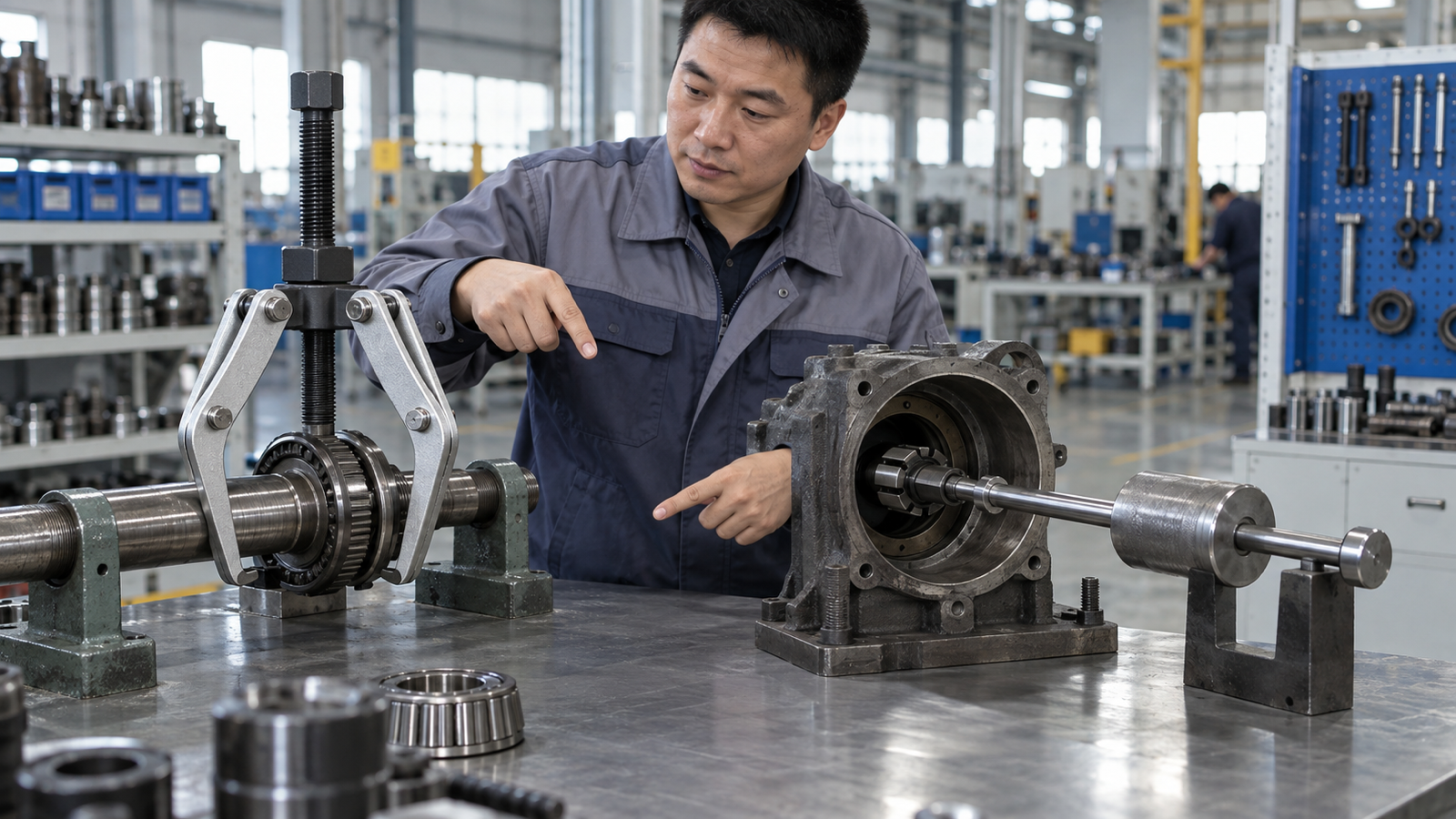
An axle bearing puller is a grip-and-reaction system using jaws, collets, separators, flanges, bridges, or frames. A slide hammer is a force method: a weighted mass travels along a rod and strikes a stop. One names contact geometry; the other names actuation.
For an axle-tool assortment, separate these choices before comparing case photos or piece counts:
- Grip location: outer shoulder, inner race, flange, or specified bore surface.
- Reaction path and application: shaft end, bridge, counterstay, housing face, hub studs, axle housing, or blind bore.
- Actuation: forcing screw, hydraulic cylinder, or sliding mass.
Here is the clean buying rule: select the attachment from the interface, then select a force method that has room, control, and approved connections. KOLARWIN’s automotive repair tools range gives distributors a wider category view before a puller line is built.
Action: send suppliers a section drawing showing axle diameter, bearing ring, rear clearance, and the reaction surface.
Initial comparison for a product range
| Item | Axle bearing puller | Slide hammer | Buyer check |
|---|---|---|---|
| What it describes | Grip, frame, and reaction arrangement | Axial impulse from moving mass | Specify both, not one label |
| Typical connection | Jaws, collet, separator, bridge, or hub studs | Threaded rod, adapter, or approved jaw attachment | Match threads and locking parts |
| Force character | Steady screw or hydraulic load, depending on model | Repeated axial impulse | Confirm manual and clearance |
| Main fit question | Can the target ring or shoulder be engaged? | Can the attachment stay engaged through its stroke? | Test a representative axle |
2. How does an axle bearing puller grip the part?
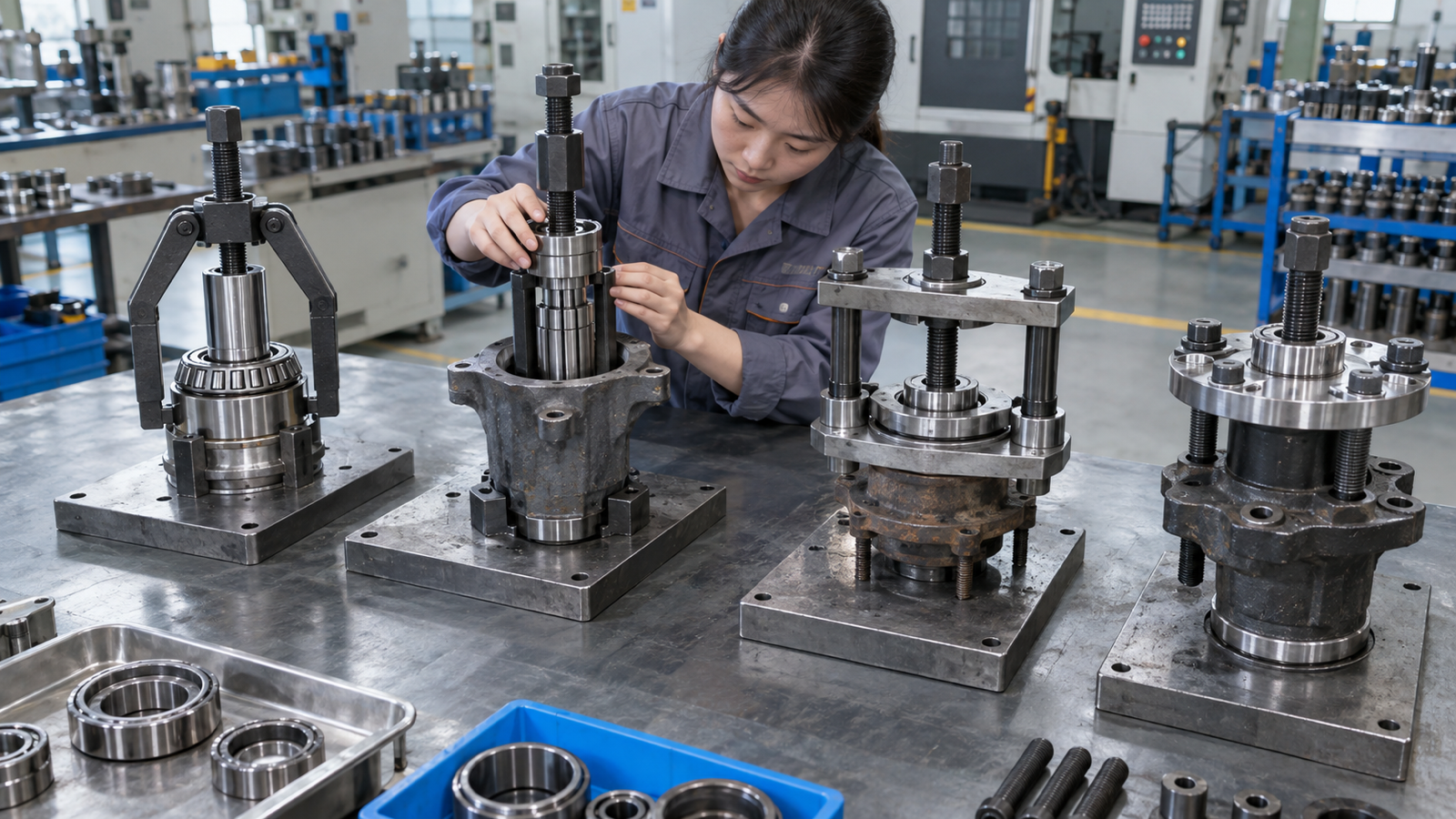
Grip geometry decides whether force reaches the bearing. External jaws sit behind a shoulder or ring. An internal puller expands inside a bore. A separator uses thin plates where jaw tips cannot enter. A hub puller may connect through a flange or stud pattern.
Axle assemblies add awkward neighbours. A seal, sensor, retaining lip, or thin flange can look convenient while offering a poor load path. A bearing may sit on a shaft or inside a housing, so one catalogue tool cannot suit both.
- Name the ring or shoulder that must move and measure usable grip depth.
- Check jaw-tip thickness against seals, chamfers, and adjacent parts.
- Identify every surface that must remain reusable after removal.
Contact comes before capacity: a higher number cannot correct a jaw that rolls out or a collet on a seal. Use KOLARWIN’s mechanic tools list to place specialist pullers in a workshop assortment.
Action: require a dimensioned fit sketch with the target ring and excluded surfaces marked.
Grip-method comparison
| Grip method | Suitable interface when | Main stop condition | Evidence for approval |
|---|---|---|---|
| External jaws | A sound outside shoulder remains exposed | Jaw touches seal, cage, or thin flange | Reach, spread, tip profile, fit photo |
| Internal collet | A bore gives a strong internal shoulder | Fingers bottom out or grip a chamfer | Bore range, engagement depth, section view |
| Separator plates | A narrow rear gap accepts both plates | Plates sit unevenly or on a weak edge | Plate thickness, opening, shoulder drawing |
| Hub or flange adapter | Stud or bolt pattern carries the pull | Pattern, thread, or clearance does not match | Pattern drawing, adapter BOM |
3. What does a slide hammer do during axle bearing removal?
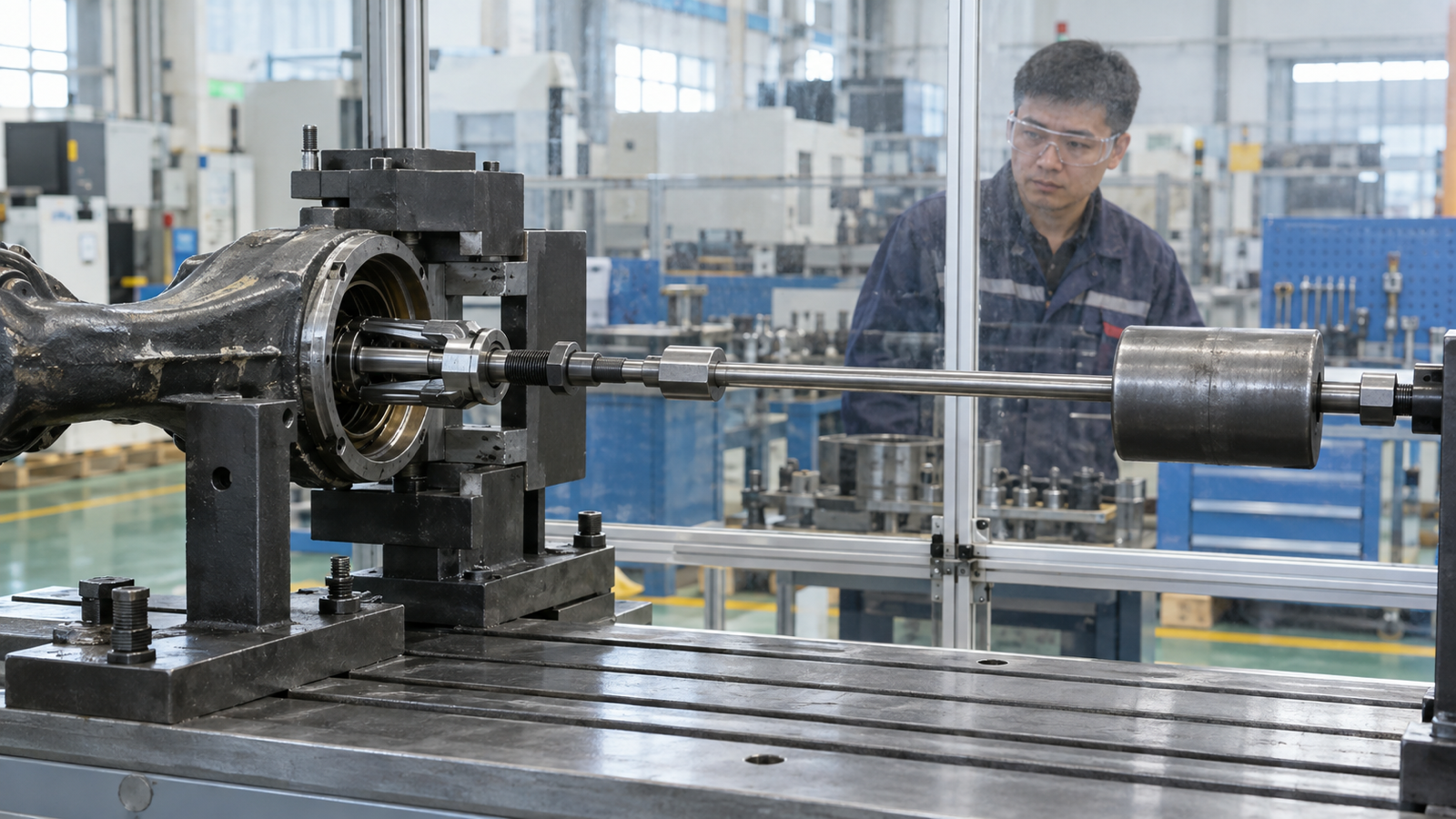
A slide hammer sends axial impulse through a moving mass and fixed stop. It does not decide whether grip sits inside a bore or behind an outside shoulder. A collet, jaw, separator, or flange adapter still controls contact.
Impulse can help where a bridge cannot fit, but it changes release behaviour. A weak bite may loosen suddenly, a wrong thread may damage an adapter, and a short bay may lack stroke clearance. Hammer mass, rod length, stop, and thread vary by set.
- Confirm attachment locking, full-stroke clearance, and a clear release path.
- Keep people away from the line of pull.
- Follow current instructions for impact, guarding, and inspection.
The hammer is only half the product: an RFQ should name rod, stop, adapter, and grip range. Do not sell a loose sliding mass as a complete system.
Action: request a matrix showing every attachment, thread, permitted orientation, and limit.
Slide-hammer package review
| Package element | Buyer question | Risk if omitted |
|---|---|---|
| Weighted mass | What mass and usable stroke are supplied? | Buyer infers force from appearance |
| Rod and stop | Does the stop stay secure under repeated movement? | Sudden release or damaged threads |
| Attachment | Internal, external, separator, or flange type? | Wrong grip geometry |
| Instructions | Are impact and inspection limits stated? | Uncontrolled operating practice |
4. When does a screw-type axle bearing puller suit better?
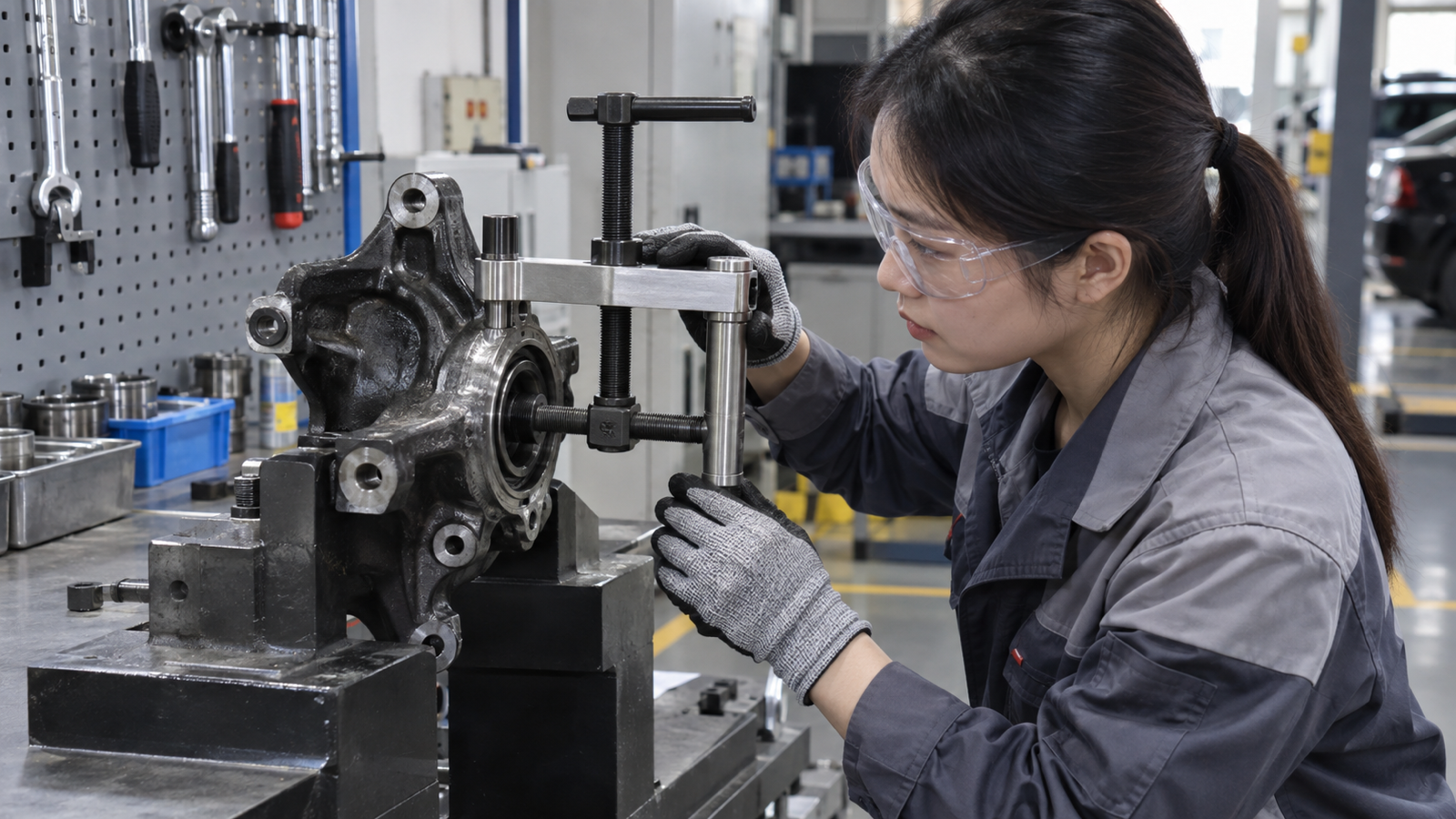
A screw-type puller applies steady force through a spindle, bridge, or counterstay. It may suit an axle bearing with a stable reaction face and little room for a sliding stroke. The operator can pause and inspect alignment within the maker’s limit.
Steady force does not fix poor setup. The bridge must stay square, the grip engaged, and the spindle supported at a protected centre point. Reconsider when no bridge surface exists or the attachment cannot reach.
- Confirm bridge clearance, spindle length, thread, centre support, and stroke.
- Inspect whether frame and attachment are rated together.
- State whether the bearing or axle must be preserved.
Control has a geometry requirement: the reaction path must stay stable while the target moves. Ask for an assembly drawing rather than a frame-only photograph.
Action: fit-test the narrowest, deepest application before adding the screw configuration to a private-label line.
For sourcing context around a mixed program, use KOLARWIN’s China OEM auto-tools sourcing guide.
Screw-puller decision points
| Decision point | Screw puller may suit when | Reconsider when |
|---|---|---|
| Reaction face | Bridge or housing face stays square | No firm face can support the frame |
| Axial control | Slow, inspectable movement is preferred | Required stroke exceeds available space |
| Grip | Collet, jaws, or separator remain fully seated | Grip is shallow or sits on a seal |
| Packaging | Frame, spindle, adapters, and spares fit a case | Missing parts would be sourced ad hoc |
5. When can a slide hammer suit an axle bearing application?
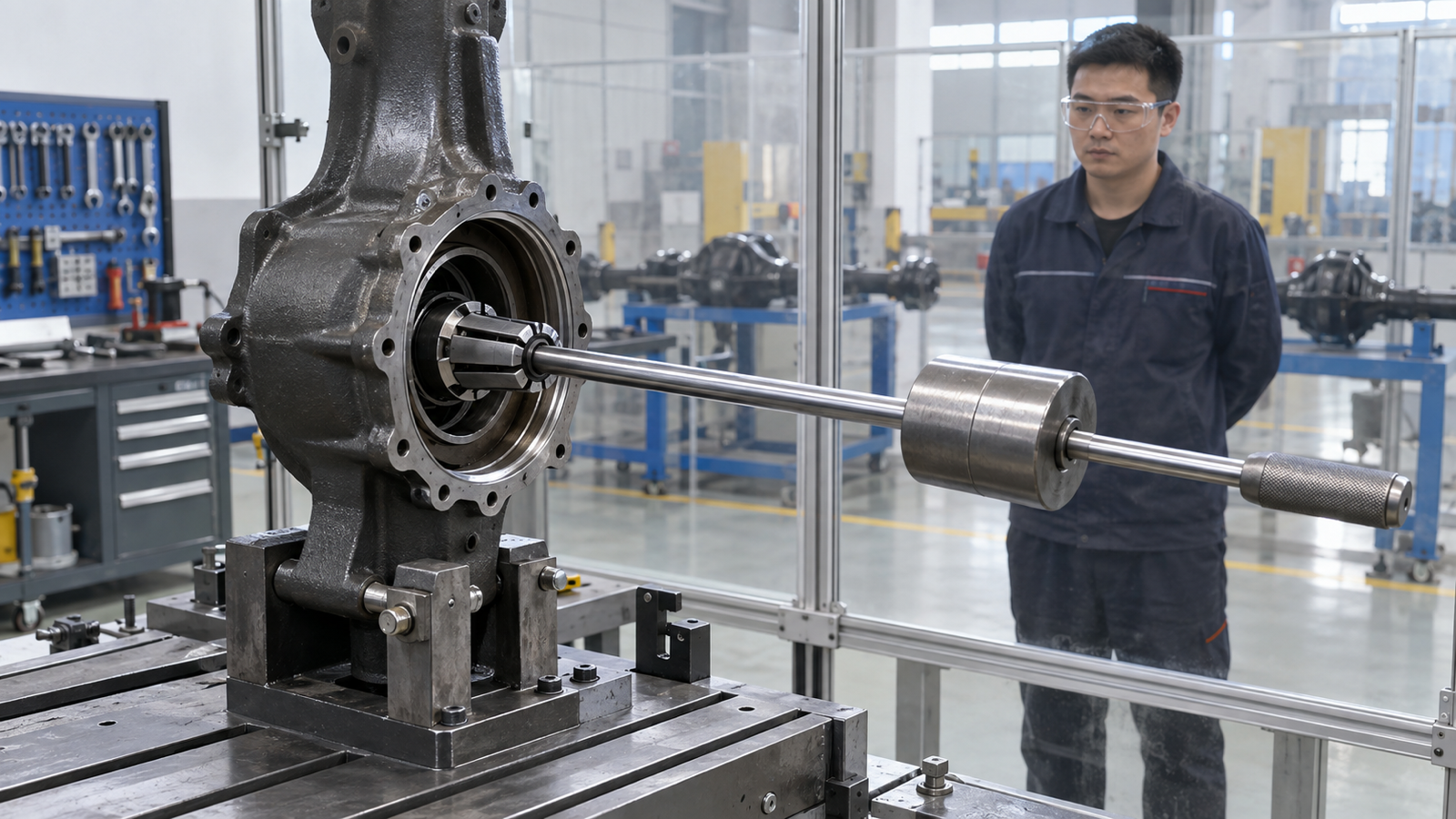
A slide hammer may suit when access is one-sided, a bridge cannot be placed, and an approved attachment can maintain a sound grip. Blind housings and compact bores create this situation. Correct fit still depends on bore diameter, shoulder depth, ring position, and surrounding clearance.
A slide hammer can be awkward beside a vehicle body, lift arm, or bench wall. Impact needs a different risk review from a screw. A printed diameter range does not prove that an internal finger can engage the actual race shoulder.
- Measure the full stroke envelope, not only axle length.
- Check grip engagement before impulse and confirm operator clearance.
- Compare a counterstay or screw option where impact is unsuitable.
Fit and stroke must agree: a perfect collet fails if the rod lacks safe travel or the stop cannot be controlled.
Action: approve one blind-housing sample with full engagement visible and the mass parked safely.
Slide-hammer suitability screen
| Application condition | Slide hammer may suit | Ask before approval |
|---|---|---|
| One-sided access | No bridge or rear support can fit | Is the attachment fully specified? |
| Blind housing | Internal grip reaches a sound shoulder | Bore, depth, and bottom clearance |
| Load behaviour | Grip stays secure under impulse | Impact limits and stop design |
6. How do internal and external attachments change the choice?
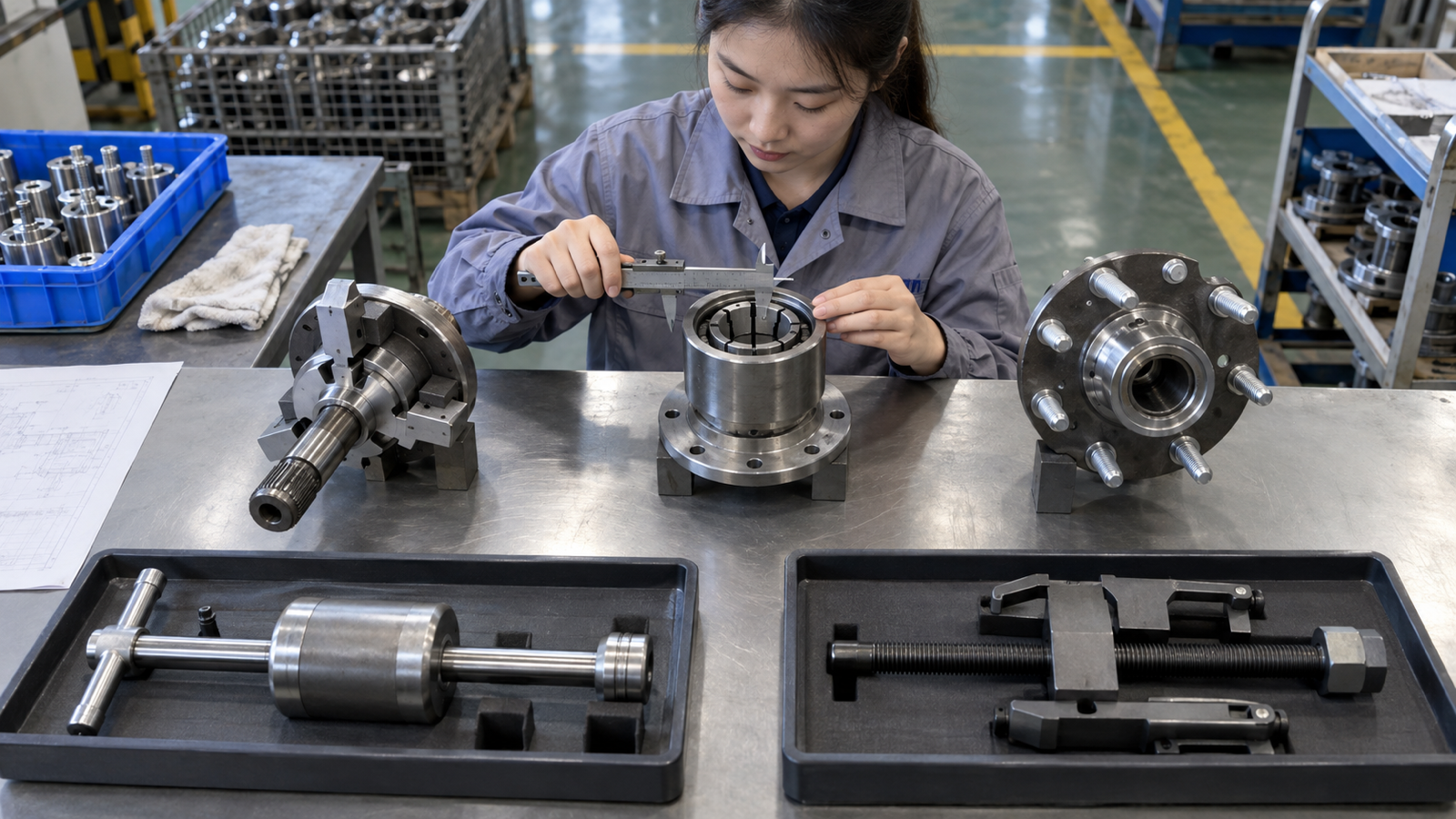
An internal attachment expands inside a bearing bore or approved cavity. It suits a closed housing only when fingers reach a strong surface behind the target. An external attachment hooks behind an outside shoulder. A separator or flange adapter offers another load path.
“Slide-hammer puller” can hide several assemblies. One set may include an internal collet and reversible jaw; another may need a separate rod, bridge, or adapter. Reversible jaws can change orientation while spread, reach, and force limit also change.
- Request a component-level bill of materials and record internal and external ranges separately.
- Check each adapter’s permitted use with the hammer.
- Test the smallest bore and shallowest shoulder in the target range.
Name the attachment in every SKU: customers should see “internal collet plus slide hammer” or “external jaw plus screw frame,” not only “axle puller kit.”
Action: print a fit matrix showing attachment, access direction, reaction requirement, and excluded surfaces.
Attachment-choice matrix
| Attachment | Grip surface | Typical actuator | Buyer must verify |
|---|---|---|---|
| Internal collet | Bore shoulder or specified inner surface | Slide hammer, screw, or bridge | Bore range and engagement depth |
| External jaws | Outside ring or shoulder | Screw, hydraulic, or slide hammer | Reach, spread, jaw seating |
| Separator | Rear face behind component | Beam, screw, or hydraulic frame | Plate seating and plate thickness |
| Flange adapter | Hub or axle stud pattern | Screw, hydraulic, or approved hammer | Pattern, thread, and support |
7. How do axle shafts, hubs, and blind housings change the tool choice?
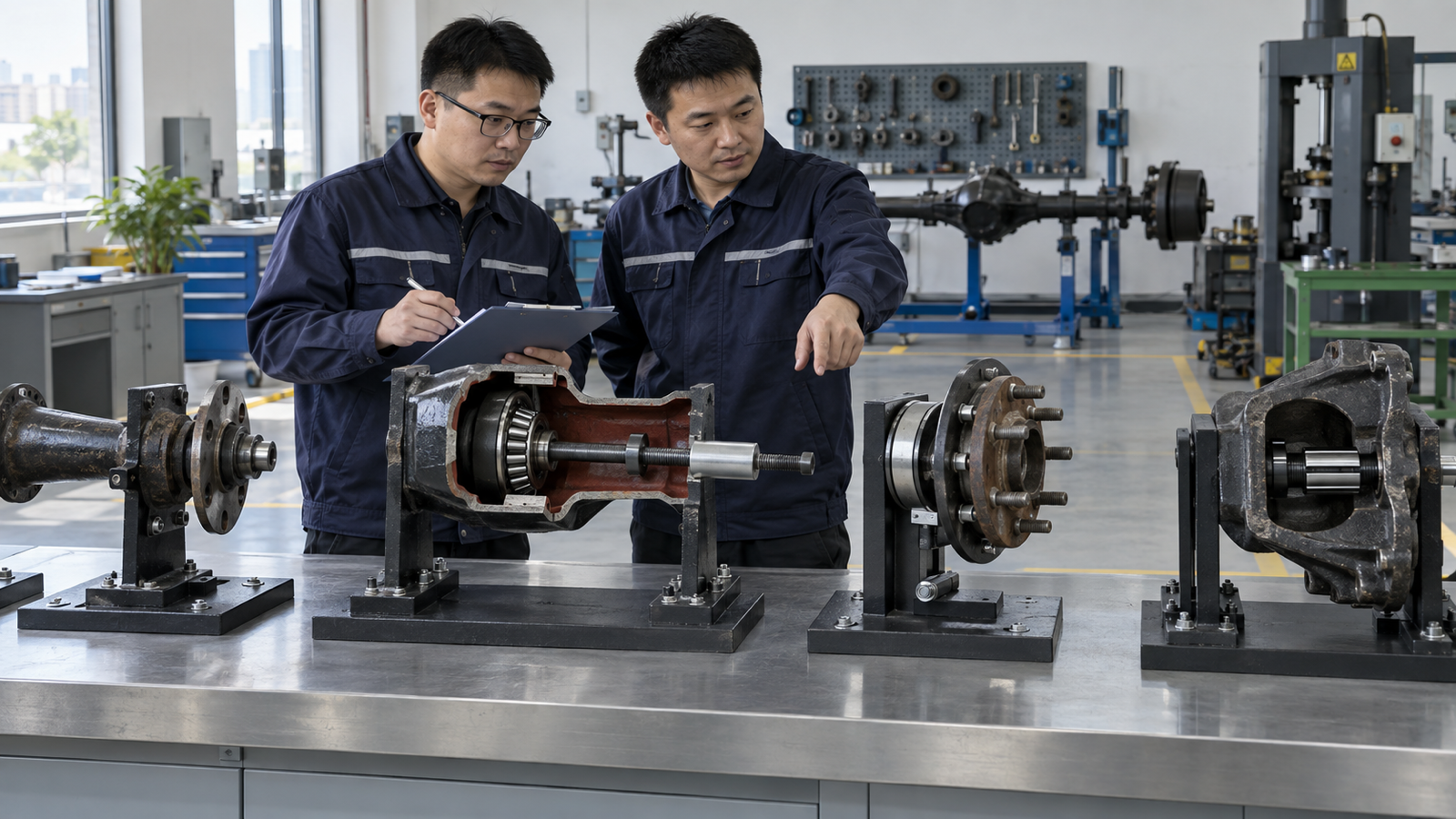
Axle work covers arrangements that should not become one vehicle procedure. A bearing may sit on a shaft, remain inside an axle tube after the shaft is removed, or sit on a hub flange. A blind housing may leave only a bore. Pulling an axle shaft by its flange is a different operation from extracting the housing-retained bearing with an attachment that captures the bearing inside the tube.
Each arrangement changes the grip and reaction question:
- Axle shaft: identify the fitted ring and protect threads, splines, and seals.
- Housing-retained axle bearing: confirm tube inside diameter, bearing position, rear access, attachment profile, and clearance for the rod or counterstay.
- Hub or open housing: check studs, flange thickness, sensor clearance, and square jaw or separator seating.
- Blind housing: check internal engagement, bottom clearance, and actuator path.
Vehicle names do not replace measurements: confirm the actual assembly and current service information before promising a tool for a model range. A private-label program can still offer application guidance without publishing one universal removal sequence.
Action: build separate sample panels for shaft, hub, open housing, and blind housing applications before packaging approval.
Application-to-attachment map
| Assembly | Common access question | Possible system | Do not assume |
|---|---|---|---|
| Shaft-mounted bearing | Can the target race be reached behind? | External jaws or separator plus screw | Hub tool will fit the shaft |
| Bearing retained inside axle tube | Can a dedicated attachment capture the bearing without contacting the tube or seal land? | Internal axle-bearing attachment with approved slide hammer or counterstay | Axle-flange plate removes the bearing |
| Hub bearing | Does a flange or stud pattern react the pull? | Flange adapter or hub puller | Stud spacing is universal |
| Blind housing | Can an internal grip reach behind the ring? | Internal collet plus slide hammer or bridge | Every bore accepts every collet |
8. How should buyers compare control, speed, and risk?
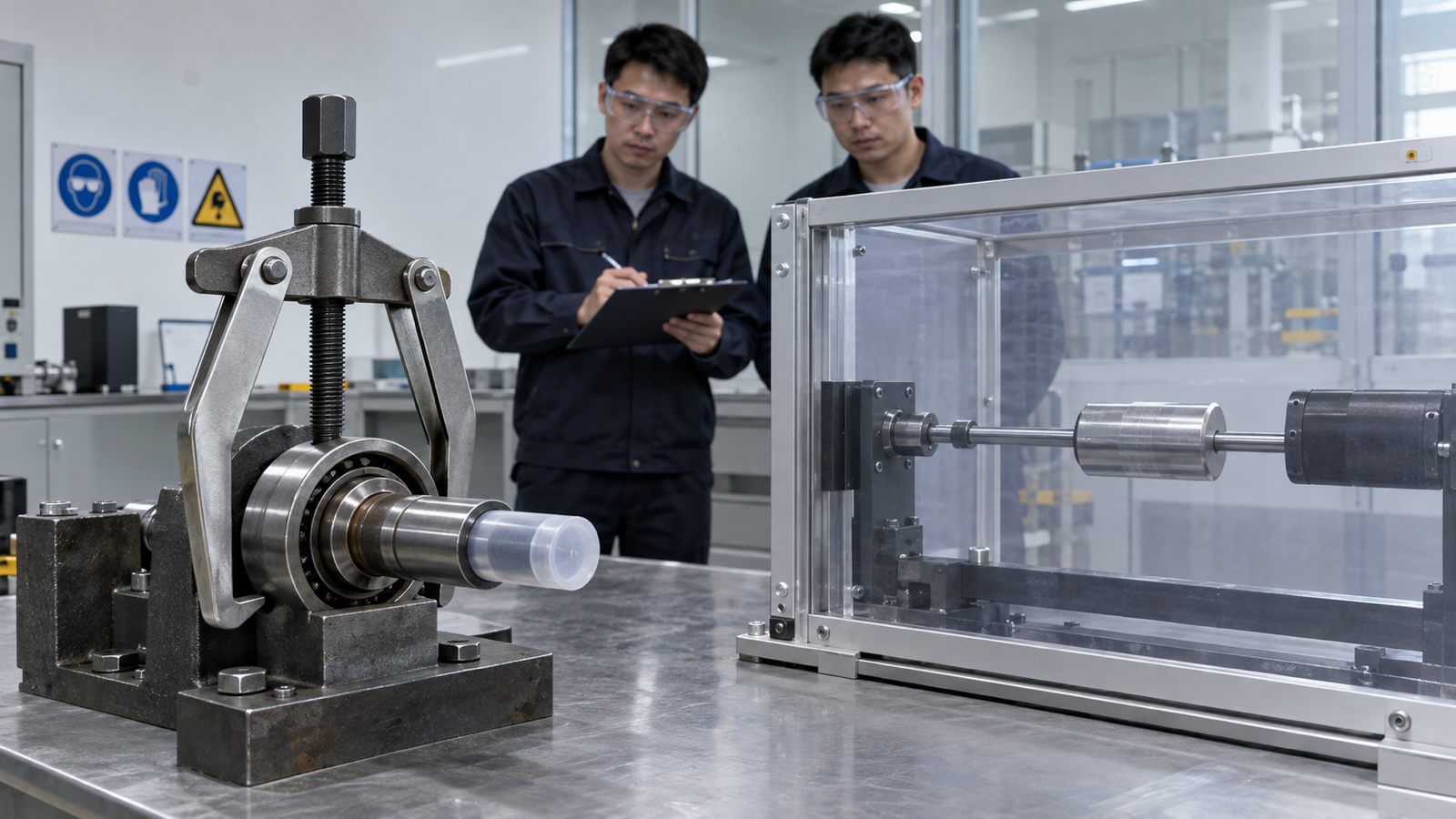
“Faster” only has meaning after grip, access, and operator control are defined. A slide hammer can avoid a bridge in a cramped bay. A screw puller can provide steadier movement where inspection matters. A hydraulic arrangement reduces manual spindle effort while adding stored pressure, hose, and coupler hazards.
Buyers should compare the complete work method rather than one headline feature:
- Control: pause points, alignment checks, and adjustment access.
- Access: bridge room, hammer stroke, operator stance, and guarding.
- Repeat work and failure path: attachment changes, spares, inspection time, jaw release, adapter damage, fragments, or stored energy.
Risk follows the whole load path: poor seating can make a screw setup hazardous, while impact needs release space and a confirmed connection. KOLARWIN’s distributor tool-set guide places this specialty system in a broader assortment review.
Action: score candidates against grip, access, control, guarding, spares, and documentation before unit price.
Control and risk comparison
| Criterion | Screw puller | Slide hammer | Procurement question |
|---|---|---|---|
| Force delivery | Steady through spindle or frame | Repeated axial impulse | Which method suits the assembly? |
| Operator control | Pause and inspect between turns | Clear stroke and release zone | Can the user stay outside the path? |
| Space need | Bridge and reaction face | Rod travel and mass clearance | Which envelope exists in the bay? |
9. What specifications and documents should buyers request?
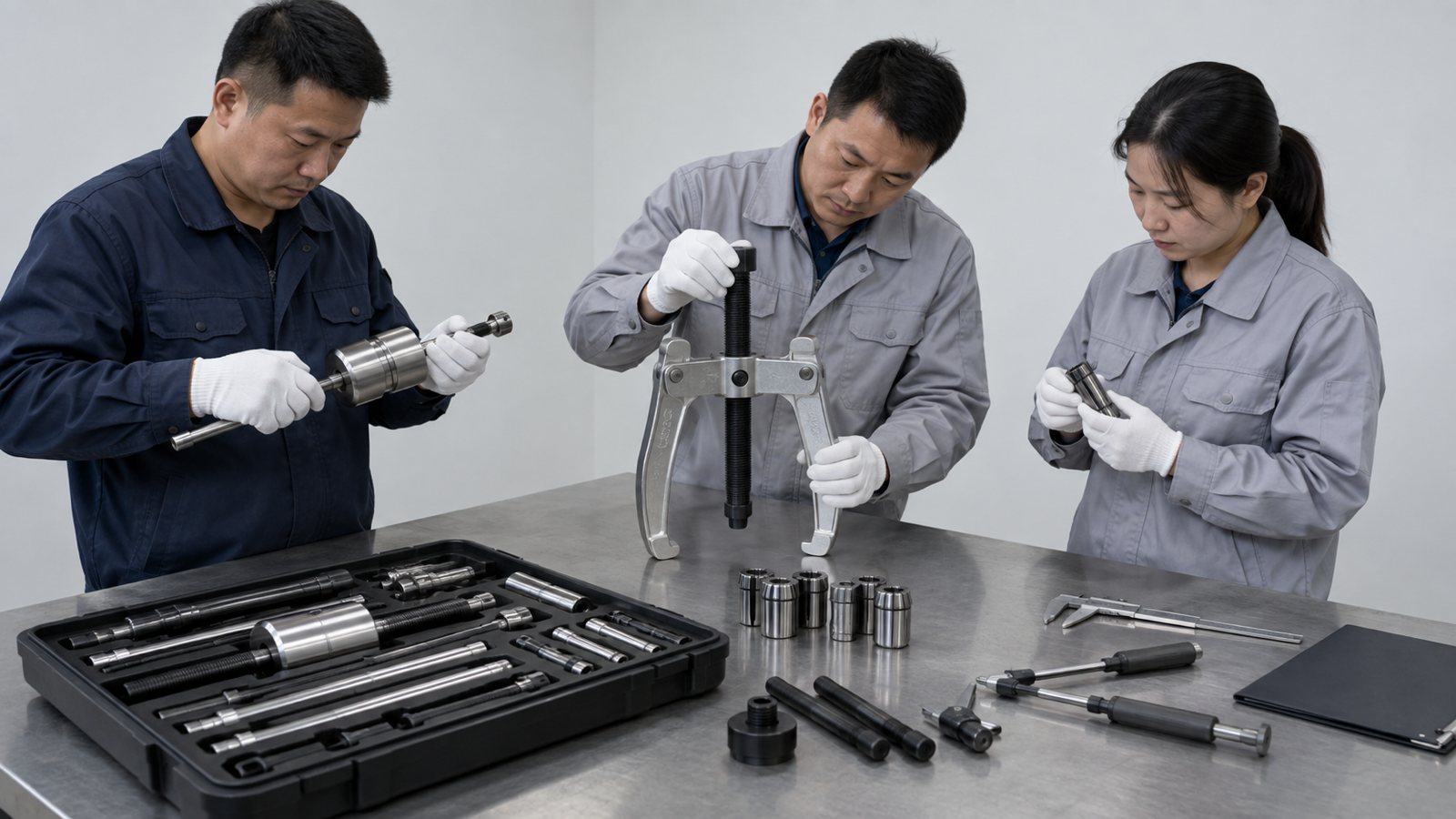
An RFQ should describe the exact rated configuration rather than “heavy-duty axle puller.” Request geometry, actuation, inspection, packaging, and application evidence. Similar-looking products may use different rods, threads, jaws, or force limits.
Include these fields:
- Internal and external spread, bore range, reach, throat depth, jaw-tip thickness, and stroke.
- Attachment type, rod length, hammer mass, stop, thread, pins, and locking method.
- Configuration-specific force or pressure, frame, hose, coupler, protection, spare parts, wear limits, instructions, and packaging BOM.
Paperwork should describe the load path: a capacity number without reach, spread, attachment, and test basis can mislead. KOLARWIN’s socket-tools system covers complementary accessories, but socket claims do not transfer into puller ratings.
Action: make a signed RFQ checklist part of sample approval and change control.
RFQ field checklist
| Field group | Required detail | Why it matters |
|---|---|---|
| Geometry | Bore, spread, reach, shoulder depth, stroke | Proves interface fit |
| Actuation | Screw, hydraulic, or slide hammer; complete BOM | Defines force path |
| Rating | Configuration, test basis, pressure or force limit | Prevents headline-number misuse |
| Safety | Guards, PPE, inspection, stop conditions | Defines operating controls |
10. How should a distributor approve a puller and slide-hammer program?
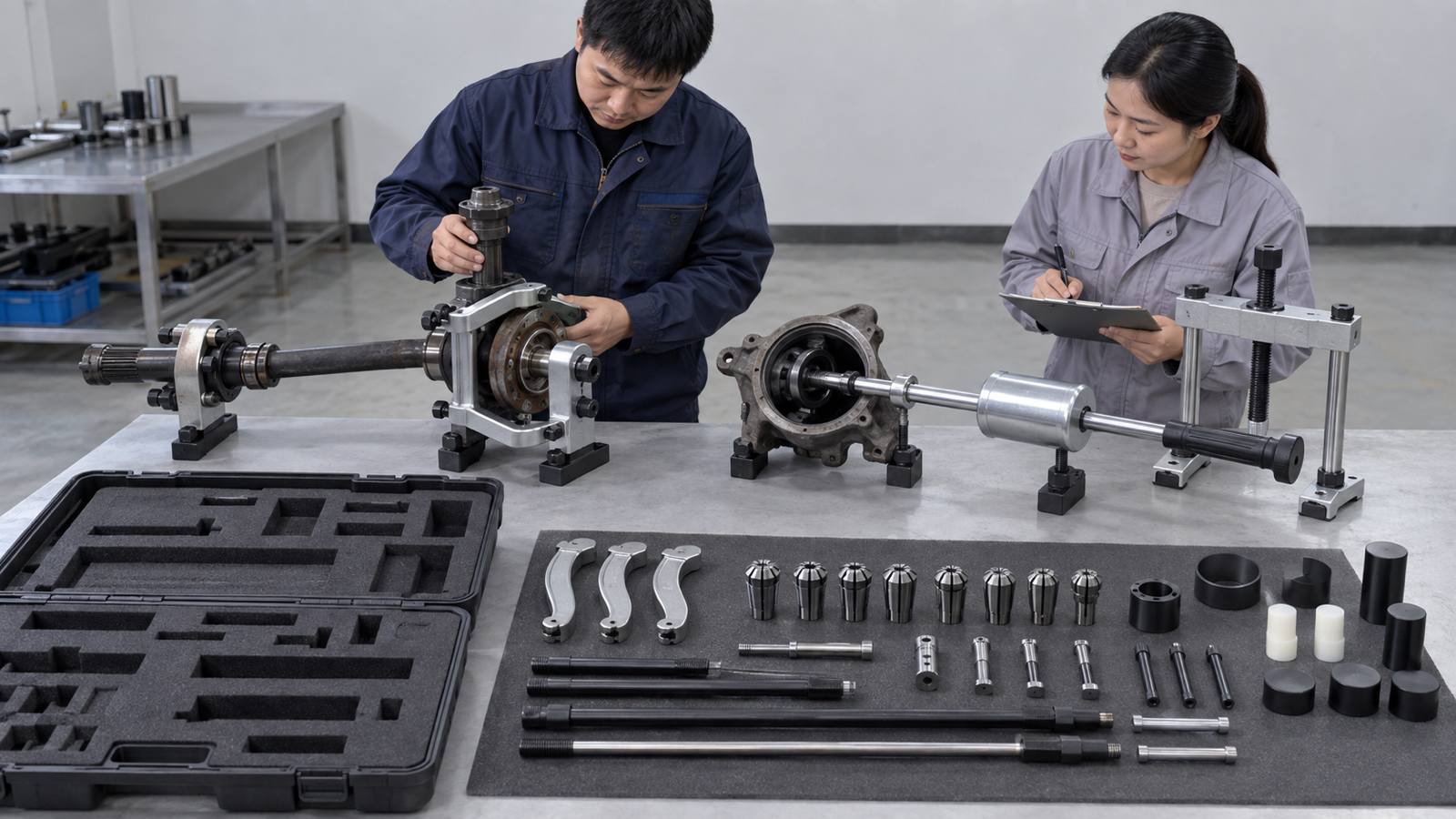
Approve the product as a documented system. Test representative shafts, hubs, open housings, and blind housings. Confirm grip, alignment, reaction support, clearance, and protection. Freeze the BOM, drawings, instructions, spares, and packaging.
Use a staged review:
- Fit sample: measure the interface and photograph intended contact.
- Function and safety: check movement, guarding, PPE, isolation, operator position, and stops.
- Commercial review: confirm case layout, spares, language, change notice, and pilot feedback.
A clean approval ends with a decision rule: if attachment, reaction path, and force method cannot share one sheet, the kit is not catalogue-ready. Compare mechanics tool-set options and OEM socket-set packaging after freezing the puller BOM. Then contact KOLARWIN about an axle-puller RFQ and review B2B sourcing guidance.
Action: issue one approval sheet per SKU and reject later changes until a new fit check is signed.
FAQ: Is a slide hammer the same as an axle bearing puller? No. A slide hammer supplies axial impulse; the puller system includes attachment, grip, reaction path, and connections.
FAQ: Can any slide hammer remove an axle bearing? No. Bore, shoulder, attachment, thread, stroke, and instructions must match. A generic diameter range does not prove fit.
FAQ: Should buyers choose a screw puller or a slide hammer? Choose from access, reaction support, control, grip security, and the rated configuration. A screw may suit a stable bridge; a slide hammer may suit one-sided access.
FAQ: Does an internal collet make a tool a slide-hammer puller? No. The collet describes internal grip. It may connect to a hammer, bridge, screw, or another approved actuator.
FAQ: What should a private-label buyer put on the package? Name attachment, range, actuator, components, warnings, inspection guidance, and limits. Avoid “fits all” and universal force claims.
Looking for a reliable mechanic tools manufacturer in China?
If you are sourcing hand tools, socket tools, automotive repair tools, mechanic tool sets or OEM private label tools, contact KOLARWIN Tools for factory-direct quotation, customization support and product consultation.


