
Home/Blog/ Spark Plug Socket Sizes: A Buyer’s Guide to Hex, Drive, and Access

Spark Plug Socket Sizes: A Buyer’s Guide to Hex, Drive, and Access

Get OEM Tool Catalog + Quote Back to Tool Sourcing Blog
Unbranded spark plug sockets in six common hex sizes arranged on a factory inspection bench
This KOLARWIN Tools article is written for overseas distributors, wholesalers, importers and private label tool brands sourcing mechanic tools, automotive repair tools, socket tools, hand tools and OEM tool sets from China. Use this guide to compare product options, check supplier quality points and move from reading to a faster B2B inquiry.

Need OEM supplier support for this product type?

Contact KOLARWIN Tools for OEM mechanic tools, private label packaging, wholesale quotation and product range support. This gives overseas buyers a clear path from article reading to supplier discussion.

A full socket drawer can still stall on one spark plug. A 5/8-inch socket may fit one application while a 14 mm thin-wall 12-point tool suits another. Wall, reach, retainer, drive, and access decide whether a product clears nearby wiring.

Spark plug socket sizes must follow the plug’s specified hex, thread, reach, and engine access. Treat 14 mm, 16 mm, 18 mm, 20.8 mm, 5/8 inch, and 13/16 inch as catalog labels to check against the exact plug specification. Nearby inch and metric values are not exact conversions. Confirm each target plug, then sample-fit a finished socket.

1. What spark plug socket sizes should a buyer stock?

Spark plug tool catalogs include 14 mm, 16 mm, 18 mm, 20.8 mm, 9/16 inch, 5/8 inch, 11/16 inch, 3/4 inch, and 13/16 inch sizes. Stock only sizes supported by target plug references or service channels.
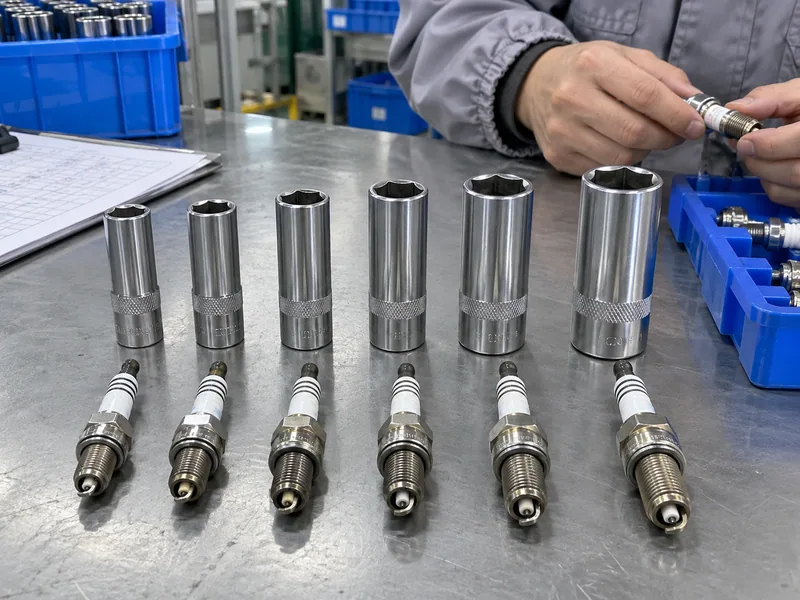
Unbranded spark plug sockets in six common hex sizes arranged on a factory inspection bench
AI-generated concept illustration; not an actual factory or test record.

Which hex sizes belong in a starter range?

Start with the plug part numbers your customers service. Manufacturer catalogs list 14 mm, 16 mm, and 20.8 mm hexes, while other plug families use different openings. A 14 mm bi-hex plug also requires the specified point form.

Size a range from confirmed plug data, then add access variants around those hexes.

  • Record the specified hex size and original unit; label any conversion separately.
  • Record 6-point or 12-point profile beside each size.
  • Separate regular, thin-wall, and extra-long versions.
  • Mark drive size on each SKU and package.

For adjacent range planning, review socket tool options alongside dedicated spark plug tools. This helps buyers avoid treating a general deep socket as a complete plug-service solution.

How should a distributor read a size chart?

Use a chart as a screening aid, then confirm a plug part number or service reference before selecting stock.

Specified hex label Exact value in mm Procurement caution
14 mm 14.0000 Check 6-point or bi-hex; do not relabel as 9/16 in
9/16 in 14.2875 Keep distinct from 14 mm in the size list
5/8 in 15.8750 Some catalogs pair this with 16 mm; confirm the approved socket fit
16 mm 16.0000 Match the actual plug and socket specification
11/16 in 17.4625 This is not an 18 mm conversion
18 mm 18.0000 Keep as its own specified opening
3/4 in 19.0500 A nearby 19 mm label is not an exact conversion
13/16 in 20.6375 Verify catalog fit; the exact conversion is not 20.8 mm
20.8 mm 20.8000 Follow the listed plug/socket pairing rather than rounding to 21 mm

The conversions use exactly 25.4 mm per inch. They describe nominal labels, not a universal interchangeability rule. Action: ask for target plug references before committing.

2. How do hex size, thread, and reach differ?

Hex size identifies the socket interface; thread diameter, pitch, seat style, and reach determine engine fit. They cannot substitute for one another.
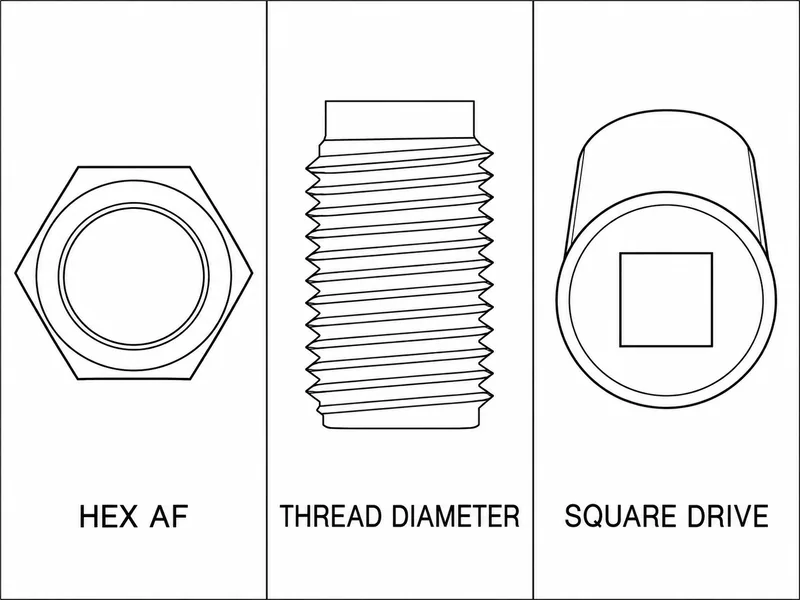
Labeled three-panel technical diagram for spark plug hex, thread diameter, and socket square drive
AI-generated technical illustration; schematic, not a dimensional drawing.

What does each plug dimension control?

The external hex is part of the metal shell below the exposed ceramic insulator and accepts a socket. Thread diameter and pitch engage the cylinder head. Reach controls threaded entry, while gasket or taper defines seating.

Put each dimension on its own line in your product data.

  • Hex across flats in the manufacturer’s specified unit
  • Thread diameter and pitch
  • Thread reach or threaded length
  • Seat style, such as gasket or tapered seat
  • Insulator clearance and shell envelope

Do not label a socket using thread size. A 14 mm thread does not mean a 14 mm hex, and a 16 mm hex does not identify thread reach.

Which dimensions belong in a buyer matrix?

Field Example entry Why procurement needs it
Hex 16.0 mm Selects socket opening
Point form 6-point Controls shell engagement
Drive 3/8 in square Matches ratchet, extension, or torque tool
Thread reference Customer plug part number Prevents false vehicle fitment
Reach Customer-specified value Protects cylinder-head compatibility
Seat Gasket or taper Supports correct installation guidance

Treat plug data as controlled. Action: require an approved plug drawing or part number before changing a socket profile. Cross-check inch and metric labels with this metric and standard socket conversion chart before publishing.

3. Which drive size should a spark plug socket use?

Drive size describes the square connection with a turning tool; it does not describe plug hex size. A 16 mm socket can use a 3/8-inch drive, while another may use 1/2-inch drive.
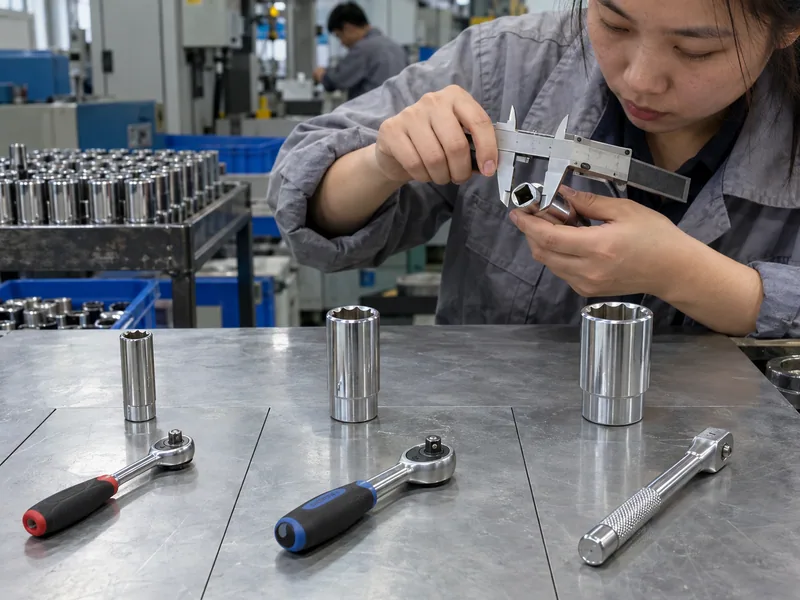
Three spark plug socket drive connections with matching ratchets and extensions on a factory bench
AI-generated concept illustration; not an actual factory or test record.

When does 3/8-inch drive make sense?

3/8-inch drive suits many service-bay spark plug sockets because it balances reach, clearance, and compatibility with common ratchets and torque tools. A 1/4-inch drive can suit compact access, but buyers should verify strength, wall design, and intended use. A 1/2-inch drive may help in a heavy-duty assortment, yet extra bulk can reduce access around coils and covers.

Choose square drive from access and tool compatibility, then choose hex from plug data.

  • Pair drive with a measured opening and body length.
  • Check extension retention and square-drive fit.
  • Specify hand-tool use unless impact service has been separately validated.
  • Keep drive marking legible after plating or finishing.

For a wider automotive assortment, see automotive repair tool ranges before deciding whether a single socket or set matches your channel.

How should drive options appear in a range sheet?

Drive Strength in a range Access tradeoff Buyer check
1/4 in Compact access and low-profile assemblies Lower force and smaller interface Confirm torque-tool compatibility
3/8 in Broad workshop compatibility May need thin-wall body Match square, detent, and extension
1/2 in Larger tool ecosystems and selected heavy-duty work More bulk near coils and covers Confirm clearance before listing

Keep drive and hex separate. Action: approve a drive only after ratchet, extension, and target plug pass a bench check.

4. How do thin-wall and deep designs affect access?

Thin-wall construction helps a socket enter a narrow plug well, while deep construction reaches a recessed plug. Neither repairs a wrong hex or unsuitable drive.

Thin-wall and deep spark plug socket reaching a recessed plug in an engine access fixture
AI-generated concept illustration; not an actual factory or test record.

What should buyers measure around a plug well?

Measure plug hex, socket envelope, well diameter, reach, and clearance around coils or boots. A correct hex can still fail when outside diameter contacts a casting.

Measure the complete access envelope instead of copying a nominal size.

  • Capture minimum bore diameter at the entry point.
  • Record required socket depth and extension length.
  • Check external flats, chamfers, and knurling against nearby parts.
  • Confirm ceramic and boot clearance during insertion.

A thin wall can reduce outside diameter, but it also leaves less material around a socket opening. Supplier drawings should state wall dimensions and intended hand-tool duty.

Which body style fits each access problem?

Body style Best use Main risk Sample evidence
Standard deep Open plug wells Bottoms out before plug seats Depth and plug seating check
Thin-wall deep Narrow wells around coils Outside clearance or wall strength may fail Bore and wall measurement
Extra-long Recessed plugs Excess length can foul covers Full insertion trial
Low-profile Limited height above plug Insufficient engagement depth Engagement and retention check

Treat “thin wall” as a measured feature. Action: request outside diameter, wall thickness, and usable depth on a drawing.

5. Which retainer should hold a spark plug?

A spark plug socket may use a rubber insert, magnet, or spring retainer. A retainer should hold a plug without cracking ceramic or marking the shell.
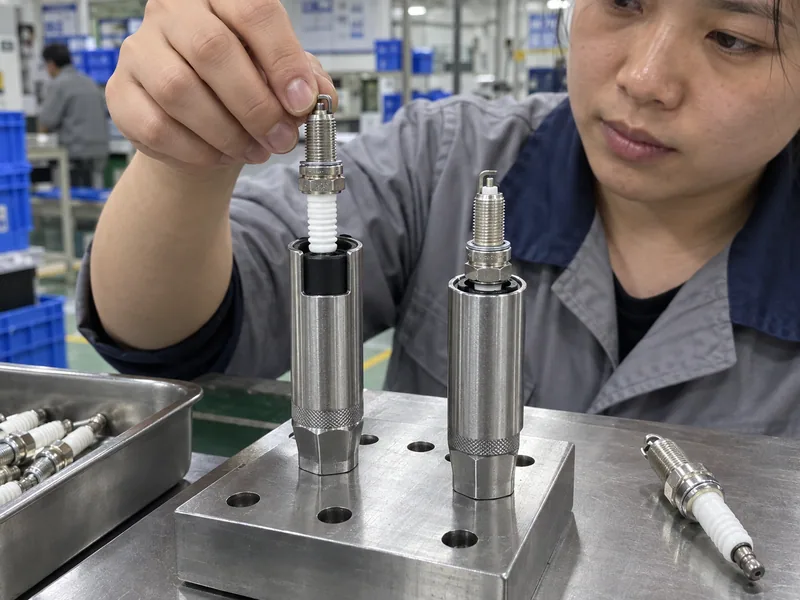
Rubber insert and magnetic spark plug sockets holding separate sample plugs during retention inspection
AI-generated concept illustration; not an actual factory or test record.

How do retainer choices differ?

Rubber inserts provide a compliant grip and can suit mixed service environments. Magnets can hold a steel shell cleanly, but holding force and clearance require checking. A fixed retainer may simplify assembly, while a replaceable insert can support service kits.

Specify its force and replacement path before launch.

  • Test retention with clean and lightly oily plugs.
  • Check release after the plug reaches the seat.
  • Inspect insert concentricity and burr-free edges.
  • State whether a retainer is replaceable.

Do not promise one insert suits every shell geometry. Plug shape, hex depth, ceramic diameter, and finish can change holding behavior. Compare adjacent hand tool range options only after fit passes.

What should a retainer inspection record show?

Retainer type Useful characteristic Possible failure QC check
Rubber insert Compliant grip on the intended plug neck or insulator area, by design Hardening, tearing, or loose fit Pull and release test
Magnet Positive steel-shell pickup Weak force or debris attraction Pickup test with target plug
Spring clip Repeatable mechanical contact Shell marking or fatigue Cycle and visual check
No retainer Lower part count Plug can fall during handling Use only with controlled access

Choose retention from handling needs. Action: add a retention test to the sample approval sheet rather than a generic “secure” claim.

6. Should buyers specify swivels, extensions, or wobble features?

Swivels, wobble ends, and extensions can reach angled or recessed plugs, but each adds movement or clearance demand. Specify them only after a straight socket fails an access test.
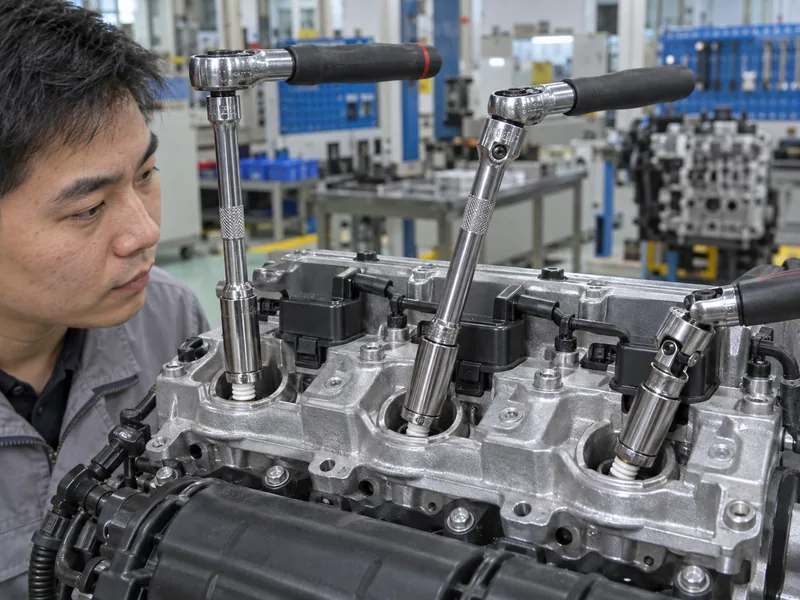
Straight, wobble, and swivel spark plug socket access options arranged around an engine fixture
AI-generated concept illustration; not an actual factory or test record.

Where does a swivel help?

A controlled swivel can guide a socket around an obstruction. A wobble connection offers limited angular movement. A fixed extension gives predictable alignment when access remains straight.

Extra movement must still leave full hex engagement.

  • Define working angle and usable engagement.
  • Check joint looseness after repeated cycles.
  • Confirm the retainer remains concentric while angled.
  • Package extension length as a separate specification.

Avoid claims such as “fits all tight spaces.” Access depends on vehicle architecture, plug location, coil shape, and nearby hardware.

How should an access kit be compared?

Feature Access benefit Added concern Approval method
Fixed extension Straight, repeatable reach May be too long or short Depth trial
Wobble end Small angular correction Reduced alignment under load Angle and cycle test
Universal swivel Larger angle range More bulk and possible side load Clearance and engagement test
Locking extension Helps prevent separation Added mechanism and cost Retention-cycle test

For torque-controlled reassembly, read torque wrench guidance and separate this work from the impact socket category. Action: approve each access feature with a physical fixture, not a catalog photograph.

7. How should a distributor build a spark plug socket assortment?

Build an assortment around verified hex sizes, drive standards, access, and service channels. A documented small set can outperform a kit filled with near-matches.

Chinese tool professionals organizing a verified spark plug socket assortment by size and access role
AI-generated concept illustration; not an actual factory or test record.

Which SKUs deserve priority?

Prioritize sizes supported by customer repair data, plug catalogs, and service demand. Keep separate SKUs when point form, wall, length, or retainer changes fit.

Every SKU should answer a distinct service problem.

  • Core hex sizes backed by plug references
  • Thin-wall options for measured narrow wells
  • Deep or extra-long options for recessed plugs
  • 6-point and 12-point versions only where specified
  • Replacement retainers or extensions where a service program needs them

Use a mechanics tool set configuration review to place spark plug sockets within a larger kit without disguising model limitations.

What belongs in an assortment scorecard?

Scorecard field Buyer question Evidence
Coverage Which confirmed plug references does SKU serve? Customer list or catalog
Access Does body fit measured plug wells? Fixture or vehicle sample
Drive Which turning tools connect correctly? Square and detent check
Retention Does plug stay seated and release cleanly? Cycle record
Differentiation Why does this SKU exist beside another? Dimension comparison

Keep a reason code for each new SKU. Action: remove duplicates that differ only by an unverified label or unsupported vehicle claim.

8. How can buyers verify sample fit and quality?

Sample approval should combine dimensional inspection, plug engagement, access testing, retention, and finish review. A photo cannot replace a fit trial.
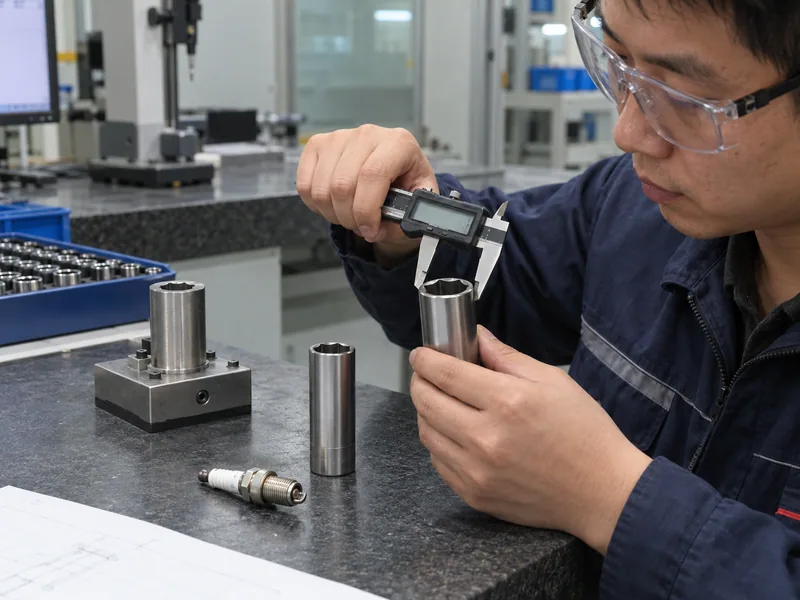
Quality technician measuring spark plug socket opening and wall clearance with a caliper
AI-generated concept illustration; not an actual factory or test record.

Which QC checks catch costly failures?

Measure opening across flats, point form, drive square, outside diameter, depth, wall thickness, and concentricity. Test target plugs for full engagement and controlled removal.

Plating cannot rescue a socket that bottoms out or rocks on a hex.

  • Verify gauge or calibrated instrument status.
  • Record measurements against drawing tolerances.
  • Inspect burrs, chrome flaking, cracks, and insert damage.
  • Cycle the retainer and joint when present.
  • Quarantine any sample that needs forceful side loading.

Do not convert one successful plug trial into a broad vehicle claim. Keep sample records tied to exact plug references.

What should a sample report record?

Check Record Acceptance basis
Hex engagement Full seating and no rocking Target plug and drawing
Outside clearance Minimum gap around well Customer fixture or vehicle
Drive fit Square, detent, and extension connection Matching hand tool
Retention Pickup, hold, and release Defined cycle method
Appearance Burrs, plating, marking Approved visual standard

Keep a signed sample file with photos and measurements. Action: block bulk approval until each listed plug and access feature passes.

9. What should a spark plug socket RFQ include?

An RFQ should describe geometry, target applications, test method, packaging, and evidence. “Professional spark plug socket” is too vague for comparable quotes.
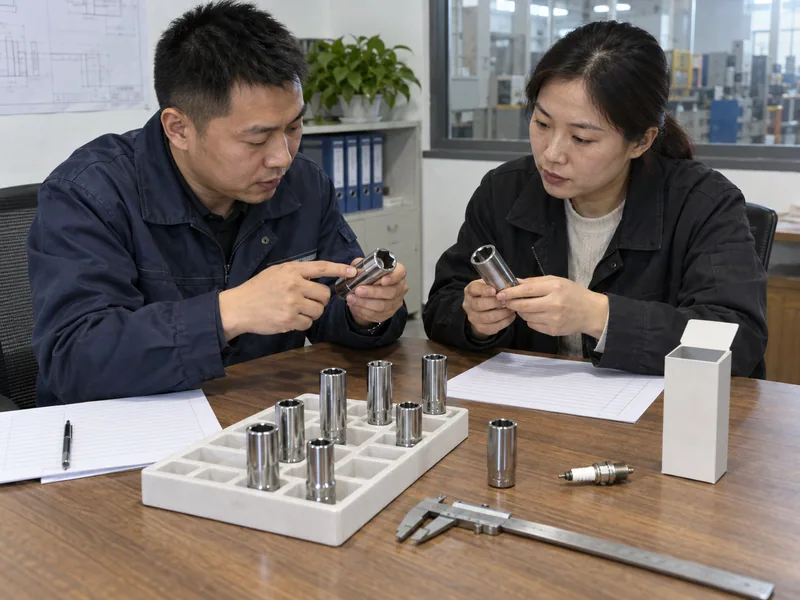
B2B buyer and quality engineer reviewing spark plug socket samples and blank RFQ documents
AI-generated concept illustration; not an actual factory or test record.

Which RFQ fields reduce rework?

State nominal hex, point count, drive, length, depth, outside diameter, wall, retainer, finish, marking, and package contents. Add target plug numbers or drawings where fit matters.

Suppliers can quote the same object, while buyers can compare samples on equal terms.

  • Attach a controlled drawing with revision number.
  • List required sample quantity and inspection points.
  • Separate requested features from optional features.
  • Ask for deviations before production approval.
  • Exclude unverified fitment language from packaging.

For broader sourcing context, compare complete mechanic tool sourcing guidance with your own program requirements.

What belongs in the final RFQ checklist?

RFQ block Required content Supplier response
Geometry Hex, points, drive, depth, wall, outside diameter Drawing and sample
Access Target well, extension, angle, clearance Fit record
Retention Insert or magnet type and replacement plan Material and cycle result
Quality Measurement points and visual standard Inspection report
Commercial Packaging, label, revision, quantity Quotation with assumptions

Make every exception visible in writing. Action: issue one approved RFQ revision to all shortlisted suppliers.

10. How should a buyer make the final spark plug socket decision?

Choose a spark plug socket by verified hex, plug geometry, access clearance, drive compatibility, retainer behavior, and sample evidence. A low price cannot compensate for a wrong hex or blocked access.
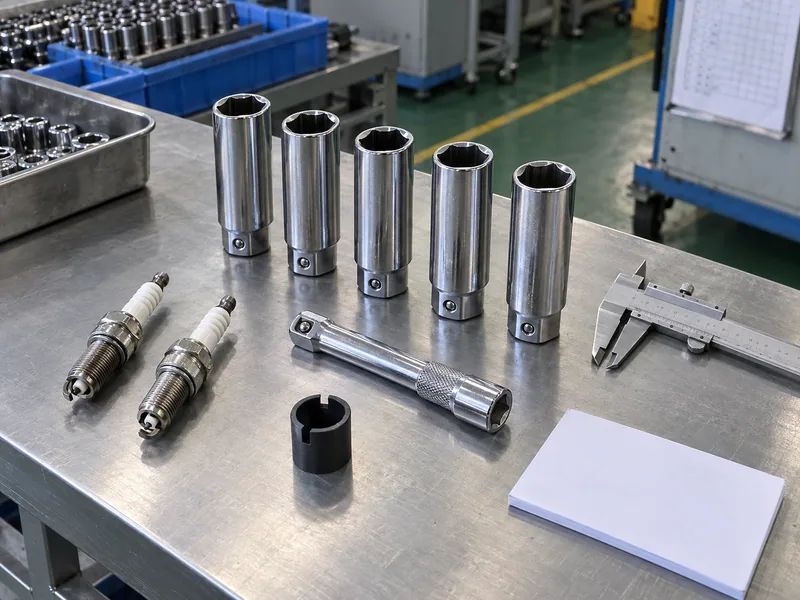
Buyer approval layout with spark plug socket samples, plugs, caliper, and inspection card
AI-generated concept illustration; not an actual factory or test record.

What should a purchase decision require?

Use this short gate before listing or ordering:

  • Confirm exact plug references and service region.
  • Match hex, point form, thread-related application data, and reach.
  • Select drive, depth, wall, retainer, and access features separately.
  • Approve samples through measured fit and handling tests.
  • Write package claims around verified coverage only.

Sell a documented tool choice that a distributor can explain to a workshop buyer.

KOLARWIN can review a buyer’s socket schedule, drawings, and sample requirements through contact with KOLARWIN Tools. Buyers can also review the main tool range before sending an RFQ.

Can I use a regular deep socket for a spark plug?

Sometimes, if hex, depth, outside diameter, and access all match. A dedicated socket adds retention and plug-well control, so approve a regular deep socket only after a physical fit test.

What size spark plug socket fits most cars?

5/8-inch and 16 mm labels are both common in catalogs, but they are not exact numerical equivalents and no single size covers every vehicle or plug. Confirm the plug hex and service data before buying.

Does spark plug socket drive size change plug fit?

Drive size changes the connection with a ratchet or torque tool. Hex size controls plug engagement, so both fields belong in a product specification.

Is a magnetic socket better than a rubber insert?

Neither retainer wins in every application. Compare pickup force, release behavior, contamination, ceramic clearance, and replacement cost with target plugs.

Should a spark plug socket be impact-rated?

Do not assume so. Spark plug service normally calls for controlled hand-tool use; list impact capability only after separate design, marking, and validation work.

Looking for a reliable mechanic tools manufacturer in China?

If you are sourcing hand tools, socket tools, automotive repair tools, mechanic tool sets or OEM private label tools, contact KOLARWIN Tools for factory-direct quotation, customization support and product consultation.


A full socket drawer can still stall on one spark plug. A 5/8-inch socket may fit one application while a 14 mm thin-wall 12-point tool suits another. Wall, reach, retainer, drive, and access decide whether a product clears nearby wiring.

Spark plug socket sizes must follow the plug’s specified hex, thread, reach, and engine access. Treat 14 mm, 16 mm, 18 mm, 20.8 mm, 5/8 inch, and 13/16 inch as catalog labels to check against the exact plug specification. Nearby inch and metric values are not exact conversions. Confirm each target plug, then sample-fit a finished socket.

1. What spark plug socket sizes should a buyer stock?

Spark plug tool catalogs include 14 mm, 16 mm, 18 mm, 20.8 mm, 9/16 inch, 5/8 inch, 11/16 inch, 3/4 inch, and 13/16 inch sizes. Stock only sizes supported by target plug references or service channels.

Unbranded spark plug sockets in six common hex sizes arranged on a factory inspection bench
AI-generated concept illustration; not an actual factory or test record.

Which hex sizes belong in a starter range?

Start with the plug part numbers your customers service. Manufacturer catalogs list 14 mm, 16 mm, and 20.8 mm hexes, while other plug families use different openings. A 14 mm bi-hex plug also requires the specified point form.

Size a range from confirmed plug data, then add access variants around those hexes.

For adjacent range planning, review socket tool options alongside dedicated spark plug tools. This helps buyers avoid treating a general deep socket as a complete plug-service solution.

How should a distributor read a size chart?

Use a chart as a screening aid, then confirm a plug part number or service reference before selecting stock.

Specified hex label Exact value in mm Procurement caution
14 mm 14.0000 Check 6-point or bi-hex; do not relabel as 9/16 in
9/16 in 14.2875 Keep distinct from 14 mm in the size list
5/8 in 15.8750 Some catalogs pair this with 16 mm; confirm the approved socket fit
16 mm 16.0000 Match the actual plug and socket specification
11/16 in 17.4625 This is not an 18 mm conversion
18 mm 18.0000 Keep as its own specified opening
3/4 in 19.0500 A nearby 19 mm label is not an exact conversion
13/16 in 20.6375 Verify catalog fit; the exact conversion is not 20.8 mm
20.8 mm 20.8000 Follow the listed plug/socket pairing rather than rounding to 21 mm

The conversions use exactly 25.4 mm per inch. They describe nominal labels, not a universal interchangeability rule. Action: ask for target plug references before committing.

2. How do hex size, thread, and reach differ?

Hex size identifies the socket interface; thread diameter, pitch, seat style, and reach determine engine fit. They cannot substitute for one another.

Labeled three-panel technical diagram for spark plug hex, thread diameter, and socket square drive
AI-generated technical illustration; schematic, not a dimensional drawing.

What does each plug dimension control?

The external hex is part of the metal shell below the exposed ceramic insulator and accepts a socket. Thread diameter and pitch engage the cylinder head. Reach controls threaded entry, while gasket or taper defines seating.

Put each dimension on its own line in your product data.

Do not label a socket using thread size. A 14 mm thread does not mean a 14 mm hex, and a 16 mm hex does not identify thread reach.

Which dimensions belong in a buyer matrix?

Field Example entry Why procurement needs it
Hex 16.0 mm Selects socket opening
Point form 6-point Controls shell engagement
Drive 3/8 in square Matches ratchet, extension, or torque tool
Thread reference Customer plug part number Prevents false vehicle fitment
Reach Customer-specified value Protects cylinder-head compatibility
Seat Gasket or taper Supports correct installation guidance

Treat plug data as controlled. Action: require an approved plug drawing or part number before changing a socket profile. Cross-check inch and metric labels with this metric and standard socket conversion chart before publishing.

3. Which drive size should a spark plug socket use?

Drive size describes the square connection with a turning tool; it does not describe plug hex size. A 16 mm socket can use a 3/8-inch drive, while another may use 1/2-inch drive.

Three spark plug socket drive connections with matching ratchets and extensions on a factory bench
AI-generated concept illustration; not an actual factory or test record.

When does 3/8-inch drive make sense?

3/8-inch drive suits many service-bay spark plug sockets because it balances reach, clearance, and compatibility with common ratchets and torque tools. A 1/4-inch drive can suit compact access, but buyers should verify strength, wall design, and intended use. A 1/2-inch drive may help in a heavy-duty assortment, yet extra bulk can reduce access around coils and covers.

Choose square drive from access and tool compatibility, then choose hex from plug data.

For a wider automotive assortment, see automotive repair tool ranges before deciding whether a single socket or set matches your channel.

How should drive options appear in a range sheet?

Drive Strength in a range Access tradeoff Buyer check
1/4 in Compact access and low-profile assemblies Lower force and smaller interface Confirm torque-tool compatibility
3/8 in Broad workshop compatibility May need thin-wall body Match square, detent, and extension
1/2 in Larger tool ecosystems and selected heavy-duty work More bulk near coils and covers Confirm clearance before listing

Keep drive and hex separate. Action: approve a drive only after ratchet, extension, and target plug pass a bench check.

4. How do thin-wall and deep designs affect access?

Thin-wall construction helps a socket enter a narrow plug well, while deep construction reaches a recessed plug. Neither repairs a wrong hex or unsuitable drive.

Thin-wall and deep spark plug socket reaching a recessed plug in an engine access fixture
AI-generated concept illustration; not an actual factory or test record.

What should buyers measure around a plug well?

Measure plug hex, socket envelope, well diameter, reach, and clearance around coils or boots. A correct hex can still fail when outside diameter contacts a casting.

Measure the complete access envelope instead of copying a nominal size.

A thin wall can reduce outside diameter, but it also leaves less material around a socket opening. Supplier drawings should state wall dimensions and intended hand-tool duty.

Which body style fits each access problem?

Body style Best use Main risk Sample evidence
Standard deep Open plug wells Bottoms out before plug seats Depth and plug seating check
Thin-wall deep Narrow wells around coils Outside clearance or wall strength may fail Bore and wall measurement
Extra-long Recessed plugs Excess length can foul covers Full insertion trial
Low-profile Limited height above plug Insufficient engagement depth Engagement and retention check

Treat “thin wall” as a measured feature. Action: request outside diameter, wall thickness, and usable depth on a drawing.

5. Which retainer should hold a spark plug?

A spark plug socket may use a rubber insert, magnet, or spring retainer. A retainer should hold a plug without cracking ceramic or marking the shell.

Rubber insert and magnetic spark plug sockets holding separate sample plugs during retention inspection
AI-generated concept illustration; not an actual factory or test record.

How do retainer choices differ?

Rubber inserts provide a compliant grip and can suit mixed service environments. Magnets can hold a steel shell cleanly, but holding force and clearance require checking. A fixed retainer may simplify assembly, while a replaceable insert can support service kits.

Specify its force and replacement path before launch.

Do not promise one insert suits every shell geometry. Plug shape, hex depth, ceramic diameter, and finish can change holding behavior. Compare adjacent hand tool range options only after fit passes.

What should a retainer inspection record show?

Retainer type Useful characteristic Possible failure QC check
Rubber insert Compliant grip on the intended plug neck or insulator area, by design Hardening, tearing, or loose fit Pull and release test
Magnet Positive steel-shell pickup Weak force or debris attraction Pickup test with target plug
Spring clip Repeatable mechanical contact Shell marking or fatigue Cycle and visual check
No retainer Lower part count Plug can fall during handling Use only with controlled access

Choose retention from handling needs. Action: add a retention test to the sample approval sheet rather than a generic “secure” claim.

6. Should buyers specify swivels, extensions, or wobble features?

Swivels, wobble ends, and extensions can reach angled or recessed plugs, but each adds movement or clearance demand. Specify them only after a straight socket fails an access test.

Straight, wobble, and swivel spark plug socket access options arranged around an engine fixture
AI-generated concept illustration; not an actual factory or test record.

Where does a swivel help?

A controlled swivel can guide a socket around an obstruction. A wobble connection offers limited angular movement. A fixed extension gives predictable alignment when access remains straight.

Extra movement must still leave full hex engagement.

Avoid claims such as “fits all tight spaces.” Access depends on vehicle architecture, plug location, coil shape, and nearby hardware.

How should an access kit be compared?

Feature Access benefit Added concern Approval method
Fixed extension Straight, repeatable reach May be too long or short Depth trial
Wobble end Small angular correction Reduced alignment under load Angle and cycle test
Universal swivel Larger angle range More bulk and possible side load Clearance and engagement test
Locking extension Helps prevent separation Added mechanism and cost Retention-cycle test

For torque-controlled reassembly, read torque wrench guidance and separate this work from the impact socket category. Action: approve each access feature with a physical fixture, not a catalog photograph.

7. How should a distributor build a spark plug socket assortment?

Build an assortment around verified hex sizes, drive standards, access, and service channels. A documented small set can outperform a kit filled with near-matches.

Chinese tool professionals organizing a verified spark plug socket assortment by size and access role
AI-generated concept illustration; not an actual factory or test record.

Which SKUs deserve priority?

Prioritize sizes supported by customer repair data, plug catalogs, and service demand. Keep separate SKUs when point form, wall, length, or retainer changes fit.

Every SKU should answer a distinct service problem.

Use a mechanics tool set configuration review to place spark plug sockets within a larger kit without disguising model limitations.

What belongs in an assortment scorecard?

Scorecard field Buyer question Evidence
Coverage Which confirmed plug references does SKU serve? Customer list or catalog
Access Does body fit measured plug wells? Fixture or vehicle sample
Drive Which turning tools connect correctly? Square and detent check
Retention Does plug stay seated and release cleanly? Cycle record
Differentiation Why does this SKU exist beside another? Dimension comparison

Keep a reason code for each new SKU. Action: remove duplicates that differ only by an unverified label or unsupported vehicle claim.

8. How can buyers verify sample fit and quality?

Sample approval should combine dimensional inspection, plug engagement, access testing, retention, and finish review. A photo cannot replace a fit trial.

Quality technician measuring spark plug socket opening and wall clearance with a caliper
AI-generated concept illustration; not an actual factory or test record.

Which QC checks catch costly failures?

Measure opening across flats, point form, drive square, outside diameter, depth, wall thickness, and concentricity. Test target plugs for full engagement and controlled removal.

Plating cannot rescue a socket that bottoms out or rocks on a hex.

Do not convert one successful plug trial into a broad vehicle claim. Keep sample records tied to exact plug references.

What should a sample report record?

Check Record Acceptance basis
Hex engagement Full seating and no rocking Target plug and drawing
Outside clearance Minimum gap around well Customer fixture or vehicle
Drive fit Square, detent, and extension connection Matching hand tool
Retention Pickup, hold, and release Defined cycle method
Appearance Burrs, plating, marking Approved visual standard

Keep a signed sample file with photos and measurements. Action: block bulk approval until each listed plug and access feature passes.

9. What should a spark plug socket RFQ include?

An RFQ should describe geometry, target applications, test method, packaging, and evidence. “Professional spark plug socket” is too vague for comparable quotes.

B2B buyer and quality engineer reviewing spark plug socket samples and blank RFQ documents
AI-generated concept illustration; not an actual factory or test record.

Which RFQ fields reduce rework?

State nominal hex, point count, drive, length, depth, outside diameter, wall, retainer, finish, marking, and package contents. Add target plug numbers or drawings where fit matters.

Suppliers can quote the same object, while buyers can compare samples on equal terms.

For broader sourcing context, compare complete mechanic tool sourcing guidance with your own program requirements.

What belongs in the final RFQ checklist?

RFQ block Required content Supplier response
Geometry Hex, points, drive, depth, wall, outside diameter Drawing and sample
Access Target well, extension, angle, clearance Fit record
Retention Insert or magnet type and replacement plan Material and cycle result
Quality Measurement points and visual standard Inspection report
Commercial Packaging, label, revision, quantity Quotation with assumptions

Make every exception visible in writing. Action: issue one approved RFQ revision to all shortlisted suppliers.

10. How should a buyer make the final spark plug socket decision?

Choose a spark plug socket by verified hex, plug geometry, access clearance, drive compatibility, retainer behavior, and sample evidence. A low price cannot compensate for a wrong hex or blocked access.

Buyer approval layout with spark plug socket samples, plugs, caliper, and inspection card
AI-generated concept illustration; not an actual factory or test record.

What should a purchase decision require?

Use this short gate before listing or ordering:

Sell a documented tool choice that a distributor can explain to a workshop buyer.

KOLARWIN can review a buyer’s socket schedule, drawings, and sample requirements through contact with KOLARWIN Tools. Buyers can also review the main tool range before sending an RFQ.

Can I use a regular deep socket for a spark plug?

Sometimes, if hex, depth, outside diameter, and access all match. A dedicated socket adds retention and plug-well control, so approve a regular deep socket only after a physical fit test.

What size spark plug socket fits most cars?

5/8-inch and 16 mm labels are both common in catalogs, but they are not exact numerical equivalents and no single size covers every vehicle or plug. Confirm the plug hex and service data before buying.

Does spark plug socket drive size change plug fit?

Drive size changes the connection with a ratchet or torque tool. Hex size controls plug engagement, so both fields belong in a product specification.

Is a magnetic socket better than a rubber insert?

Neither retainer wins in every application. Compare pickup force, release behavior, contamination, ceramic clearance, and replacement cost with target plugs.

Should a spark plug socket be impact-rated?

Do not assume so. Spark plug service normally calls for controlled hand-tool use; list impact capability only after separate design, marking, and validation work.

Why Partner with Kolarwin Tools?

Factory-Direct Pricing Skip the middleman — access competitive wholesale prices and protect your margins
Private Label & OEM Ready Your brand, our expertise — full customization from logo to packaging
Fast Global Shipping Reliable delivery to 60+ countries with full export documentation support
Low MOQ, High Flexibility Start small, scale fast — flexible order quantities to fit your business
Dedicated B2B Support One-on-one account management from quote to delivery, every time

Get Your Free Quote in 24 Hours

Tell us your sourcing needs — we'll respond with a tailored quote, product specs, and the best pricing for your market. No commitment required.

Chat on WhatsApp Email Us Directly
