Need OEM supplier support for this product type?
Contact KOLARWIN Tools for OEM mechanic tools, private label packaging, wholesale quotation and product range support. This gives overseas buyers a clear path from article reading to supplier discussion.
Buying a bearing puller by jaw count or catalogue photo creates trouble. A tool may miss the shoulder, overload a seal, or require a counterstay your workshop lacks. This guide maps each puller type to its grip, actuation, access geometry, and buying checks. It is written for distributors, repair-tool importers, and engineering buyers who need a repeatable approval decision rather than a generic “heavy-duty” label.
Contents: Types · External jaws · Internal/blind-hole · Slide hammer · Separator · Reversible jaws · Mechanical vs hydraulic · Applications · Documents · Approval
1. What types of bearing pullers are used in automotive repair?
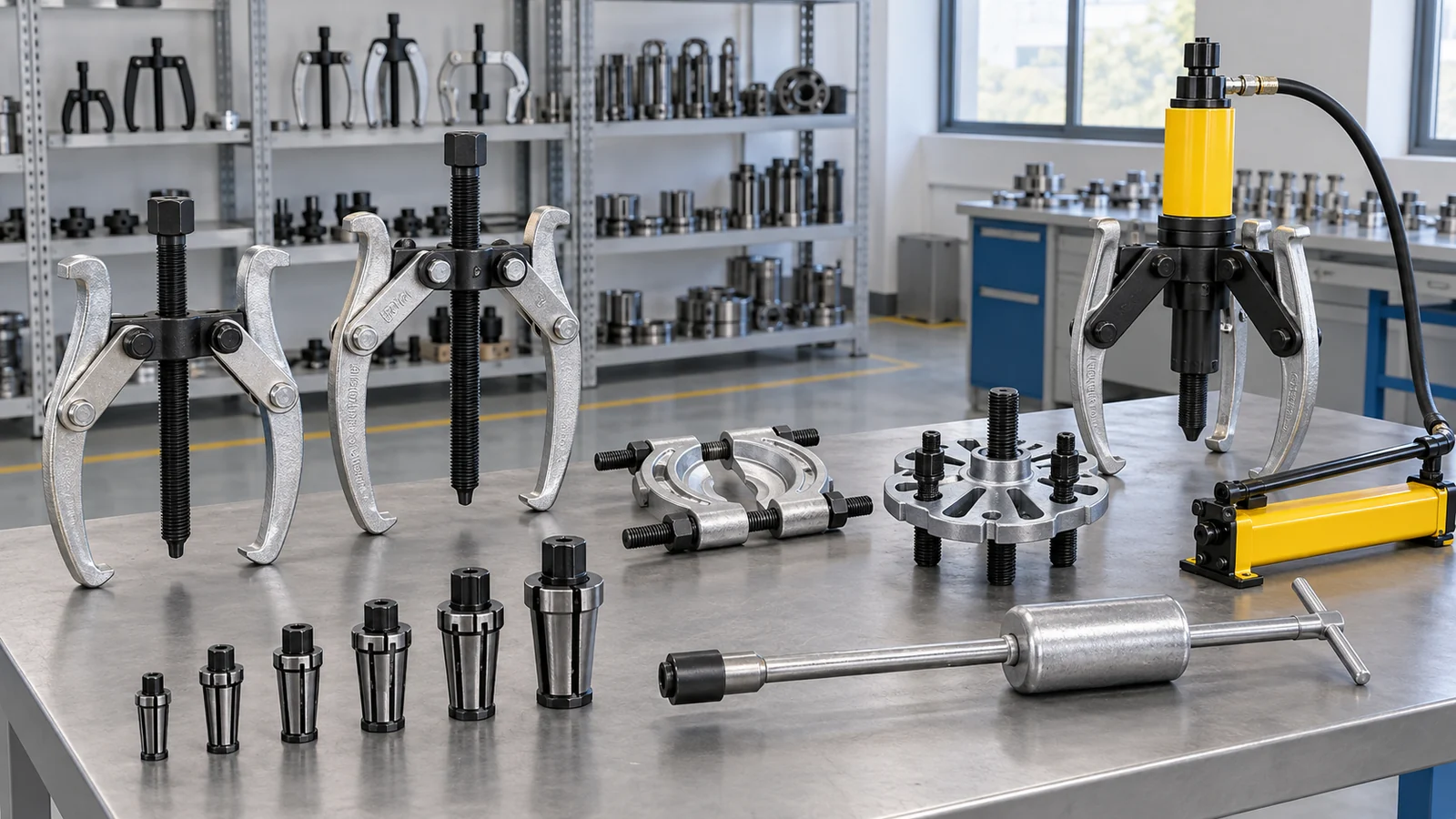
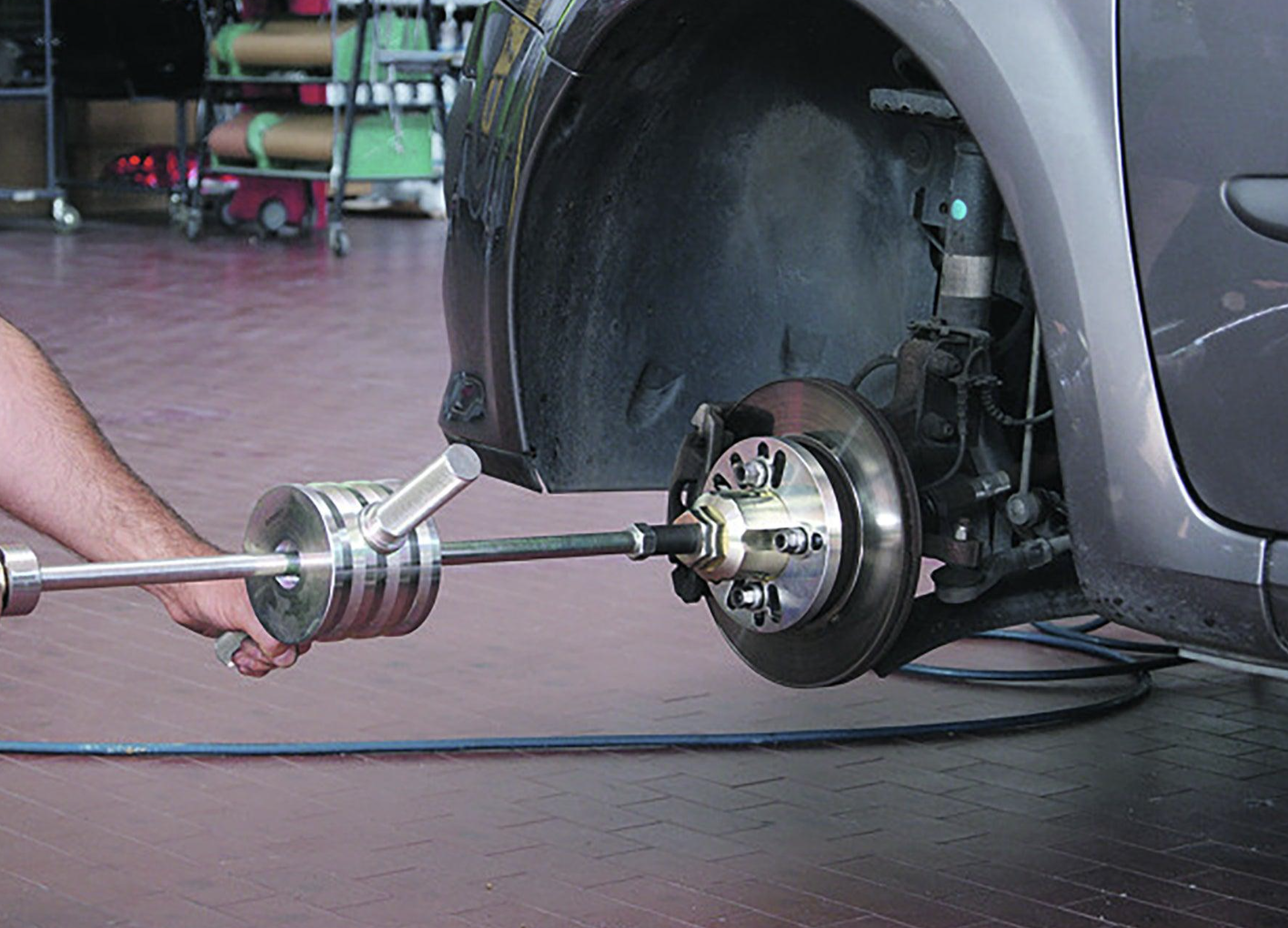
Bearing work starts with two questions: where can the puller grip, and how will it apply force? External jaws grip behind an outside shoulder. Internal tools expand inside a bore. A separator creates a purchase where jaws cannot enter. Slide hammer, mechanical, and hydraulic describe actuation.
For a workshop assortment, separate these families before comparing prices:
- External two- or three-jaw pullers for exposed shoulders.
- Internal, separator, or slide-hammer sets for restricted access.
- Reversible jaws for inside and outside gripping.
- Mechanical or hydraulic actuation after grip and access are known.
Here is the buying shortcut: classify access and load path first, then compare actuation and package contents. See KOLARWIN’s automotive repair tools range for related bearing, hub, CV-joint, and slide-hammer families.
Action: send a supplier a measured application drawing with bearing location, clearance, shoulder, and support. Ask for a matching tool sketch.
Type map for an initial assortment
| Puller family | How it grips | Typical access | Buyer’s first check |
|---|---|---|---|
| External jaw | Behind an outside ring or shoulder | Open or projecting component | Reach, spread, jaw-tip seat |
| Internal/blind-hole | Expanding segments inside the bore | Housing or closed-end bore | Bore range, shoulder depth |
| Separator/splitter | Thin plates behind a component | Very little jaw clearance | Plate thickness, shoulder strength |
| Slide hammer | Approved attachment plus axial impulse | No room for a counterstay | Adapter fit, impact instructions |
| Reversible jaw | Jaw orientation changes inside/outside grip | Multiple open applications | Separate ranges and force limits |
2. What is an external-jaw puller used for?
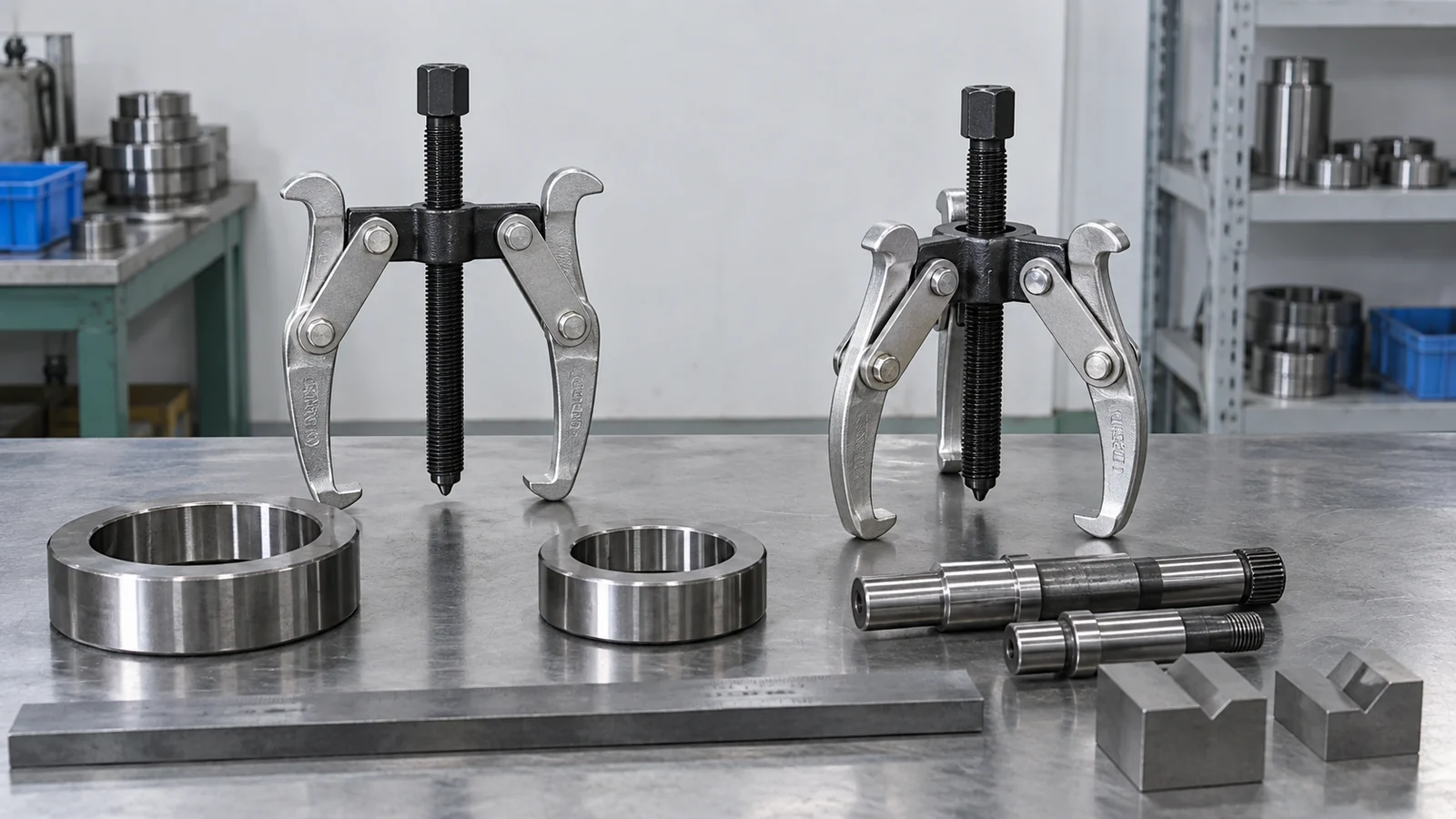
An external-jaw, or outside, puller reaches behind an exposed outer ring or sound shoulder. Its centre spindle bears against a shaft end. Jaws should load that ring or shoulder, never rolling elements, cage, seal, or a thin flange.
Two jaws suit narrow access. Three jaws can share load more evenly when space permits. Jaw count does not establish capacity or self-locking behaviour. Effective reach matters more than a large maximum spread.
- Measure effective reach, spread, throat depth, stroke, and tip thickness.
- Confirm arm locking or self-centering behaviour.
- Ask about replaceable tips, pins, and arms.
The practical test: place a transparent overlay on your component drawing and mark every point that a jaw could touch. If contact lands on a seal or rolling element, specify another puller family.
Action: require a reach-and-spread drawing. Do not approve a three-jaw tool from a photograph or maximum diameter alone.
External-jaw approval checks
| Check | Why it affects the purchase | Evidence to request |
|---|---|---|
| Effective reach | Determines whether tips reach a sound shoulder | Dimensioned drawing |
| External spread | Sets component diameter range | Minimum and maximum values |
| Jaw profile | Controls ring contact and slip risk | Tip detail or sample fit |
| Spindle support | Keeps force axial | Shaft-end and centre-support detail |
3. How do internal and blind-hole pullers work?
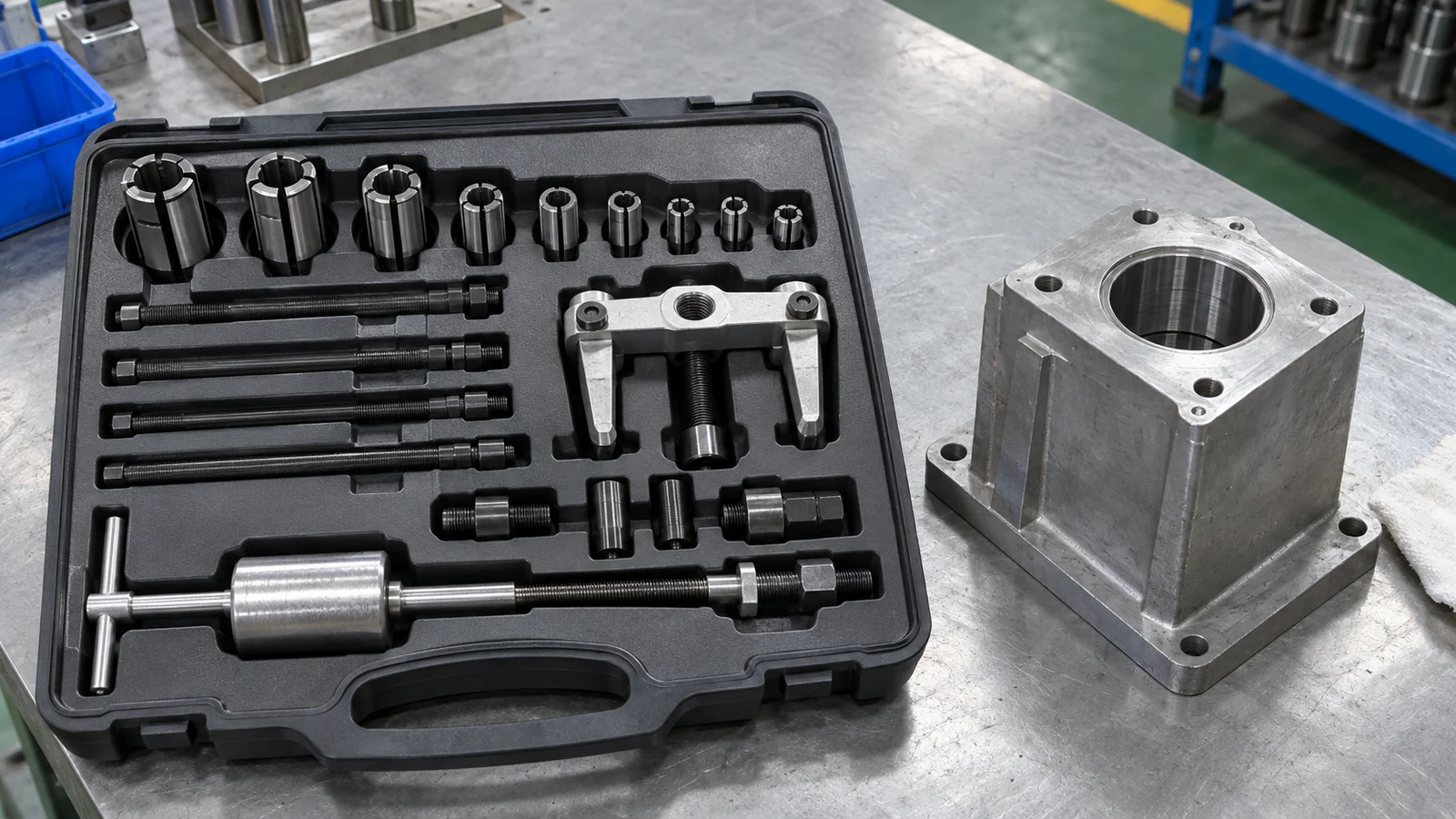
An internal puller enters through a bearing bore, then expands against an inner-ring shoulder. “Blind-hole puller” describes a housing or closed-end bore with no rear access. It does not mean every blind geometry will fit.
Check bore range, engagement depth, bottom clearance, and access depth. Some sets need a slide hammer; others require a counterstay or forcing screw. A shaft-mounted bearing may still need an external or separator tool.
- Confirm bore diameter at the engagement zone and locate the shoulder.
- Check seal and chamfer clearance.
- Identify the actuator, counterstay, adapters, and replacement segments.
Keep these decisions separate: internal grip and internal actuation are different choices. An expanding collet may be correct, while a slide hammer may be wrong for a delicate housing or a badly retained grip.
Action: ask for a section-view fit sketch. Approve only after a sample passes.
Internal-puller fit questions
| Question | Risk if ignored | Approval evidence |
|---|---|---|
| What bore range is usable? | Collet cannot expand correctly | Stated working range |
| Where does the shoulder sit? | Tips load a chamfer or seal | Section drawing |
| How deep is the bore? | Tool bottoms before engagement | Usable depth and stop detail |
| What actuates extraction? | Missing counterstay or hammer | Complete BOM |
4. What does a slide-hammer puller add?
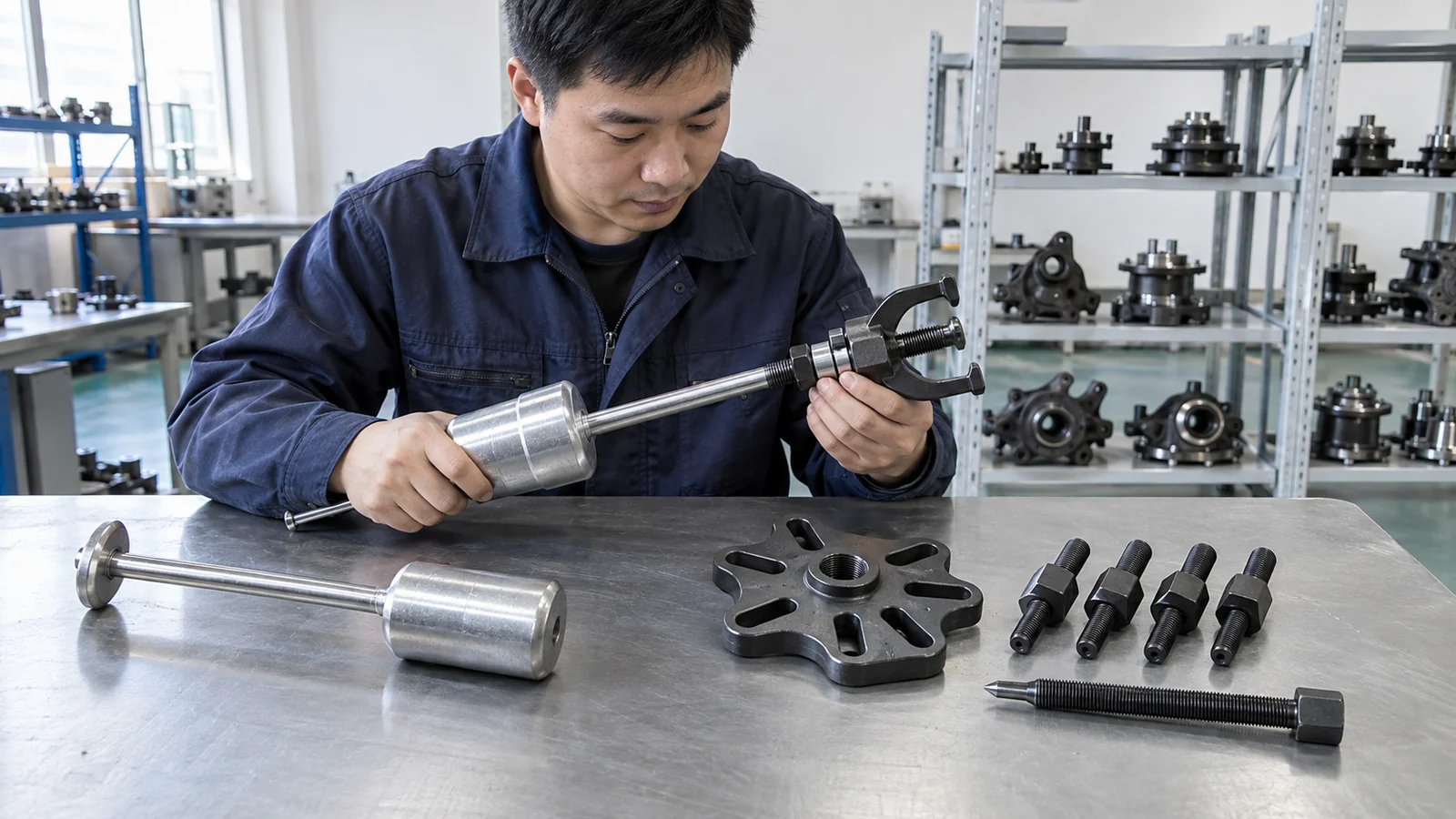
A slide hammer is an actuation method, not a grip category. A weighted mass travels along a rod and strikes a stop, creating an axial impulse. The attachment may be internal, external, or another approved adapter.
Slide hammers help where a counterstay cannot fit. Impact changes the risk profile: a weak grip can release suddenly, while an unapproved adapter can damage threads. Hammer mass, rod length, thread, and interchangeability vary by set.
- Confirm hammer mass, rod, thread, stop, and adapter locking.
- Keep the line of pull clear of people.
- Check whether the manual permits impact for the attachment.
A useful distinction: “slide-hammer puller” should never appear as a complete specification unless the attachment, rod, stop, and rated configuration are named.
Action: buy hammer and attachment as a documented system. Request a compatibility matrix, then test grip on a representative housing.
Slide-hammer package checks
| Package item | Buyer question | Why it matters |
|---|---|---|
| Hammer body | What mass and stroke are supplied? | Impulse varies by assembly |
| Rod and thread | Does it match every adapter? | Prevents loose or damaged connections |
| Internal attachment | What bore and shoulder range? | Determines blind-hole coverage |
| Instructions | Are impact limits clear? | Sets safe operating conditions |
5. When should a separator or splitter puller be used?
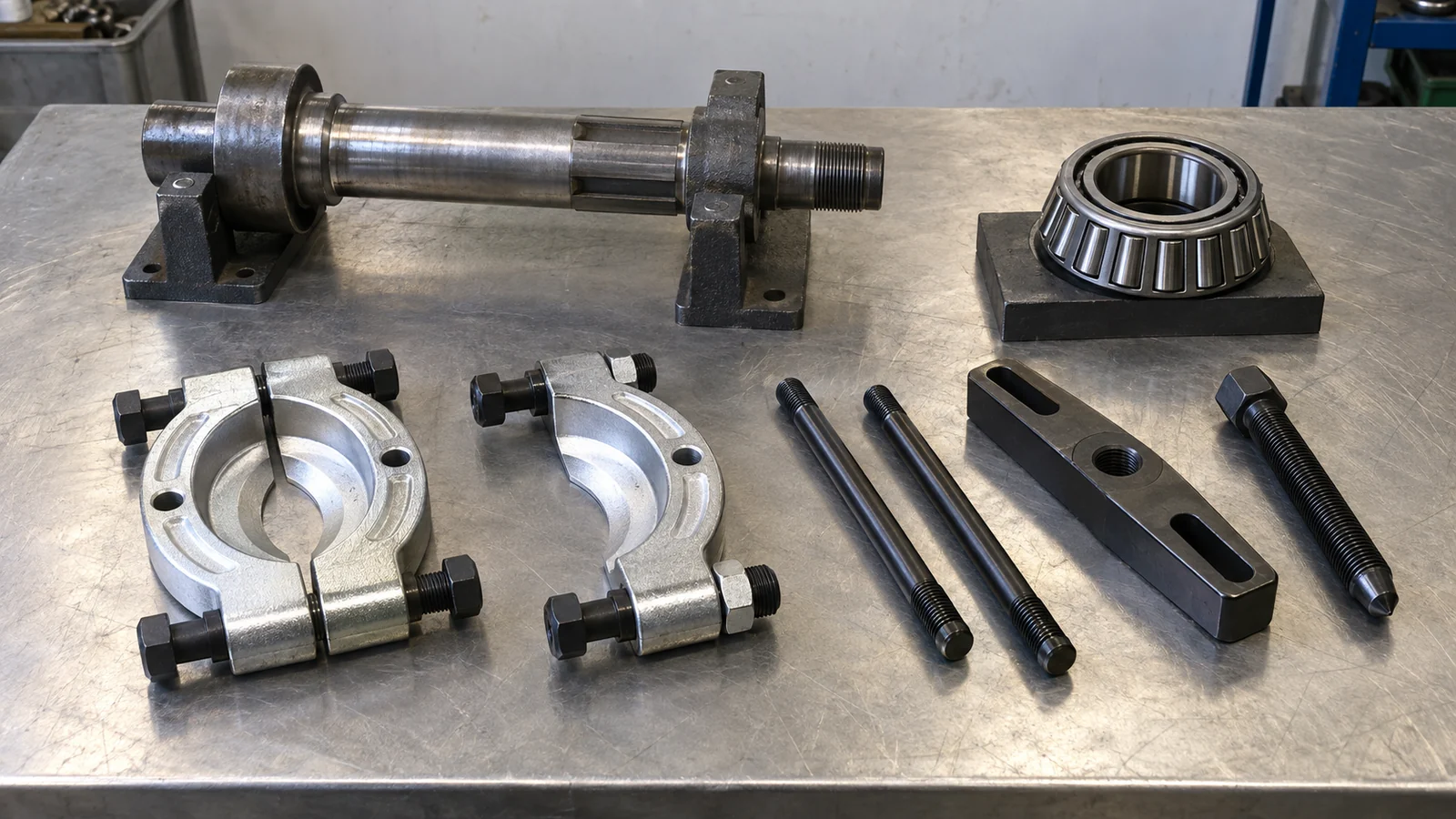
A separator, or bearing splitter, uses two tapered plates tightened behind a component. A beam or threaded puller attaches to the separator. This helps when jaws cannot get behind a pressed inner ring.
A splitter needs a sound shoulder and even plate seating. Plates must not press on a seal, thin flange, sharp chamfer, or soft housing. A separator is not an internal blind-hole puller.
- Measure opening, plate thickness, taper, bolt size, and depth.
- Confirm the matching beam, spindle, or frame.
- Verify parallel shoulder contact during loading.
The clearance rule is blunt: if a plate cannot sit fully behind a sound shoulder, choose another method rather than forcing the splitter into a partial bite.
Action: include a separator section drawing in the RFQ. Ask the supplier to mark contact surfaces and provide a frame.
Separator purchase criteria
| Criterion | What to measure | Failure mode |
|---|---|---|
| Minimum opening | Smallest seated gap | Plates cannot enter |
| Plate thickness | Actual knife-edge thickness | Seal or shoulder damage |
| Taper and depth | Seating profile behind ring | Uneven loading |
| Bolt and thread | Fastener and puller match | Stripped connection |
6. Are reversible-jaw pullers interchangeable between jobs?
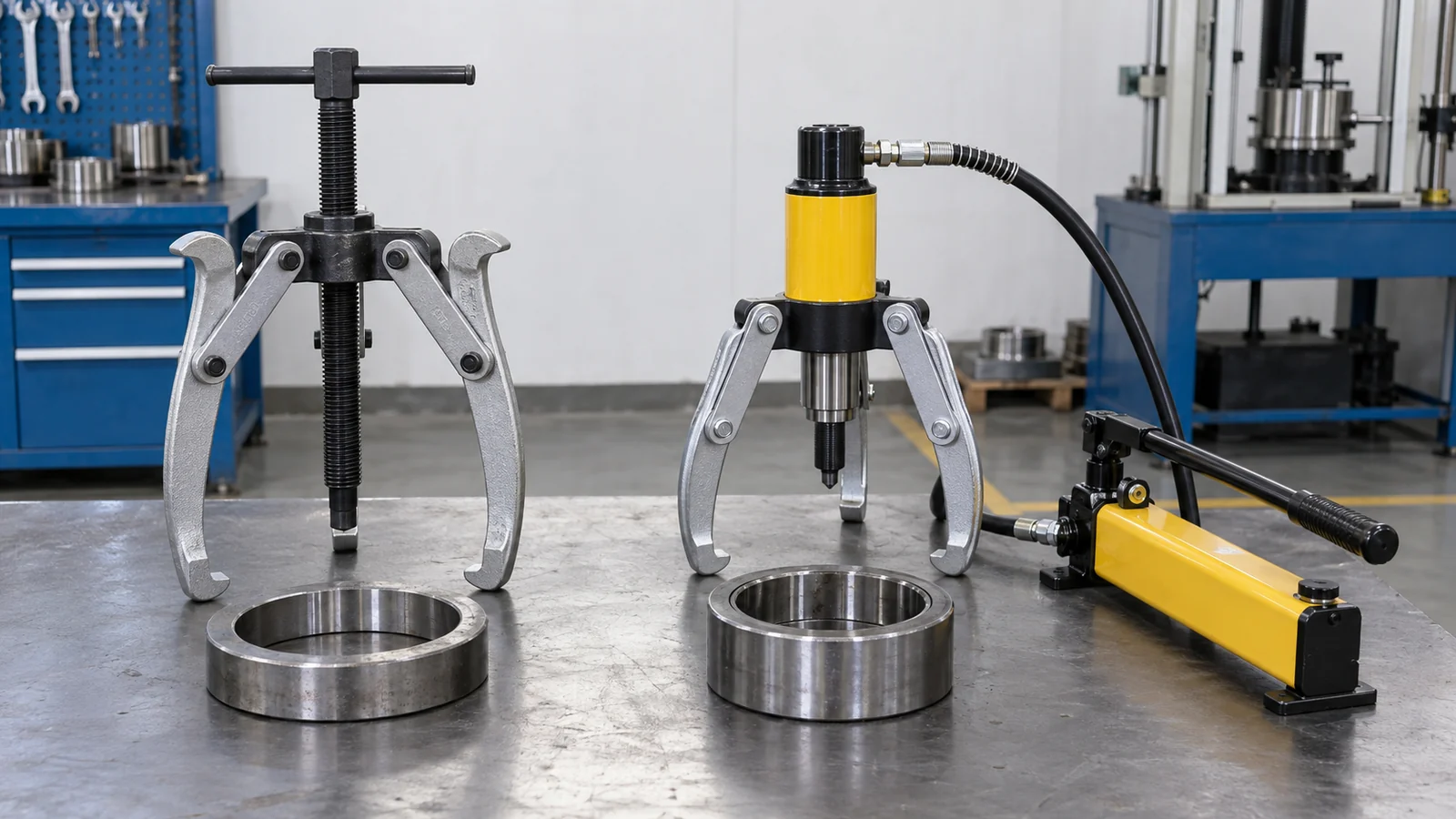
Reversible jaws can be repositioned for outside or inside gripping. That flexibility can cover more applications with fewer frames. Both orientations may have different spread, reach, and force limits. Some internal configurations need centre support or a slide hammer.
Check each orientation independently. Jaw-tip shape, arm locking, self-centering, and spindle support can change after the jaws are flipped. “Internal and external” without separate dimensions leaves an approval gap.
- Record internal and external spread and reach separately.
- Confirm jaw direction and spindle support in each mode.
- Ask about replacement arms, pins, and tips.
The safe assumption: reversible means reconfigurable, not equally rated in every mode.
Action: request inside and outside fit drawings. Add both configurations to sample approval.
Reversible-jaw comparison
| Configuration | Grip location | Separate data needed | Common oversight |
|---|---|---|---|
| Outside | Behind external shoulder | Spread, reach, jaw seat | Assuming internal data applies |
| Inside | Inside bore or opening | Bore range, reach, support | Missing centre support |
7. How do mechanical and hydraulic pullers differ?
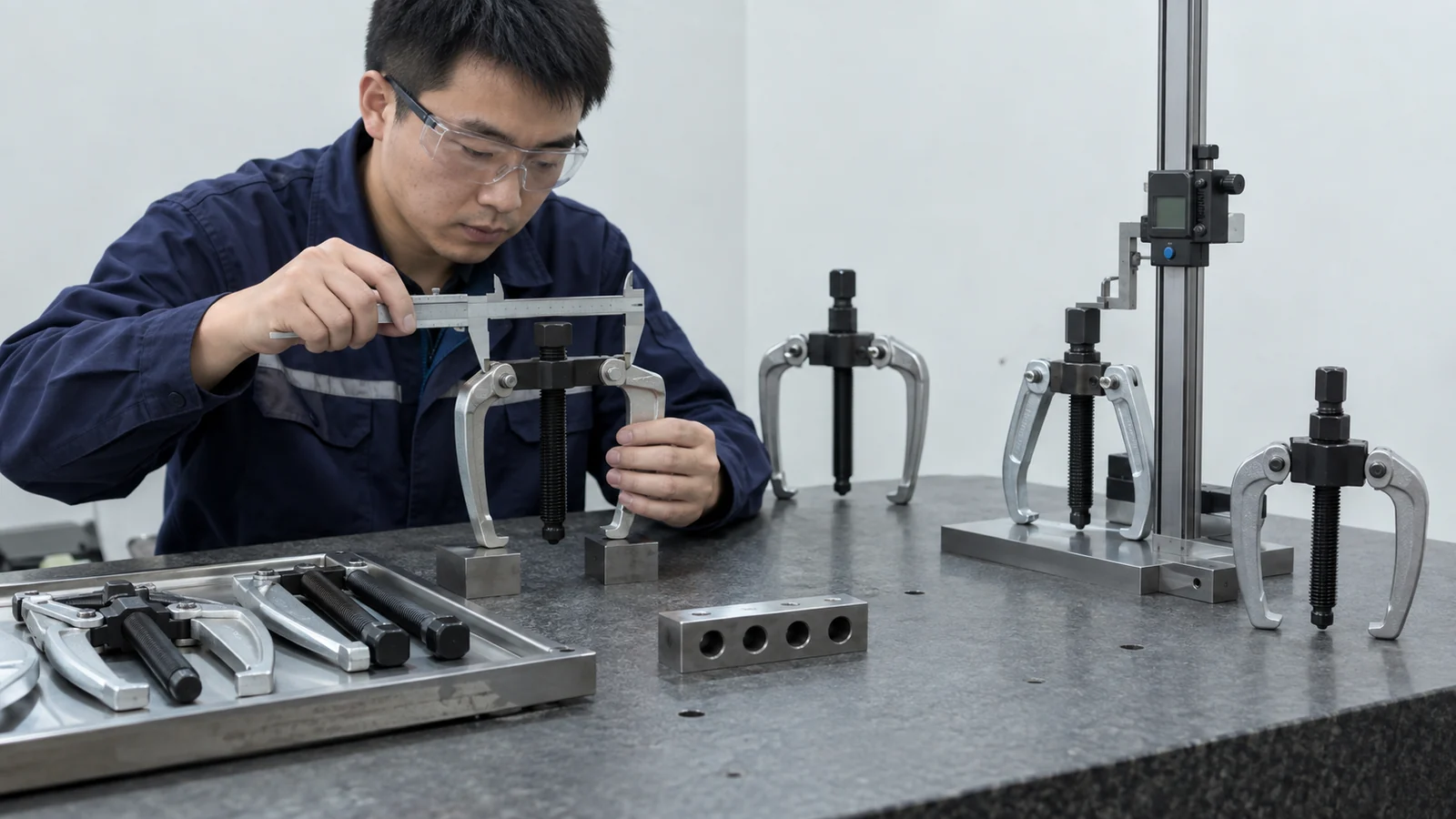
Mechanical pullers create force through a threaded spindle turned with a hand wrench. They are portable, yet spindle torque does not reveal withdrawal force. Do not add impact tools or extensions unless instructions allow it.
Hydraulic pullers use a cylinder and pump. They can reduce manual effort for high-load assemblies, but stored pressure, hoses, relief protection, and support add risks. A force figure belongs to a stated cylinder, frame, jaw arrangement, pressure, and test basis. The weakest component limits the system.
- Compare complete system ratings, not cylinder ratings alone.
- Check pressure, stroke, couplers, hoses, and relief protection.
- Confirm frame, jaws, adapters, supports, guards, and service parts.
The force question has two halves: can the tool generate the load, and can every component contain it? A catalogue number answers neither without its configuration.
Action: request a force-versus-configuration table. Keep mechanical and hydraulic ratings in separate fields.
Mechanical versus hydraulic buying table
| Factor | Mechanical | Hydraulic |
|---|---|---|
| Force source | Threaded spindle | Cylinder and pump |
| Access need | Wrench clearance | Pump, hose, and frame clearance |
| Main document check | Spindle and frame limit | Pressure, force, relief, and system limit |
| Buyer caution | No unapproved impact or extensions | No altered relief setting or unsupported load |
8. Which puller type fits a wheel bearing application?

No single puller suits every wheel bearing. Match the tool with the component interface. A hub puller may bolt through a flange; a CV-joint puller supports a joint housing. Neither becomes a general bearing puller without its interface.
For buyers, adjacent tools deserve their own product labels:
- Wheel-hub puller: flange, hub, or knuckle interface.
- CV-joint puller: joint-housing support while protecting boot and splines.
- Bearing press: steady axial force from a supported press.
- Induction heater or oil-injection system: specialist methods with separate procedures.
Match the interface, not the nickname: a “hub puller” may remove a hub assembly while an internal puller removes a bearing from its housing.
Action: build a matrix with component, bearing position, grip surface, access, support, and actuator. Use this wheel-bearing puller safety guide during review.
Application matching matrix
| Application condition | Likely family | Adjacent tool to distinguish | Confirm before order |
|---|---|---|---|
| Bearing on exposed shaft | External jaw or separator | Press | Ring and shoulder load path |
| Bearing in closed housing | Internal/blind-hole | Slide hammer | Bore and shoulder engagement |
| Hub flange removal | Hub puller | Generic three-jaw puller | Bolt pattern and support |
| CV joint removal | CV-joint puller | Hub puller | Joint housing and boot clearance |
9. What should B2B buyers check in supplier documents?
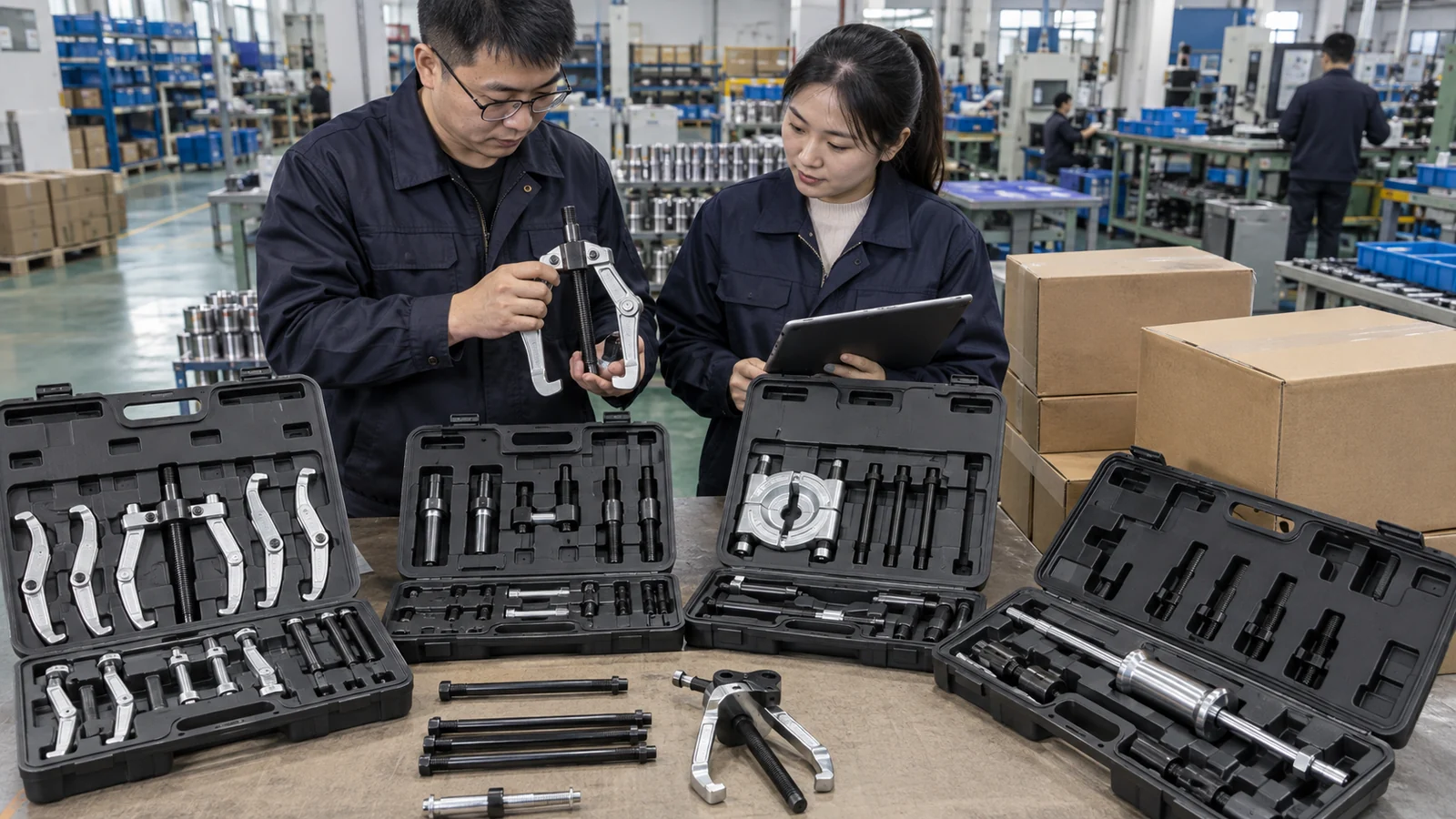
A buyer needs more than a tool name and maximum diameter. Request geometry, force, construction, safety, service, packaging, and compliance evidence in comparable fields. A rating without configuration or test basis needs verification.
Product documentation should cover:
- Puller family, internal or external use, arm count, and reversible status.
- Spread, reach, bore range, throat depth, stroke, tip thickness, and clearances.
- Force or pressure limits by configuration and permitted actuation.
- Frame, spindle, hydraulic, adapter, wear-part, manual, and declaration details.
Paperwork earns approval only when it maps onto the sample: compare every listed dimension with a measured component, then record any exception before purchase order release.
Action: use a two-column RFQ: “supplier value” and “buyer verification.” Add current drawings, manual revision, BOM, spares, and packaging photos. Compare mechanics tool-set configurations only for wider assortment planning.
Supplier-document checklist
| Document field | Buyer decision | Status to record |
|---|---|---|
| Dimensioned drawing | Fit and access | Supplied / missing |
| Force table | Safe configuration | Verified / needs verification |
| BOM and spares | Complete resale package | Complete / gap |
| Manual revision | Operating limits | Current / outdated |
10. How should buyers approve a bearing-puller program before bulk production?
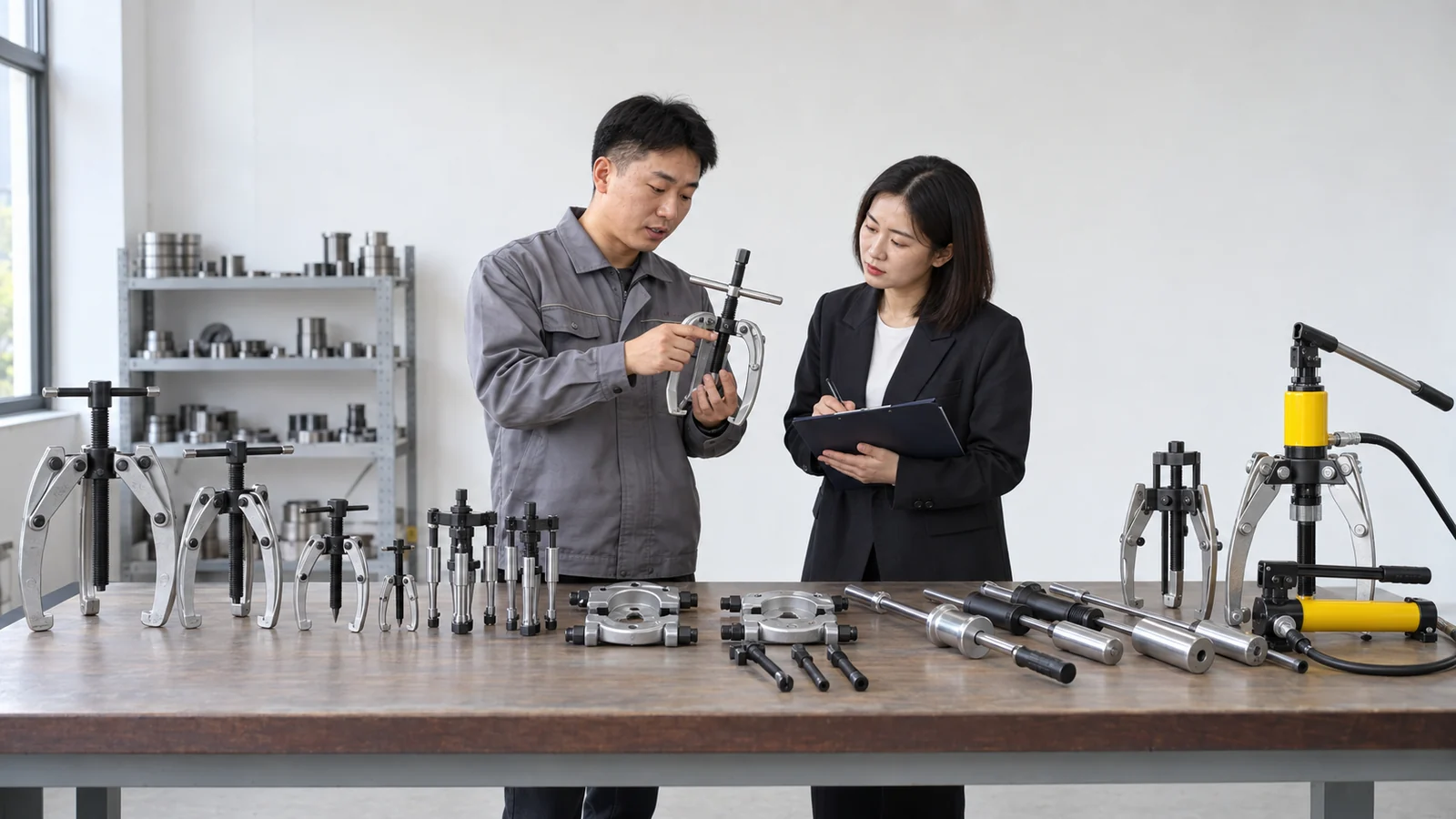
Bulk approval should reproduce a real extraction decision. Record target component, interfaces, clearance, and load path. Fit the attachment on a representative sample.
The approval record should cover:
- Fit, engagement depth, reach, spread, alignment, and support.
- Lowest-rated part in the force chain, including hose or adapter.
- Sample operation under the permitted method and limit.
- Case layout, BOM, spares, instructions, and change control.
A clean approval has a paper trail: the same sample, drawing, BOM, and manual revision should identify what bulk production must reproduce.
Action: issue a signed sheet with photos, measured interfaces, accepted configuration, risks, and revision number. Review mechanic tool-set selection for distributors and OEM socket-set packaging options for case context only. A socket-tools system can complement a package but cannot replace a puller.
If an application remains unclear, pause the order. Send drawings, photos, measured interfaces, quantity, packaging, and spare-parts needs through the B2B tool sourcing blog or contact the KOLARWIN team about a bearing-puller RFQ. The next step may be another puller family, a press, or an adapter.
FAQs
#### What is the difference between an external and internal bearing puller?
An external puller grips behind an outside shoulder. An internal puller expands inside a bore. Choose by access and force path.
#### Is a slide hammer a separate type of bearing puller?
A slide hammer describes force application. The complete tool needs an approved attachment. Check thread, engagement, and impact limits.
#### Can a reversible-jaw puller replace separate internal and external sets?
It can cover multiple applications when both orientations fit. Verify reach, spread, jaw direction, support, and force limits separately. Capacity may differ by mode.
#### Should buyers choose mechanical or hydraulic pullers?
Choose after access and grip are defined. Mechanical tools suit portable jobs. Hydraulic systems can assist higher-load work but need matching ratings across cylinder, frame, jaws, hoses, adapters, and support.
#### What should a supplier include with a bearing-puller quotation?
Request a dimensioned drawing, force data by configuration, BOM, manual revision, spares, safety limits, and applicable conformity documents. Add a sample-fit requirement for non-standard work.
Looking for a reliable mechanic tools manufacturer in China?
If you are sourcing hand tools, socket tools, automotive repair tools, mechanic tool sets or OEM private label tools, contact KOLARWIN Tools for factory-direct quotation, customization support and product consultation.