
Need OEM supplier support for this product type?
Contact KOLARWIN Tools for OEM mechanic tools, private label packaging, wholesale quotation and product range support. This gives overseas buyers a clear path from article reading to supplier discussion.
A vehicle positioning jack lifts a mounted tire onto a rolling support for controlled, short-distance vehicle movement. Buyers also call this equipment a car wheel dolly or self-loading wheel dolly. Similar-looking units can differ in mechanism, capacity, tire fit, and packaging. Use model documentation and sample checks before approving an import order.
Table of contents
- 1. What Is a Vehicle Positioning Jack?
- 2. How Do Mechanical, Hydraulic, and Platform Designs Differ?
- 3. How Should Buyers Read Load Ratings for One Dolly or a Set?
- 4. Which Tire Dimensions Must Match?
- 5. How Do Casters and Floor Conditions Affect Movement?
- 6. Where Can a Positioning Jack Be Used Safely in a Workshop?
- 7. How Should a Distributor Inspect Samples Before Approval?
- 8. Should Units Be Packed as Singles, Pairs, or Four-Piece Sets?
- 9. What Documents and Spares Should an OEM Supplier Provide?
- 10. What Should a B2B RFQ Include?
1. What Is a Vehicle Positioning Jack?
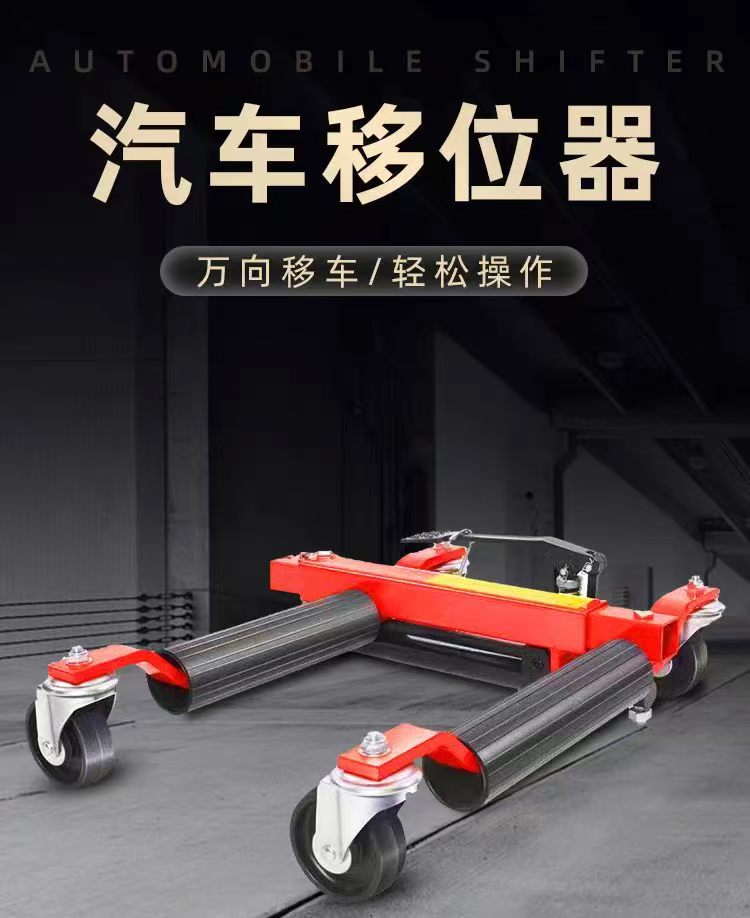
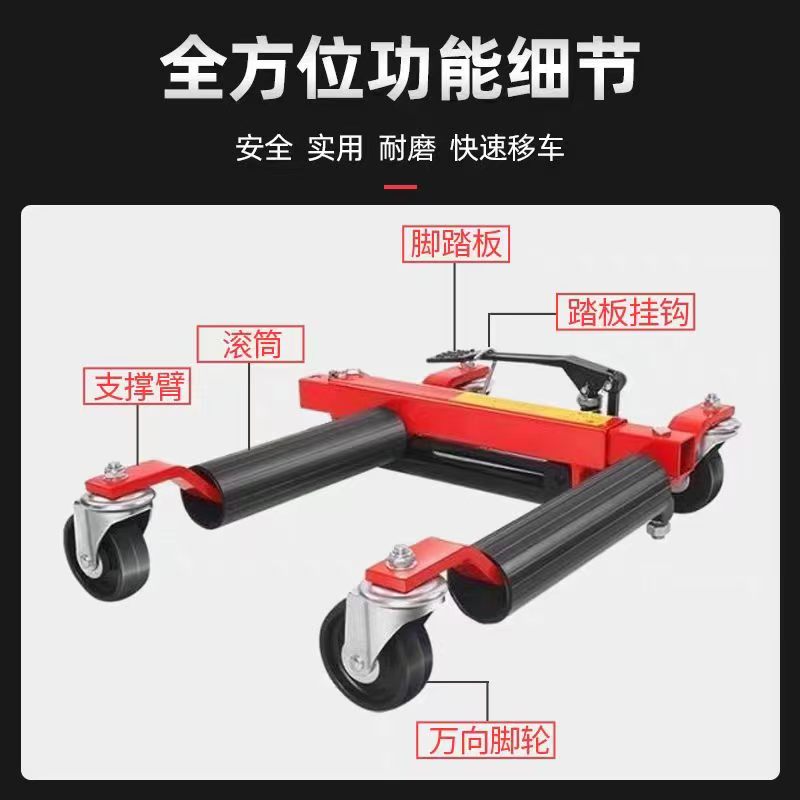
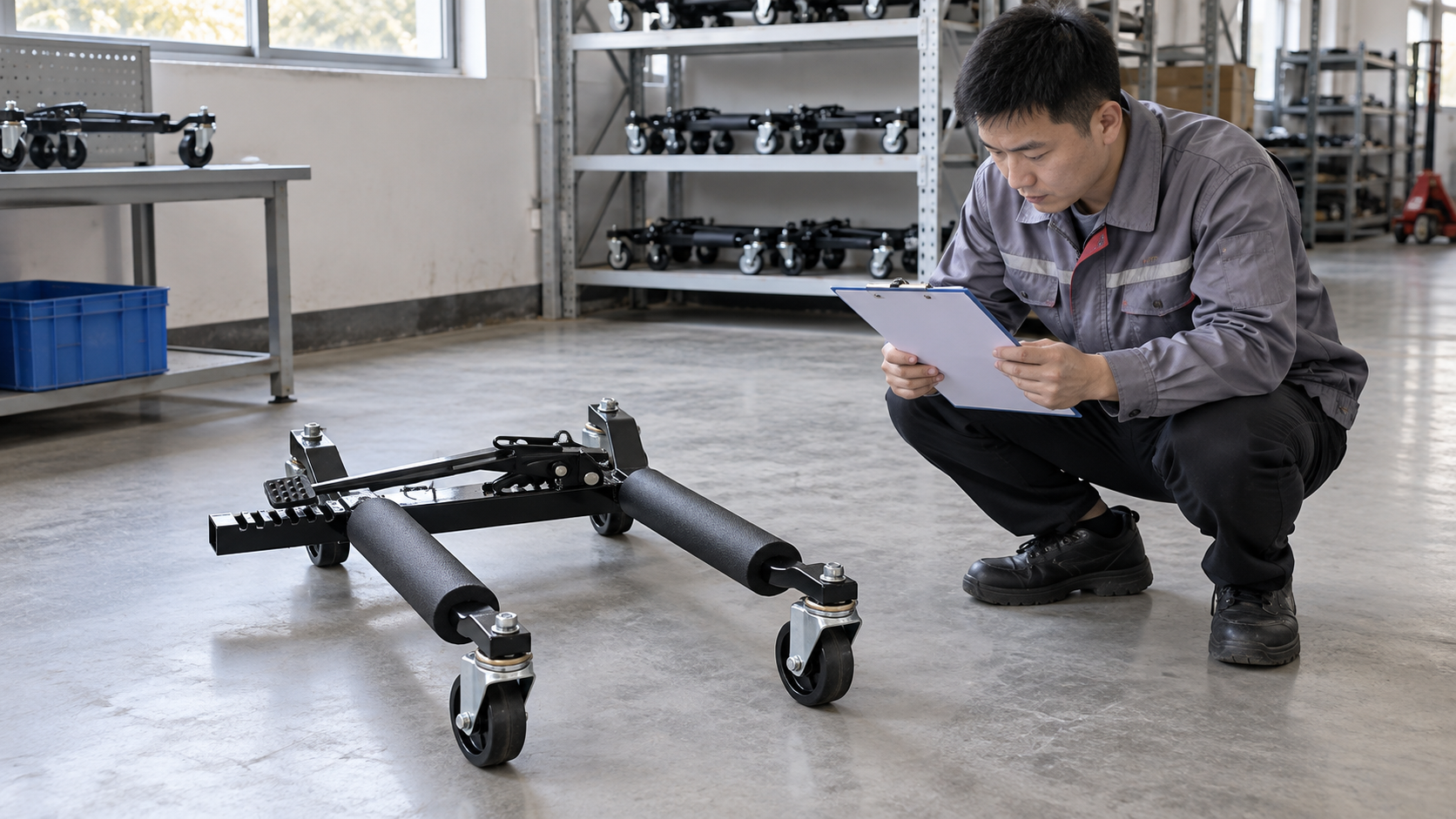
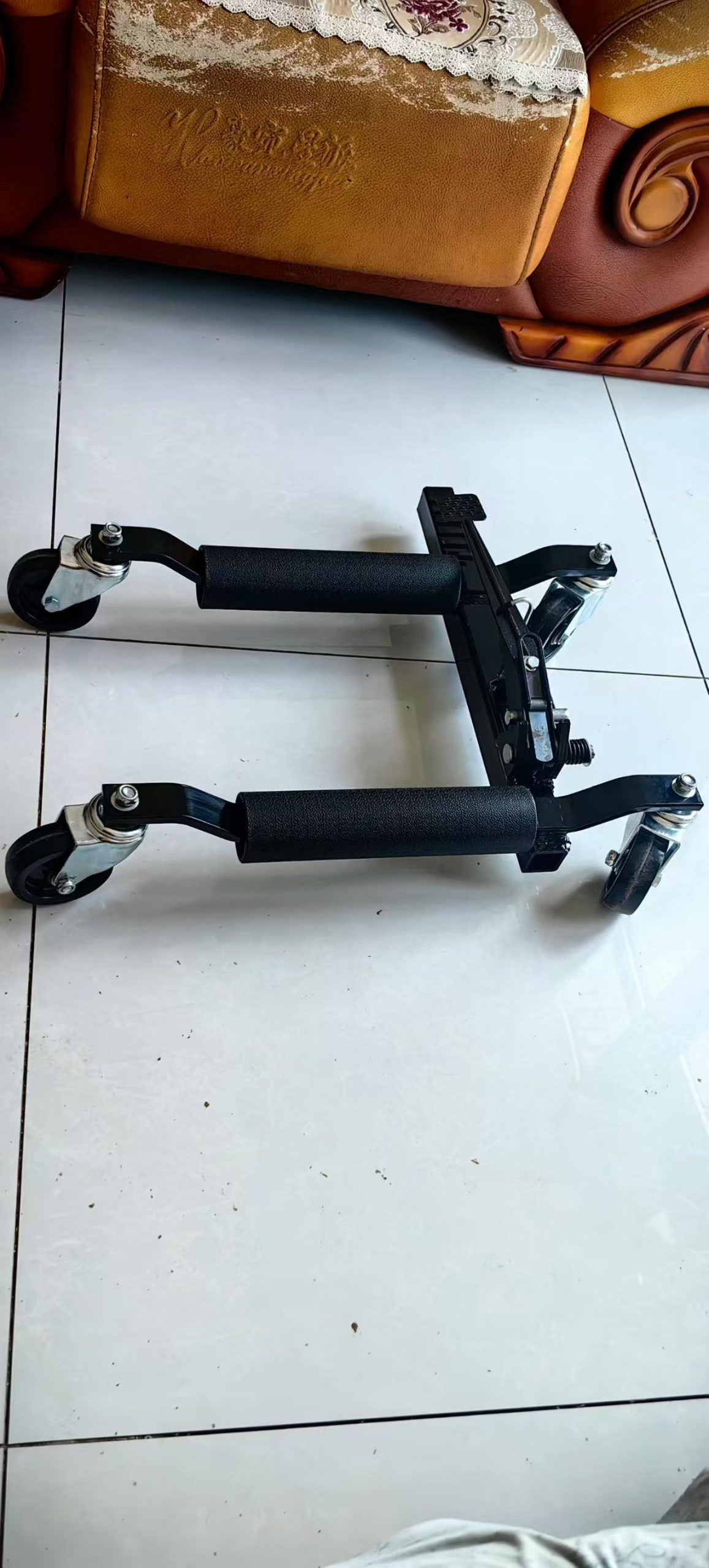
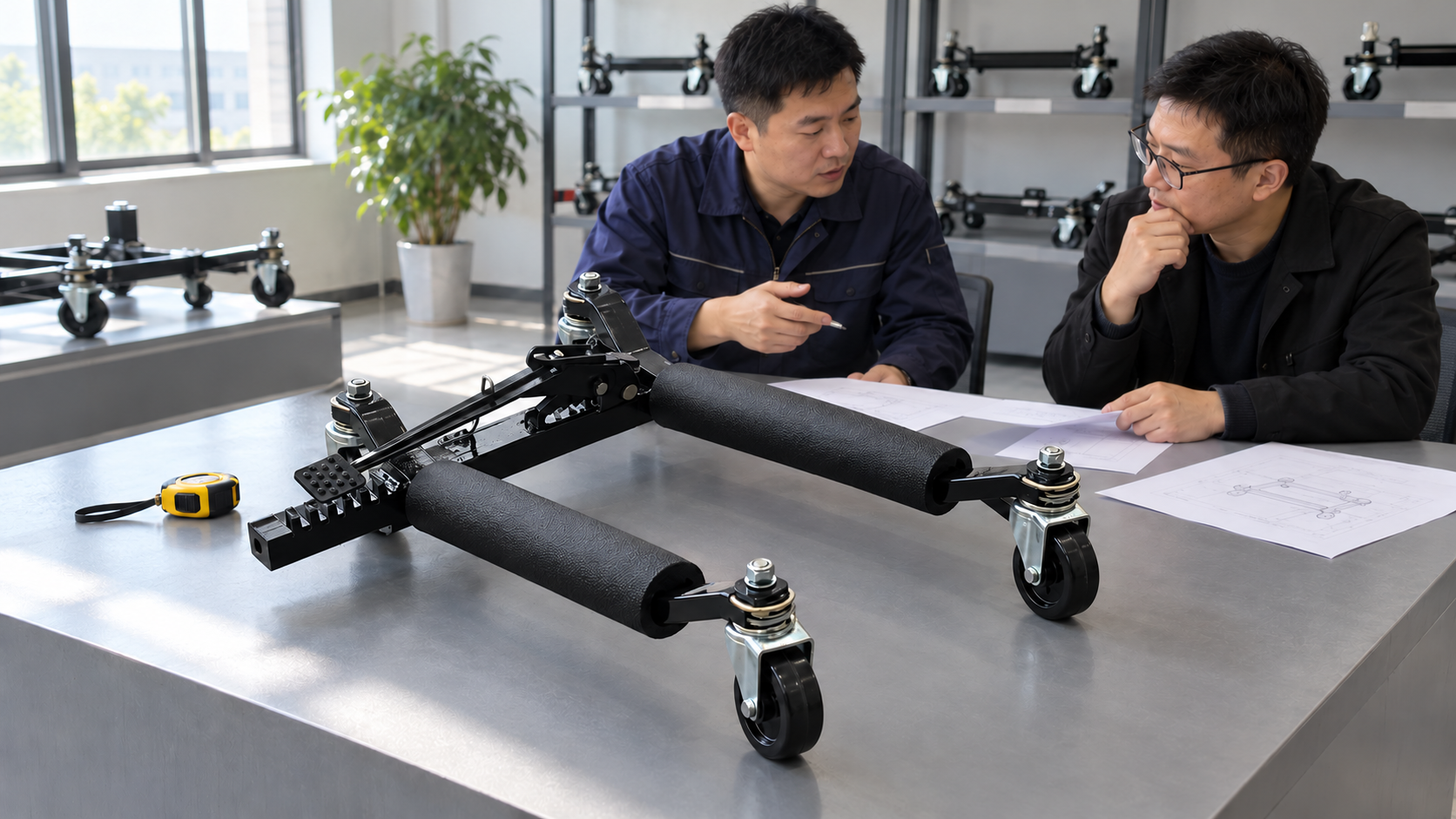
A vehicle positioning jack supports a mounted tire while staff reposition a stationary vehicle on an approved floor. A product may combine twin rollers, a pedal, a toothed bar, and four casters. Confirm mechanism from a parts drawing and rated capacity from model-specific documentation. Include positioning equipment when planning an automotive repair tool assortment.
Use it for controlled positioning: clearing a bay, aligning a disabled car, or moving a project vehicle. It does not replace a service jack, axle stand, lift, or towing equipment. It does not support work beneath a vehicle.
Ask suppliers these product-definition questions:
- Which mounted tire does each unit support, and how many units must operate together?
- Which wheel width and tire shape fit its rollers or platform?
Specify the product by its movement job and limits. Define wheel fit, load conditions, vehicle type, floor, package quantity, and movement distance in your brief.
Buyer definition table
| Item to define | Buyer wording | Why it matters |
|---|---|---|
| Main job | Short-distance indoor positioning | Sets a realistic use boundary |
| Supported area | Wheel or tire contact area | Avoids confusing it with a chassis lift |
| Mechanism | Mechanical, hydraulic, or supplier-confirmed design | Determines inspection points |
| Sale unit | Single, pair, or four-piece set | Controls price and freight comparison |
Action: send one use scenario and wheel photo. Request a matching drawing before private-label packaging.
2. How Do Mechanical, Hydraulic, and Platform Designs Differ?
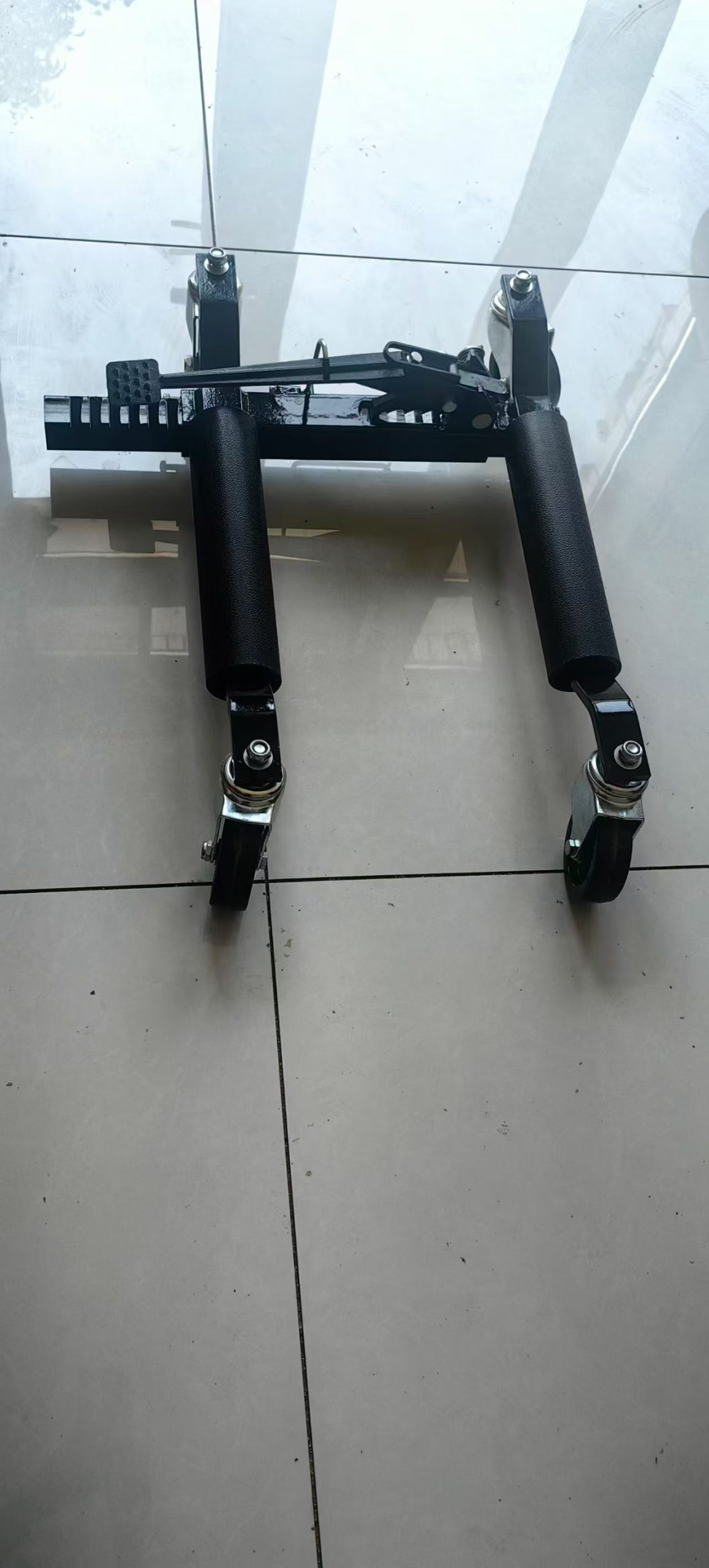
Mechanical models may use a pedal, lever, ratchet, screw, or toothed bar. Hydraulic models use a pump and fluid circuit. The supplied photos do not confirm those components. A fixed platform dolly has no integrated lifting mechanism. It requires a separate approved lifting method before loading.
Design family affects training, spares, packaging, and inspection. Check teeth and travel on mechanical units. Check leaks and release on hydraulic units. Check restraint and casters on platforms.
Use this short list when comparing offers:
- Request a labeled mechanism drawing or parts view.
- Ask which parts carry wheel load during rolling.
- Record release and adjustment methods.
- Separate verified construction from product nicknames.
Mechanism choice determines your service burden. Choose a design your network can inspect and support. Ask for replacement identification before comparing price. Match service requirements with your workshop and distributor program.
Design comparison table
| Design family | Typical buyer check | Possible service concern | Evidence to request |
|---|---|---|---|
| Mechanical roller | Tooth engagement and linkage travel | Wear at teeth, pins, or pivots | Parts drawing and operating sample |
| Hydraulic roller | Pump, release, and fluid containment | Seals, fluid, hoses where fitted | Circuit description and leak test record |
| Platform | Surface support and edge retention | Platform or caster attachment | Platform dimensions and load path |
Action: ask suppliers to identify load-bearing parts. Compare sample construction and operation against approved drawings before acceptance.
3. How Should Buyers Read Load Ratings for One Dolly or a Set?
Unclear load descriptions cause purchasing disputes. A rating may apply to one jack, pair, or four-unit set. It may assume a centered wheel and level floor. Do not divide a set rating without evidence.
Corner loads need separate treatment. A vehicle may not sit evenly across four points. Balance, wheel condition, steering angle, and floor irregularity can increase one corner’s share. Request per-unit load and corner limits.
Compare these fields across quotations:
- Rated load per unit and unit system.
- Pair or four-unit rating, if offered.
- Wheel count and location during movement.
- Load distribution limits.
- Static, rolling, or both conditions.
Compare ratings under documented operating conditions. Separate per-unit, set, test condition, and unresolved points. Never approve fit by dividing total vehicle weight by four; verify each supported wheel load.
Load interpretation table
| RFQ field | Acceptable response | Follow-up if missing |
|---|---|---|
| Per-unit rating | Stated with test condition | Request a unit test statement |
| Pair rating | Clearly tied to two-unit use | Ask how load was distributed |
| Four-unit rating | Linked to four contact points | Ask about uneven corner loads |
| Static or rolling | Each condition named | Request separate limits |
| Unit system | kg, lb, or both | Require one agreed conversion |
Action: put “per unit” and “set” on separate RFQ lines. Record wheel placement during sample approval.
4. Which Tire Dimensions Must Match?
Tire fit has three measurements. Tire width describes side-to-side span. Full outside diameter measures tread-to-tread distance across a mounted tire. Rim diameter describes wheel size inside the tire. Width can fit while tire height or rim shape interferes.
Keep these dimensions separate during comparison. Rim diameter cannot confirm roller clearance. Width cannot confirm body clearance or caster stability. Ask how measurements are taken and whether a tire sits centered.
Collect these details from a target vehicle:
- Mounted tire width measured by the supplier-defined method.
- Full outside diameter including tread and sidewall.
- Rim diameter and wheel profile.
- Wheel position and steering angle.
- Sidewall clearance from contact edge.
A fit sheet must carry all three dimensions. Send a tire photo, width, outside diameter, and rim diameter together. Request a marked drawing showing each clearance.
Tire fit table
| Measurement | What it describes | Supplier confirmation |
|---|---|---|
| Tire width | Mounted tire’s side-to-side span | Supported width range and measuring point |
| Full tire OD | Outside height of mounted tire | Clearance and roller or platform path |
| Rim diameter | Metal wheel size inside tire | Any rim or sidewall interference |
| Sidewall shape | Bulge, profile, or unusual contour | Centering and contact method |
| Steering angle | Wheel direction during placement | Loading condition and limits |
Action: check minimum and maximum tire sizes, including diameter limits, before approving a production sample.
5. How Do Casters and Floor Conditions Affect Movement?
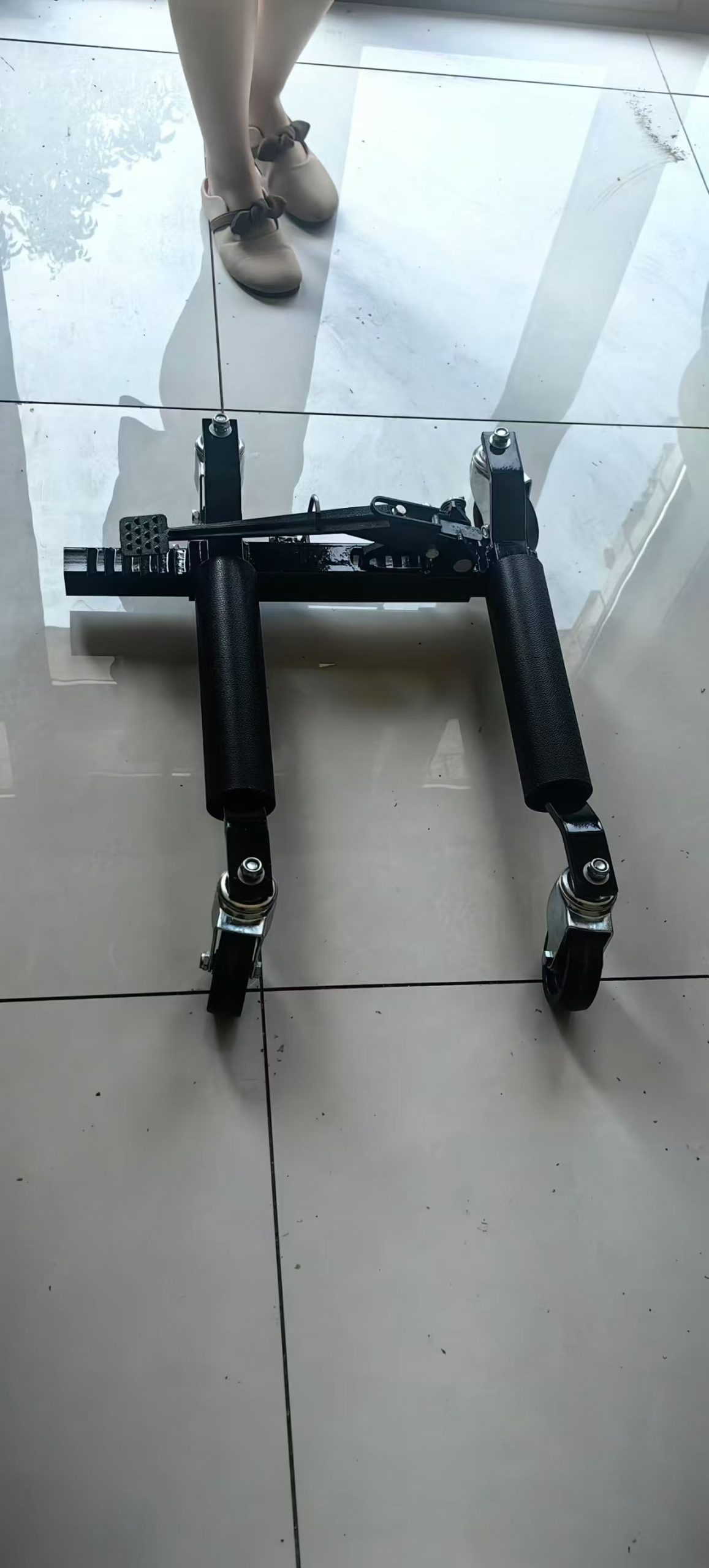
Casters transfer load through small contact points. Diameter, swivel action, tread, attachment, and locks affect movement. Four casters may bind at joints, debris, ramps, or soft surfaces.
Floor defects can interrupt otherwise predictable rolling. A swivel caster can track differently from a rigid wheel. A lock may stop swivel, rolling, or both. Ask which locking function each caster provides. A non-steering vehicle needs a clear path.
Check these conditions at your site:
- Concrete finish and floor flatness.
- Seams, drains, ramps, lips, and thresholds.
- Debris that could stop a caster.
- Lock access while a tire sits on the unit.
- Turning space and destination clearance.
Check casters against your approved floor route. Run a controlled trial on an approved shop surface. Record tracking, pedal access, turning effort, and contact points.
Floor and caster table
| Site feature | Risk to check | Buyer evidence |
|---|---|---|
| Smooth level concrete | Baseline rolling behavior | Short sample route |
| Unapproved seam or drain | Caster snag or sudden stop | Mark route prohibited |
| Ramp or slope | Uncontrolled movement | Site rule and route restriction |
| Debris or dust | Caster blockage | Cleaning requirement |
| Tight bay | Turning or steering conflict | Clear path sketch |
Action: document approved routes and prohibited floor features in your RFQ. Keep loaded trials away from unapproved seams.
6. Where Can a Positioning Jack Be Used Safely in a Workshop?
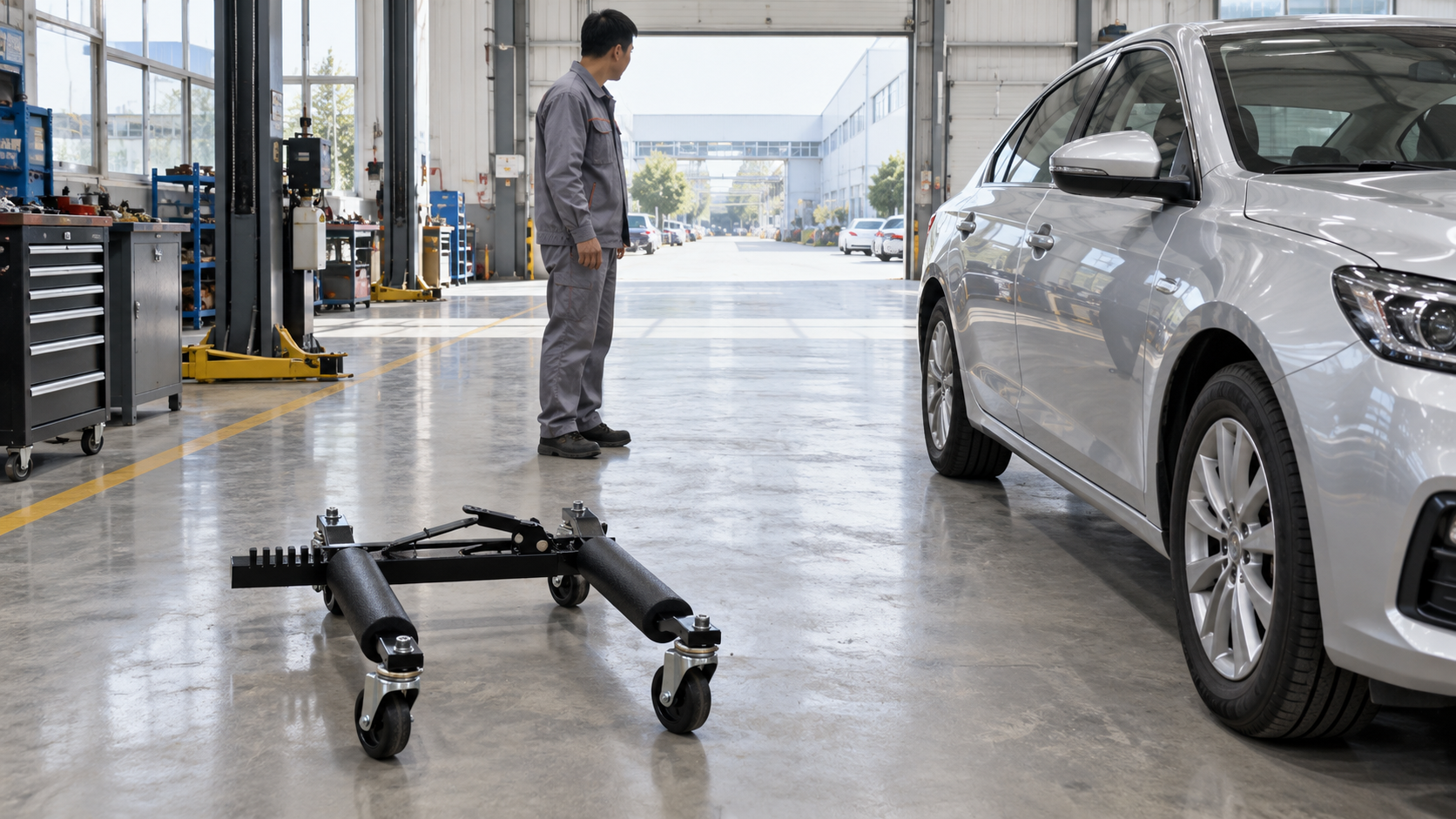
Use a vehicle positioning jack only for controlled indoor movement under a site procedure. Typical tasks include clearing a bay or positioning a non-running vehicle before unloading. Confirm any extended storage separately with model instructions. Limits depend on model instructions, vehicle, floor, and staff.
Do not use it for under-car repair, road towing, occupants, engine starting, ramps, rough surfaces, or an unclear path. The manufacturer safety manual restricts its model to movement tasks on a hard, level surface. It prohibits work on, around, or beneath a dolly-supported vehicle. Confirm equivalent boundaries in your own model instructions.
Build a workshop rule around:
- Trained operators and a named supervisor.
- Wheel chocking or other controls before loading.
- A clear path and destination.
- No passengers, engine start, or work below a vehicle.
- A stop rule for binding, uneven loading, or damage.
Safe positioning begins with a written boundary. Document permitted movement tasks alongside product instructions. Keep repair support and road towing outside that task.
Use boundary table
| Controlled use | Exclude from product scope |
|---|---|
| Indoor bay repositioning | Road towing |
| Moving a stationary project vehicle | Work under a supported vehicle |
| Short movement on approved floor | Ramps, rough seams, or soft ground |
| Trained staff following a route | Occupants or engine operation |
Action: arrange a supervised sample trial in a cleared bay. Record stop conditions before loading.
7. How Should a Distributor Inspect Samples Before Approval?
Receiving inspection should compare a sample against RFQ text, drawings, labels, and packing details. Check identity, welds, fasteners, rollers, pedal or pump action, casters, damage, and clearances. Appearance cannot replace a functional check.
Qualified staff should assess a compatible vehicle or fixture under an agreed test procedure. Confirm ratings before loaded trials; never improvise overload tests. Record load arrangement, wheel position, floor, route, deformation, or binding. Do not turn inspection into an under-car repair test. List unclear ratings for correction.
A useful inspection list includes:
- Part number, unit count, labels, and instructions.
- Roller or platform dimensions against drawing.
- Tooth, pedal, pump, release, and return action.
- Caster attachment, wheel condition, and lock behavior.
- Fit with target width and outside diameter.
- Damage, missing spares, and loose hardware.
Keep measurements and photographs with your approval. Record pass, fail, or clarification for each check. Retain a dated sample reference for later shipments.

Sample inspection table
| Inspection area | Record | Approval question |
|---|---|---|
| Identity | Part number and unit count | Does shipment match RFQ? |
| Mechanism | Action and return behavior | Does operation match drawing? |
| Load path | Contact surfaces and fasteners | Are load-bearing points visible? |
| Wheel fit | Width, OD, rim clearance | Does target tire sit correctly? |
| Casters | Tracking and lock behavior | Does route trial remain controlled? |
| Packaging | Damage and missing items | Can units reach customers intact? |
Action: prepare an approval form before receipt. Resolve deviations in writing before production.
8. Should Units Be Packed as Singles, Pairs, or Four-Piece Sets?
Package quantity changes selling logic and freight handling. A single may serve as a replacement or combine with matched units. A pair may serve one axle. A four-piece set may support four locations, yet verify uneven-corner limits. Follow your model’s required operating configuration.
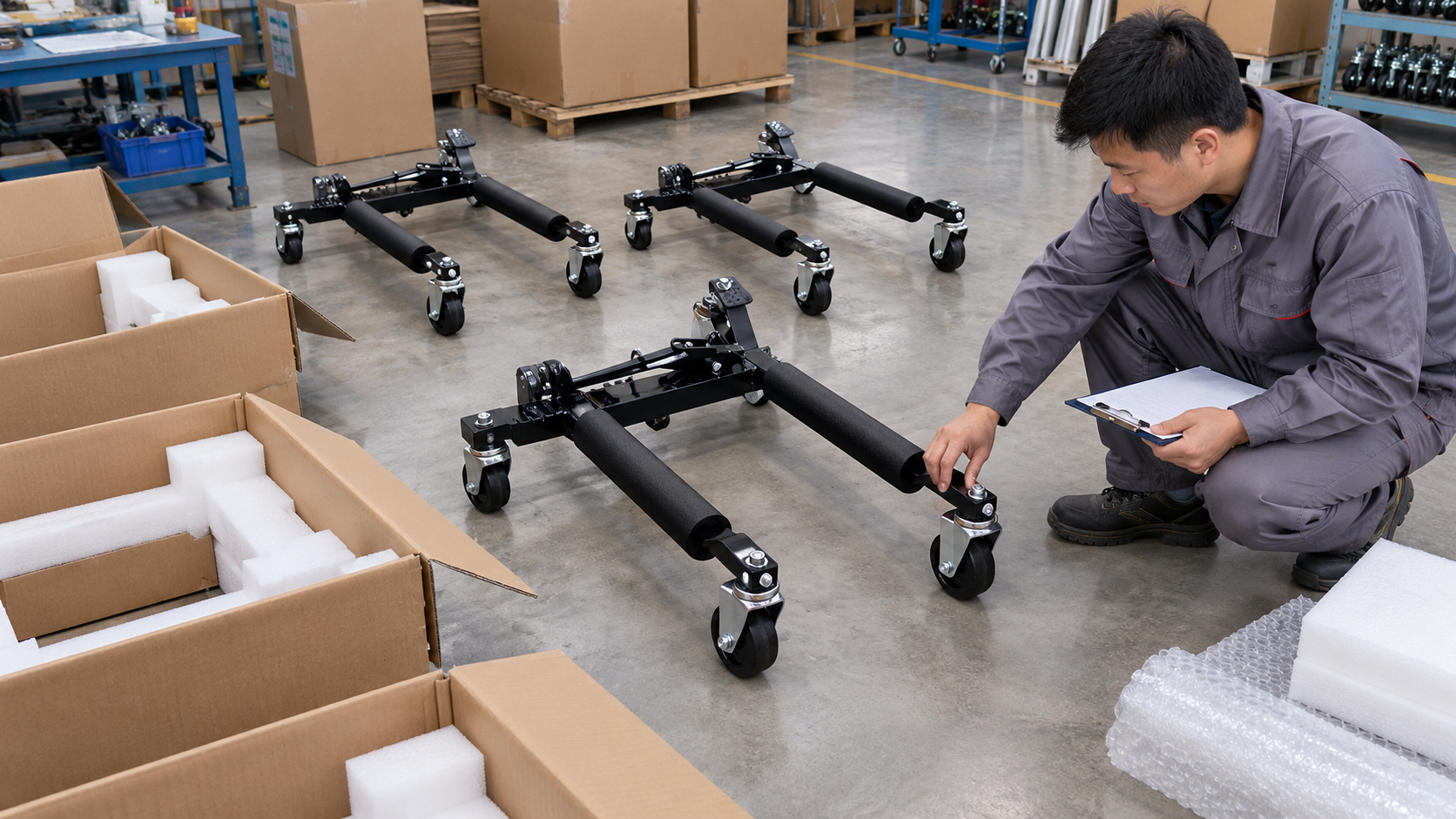
Packaging affects carton strength, protection, labels, spares, and picking. Heavy parts can punch through a carton if pieces are loose. Request packed dimensions and gross weight from a sample. Use confirmed carton data for final freight pricing.
Ask whether each quoted price covers one dolly, a pair, or four units. Record currency, trade terms, and included accessories. Compare offers on an identical quantity basis.
If your order includes mechanics tool sets, assign those tool sets separate SKUs and carton counts.
Clarify these points before comparing freight:
- Sale unit and carton quantity.
- Protection for casters, pedals, teeth, and paint.
- Carton marks, barcode position, and language.
- Pallet or container loading plan.
- Spares packed with each unit or separately.
Packaging should follow the customer’s operating quantity. Choose a sale unit from workshop use, then validate carton handling with a packed sample. List other items from KOLARWIN’s tool product range separately when consolidating a shipment.
Packaging and logistics table
| Package choice | Buyer fit | Check before order |
|---|---|---|
| Single unit | Replacement or combining matched units | Required operating quantity and compatibility |
| Pair | Two-wheel or axle-related workflow | Pair load condition and matching parts |
| Four-piece set | Multi-wheel positioning plan | Uneven corner limits and set contents |
| Mixed carton | Distributor assortment | Picking labels and protection layout |
Action: request packed-carton photographs, dimensions, gross weight, and protection details for freight pricing.
9. What Documents and Spares Should an OEM Supplier Provide?
An OEM supplier should provide information that helps staff identify correct use and replacement parts. A basic pack may include a drawing, parts list, operating guide, inspection record, carton mark, and spare list. Scope depends on your agreement.
Ask for files matching delivered hardware. A generic manual with another model number creates claim confusion. Spares need names, reference numbers, and compatibility notes. Mechanical spare lists may include approved ratchet assemblies, pins, rollers, and casters. Hydraulic versions may require seals, release parts, and hoses where fitted.
KOLARWIN’s automotive tool sourcing guides cover wider purchasing questions. Keep approved model documents with each RFQ.
Your document request can include:
- Dimensional drawing with wheel-contact and caster details.
- Parts diagram with reference numbers.
- Use limits and floor boundaries.
- Inspection or batch record, if agreed.
- Spare list, order format, and packing method.
- Private-label artwork and carton files.
After-sales support depends on model-matched documents. Connect each spare number with a model code, photo, and replacement note. Supplier context appears in China OEM auto tools guidance.
OEM document table
| Document or spare | Buyer purpose | Acceptance check |
|---|---|---|
| Product drawing | Fit and RFQ approval | Matches sample dimensions |
| Parts diagram | Service identification | References match hardware |
| Operating guide | Controlled workshop use | States limits clearly |
| Inspection record | Batch review | Agreed fields are completed |
| Spare list | After-sales ordering | Names, numbers, compatibility |
| Packaging artwork | Private-label sales | Approved marks and warnings |
Action: request documents with your sample. File approved revisions under one model code before online listing.
10. What Should a B2B RFQ Include?
An effective RFQ turns a broad request into a verifiable sample and comparable offer. State your channel, vehicle type, tire dimensions, floor, route, sale unit, private-label needs, and documents. Ask suppliers to separate verified data from sample-confirmed items.
Use these fields in your RFQ:
- Product type and controlled movement task.
- Mechanical, hydraulic, or platform preference.
- Tire width, outside diameter, rim diameter, and target sample.
- Per-unit and set ratings with test conditions.
- Caster, floor, and route details.
- Packaging, carton data, labels, and spares.
- Drawing, manual, parts list, inspection record, and sample plan.
Use a complete mechanic tools list for distributors when planning adjacent purchases. Confirm this product’s fit and operating limits separately.
Request a written answer for every RFQ field. Include target tire dimensions, an approved floor route, and your sample form. Send KOLARWIN your positioning-jack requirements for a model-specific discussion.
Q1: What does a vehicle positioning jack do?
It supports a mounted tire for short, controlled vehicle movement on a suitable workshop floor.
Q2: Does a positioning jack replace a service jack or axle stand?
A positioning dolly serves a different task. Use approved repair-support equipment for work beneath a vehicle.
Q3: Which tire dimensions should buyers provide?
Provide mounted tire width, full outside diameter, and rim diameter. Width checks contact fit; outside diameter and rim shape affect clearance.
Q4: Does a four-piece set rating equal four times one-unit rating?
A simple multiplication cannot approve vehicle compatibility. Request separate per-unit and set ratings with uneven-corner conditions.
Q5: What should I request before placing an OEM order?
Request a matched sample, drawing, use guide, parts list, inspection record, packaging data, spare list, and RFQ answers.
Looking for a reliable mechanic tools manufacturer in China?
If you are sourcing hand tools, socket tools, automotive repair tools, mechanic tool sets or OEM private label tools, contact KOLARWIN Tools for factory-direct quotation, customization support and product consultation.


