
Home/Blog/ Crowfoot Wrench Torque Calculation: A Practical Guide

Crowfoot Wrench Torque Calculation: A Practical Guide

Get OEM Tool Catalog + Quote Back to Tool Sourcing Blog
Open-end crowfoot wrench heads beside a torque wrench on a sample bench
This KOLARWIN Tools article is written for overseas distributors, wholesalers, importers and private label tool brands sourcing mechanic tools, automotive repair tools, socket tools, hand tools and OEM tool sets from China. Use this guide to compare product options, check supplier quality points and move from reading to a faster B2B inquiry.

Need OEM supplier support for this product type?

Contact KOLARWIN Tools for OEM mechanic tools, private label packaging, wholesale quotation and product range support. This gives overseas buyers a clear path from article reading to supplier discussion.

A crowfoot can reach a fastener that a socket cannot, but its position may change a torque wrench’s effective length. Buyers and technicians need a clear rule for when a correction is required, what dimensions enter the calculation, and which assumptions must hold. This guide explains the geometry, a conditional 90-degree method, sample controls, and RFQ fields without treating one formula as universal.

1. Why does crowfoot position affect indicated torque?

Fastener torque depends on the perpendicular distance from its axis to the applied force. Adding a crowfoot inline can move the fastener center relative to the wrench’s square drive and change leverage. A sideways crowfoot may preserve effective length, but that layout alone does not set the force vector. Follow the wrench maker’s specified hand position and pull direction. The general torque wrench guide is a useful companion when setting the wrench’s range and procedure.
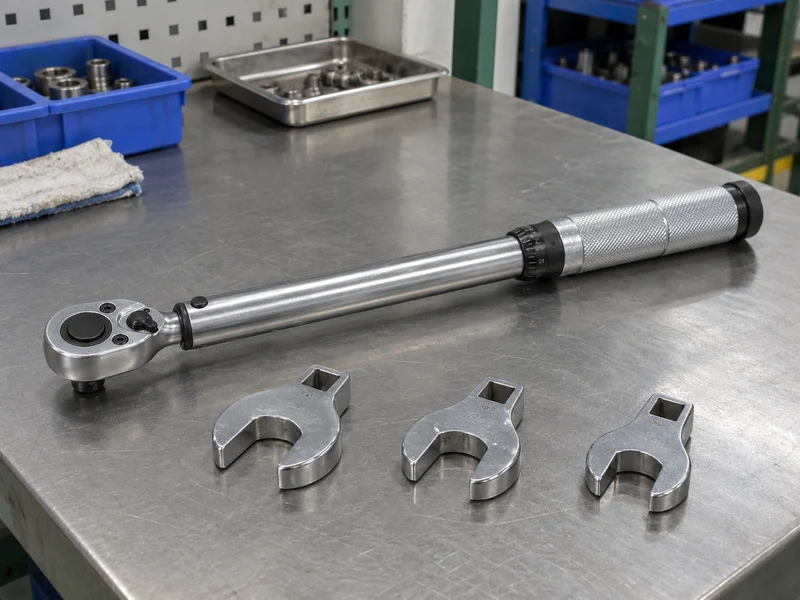
Open-end crowfoot wrench heads beside a torque wrench on a sample bench
Product illustration; confirm actual model specifications and fit.
  • Identify the square-drive center and fastener center.
  • Determine whether the crowfoot extends along the wrench axis.
  • Keep adapter orientation consistent through the pull.

Treat orientation as a geometry question, not a rule based only on appearance. Photograph the approved setup and record dimensions for repeat service work.

Setup

Setup Effect
Inline extension May increase effective length
90-degree arrangement Can preserve effective length under assumptions
Flex-head wrench Changes assumptions if head angle is engaged

2. When can a 90-degree arrangement use the wrench setting directly?

A direct setting can apply when the crowfoot axis is 90 degrees to the wrench handle, the wrench head and handle remain straight, and any flex joint stays unangled. The technician must also apply force perpendicular to the handle at the maker-defined effective grip point, in the intended plane. Under those conditions, the fastener’s perpendicular moment arm remains the wrench’s defined effective length. A right-angle adapter does not guarantee a right-angle force: pushing sideways or pulling at an oblique angle changes the moment arm. Confirm the maker’s specified force direction and use its instructions for any setup that departs from this geometry.
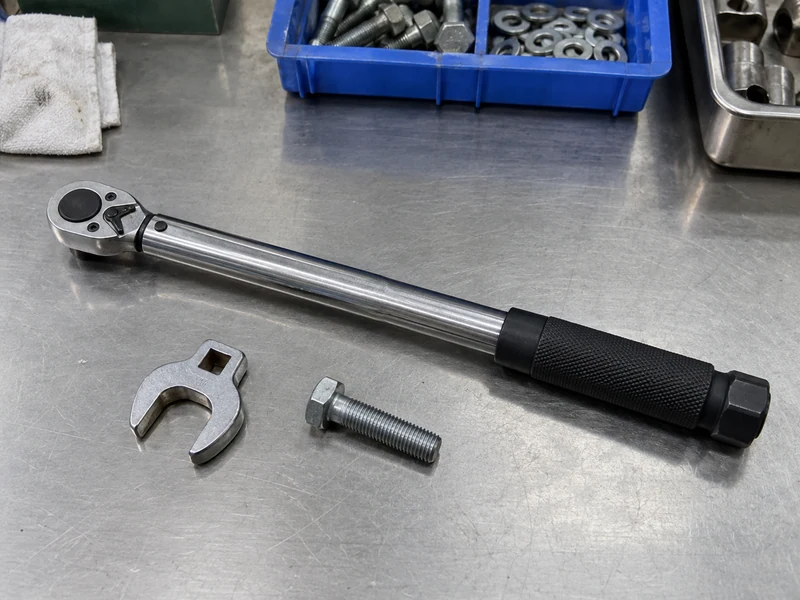
Detached torque wrench and crowfoot adapter on an inspection table
Product illustration; confirm actual model specifications and fit before selection.
  • Confirm crowfoot-to-handle angle and that the wrench head is straight.
  • Pull perpendicular to the handle at the maker-defined grip reference.
  • If the force direction, flex angle, or plane differs, stop using the direct-setting rule and consult the wrench maker.

A right-angle adapter works as a direct-setting case only with the specified straight wrench and perpendicular pull. Mark both the adapter orientation and hand-force direction in the work instruction.

Condition

Setup condition Direct-setting decision
Adapter 90°, straight head, force perpendicular at specified grip May preserve effective length under maker instructions
Adapter 90° but force applied obliquely Right angle alone is insufficient; moment arm changes
Flex head angled or force plane altered Do not assume direct setting or apply a simple correction without maker guidance

3. What formula applies when crowfoot length changes effective length?

For a straight torque wrench and a crowfoot aligned inline, a manufacturer’s correction may use Tset = Ttarget × L ÷ (L + C). Here L is the maker-defined effective length from the square-drive center to its specified grip reference, and C is the signed change in fastener-center distance projected along the wrench axis. The relation assumes a straight wrench and the normal perpendicular pull at that grip point. An oblique pull changes the perpendicular moment arm; a simple inline formula does not correct an arbitrary force angle. Follow the tool maker’s calculator or instructions whenever the setup differs.
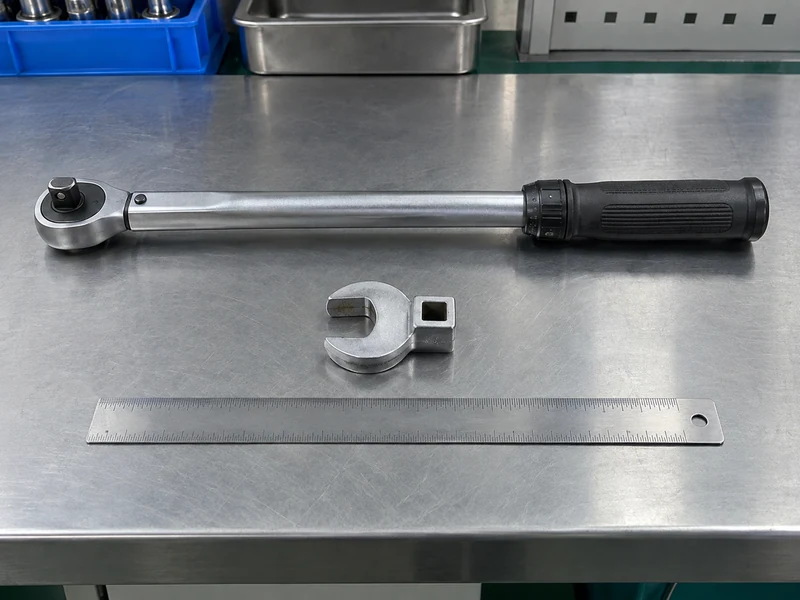
Torque wrench, crowfoot adapter, and plain ruler laid separately
Product illustration; confirm actual model specifications and fit before selection.
  • Use a single torque unit throughout.
  • Measure from drive center to the maker-defined handle reference.
  • Use signed C according to the wrench maker’s method.

The equation is useful only after the dimensions match its definition. Use the wrench manufacturer’s instructions or calculator when available.

Symbol

Symbol Definition
Ttarget Required fastener torque
L Effective wrench length per manufacturer
C Axial length change from adapter setup
Tset Adjusted wrench setting

4. How do you work through a sample calculation?

Suppose a fastener target is 100 N·m, the effective length is 400 mm, and an inline crowfoot adds 50 mm along the handle axis. Under the stated perpendicular-pull assumptions, the setting becomes 100 × 400 ÷ (400 + 50), or about 88.9 N·m. At 90 degrees, a setup that preserves the effective length may use the target setting directly, subject to the wrench maker’s method. These examples describe two defined geometries; they do not authorize guessing at intermediate angles or force directions. If an angled access position changes both projected extension and force direction, use an approved calculator or alternate setup.
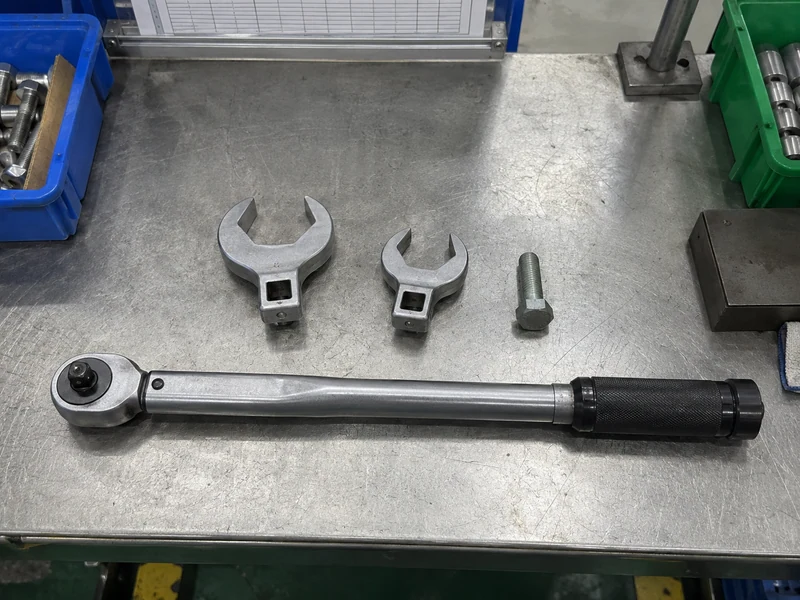
Two crowfoot offsets beside a detached torque wrench and fastener
Product illustration; confirm actual model specifications and fit before selection.
  • Record target torque, effective length, projected extension, and force direction.
  • Calculate without rounding until the final setting.
  • Check that the value sits inside the wrench’s allowed range and resolution.

Check arithmetic and fit before loading the fastener. Document the worked example beside the exact wrench and adapter model.

Input

Input Example
Target torque 100 N·m
Wrench length 400 mm
Inline extension 50 mm
Adjusted setting About 88.9 N·m

5. How should length and angle be measured?

Measure between geometric centers, not outside edges. Wrench length runs from square-drive center to the maker-defined effective grip point, not an arbitrary spot on the handle. Crowfoot change is the fastener-center displacement projected parallel to the wrench axis. Projection supplies only the length component; it does not account by itself for a force vector that is no longer perpendicular to the handle. Draw the setup in side view, mark the grip point, adapter angle, fastener center, and pull direction, then ask the wrench maker to confirm any nonstandard geometry.
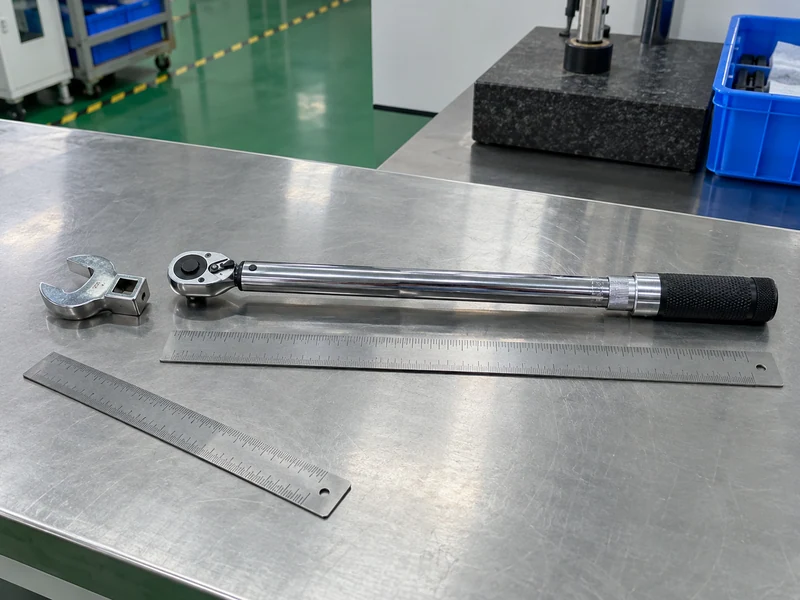
Crowfoot adapter and measuring rules beside an unconnected torque wrench
Product illustration; confirm actual model specifications and fit before selection.
  • Use the torque wrench manual’s reference point.
  • Measure center-to-center with the tool aligned as used.
  • For angled setups, project the added distance along the wrench axis.

A small geometry mistake can matter when the extension is large relative to wrench length. Keep a dimensioned setup drawing for nonstandard adapter positions.

Measurement

Measurement Method
L Drive center to specified handle reference
C Axial projected change in fastener center location
Angle Between wrench axis and crowfoot configuration

6. What can make a formula-based correction unreliable?

The calculation assumes a rigid, straight, aligned wrench and repeatable loading. A flex head, loose drive, crowfoot movement, side loading, or oblique pull can change the moment arm or invalidate the model. Torque-wrench accuracy and calibration still apply, while damaged threads, lubrication changes, joint settling, and poor technique remain separate joint variables. For a force applied at angle θ to the handle, the moment arm depends on the perpendicular component; do not substitute an axial projection into the inline formula and call that a complete correction. Reposition the tool or obtain a maker-approved method.
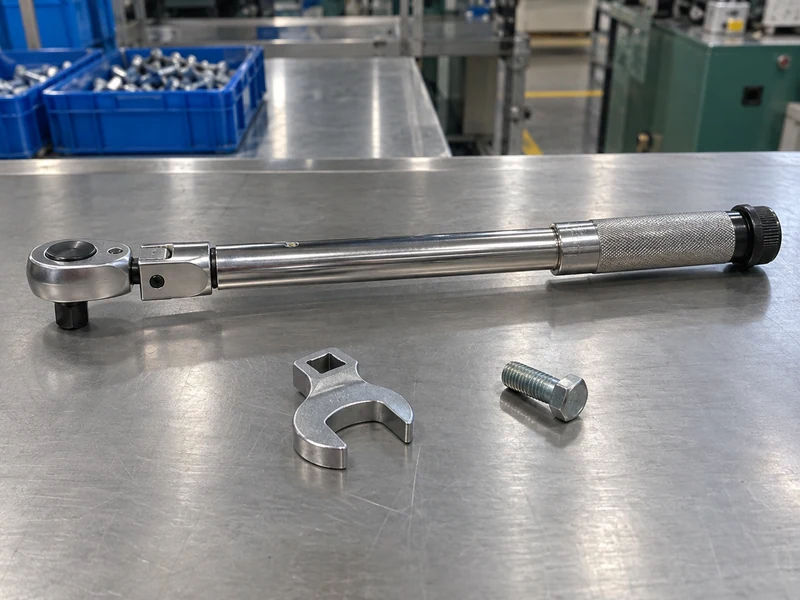
Straight flex-head torque wrench with a separate crowfoot adapter
Product illustration; confirm actual model specifications and fit before selection.
  • Inspect the wrench and adapter for play or damage.
  • Apply force perpendicular to the handle at the specified grip point.
  • Use the same joint condition and torque procedure as the service specification.

Formula output cannot correct an uncontrolled setup. Reject a setup that shifts under load or falls outside the torque wrench’s approved use.

Risk

Risk Why it matters
Flex head angle Changes effective length assumptions
Side load Can affect indicated torque and tool safety
Joint condition Changes clamp load despite torque reading

7. How do different crowfoot styles change the setup?

Open-end crowfoots, flare-nut forms, and different offsets provide distinct access and contact geometry. Head depth and thickness determine whether the tool reaches the fastener; drive size sets the connection. The socket tools range gives buyers a related drive-family catalog reference. A long offset does not automatically create the same correction as a straight inline extension. Confirm that the working head fully seats and that adjacent components do not force an unintended angle. For a brake-line fitting, a flare-nut crowfoot may improve access around tubing, but the wrench still needs a straight pull path and a documented torque method. The automotive repair tool range helps buyers place this adapter in a broader service context.
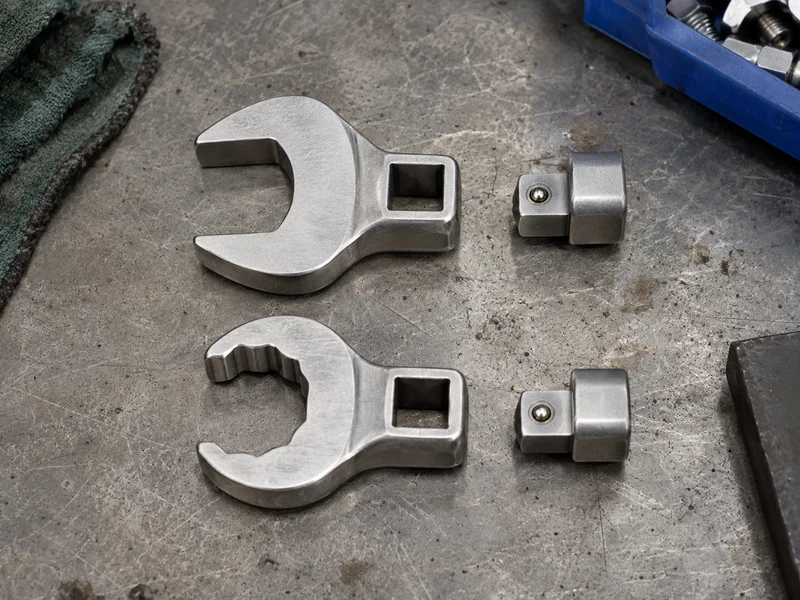
Open-end and flare-nut crowfoot tools arranged side by side
Product illustration; confirm actual model specifications and fit before selection.
  • Match opening size and fastener profile.
  • Check drive square fit and head clearance.
  • Measure offset for each crowfoot design rather than assuming interchangeability.

Access requirements and leverage correction belong in the same selection review. Specify head style, size, drive, offset, and intended wrench family.

Crowfoot field

Crowfoot field Sample review
Opening Correct fit and full contact
Offset Dimensioned change from drive to fastener
Drive Square size and retention fit

8. What sample tests should a tool buyer run?

Use a calibrated torque analyzer or suitable reference setup to compare wrench behavior with and without the adapter. Test the direct 90-degree configuration with a perpendicular pull at the specified grip point, then test any planned inline setup using its calculated setting. Keep operator, grip point, force direction, joint fixture, and tool condition constant. Record each adapter model, angle, L, projected C, setting, and measured result. Do not treat an informal click test as traceable evidence. For a buyer’s sample file, keep the wrench calibration ID, analyzer ID, operator, pull-point photo, and every repeat value together. If measured torque varies when grip position or force angle changes, the test has exposed an uncontrolled setup rather than a crowfoot specification. A hand-tool program can list torque wrenches and crowfoots as a matched use pair, provided the exact model instructions remain attached. If operators will use a nonstandard pull angle, test that exact geometry and obtain manufacturer acceptance before publishing a correction table.
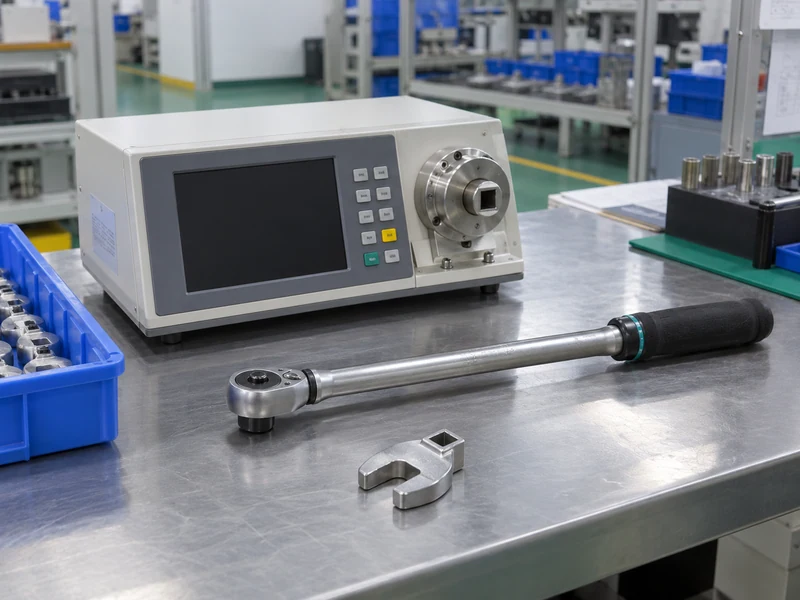
Torque analyzer and detached torque tools at rest on a QC bench
Product illustration; confirm actual model specifications and fit before selection.
  • Define test points within the wrench’s rated range.
  • Repeat each setup and record scatter.
  • Inspect adapter movement and fastener seating after each trial.

A controlled comparison makes an approved calculation auditable. Set acceptance limits with the quality team before testing samples.

Test

Test Record
Baseline Wrench alone at target points
Adapter setup Angle, L, C, and setting
Outcome Measured torque, repeats, and observations

9. How should distributors specify a crowfoot range?

Plan by opening size, drive size, head profile, offset, material and finish requirements, plus compatible torque-wrench families. Separate common open-end access from flare-nut applications when rounded fasteners or tube fittings change the contact need. Avoid selling an assortment with a generic torque correction claim. A SKU matrix can list opening, square-drive size, head type, center offset, compatible wrench model, maker-defined grip reference, and approved force direction. For instance, a buyer might stock two openings on the same drive but require separate offset values because their head lengths differ. The mechanics tool sets page can help buyers place crowfoots within a larger service-tool program. For broader category planning, consult the mechanic tool planning guide.
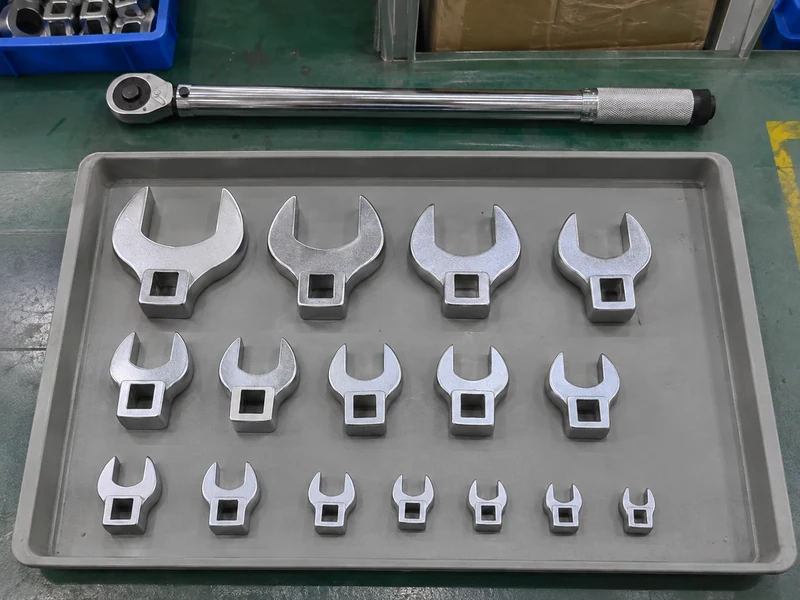
Crowfoot adapters organized by apparent size with a wrench separate
Product illustration; confirm actual model specifications and fit before selection.
  • Map fastener sizes and drive family by customer segment.
  • Include length and offset data for each model.
  • Keep correction guidance model-specific and tied to a wrench manual.

Document the tested geometry beside each approved adapter and wrench pairing. Review duplicated openings and missing drive sizes before finalizing a kit.

Catalog field

Catalog field Why include it
Opening / drive Confirms fit
Center offset Supports calculation
Compatibility Connects adapter to wrench instructions

10. What should a torque adapter RFQ include?

State opening size, crowfoot style, square-drive size, effective offset, material, finish, fit tolerance, intended wrench family, packaging, and required inspection evidence. Provide a drawing for unusual geometry. If buyers need calculation guidance, attach the specific torque wrench manual or model so assumptions can be checked. For supplier qualification context, review the supplier selection guide, then send the dimensioned setup through contact KOLARWIN.

Hands reviewing a blank worksheet beside torque tools
Product illustration; confirm actual model specifications and fit before selection.
  • Send a dimensioned drawing and sample fastener.
  • Identify angle and correction method expected in service.
  • List packaging and quality documents explicitly.

Clear geometry protects both torque accuracy and buyer confidence. Approve one combined wrench-adapter setup before assortment release.

Q1: Do all crowfoot wrenches require a torque correction?

No. Correction depends on geometry, maker-defined grip point, and force direction. A 90-degree adapter may preserve effective length only with a straight head and perpendicular pull at the specified grip point.

Q2: Can I always use a crowfoot at 90 degrees without correction?

Only when the adapter is perpendicular to the handle, the wrench head is straight, the flex joint is not angled, and force is applied perpendicular to the handle at the maker-defined grip point. Otherwise, consult the wrench maker.

Q3: What does L mean in a crowfoot calculation?

It is the torque wrench’s effective length measured by the maker’s stated reference points.

Q4: Can I use the formula with a flex-head torque wrench?

Only if the flex head remains in the required straight position and maker instructions allow it.

Q5: Does the formula correct for thread lubrication?

No. Joint condition and service torque specification remain separate variables.

Looking for a reliable mechanic tools manufacturer in China?

If you are sourcing hand tools, socket tools, automotive repair tools, mechanic tool sets or OEM private label tools, contact KOLARWIN Tools for factory-direct quotation, customization support and product consultation.


A crowfoot can reach a fastener that a socket cannot, but its position may change a torque wrench’s effective length. Buyers and technicians need a clear rule for when a correction is required, what dimensions enter the calculation, and which assumptions must hold. This guide explains the geometry, a conditional 90-degree method, sample controls, and RFQ fields without treating one formula as universal.

1. Why does crowfoot position affect indicated torque?

Fastener torque depends on the perpendicular distance from its axis to the applied force. Adding a crowfoot inline can move the fastener center relative to the wrench’s square drive and change leverage. A sideways crowfoot may preserve effective length, but that layout alone does not set the force vector. Follow the wrench maker’s specified hand position and pull direction. The general torque wrench guide is a useful companion when setting the wrench’s range and procedure.

Open-end crowfoot wrench heads beside a torque wrench on a sample bench
Product illustration; confirm actual model specifications and fit.

Treat orientation as a geometry question, not a rule based only on appearance. Photograph the approved setup and record dimensions for repeat service work.

Setup

Setup Effect
Inline extension May increase effective length
90-degree arrangement Can preserve effective length under assumptions
Flex-head wrench Changes assumptions if head angle is engaged

2. When can a 90-degree arrangement use the wrench setting directly?

A direct setting can apply when the crowfoot axis is 90 degrees to the wrench handle, the wrench head and handle remain straight, and any flex joint stays unangled. The technician must also apply force perpendicular to the handle at the maker-defined effective grip point, in the intended plane. Under those conditions, the fastener’s perpendicular moment arm remains the wrench’s defined effective length. A right-angle adapter does not guarantee a right-angle force: pushing sideways or pulling at an oblique angle changes the moment arm. Confirm the maker’s specified force direction and use its instructions for any setup that departs from this geometry.

Detached torque wrench and crowfoot adapter on an inspection table
Product illustration; confirm actual model specifications and fit before selection.

A right-angle adapter works as a direct-setting case only with the specified straight wrench and perpendicular pull. Mark both the adapter orientation and hand-force direction in the work instruction.

Condition

Setup condition Direct-setting decision
Adapter 90°, straight head, force perpendicular at specified grip May preserve effective length under maker instructions
Adapter 90° but force applied obliquely Right angle alone is insufficient; moment arm changes
Flex head angled or force plane altered Do not assume direct setting or apply a simple correction without maker guidance

3. What formula applies when crowfoot length changes effective length?

For a straight torque wrench and a crowfoot aligned inline, a manufacturer’s correction may use Tset = Ttarget × L ÷ (L + C). Here L is the maker-defined effective length from the square-drive center to its specified grip reference, and C is the signed change in fastener-center distance projected along the wrench axis. The relation assumes a straight wrench and the normal perpendicular pull at that grip point. An oblique pull changes the perpendicular moment arm; a simple inline formula does not correct an arbitrary force angle. Follow the tool maker’s calculator or instructions whenever the setup differs.

Torque wrench, crowfoot adapter, and plain ruler laid separately
Product illustration; confirm actual model specifications and fit before selection.

The equation is useful only after the dimensions match its definition. Use the wrench manufacturer’s instructions or calculator when available.

Symbol

Symbol Definition
Ttarget Required fastener torque
L Effective wrench length per manufacturer
C Axial length change from adapter setup
Tset Adjusted wrench setting

4. How do you work through a sample calculation?

Suppose a fastener target is 100 N·m, the effective length is 400 mm, and an inline crowfoot adds 50 mm along the handle axis. Under the stated perpendicular-pull assumptions, the setting becomes 100 × 400 ÷ (400 + 50), or about 88.9 N·m. At 90 degrees, a setup that preserves the effective length may use the target setting directly, subject to the wrench maker’s method. These examples describe two defined geometries; they do not authorize guessing at intermediate angles or force directions. If an angled access position changes both projected extension and force direction, use an approved calculator or alternate setup.

Two crowfoot offsets beside a detached torque wrench and fastener
Product illustration; confirm actual model specifications and fit before selection.

Check arithmetic and fit before loading the fastener. Document the worked example beside the exact wrench and adapter model.

Input

Input Example
Target torque 100 N·m
Wrench length 400 mm
Inline extension 50 mm
Adjusted setting About 88.9 N·m

5. How should length and angle be measured?

Measure between geometric centers, not outside edges. Wrench length runs from square-drive center to the maker-defined effective grip point, not an arbitrary spot on the handle. Crowfoot change is the fastener-center displacement projected parallel to the wrench axis. Projection supplies only the length component; it does not account by itself for a force vector that is no longer perpendicular to the handle. Draw the setup in side view, mark the grip point, adapter angle, fastener center, and pull direction, then ask the wrench maker to confirm any nonstandard geometry.

Crowfoot adapter and measuring rules beside an unconnected torque wrench
Product illustration; confirm actual model specifications and fit before selection.

A small geometry mistake can matter when the extension is large relative to wrench length. Keep a dimensioned setup drawing for nonstandard adapter positions.

Measurement

Measurement Method
L Drive center to specified handle reference
C Axial projected change in fastener center location
Angle Between wrench axis and crowfoot configuration

6. What can make a formula-based correction unreliable?

The calculation assumes a rigid, straight, aligned wrench and repeatable loading. A flex head, loose drive, crowfoot movement, side loading, or oblique pull can change the moment arm or invalidate the model. Torque-wrench accuracy and calibration still apply, while damaged threads, lubrication changes, joint settling, and poor technique remain separate joint variables. For a force applied at angle θ to the handle, the moment arm depends on the perpendicular component; do not substitute an axial projection into the inline formula and call that a complete correction. Reposition the tool or obtain a maker-approved method.

Straight flex-head torque wrench with a separate crowfoot adapter
Product illustration; confirm actual model specifications and fit before selection.

Formula output cannot correct an uncontrolled setup. Reject a setup that shifts under load or falls outside the torque wrench’s approved use.

Risk

Risk Why it matters
Flex head angle Changes effective length assumptions
Side load Can affect indicated torque and tool safety
Joint condition Changes clamp load despite torque reading

7. How do different crowfoot styles change the setup?

Open-end crowfoots, flare-nut forms, and different offsets provide distinct access and contact geometry. Head depth and thickness determine whether the tool reaches the fastener; drive size sets the connection. The socket tools range gives buyers a related drive-family catalog reference. A long offset does not automatically create the same correction as a straight inline extension. Confirm that the working head fully seats and that adjacent components do not force an unintended angle. For a brake-line fitting, a flare-nut crowfoot may improve access around tubing, but the wrench still needs a straight pull path and a documented torque method. The automotive repair tool range helps buyers place this adapter in a broader service context.

Open-end and flare-nut crowfoot tools arranged side by side
Product illustration; confirm actual model specifications and fit before selection.

Access requirements and leverage correction belong in the same selection review. Specify head style, size, drive, offset, and intended wrench family.

Crowfoot field

Crowfoot field Sample review
Opening Correct fit and full contact
Offset Dimensioned change from drive to fastener
Drive Square size and retention fit

8. What sample tests should a tool buyer run?

Use a calibrated torque analyzer or suitable reference setup to compare wrench behavior with and without the adapter. Test the direct 90-degree configuration with a perpendicular pull at the specified grip point, then test any planned inline setup using its calculated setting. Keep operator, grip point, force direction, joint fixture, and tool condition constant. Record each adapter model, angle, L, projected C, setting, and measured result. Do not treat an informal click test as traceable evidence. For a buyer’s sample file, keep the wrench calibration ID, analyzer ID, operator, pull-point photo, and every repeat value together. If measured torque varies when grip position or force angle changes, the test has exposed an uncontrolled setup rather than a crowfoot specification. A hand-tool program can list torque wrenches and crowfoots as a matched use pair, provided the exact model instructions remain attached. If operators will use a nonstandard pull angle, test that exact geometry and obtain manufacturer acceptance before publishing a correction table.

Torque analyzer and detached torque tools at rest on a QC bench
Product illustration; confirm actual model specifications and fit before selection.

A controlled comparison makes an approved calculation auditable. Set acceptance limits with the quality team before testing samples.

Test

Test Record
Baseline Wrench alone at target points
Adapter setup Angle, L, C, and setting
Outcome Measured torque, repeats, and observations

9. How should distributors specify a crowfoot range?

Plan by opening size, drive size, head profile, offset, material and finish requirements, plus compatible torque-wrench families. Separate common open-end access from flare-nut applications when rounded fasteners or tube fittings change the contact need. Avoid selling an assortment with a generic torque correction claim. A SKU matrix can list opening, square-drive size, head type, center offset, compatible wrench model, maker-defined grip reference, and approved force direction. For instance, a buyer might stock two openings on the same drive but require separate offset values because their head lengths differ. The mechanics tool sets page can help buyers place crowfoots within a larger service-tool program. For broader category planning, consult the mechanic tool planning guide.

Crowfoot adapters organized by apparent size with a wrench separate
Product illustration; confirm actual model specifications and fit before selection.

Document the tested geometry beside each approved adapter and wrench pairing. Review duplicated openings and missing drive sizes before finalizing a kit.

Catalog field

Catalog field Why include it
Opening / drive Confirms fit
Center offset Supports calculation
Compatibility Connects adapter to wrench instructions

10. What should a torque adapter RFQ include?

State opening size, crowfoot style, square-drive size, effective offset, material, finish, fit tolerance, intended wrench family, packaging, and required inspection evidence. Provide a drawing for unusual geometry. If buyers need calculation guidance, attach the specific torque wrench manual or model so assumptions can be checked. For supplier qualification context, review the supplier selection guide, then send the dimensioned setup through contact KOLARWIN.

Hands reviewing a blank worksheet beside torque tools
Product illustration; confirm actual model specifications and fit before selection.

Clear geometry protects both torque accuracy and buyer confidence. Approve one combined wrench-adapter setup before assortment release.

Q1: Do all crowfoot wrenches require a torque correction?

No. Correction depends on geometry, maker-defined grip point, and force direction. A 90-degree adapter may preserve effective length only with a straight head and perpendicular pull at the specified grip point.

Q2: Can I always use a crowfoot at 90 degrees without correction?

Only when the adapter is perpendicular to the handle, the wrench head is straight, the flex joint is not angled, and force is applied perpendicular to the handle at the maker-defined grip point. Otherwise, consult the wrench maker.

Q3: What does L mean in a crowfoot calculation?

It is the torque wrench’s effective length measured by the maker’s stated reference points.

Q4: Can I use the formula with a flex-head torque wrench?

Only if the flex head remains in the required straight position and maker instructions allow it.

Q5: Does the formula correct for thread lubrication?

No. Joint condition and service torque specification remain separate variables.

Why Partner with Kolarwin Tools?

Factory-Direct Pricing Skip the middleman — access competitive wholesale prices and protect your margins
Private Label & OEM Ready Your brand, our expertise — full customization from logo to packaging
Fast Global Shipping Reliable delivery to 60+ countries with full export documentation support
Low MOQ, High Flexibility Start small, scale fast — flexible order quantities to fit your business
Dedicated B2B Support One-on-one account management from quote to delivery, every time

Get Your Free Quote in 24 Hours

Tell us your sourcing needs — we'll respond with a tailored quote, product specs, and the best pricing for your market. No commitment required.

Chat on WhatsApp Email Us Directly
