Need OEM supplier support for this product type?
Contact KOLARWIN Tools for OEM mechanic tools, private label packaging, wholesale quotation and product range support. This gives overseas buyers a clear path from article reading to supplier discussion.
Choosing the right car dent puller for wholesale is less about finding the cheapest kit and more about matching the pulling system, tool quality and kit configuration to your target customers.
For distributors, importers and private-label automotive tool brands, this matters because “dent puller” describes several very different products.
A simple suction cup, a glue-tab mini lifter and a professional slide hammer can all be sold as car dent pullers, but they serve different users, repair conditions and price segments.
If you are building or expanding an automotive repair tools range, this guide explains what you should evaluate before placing a bulk or OEM order.
<blockquote> <p>Distributors sourcing car dent pullers should first choose the correct pulling system for their target market, then evaluate pulling mechanism, materials, tabs and adapters, workmanship, kit configuration, packaging and OEM capability. Suction pullers suit simple shallow dents, while glue pullers, mini lifters and slide hammers provide more specialized PDR solutions.
In short:
Key points:
- A car dent puller is a product category, not one universal tool.
- Suction, glue-tab, bridge, mini-lifter and slide-hammer systems serve different applications.
- Kit configuration should reflect your actual customer group.
- Small components such as tabs, threads and adapters can determine overall product quality.
- For OEM orders, test the complete working system before approving mass production.
What Types of Car Dent Pullers Should Distributors Source?
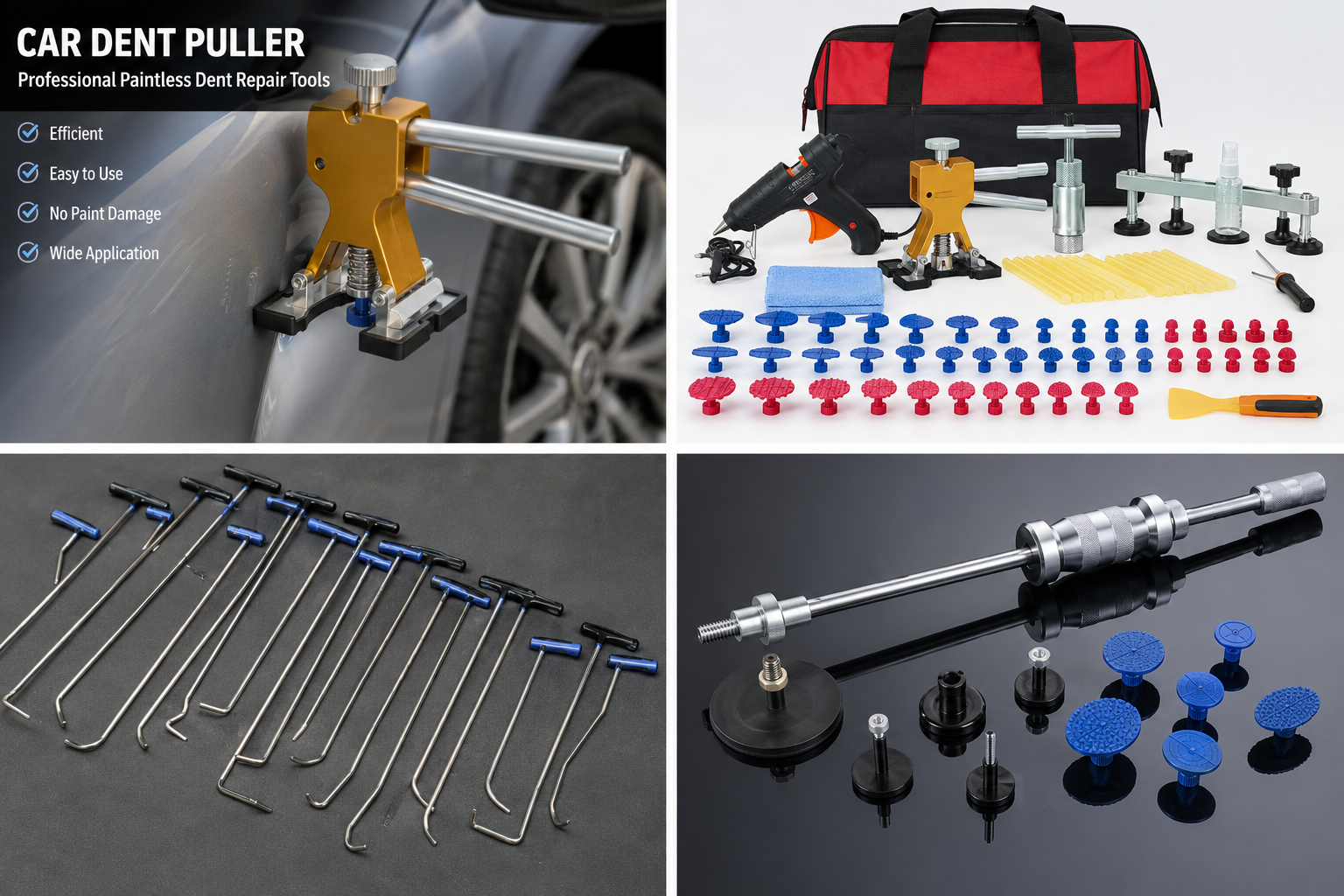
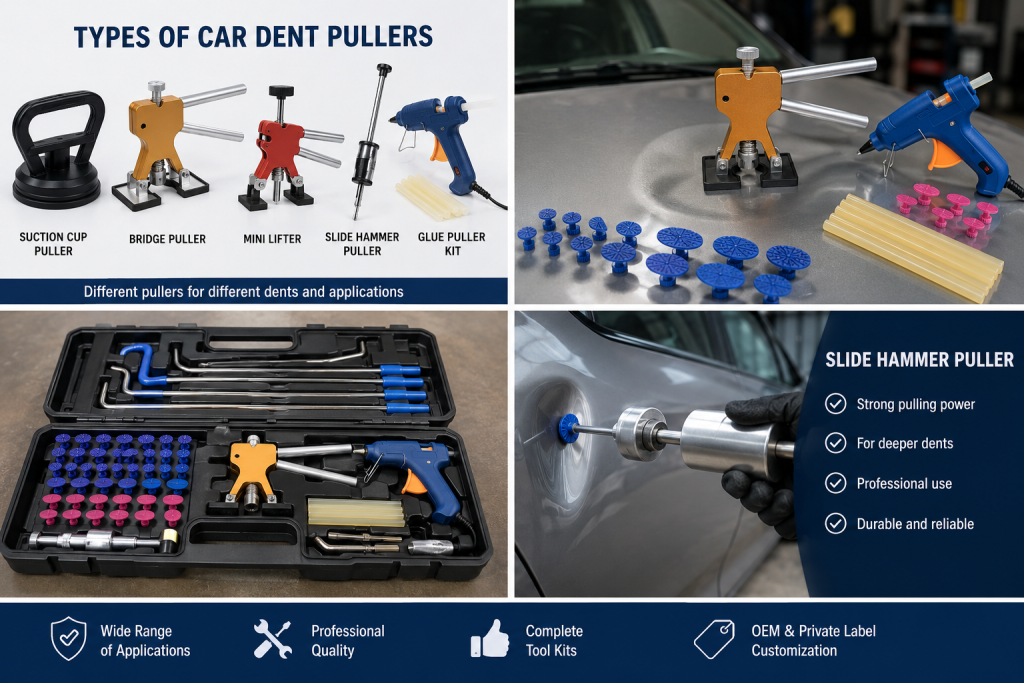
The main types of car dent pullers are suction cup pullers, glue-tab pullers, bridge pullers, mini lifters and slide hammer pullers.
For distributors, the important question is not “Which one is best?” but “Which one fits my customer base?”
| Car Dent Puller Type | Typical Application | Main Advantage | Suitable Sales Channel |
|---|---|---|---|
| Suction cup puller | Large, shallow dents | Simple operation | Retail / DIY |
| Glue-tab puller | Small-medium dents | Targeted pulling | DIY / workshop |
| Bridge puller | Controlled dent lifting | Gradual force | Retail / professional |
| Mini lifter | Small dents and hail damage | Precise control | PDR technicians |
| Slide hammer puller | Deeper or stubborn dents | Strong pulling force | Workshop / professional |
| Complete PDR kit | Multiple dent types | Broader application | Distributors / tool brands |
Professional PDR systems often combine several of these tools rather than relying on one pulling method.
That creates an important sourcing opportunity.
Instead of selling one generic “dent remover,” distributors can create multiple product levels for different buyers.
Key Takeaway: Start by defining the customer, application and price segment before deciding which dent puller to import.
How Does a Suction Cup Car Dent Puller Differ From a Glue Puller?
A suction cup car dent puller grips the panel through vacuum pressure, while a glue puller uses an adhesive tab attached to the damaged area.
This difference has a major effect on application.
Suction cup dent pullers
They are generally better suited to:
- Broad, shallow dents
- Smooth surfaces
- Flat or mildly curved panels
- Simple consumer applications
Their advantages include:
- No glue required
- Fast setup
- Simple packaging
- Easy customer understanding
- Lower entry-level price
But suction depends on the cup creating a proper seal.
Small, sharp dents provide too little surface area, while highly curved or uneven surfaces can prevent reliable suction.
Glue pullers
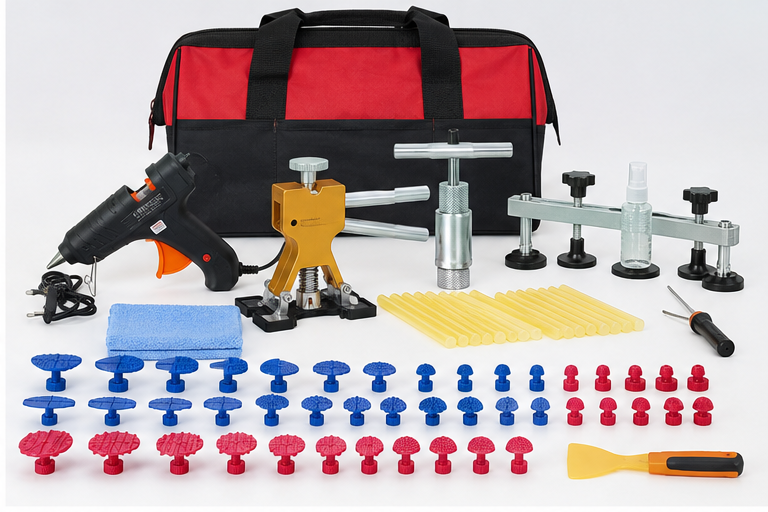
Glue systems normally include:
- Glue gun
- Hot-melt glue sticks
- Pulling tabs
- Mini lifter, bridge or T-bar
- Glue-removal accessories
Because the pulling tab creates a concentrated attachment point, the technician has much greater control over where pulling force is applied.
For distributors, this creates two different product positions: suction cups can work as simple entry-level items, while glue pulling systems support a more specialized PDR range.
Key Takeaway: Do not treat suction and glue pullers as interchangeable products. They serve different applications and buyer expectations.
Is a Slide Hammer Dent Puller Worth Adding to a Professional Tool Range?
A slide hammer dent puller is worth considering when your customers include professional workshops, body repair businesses or PDR technicians requiring stronger pulling force.
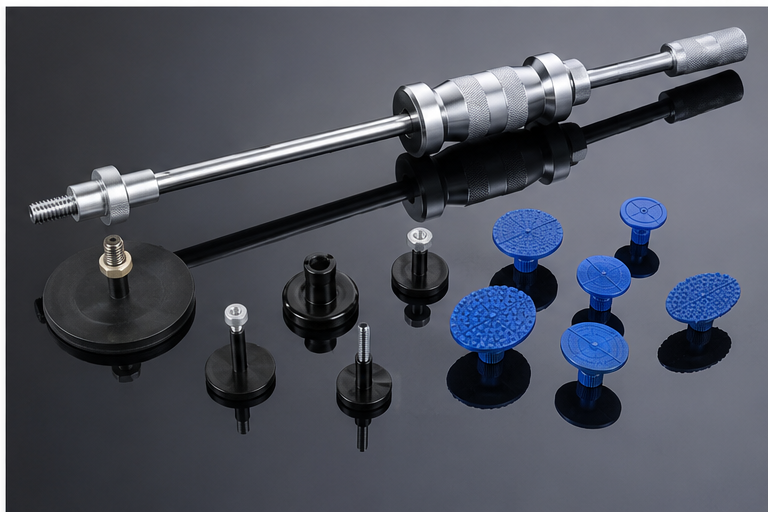
A slide hammer uses a movable weight traveling along a shaft. When the weight strikes the stop, kinetic energy transfers into outward pulling force.
That makes the mechanism fundamentally different from a bridge or mini lifter.
What should buyers inspect?
When evaluating samples, check:
- Shaft diameter
- Shaft straightness
- Sliding weight
- Stop strength
- Handle construction
- Thread quality
- Adapter design
- Surface treatment
- Connection between components
Here is where sourcing becomes important.
Two slide hammers may look almost identical in photographs.
But after repeated workshop use, differences in thread machining, shaft straightness, welding and material strength become much more important than appearance.
A professional buyer should therefore test the tool repeatedly rather than approve it based only on a catalog image.
Key Takeaway: For professional slide hammers, mechanical reliability and adapter compatibility are more important than cosmetic appearance.
What Should Distributors Check in a Glue Dent Puller Kit?
Distributors should evaluate a glue dent puller kit as a complete system because a problem with one small component can affect the performance of the entire kit.
Consider a 50-piece or 100-piece PDR kit.
The headline piece count sounds attractive.
But what actually creates value?
Check the pulling devices
Evaluate:
- Mini lifter strength
- Bridge stability
- T-bar construction
- Slide hammer operation
- Adjustment mechanism
Check the glue tabs
Look at:
- Material
- Thickness
- Head shape
- Stem strength
- Surface texture
- Size assortment
A large number of tabs does not automatically make a better kit.
A more useful assortment should contain different shapes and sizes suitable for different dent profiles.
Check the consumables
Review:
- Glue gun specification
- Glue stick diameter
- Glue stick quantity
- Glue removal accessories
- Replacement availability
For distributors, replacement availability is particularly important.
Customers may continue using the metal pulling equipment for years while repeatedly purchasing glue and tabs.
Key Takeaway: Evaluate PDR kits based on component usefulness and compatibility, not just the advertised piece count.
How Should Buyers Evaluate the Material and Workmanship of a Car Dent Puller?
Buyers should evaluate a car dent puller according to the stress each component experiences during actual operation.
Different components require different characteristics.
Metal components
Inspect:
- Steel specification
- Hardness where relevant
- Welding quality
- Machining accuracy
- Thread fit
- Corrosion protection
- Surface finishing
Plastic components
For handles and glue tabs, evaluate:
- Material toughness
- Impact resistance
- Dimensional consistency
- Flash around molded edges
- Connection strength
Rubber components
For suction systems, check:
- Cup flexibility
- Surface smoothness
- Edge consistency
- Sealing performance
- Aging resistance
A dent puller does not need the most expensive material everywhere.
It needs the appropriate material in the appropriate component.
This distinction can help distributors avoid paying for specifications that add little customer value while still protecting critical working parts.
Key Takeaway: Evaluate materials component by component instead of asking only whether the complete product is “heavy duty.”
Which Car Dent Puller Kit Configuration Is Best for Wholesale?
The best car dent puller kit configuration depends on whether you sell to consumers, automotive retailers, general repair shops or professional PDR technicians.
One universal kit rarely serves all four groups equally well.
Entry-level retail kit
A basic configuration might contain:
- Mini lifter
- Bridge puller
- Glue gun
- Glue sticks
- Assorted tabs
- Knockdown pen
- Removal bottle
This provides an understandable package for retail buyers without making the kit unnecessarily complex.
Workshop kit
A workshop-oriented kit could add:
- Slide hammer
- T-bar puller
- Larger tab assortment
- Multiple knockdowns
- PDR hammer
- Basic rods
Professional PDR kit
A broader professional configuration may contain:
- Multiple PDR rods
- Whale tails
- Slide hammer
- Mini lifter
- Bridge puller
- Glue system
- Knockdown tools
- PDR hammer
- Reflection board or PDR light
This approach creates a much clearer product ladder:
Basic → Workshop → Professional
For wholesalers, that is often more useful than competing with other sellers on whether a case contains 85, 97 or 103 pieces.
Key Takeaway: Build kits around customer level and repair application—not arbitrary piece counts.
Should Distributors Buy Individual Dent Pullers or Complete PDR Kits?
Distributors should consider carrying both individual dent pullers and complete paintless dent repair tool kits if their sales channels support professional and retail customers.
The two formats solve different commercial needs.
| Buying Format | Advantages | Best For |
| Individual puller | Lower inventory investment | Retail replacement |
| Small dent repair kit | Easy to sell | DIY / e-commerce |
| Workshop kit | Higher order value | Garages |
| Professional PDR kit | Complete solution | PDR technicians |
| OEM customized kit | Brand differentiation | Importers / distributors |
Individual products can generate repeat sales.
Complete kits increase average order value.
A distributor can therefore use a complete PDR kit as the main product while stocking glue tabs, glue sticks, knockdowns and other accessories separately.
This creates a more sustainable product category than selling only one complete kit.
Key Takeaway: A strong PDR range combines complete kits with individual tools, accessories and replacement consumables.
What OEM Options Matter When Private Labeling Car Dent Pullers?
The most useful OEM options for car dent pullers are those that improve brand recognition, retail presentation and product differentiation.
Common customization can include:
- Laser-engraved logo
- Printed logo
- Custom handle colors
- Custom glue gun colors
- Custom carrying case
- Color box
- Sleeve packaging
- Barcode labels
- Instruction manual
- Custom tool combinations
But distributors should distinguish between cosmetic customization and functional customization.
Changing a handle from blue to red is cosmetic.
Changing the slide hammer weight, improving an adapter or developing a more appropriate kit combination changes the product itself.
For established tool brands, functional improvements can create stronger differentiation than simply placing a logo on an existing generic kit.
Key Takeaway: Use OEM development to improve both branding and product-market fit rather than treating customization as logo printing alone.
What Quality-Control Problems Should Buyers Watch for Before Mass Production?
Before mass production, buyers should test the complete car dent puller system rather than approving individual parts independently.
Several common issues deserve attention.
Mechanical issues
Watch for:
- Loose threads
- Rough slide hammer movement
- Weak welding
- Bent shafts
- Poorly aligned bridges
- Weak lifter mechanisms
Accessory issues
Check for:
- Brittle glue tabs
- Inconsistent tab dimensions
- Incorrect thread adapters
- Missing pieces
- Poor glue gun performance
- Inconsistent glue sticks
Packaging issues
Inspect:
- Incorrect tool positions
- Loose components inside cases
- Weak case hinges
- Broken plastic clips
- Insufficient carton protection
A tool may pass a visual inspection and still fail during repeated use.
That is why distributors should keep an approved sample and compare production goods against it.
Key Takeaway: QC should test function, compatibility, completeness and packaging—not just appearance.
How Should Distributors Compare Car Dent Puller Suppliers?
Distributors should compare car dent puller suppliers using total sourcing value rather than unit price alone.
A practical supplier comparison can include:
| Evaluation Factor | What to Check |
| Product range | Can supplier support multiple PDR categories? |
| Quality consistency | Does production match approved samples? |
| OEM capability | Logo, color, case and packaging options |
| Kit development | Can configurations be adjusted? |
| QC | Are functional inspections available? |
| MOQ | Does it match your market-testing strategy? |
| Replacement products | Can individual components be reordered? |
| Communication | Are technical requirements understood clearly? |
| Export packaging | Is packaging suitable for international shipping? |
| Repeat orders | Can specifications remain consistent? |
One more point matters: do not evaluate the supplier only on the first order.
For a distributor, the real test is whether the same product can still be supplied with consistent quality six months or two years later.
That includes replacement tabs, adapters, packaging and product specifications.
A slightly cheaper quotation becomes expensive if the supplier changes components without approval or cannot maintain the original specification.
Key Takeaway: The best sourcing decision balances product quality, price, OEM flexibility and long-term supply consistency.
FAQ
Q1: What type of car dent puller is best for distributors?
There is no single best type. Suction pullers are suitable for simpler retail applications, while glue pullers, mini lifters and slide hammers are more appropriate for broader PDR and professional workshop ranges. The right choice depends on your customer group and sales channel.
Q2: What is the difference between a dent lifter and a slide hammer?
A mini dent lifter uses mechanical leverage to apply relatively gradual pulling force, while a slide hammer uses the momentum of a moving weight to generate a stronger impact-style pull. They therefore suit different repair conditions and levels of force control.
Q3: Should I source a 100-piece PDR kit because it has more tools?
Not necessarily. Piece count can be misleading because many pieces may simply be glue tabs or small accessories. Distributors should evaluate the usefulness, material quality and compatibility of each component instead of comparing kits only by total quantity.
Q4: Can car dent puller kits be customized for private-label brands?
Yes. Depending on the product and order quantity, customization can include logos, handle colors, cases, packaging, labels, instructions and tool combinations. More advanced OEM projects can also modify product specifications or kit configurations.
Q5: What should I test before ordering dent pullers in bulk?
Test pulling mechanisms, threads, adapters, welds, shafts, handles, glue tabs, consumables and packaging. The production specification should then be compared with an approved sample before shipment.
Conclusion
Choosing a car dent puller for wholesale is ultimately about matching tool design, repair application, quality level and kit configuration to the customers you actually serve.
For distributors, wholesalers and private-label automotive tool brands, a structured PDR range can extend from simple suction pullers to glue systems, mini lifters, slide hammers and complete professional dent repair kits.
Rather than comparing suppliers only by piece count or the lowest quotation, focus on functional quality, component compatibility, OEM flexibility and repeat-order consistency.
Kolarwin Tools supplies automotive repair tools for B2B buyers and supports OEM branding, customized tool combinations and private-label packaging. If you are developing a dent repair or PDR tool range, send us your target products, market, quantity and packaging requirements for evaluation.
Looking for a reliable mechanic tools manufacturer in China?
If you are sourcing hand tools, socket tools, automotive repair tools, mechanic tool sets or OEM private label tools, contact KOLARWIN Tools for factory-direct quotation, customization support and product consultation.