
Need OEM supplier support for this product type?
Contact KOLARWIN Tools for OEM mechanic tools, private label packaging, wholesale quotation and product range support. This gives overseas buyers a clear path from article reading to supplier discussion.
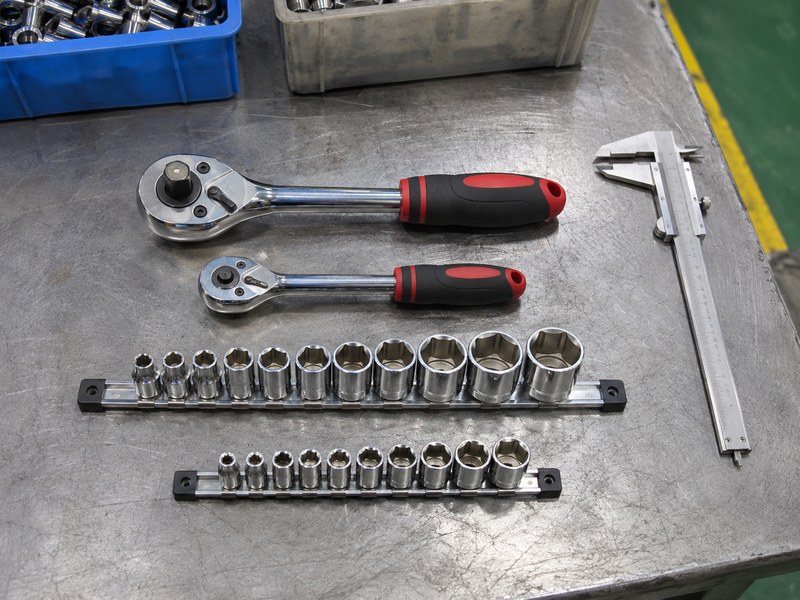
Choosing between a 1/4 vs 3/8 ratchet affects reach, socket coverage, and how a compact kit feels at a service bench. For precision work around small fasteners, a 1/4-inch drive can keep a kit compact; broader maintenance tasks often favor 3/8-inch coverage. This guide gives distributors and maintenance buyers a practical way to specify a set without assuming a ratchet has a universal torque limit.
1. What decision does a 1/4 vs 3/8 ratchet comparison answer?
A drive-size choice determines which sockets and accessories fit a ratchet and shapes how the tool fits a task. It does not, by itself, define fastener size, allowable force, or tool quality. For a compact bench kit, the useful question is which fasteners and access conditions recur in the work area.
- Map common fastener sizes and socket types before selecting a drive.
- Note confined access, extension needs, and whether users switch between stations.
- Keep manufacturer specifications and any application procedure with the tool.
Here’s the practical distinction: a smaller drive can make a compact kit easier to place in tight work areas, while a larger drive can cover a broader range of general service sockets. Confirm the actual socket range in the proposed assortment. For a catalog brief, compare socket tools and socket sets by included sizes and accessories. The right next step is to write a short task list before requesting samples.
| Buyer question | 1/4-inch drive | 3/8-inch drive |
| Kit priority | Compact access and smaller sockets | Broader general-service coverage |
| Check before buying | Socket range and access | Socket range, clearance, and kit footprint |
| What drive size cannot tell you | Safe force or quality | Safe force or quality |
2. When does a 1/4-inch ratchet suit a compact bench kit?
A 1/4-inch ratchet is a sensible candidate when work centers on smaller sockets, light assembly, or restricted spaces. Compact benches, instrument work, and maintenance kits carried between stations may benefit from a smaller ratchet head and matching accessories. Those are use-case considerations, not a claim that every small fastener calls for this drive.
- List frequent tasks and identify their required socket sizes.
- Check whether the ratchet head and handle can reach the work area.
- Confirm compatible extensions, adapters, and replacement sockets.
Here’s where a small set earns its place: it keeps a defined task kit manageable. Buyers should verify fit at the actual work position, since obstructions and hand clearance matter as much as the fastener. A 1/4-inch set may be paired with a larger drive elsewhere in a facility rather than stretched across every repair. Review mechanics tool sets for how a ratchet sits within a broader kit, then specify each component. Ask suppliers for a complete inclusion list and confirm substitutions in writing.
| Bench-kit condition | Check for a 1/4-inch set |
| Small, recurring tasks | Socket coverage matches actual fasteners |
| Tight access | Head and handle clearance at the work point |
| Shared stations | Clear labeling and a return location |
3. When is a 3/8-inch ratchet a better compact-kit choice?
A 3/8-inch ratchet may suit a compact kit when its users need a wider general-maintenance role and socket selection supports that work. It can reduce the need to maintain separate small kits, though added coverage may bring a larger assortment. The buyer should compare the exact sockets and the frequency of use rather than assuming one drive replaces every other size.
- Check which socket sizes appear most often in work orders.
- Compare the proposed range against existing inventory.
- Keep specialist or restricted-access tasks visible in the specification.
The trade-off is coverage versus compactness. If a kit moves between general service points, 3/8-inch components could simplify issue and replenishment. If work remains tightly defined, a smaller set may fit better. Review hand tools alongside ratchet needs so the kit does not duplicate tools already assigned to a bench. Ask the supplier to identify every socket, extension, and adapter by drive and size; approve any requested change before production.
| Decision factor | Favors 1/4-inch | Favors 3/8-inch |
| Work scope | Defined smaller-socket tasks | Mixed general maintenance |
| Storage priority | Small footprint | Wider coverage in one kit |
| Procurement check | Confirm task fit | Confirm assortment avoids unnecessary overlap |
4. How should buyers compare socket coverage?
Socket coverage means more than a piece count. Buyers need to know sizes, measurement system, socket depth, point configuration, and accessory fit. A high piece count can still miss a size used every week, while a shorter list can serve a clearly bounded bench task.
- Request a line-by-line contents list.
- Identify metric, SAE, or mixed requirements from the actual equipment.
- Record standard and deep socket needs separately.
A contents list prevents guesswork. Compare the list against maintenance records and current tooling before approving a set. Do not infer materials, tolerances, or standards from a drive-size label. If impact use is required, specify that separately and review impact sockets rather than treating hand sockets and impact sockets as interchangeable. The purchasing action is simple: mark each required size as present, absent, or not needed, then resolve every gap with the supplier.
| Contents-list field | Why it matters |
| Drive and socket size | Confirms physical compatibility and coverage |
| Metric or SAE | Matches installed fasteners and service documentation |
| Depth and point style | Aligns socket geometry with access and fastener shape |
5. What role do access and extensions play?
Drive size alone cannot solve poor access. A ratchet may need an extension or a different head profile, and surrounding structure can limit handle movement. Buyers should check the tool in the real service position or use a representative fixture before settling the kit configuration.
- Identify obstructions around each recurring fastener.
- Record extension lengths or joint accessories required by procedure.
- Confirm all accessories share the specified drive interface.
This is where a bench trial pays off. A small drive may offer useful access in some settings, but no drive size guarantees clearance. Use a sample or dimensional drawing to check hand space and swing arc. A joint or adapter can alter access and should be approved for its intended use. Ask the vendor to list accessory compatibility and include only items supported by the intended work. Keep broader maintenance planning separate from this compact bench-kit specification; the final configuration still needs task-level review.
| Access condition | Buyer action |
| Limited swing arc | Trial the head and handle position |
| Recessed fastener | Verify socket depth and extension fit |
| Obstruction near fastener | Confirm approved accessory configuration |
6. How should a buyer evaluate ratchet feel and operation?
For a shared bench kit, users need a tool that operates predictably and is easy to inspect. Evaluate grip, direction control, head clearance, and engagement in the actual working posture. Do not treat tooth-count claims as a substitute for checking access or operation, and avoid inferring durability from appearance alone.
- Inspect the selector and confirm direction changes are clear.
- Check handle comfort with the gloves used on site.
- Review cleaning, inspection, and replacement procedures.
A sample tells you things a catalog cannot. Ask representative users to handle the ratchet in a controlled trial, then capture their feedback against agreed criteria. Specify packaging and identification so sets remain complete after issue. Kolarwin’s about page describes its business context, but product-level performance must be confirmed for the exact model under consideration. Request the model’s documentation and sample approval record before placing a repeat order.
| Evaluation point | Sample check |
| Direction control | Selector is clear and works as intended |
| Ergonomics | Grip suits users and gloves |
| Maintenance | Inspection and replacement process is documented |
7. How can procurement prevent incomplete or mismatched kits?
Procurement teams can reduce mismatch by controlling the bill of materials, sample approval, and change process. This matters when a compact set is assembled from multiple components or sold under a private label. A drive-size name alone is not a complete purchasing specification.
- Attach the approved contents list to the purchase order.
- State packaging, markings, and labeling requirements separately.
- Require written approval for substitutions.
Put the configuration on paper before a price comparison. Quotations become easier to compare when vendors price the same socket range, accessories, case, and marking requirements. Apply supplier coordination discipline to ratchet kits without assuming every supplier offers identical services. Buyers should request a sample, approve it against the specification, and retain the approved record for replenishment.
| Procurement control | Record in the RFQ or PO |
| Configuration | Drive, socket sizes, accessories, case |
| Approval | Sample status and approved revision |
| Changes | Written authorization before substitution |
8. What quality information should buyers request?
Quality review should match the product and the buyer’s risk. Ask what inspection records are available for the specific set, how components are identified, and how nonconforming items are handled. Do not assume a general company statement proves a particular ratchet’s material, hardness, or performance.
- Request model-specific material and inspection information where applicable.
- Confirm dimensional or functional checks relevant to your specification.
- Define incoming inspection and defect escalation steps.
Make the evidence match the claim. If a supplier cites a test or standard, ask which model and batch it covers and request the supporting document. Avoid adding unverified torque limits to a purchasing requirement; use the manufacturer’s stated instructions for the exact tool. A set from socket set manufacturing can be assessed with a documented checklist, but no article can establish a product’s unseen test results. Buyers should retain the response with the approved specification.
| Quality topic | Evidence to request |
| Identification | Model and batch traceability, if available |
| Inspection | Applicable dimensional or functional records |
| Claims | Document tied to the exact model or batch |
9. How should distributors position each drive size?
Distributors can explain the difference through buyer tasks rather than vague strength claims. A 1/4-inch kit can be positioned for compact, defined bench work when its contents fit that use. A 3/8-inch kit can serve wider general maintenance when its assortment matches customer demand. Both descriptions need qualification by actual configuration.
- Segment customers by work type and kit footprint.
- Show the included socket sizes in product materials.
- Offer clear replenishment and accessory information.
Clear merchandising reduces returns. Avoid implying that drive size alone predicts safe force or service life. Show dimensions, contents, intended use, and compatibility notes that the product data supports. Keep adjacent automotive categories out of this compact-kit comparison unless a buyer specifically requests a combined assortment. Before launch, confirm all product copy against the approved specification and sample.
| Positioning detail | Customer value |
| Exact contents | Sets expectations and supports comparison |
| Intended task | Helps choose a relevant kit |
| Compatibility notes | Reduces mismatch and returns |
10. What should a buyer do before selecting a 1/4 vs 3/8 ratchet?
Start with recurring work, access, and socket coverage. Select the drive that fits those tasks, then approve the exact configuration through a sample and written contents list. For a compact bench kit, avoid paying for unused range; for a broader service kit, avoid gaps hidden by a piece-count headline.
- Document tasks and socket sizes.
- Trial access and operation in representative conditions.
- Approve the exact product, packaging, and quality records.
Use the work list as your decision rule. If it points to a tightly bounded compact kit, compare 1/4-inch options. If it points to mixed general maintenance, compare 3/8-inch coverage. Ask Kolarwin’s contact team for a model-specific contents list and applicable documentation, then record what has been verified before ordering.
Q1: What does 1/4 vs 3/8 ratchet mean? It compares the square-drive interface size, which determines compatible sockets and accessories.
Q2: Is a 1/4-inch ratchet always for small fasteners? No. Select by task, socket compatibility, access, and tool instructions.
Q3: Does a 3/8-inch ratchet have a universal torque limit? No. Limits depend on the exact product and manufacturer guidance.
Q4: Can one compact kit include both drive sizes? Yes, if the added coverage justifies its footprint and cost.
Q5: What should an RFQ include? Drive size, socket list, accessories, packaging, markings, sample approval, and requested quality documents.
Looking for a reliable mechanic tools manufacturer in China?
If you are sourcing hand tools, socket tools, automotive repair tools, mechanic tool sets or OEM private label tools, contact KOLARWIN Tools for factory-direct quotation, customization support and product consultation.


